ResearchWednesday, March 4, 2026

AI-Powered B2B Equipment Rental: The $170B Market Still Running on Phone Calls

A fragmented industry of 50,000+ rental yards across North America alone, where contractors still call 5-10 suppliers to get quotes for a single excavator. AI agents are poised to transform equipment rental into a unified, intelligent marketplace.

1.

Executive Summary

The global equipment rental market exceeds $170 billion annually — construction equipment alone represents $121.6 billion (2024), with farm equipment adding another $66.4 billion. Yet this massive industry operates like it's 1995: phone calls, WhatsApp messages, paper contracts, and manual fleet tracking.

This creates a rare opportunity: building an AI-native equipment rental marketplace where AI agents handle discovery, negotiation, logistics, and predictive maintenance — transforming a fragmented, high-friction industry into an efficient, data-driven network.


2.

Problem Statement

Who experiences this pain?
  • General contractors needing excavators, cranes, or aerial lifts for projects
  • Construction project managers coordinating equipment across multiple sites
  • Small-to-medium rental yards losing business to aggregators they can't compete with
  • Equipment owners with idle assets generating zero revenue
What's broken today?
  • Discovery friction: Finding the right equipment at the right price requires calling multiple yards
  • No real-time availability: Most rental yards don't have online inventory systems
  • Manual quote comparison: Contractors track quotes in spreadsheets or sticky notes
  • Logistics nightmare: Delivery scheduling, insurance verification, return coordination — all manual
  • No utilization data: Equipment sits idle because no one knows who needs it
  • Current vs AI-Powered Flow
    Current vs AI-Powered Flow

    3.

    Current Solutions

    CompanyWhat They DoWhy They're Not Solving It
    United RentalsLargest rental chain ($14.3B revenue)Vertically integrated — doesn't aggregate competitors. Still phone-heavy.
    EquipmentShareTech-forward rental with T3 telematicsOwns fleet, doesn't create open marketplace. Regional gaps.
    DOZRMarketplace aggregator (4K+ suppliers)Web-first, not AI-native. No agent negotiation. Manual workflow.
    BigRentzEquipment rental marketplaceTraditional marketplace model. Limited intelligence.
    IndiaMARTB2B listings including equipmentLead generation only. No transactions, no logistics.
    The pattern: Either vertically integrated chains (United Rentals, Ashtead) or simple marketplace aggregators (DOZR, BigRentz). None have built AI-native procurement where agents handle the entire workflow.
    4.

    Market Opportunity

    • Construction Equipment Rental: $121.6 billion (2024), 4.3% CAGR
    • Farm Equipment Rental: $66.4 billion (2025), 7.3% CAGR
    • Industrial Equipment Rental: $35+ billion
    • Total Addressable Market: $170B+ globally
    Why Now?
  • AI agents are production-ready: GPT-4, Claude, and specialized agents can negotiate, compare, and execute transactions
  • Telematics penetration increasing: More equipment has GPS and usage data, enabling predictive maintenance
  • CapEx-to-OpEx shift: Construction firms increasingly prefer renting to reduce capital requirements
  • Consolidation wave: Large chains acquiring smaller players creates integration opportunities
  • Labor shortage: Fewer people available to handle manual procurement processes

  • 5.

    Gaps in the Market

    Zeroth Principles Analysis

    "What are we assuming that everyone takes for granted?"

    The assumption: Equipment rental is inherently a local, relationship-based business that can't be digitized.

    Challenge: If Uber could disintermediate taxi dispatch, why can't AI agents disintermediate equipment brokers?

    Key Gaps Identified

  • No AI-native procurement interface: Buyers still describe needs to humans who search manually
  • No cross-yard price optimization: Each yard prices independently; no arbitrage layer exists
  • No predictive availability: Current systems show current inventory, not predicted availability
  • No equipment health scoring: Renters can't compare equipment condition across suppliers
  • No WhatsApp-native workflow: In India and emerging markets, WhatsApp IS the platform — no one built for it
  • No P2P rental for heavy equipment: Peer-to-peer exists for cars (Turo) but not excavators

  • 6.

    AI Disruption Angle

    How AI Agents Transform Equipment Rental

    Today's workflow (15 steps, 3-4 hours): Buyer → Searches online → Calls Yard 1 → Waits for callback → Gets quote → Calls Yard 2 → Repeats × 5 → Compares in spreadsheet → Negotiates → Books → Arranges delivery → Signs paper contract → Tracks via phone calls AI-native workflow (5 steps, 15 minutes): Buyer describes need → AI agent searches entire network → Auto-negotiates best terms → Handles insurance/logistics → Provides real-time tracking

    Specific AI Applications

    ApplicationCurrent StateAI-Enabled Future
    DiscoveryManual search + callsNatural language → instant matching
    PricingFixed rate cardsDynamic pricing with negotiation agents
    AvailabilityCall to checkReal-time + predictive availability
    LogisticsManual coordinationAutomated delivery optimization
    MaintenanceReactive repairsPredictive maintenance alerts
    InsurancePaper verificationInstant digital verification
    ---
    7.

    Product Concept

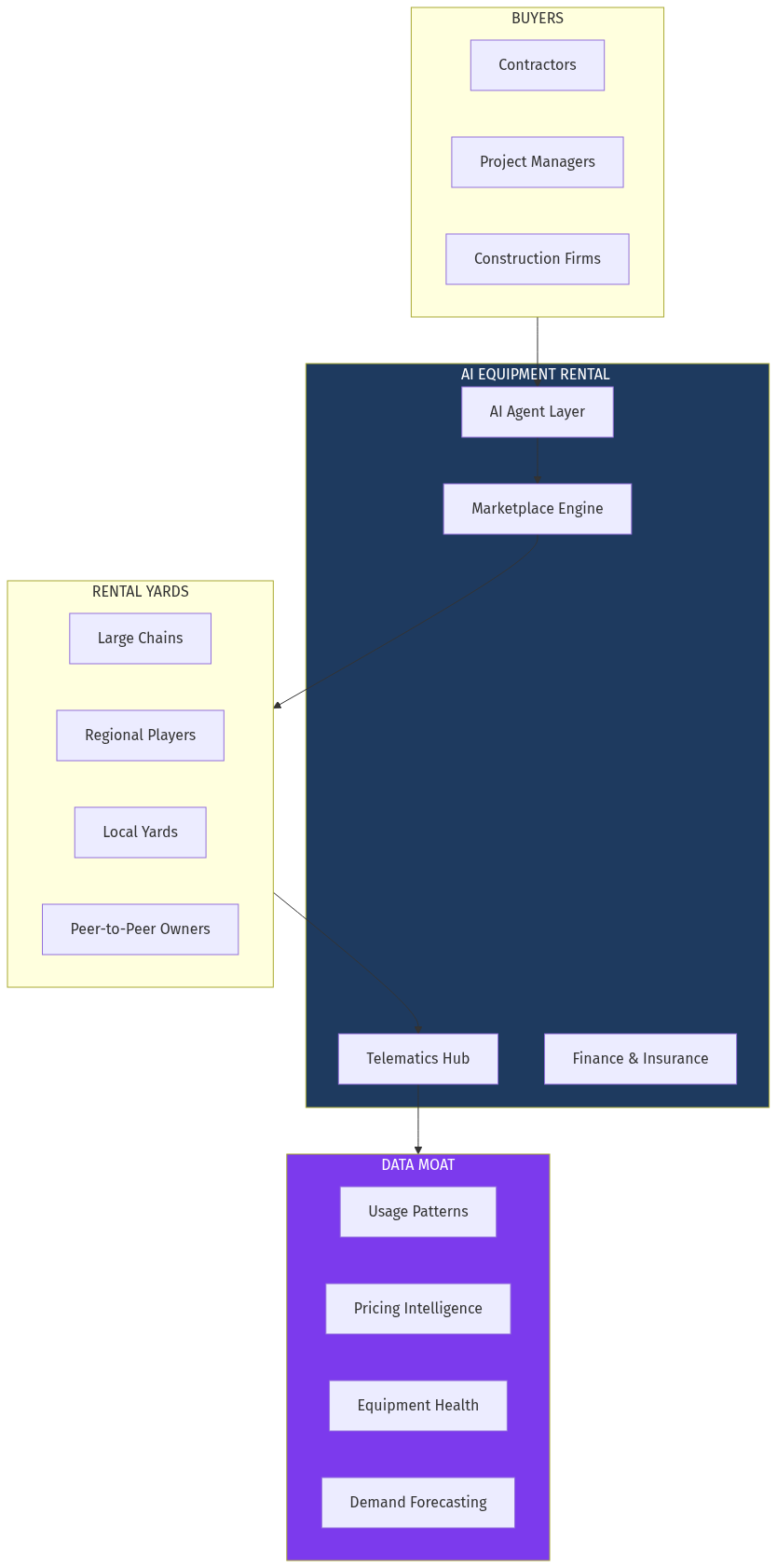
    Core Platform: EquipAI

    For Buyers:
    • Natural language equipment requests ("I need a 20-ton excavator in Mumbai for 3 weeks starting March 15")
    • AI agent searches all connected yards, negotiates best price
    • One dashboard for all rentals across vendors
    • Predictive maintenance alerts before breakdowns
    • WhatsApp-native interface for emerging markets
    For Rental Yards:
    • Free listing and fleet management SaaS
    • AI-powered demand forecasting
    • Utilization optimization recommendations
    • Instant quote response (no more missed leads)
    • Payment collection and insurance verification
    For Equipment Owners (P2P):
    • List idle equipment for rental
    • Background checks on renters
    • Usage tracking and return verification
    • Revenue share model
    Platform Architecture
    Platform Architecture

    8.

    Development Plan

    PhaseTimelineDeliverables
    MVP8 weeksWhatsApp bot for quote requests, manual backend fulfillment, 20 rental yards onboarded
    V112 weeksWeb dashboard, automated yard matching, payment integration, 100 yards
    V216 weeksAI negotiation agent, telematics integration, predictive availability, 500 yards
    V324 weeksP2P marketplace, equipment health scoring, insurance automation, 2000+ yards
    Tech Stack:
    • Backend: Node.js + PostgreSQL
    • AI: Claude API for natural language, custom models for pricing
    • Integrations: WhatsApp Business API, GPS/telematics providers
    • Payments: Razorpay (India), Stripe (global)

    9.

    Go-To-Market Strategy

    Phase 1: Wedge Market (India)

  • Target: Hyderabad/Vizag construction corridor (Shiva's network)
  • Channel: WhatsApp groups for contractors + direct outreach
  • Hook: "Get quotes from 20 rental yards with one WhatsApp message"
  • Goal: 50 active buyers, 20 yards, $100K GMV in 6 months
  • Phase 2: Vertical Expansion

  • Add categories: Farm equipment, event equipment, medical devices
  • Geographic expansion: Mumbai, Delhi, Bangalore
  • B2B partnerships: Construction companies as anchor customers
  • Phase 3: P2P Launch

  • Enable equipment owners to list idle assets
  • Insurance partnerships for P2P protection
  • Revenue-share model: 15% commission on P2P rentals
  • Incentive Mapping

    "Who profits from the status quo?"
    • Large rental chains: Benefit from fragmentation (harder for small yards to compete)
    • Brokers: Add friction but extract value
    • Equipment manufacturers: Prefer sales over rentals
    Strategy: Don't compete with United Rentals. Aggregate the 50,000 smaller yards they can't reach.
    10.

    Revenue Model

    StreamDescriptionMargin
    Transaction Fee5-8% of rental value80%+
    Subscription (SaaS)Fleet management for yards ($99-499/mo)90%
    Telematics UpsellGPS tracking + maintenance alerts70%
    Insurance CommissionRental insurance referrals20-30%
    Financing SpreadEquipment financing referrals15%
    Target Economics:
    • Average rental: $2,500
    • Take rate: 6%
    • Revenue per transaction: $150
    • Monthly target (Year 1): 500 transactions = $75K MRR

    11.

    Data Moat Potential

    What Accumulates Over Time

  • Pricing intelligence: Real transaction prices across equipment types, regions, seasons
  • Utilization patterns: When equipment sits idle vs. high demand periods
  • Equipment health data: Maintenance history, breakdown patterns, reliability scores
  • Buyer behavior: Project patterns, repeat rental needs, credit risk signals
  • Supplier performance: Delivery reliability, equipment condition, responsiveness
  • Distant Domain Import

    "What field has already solved a similar problem?"
    • Airline pricing (ITA Software → Google Flights): Dynamic pricing based on demand, time, and competition
    • Uber surge pricing: Real-time supply/demand balancing
    • CarMax inspection reports: Standardized equipment condition scoring
    Application: Build an "equipment score" combining age, maintenance history, and usage data — like a CARFAX for excavators.
    12.

    Why This Fits AIM Ecosystem

    Direct alignment with AIM.in vision:
  • B2B-first: Equipment rental is purely B2B
  • High transaction value: Average $2,500+ per rental
  • Fragmented supply: 50,000+ rental yards, no dominant aggregator in India
  • Decision support: Buyers need help comparing, not just listings
  • Repeat transactions: Same contractors rent equipment monthly/quarterly
  • Integration opportunities:
    • RCC pipe manufacturers (already in AIM database) often rent equipment
    • Construction companies use both equipment and industrial supplies
    • Cross-sell: Equipment rental → maintenance services → spare parts

    ## Pre-Mortem: Why This Might Fail

    Falsification Analysis

    "Assume 5 well-funded startups failed here. Why?"
  • Relationship lock-in: Contractors have trusted vendors they won't abandon
  • - Counter: Don't replace relationships — augment them. Let buyers keep their vendors while discovering new options.
  • Equipment is not fungible: A CAT excavator ≠ a Komatsu excavator
  • - Counter: Build detailed equipment profiles with specs, photos, and condition reports.
  • Logistics complexity: Delivery of heavy equipment is not like shipping packages
  • - Counter: Partner with logistics providers rather than building in-house.
  • Payment terms: B2B operates on net-30/60, not instant payment
  • - Counter: Offer financing and build invoice factoring partnerships.
  • Local trust matters: Rental is a trust business
  • - Counter: Build reputation systems with verified reviews and insurance coverage.

    Steelmanning Incumbents

    "Why might United Rentals win?"
    • They have $14B revenue, 1,500+ locations, and can outspend any startup
    • Their relationship with large contractors is deep
    • They're investing in technology (UR Control platform)
    Our response: We're not competing for their Fortune 500 customers. We're aggregating the long tail they can't serve economically.

    ## Verdict

    Opportunity Score: 8.5/10 Strengths:
    • Massive market with clear fragmentation
    • AI technology is ready for natural language procurement
    • Strong data moat potential
    • Clear wedge market (India + WhatsApp)
    Risks:
    • Capital-intensive to acquire both sides of marketplace
    • Logistics complexity in emerging markets
    • Established relationships in B2B are sticky
    Recommendation: Build MVP as WhatsApp-first quote aggregator in India. Prove demand with 20 yards and 50 buyers before investing in full platform. If unit economics work at $2,500 average rental with 6% take rate, scale aggressively.

    ## Sources