ResearchWednesday, March 4, 2026

AI Marketing Attribution Intelligence: The $8B Opportunity in Post-Privacy B2B Analytics

As iOS ATT and cookie deprecation shattered traditional tracking, a new breed of AI-powered attribution platforms is emerging to help B2B marketers finally understand what's actually driving revenue—not just clicks.

1.

Executive Summary

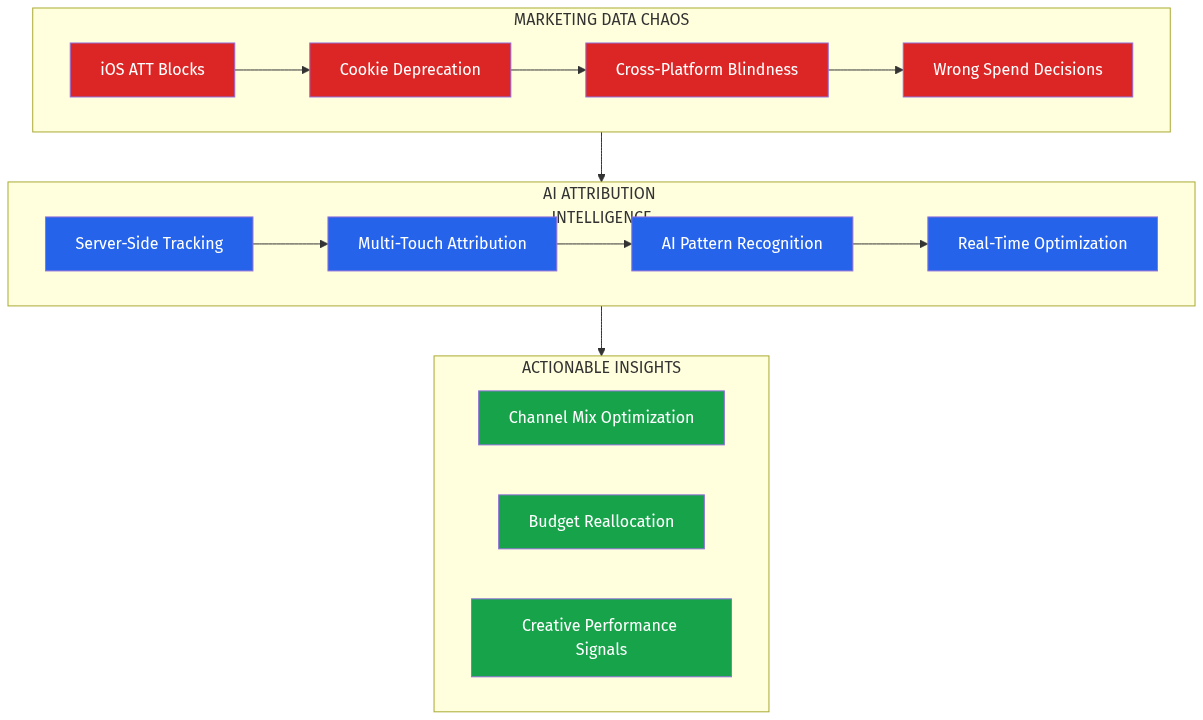
The marketing attribution market is experiencing a forced evolution. Apple's App Tracking Transparency (ATT) framework, Google's cookie phase-out, and increasing privacy regulations have rendered traditional pixel-based tracking unreliable at best, useless at worst.

For B2B SaaS companies with 6-month sales cycles and multiple stakeholder touchpoints, this isn't just inconvenient—it's existential. CMOs can't prove ROI. Growth teams are flying blind on budget allocation. And the platforms themselves (Meta, Google) are incentivized to claim credit, not reveal truth.

The opportunity: AI-powered marketing attribution that combines server-side tracking, identity resolution, and causal inference to finally answer the question every B2B marketer asks: "Which marketing dollars are actually working?"

2.

Problem Statement

Who Experiences This Pain

B2B SaaS Marketing Teams ($1M-$50M ARR)
  • Spending $50K-$500K/month on paid acquisition
  • 20-50% of conversions now appear as "direct" or "unattributed"
  • Last-click attribution credits bottom-funnel while brand investment goes unmeasured
Performance Marketing Agencies
  • Can't prove campaign value to clients
  • Attribution discrepancies between platforms create client disputes
  • Manual reporting consumes 30% of analyst time
Growth-Stage CFOs
  • Marketing is largest discretionary spend, least measurable
  • Can't confidently cut or increase budgets
  • CAC payback calculations based on faulty data

The Attribution Collapse

Before ATT (pre-2021):
  • Facebook pixel tracked 95% of conversions
  • Attribution windows were 28 days
  • Multi-touch tracking via cookies was reliable
After ATT (2024-present):
  • Only 20-40% of iOS users allow tracking
  • Attribution windows collapsed to 7 days
  • 30-50% revenue shows as "unattributed" in ad platforms
The Trust Gap: Every platform claims credit for the same conversion. Meta says they drove it. Google says they did. LinkedIn claims the credit. Meanwhile, the real attribution—a podcast mention that sparked interest 3 months ago—goes completely untracked.
3.

Current Solutions

CompanyWhat They DoWhy They're Not Solving It
CometlyServer-side tracking + AI chat for ad dataStrong for DTC/ecommerce; B2B multi-touch attribution still developing
Triple WhaleEcommerce attribution platformBuilt for Shopify, not complex B2B sales cycles
RockerboxMulti-touch attribution for enterprisesEnterprise-only pricing; implementation takes months
NorthbeamMMM + MTA hybrid attributionRequires $100K+ ad spend; focused on DTC brands
HockeyStackB2B attribution + revenue analyticsClosest to ideal; still early in AI-driven optimization

The Gap

Most solutions are either:

  • Built for DTC/ecommerce (simple purchase event, short cycle)
  • Enterprise-priced ($50K+ ACV, 6-month implementation)
  • Backward-looking (report what happened, don't optimize what's next)
  • No one is building: AI-native attribution for growth-stage B2B SaaS ($1M-$20M ARR) that combines real-time tracking with predictive budget optimization.
    4.

    Market Opportunity

    Marketing Attribution Architecture
    Marketing Attribution Architecture

    Market Size

    • Global Marketing Attribution Market: $4.2B (2024) → $8.2B (2028)
    • CAGR: 18.4%
    • B2B Segment: ~35% of total = $2.9B addressable

    Why Now

  • Privacy mandates accelerating: Chrome cookies dying in 2025, state privacy laws proliferating
  • AI capabilities mature: LLMs can now interpret marketing data conversationally
  • Server-side tracking normalized: First-party data collection is now standard practice
  • B2B ad spend exploding: LinkedIn, Meta B2B, programmatic display all growing 20%+ YoY
  • Revenue Proof Points

    From TrustMRR data (March 2026):

    • Cometly: $233K MRR - AI chat with ads data, growing steadily
    • GojiberryAI: $160K MRR, 46% growth - High-intent lead finding
    • AEO Engine: $70K MRR, 5% growth - AI for visibility optimization
    The market is willing to pay for solutions that actually work.


    5.

    Gaps in the Market

    Gap 1: No AI-Native Attribution for Growth B2B

    Current solutions bolt AI onto legacy architectures. A true AI-native solution would:

    • Use LLMs to identify attribution patterns humans miss
    • Automatically suggest budget reallocations
    • Learn from outcome data to improve predictions

    Gap 2: Cross-Platform Identity Without Enterprise Implementation

    Identity resolution exists (Clearbit, ZoomInfo) but requires complex integrations. SMB-friendly identity linking that "just works" is missing.

    Gap 3: Predictive Spend Optimization

    Attribution tools tell you what happened. None confidently tell you: "Move $10K from LinkedIn to Google brand search next week."

    Gap 4: Creative-Attribution Connection

    Which creative drove the conversion? Current tools separate creative testing from attribution. Unified systems that track creative → touchpoint → revenue are rare.

    Gap 5: AI Chat Interface for Non-Analysts

    CMOs and founders want to ask: "Why did CAC increase last month?" and get a real answer, not a dashboard to interpret.


    6.

    AI Disruption Angle

    AI Marketing Attribution Flow
    AI Marketing Attribution Flow

    The Agent-Enabled Future

    Today: Marketing analyst exports data from 5 platforms, builds spreadsheet, makes recommendation to CMO. 2027: AI marketing agent continuously:
    • Monitors cross-platform performance
    • Identifies attribution anomalies
    • Proposes budget reallocations
    • Executes changes (with approval) via API
    • Reports impact in natural language

    Specific AI Capabilities

    1. Causal Inference Models Instead of correlation-based attribution, AI can run synthetic control experiments: "What would have happened without this LinkedIn campaign?" 2. Natural Language Querying "Compare my top 3 performing campaigns by influenced revenue, excluding brand terms" → instant analysis 3. Predictive Budget Allocation ML models trained on historical data can predict: "Given current signals, here's optimal spend allocation for next 30 days" 4. Automated Creative Tagging Vision models automatically tag ad creative (product shown, CTA type, color palette) and correlate with performance
    7.

    Product Concept

    Core Product: AttributeAI

    Tagline: "Finally know what's working." Key Features:
  • One-Click Server-Side Tracking
  • - Drop in JS snippet + server endpoint - Auto-connect to Meta CAPI, Google Enhanced Conversions, LinkedIn
  • AI Attribution Engine
  • - Multi-touch attribution with configurable models - Causal inference for incrementality measurement - Real-time attribution updates (not batch)
  • Ask Anything Interface
  • - Natural language queries about marketing performance - Anomaly alerts with explanations - Weekly AI-generated performance summaries
  • Budget Optimizer
  • - AI-suggested budget reallocations - Confidence scores on recommendations - One-click implementation to ad platforms
  • Creative Intelligence
  • - Auto-tag creative elements - Track creative → conversion paths - Identify winning creative patterns

    Pricing

    TierPriceAd Spend LimitFeatures
    Growth$499/mo$50K/moCore attribution, AI chat
    Scale$999/mo$250K/mo+ Budget optimizer, creative intelligence
    EnterpriseCustomUnlimited+ Custom models, dedicated support
    ---
    8.

    Development Plan

    PhaseTimelineDeliverables
    MVP8 weeksServer-side tracking, basic attribution, Slack alerts
    V112 weeksAI chat interface, multi-touch attribution models
    V216 weeksBudget optimizer, creative tagging, ad platform sync
    V324 weeksPredictive models, enterprise features, custom integrations

    Technical Stack

    • Data Pipeline: Kafka → ClickHouse (real-time analytics)
    • AI/ML: OpenAI for NL queries, custom models for attribution
    • Integrations: Meta CAPI, Google Ads API, LinkedIn Conversion API
    • Frontend: Next.js with real-time dashboards

    9.

    Go-To-Market Strategy

    Phase 1: Founder-Led Sales (Months 1-6)

  • Target: B2B SaaS companies spending $30K-$200K/month on ads
  • Channel: LinkedIn content (attribution horror stories), Twitter/X
  • Offer: Free attribution audit → demonstrate value gap
  • Phase 2: Agency Partnerships (Months 6-12)

  • Target: B2B-focused performance agencies (50-200 clients each)
  • Offer: White-label option, revenue share
  • Playbook: Agency uses tool → recommends to clients → clients subscribe
  • Phase 3: Product-Led Growth (Months 12+)

  • Free tier: Limited tracking, basic attribution
  • Viral loops: Shareable attribution reports
  • Community: Slack community for B2B marketers
  • Customer Acquisition Cost Target

    • Direct sales: $2,000 CAC for $6,000 ACV (4-month payback)
    • Agency referral: $500 CAC (incentive) for $6,000 ACV
    • PLG: $100 CAC for $1,200 ACV (Growth tier)

    10.

    Revenue Model

    Primary Revenue

  • SaaS Subscriptions: $499-$999/month per customer
  • Enterprise Contracts: $25K-$100K ACV
  • Secondary Revenue

  • Agency White-Label: 20% of revenue share
  • Data Enrichment Add-on: $199/month for enhanced identity resolution
  • Managed Services: Attribution consulting for enterprises
  • Unit Economics Target

    MetricTarget
    ACV$8,000
    CAC$2,000
    LTV$32,000 (4-year, 10% churn)
    LTV:CAC16:1
    Gross Margin85%
    ---
    11.

    Data Moat Potential

    Proprietary Data Assets

  • Cross-Customer Attribution Patterns
  • - Learn which channels work for similar companies - Benchmark performance against anonymized cohorts
  • Creative Performance Database
  • - Tagged creative library across customers - Predictive models for creative success
  • Industry-Specific Models
  • - B2B SaaS attribution model trained on thousands of companies - Vertical-specific optimizations (fintech, HR tech, dev tools)

    Network Effects

    • More customers → better attribution models → more accurate insights → more customers
    • Agency partners create distribution and data flywheel

    12.

    Why This Fits AIM Ecosystem

    Platform Integration

    • Lead Intelligence: Attribution data enriches lead scoring in AIM
    • Supplier Marketing: Help suppliers optimize their AIM advertising
    • Research Signals: Marketing spend patterns indicate industry growth

    Strategic Value

    • Complements AIM's B2B discovery with marketing intelligence
    • Creates data feedback loop: marketing → leads → conversions → attribution
    • Potential white-label offering for AIM marketplace partners

    ## Verdict

    Opportunity Score: 8.5/10

    Strengths

    • Timing: Privacy changes have created urgent market need
    • Validation: Cometly at $233K MRR proves demand
    • Moat potential: AI models improve with data scale
    • Clear ICP: B2B SaaS with significant ad spend

    Risks

    • Competition: Well-funded players (Northbeam, HockeyStack) exist
    • Platform dependency: Relies on Meta/Google API stability
    • Complexity: Multi-touch attribution is genuinely hard problem

    Falsification Test

    Why might this fail?
  • Large platforms (Meta, Google) could improve native attribution, reducing need
  • Privacy regulations could restrict even server-side tracking
  • B2B buyers may not trust automated budget recommendations
  • Steelman Against

    Why might incumbents win?
    • HockeyStack already has B2B focus and funding
    • Enterprise budgets favor established vendors (Rockerbox, Nielsen)
    • Data warehouse-native tools (dbt + Looker) could commoditize attribution

    Final Assessment

    The attribution market is being remade. The winners will be AI-native platforms that go beyond reporting to actively optimize marketing spend. For growth-stage B2B SaaS—the underserved middle market—there's a clear opportunity to build the "Cometly for B2B" with deeper AI capabilities.

    Recommended approach: Start with a single wedge (AI chat for attribution data) and expand into budget optimization. The conversational interface is both a differentiator and a moat-building mechanism (every query trains the models).

    ## Sources