The global laboratory equipment and consumables market exceeds $80 billion annually, yet procurement remains stuck in the catalog era. Researchers—often PhD scientists earning $100K+—spend 20% of their time on administrative procurement tasks. The market is controlled by three mega-distributors (Thermo Fisher, Merck/Sigma-Aldrich, Avantor/VWR) who compete on catalog breadth rather than buyer experience.
The opportunity: An AI-powered procurement layer that sits between researchers and the fragmented supplier ecosystem, using natural language understanding to match requirements to products, automate compliance, and aggregate demand for better pricing.1.
Executive Summary
2.
Problem Statement
Who Experiences This Pain?
Primary: Academic researchers, lab managers, and procurement officers at:- Universities (40% of market)
- Pharmaceutical companies (25%)
- Biotechnology firms (15%)
- Government/national labs (10%)
- Hospitals and clinical labs (10%)
The Pain is Acute
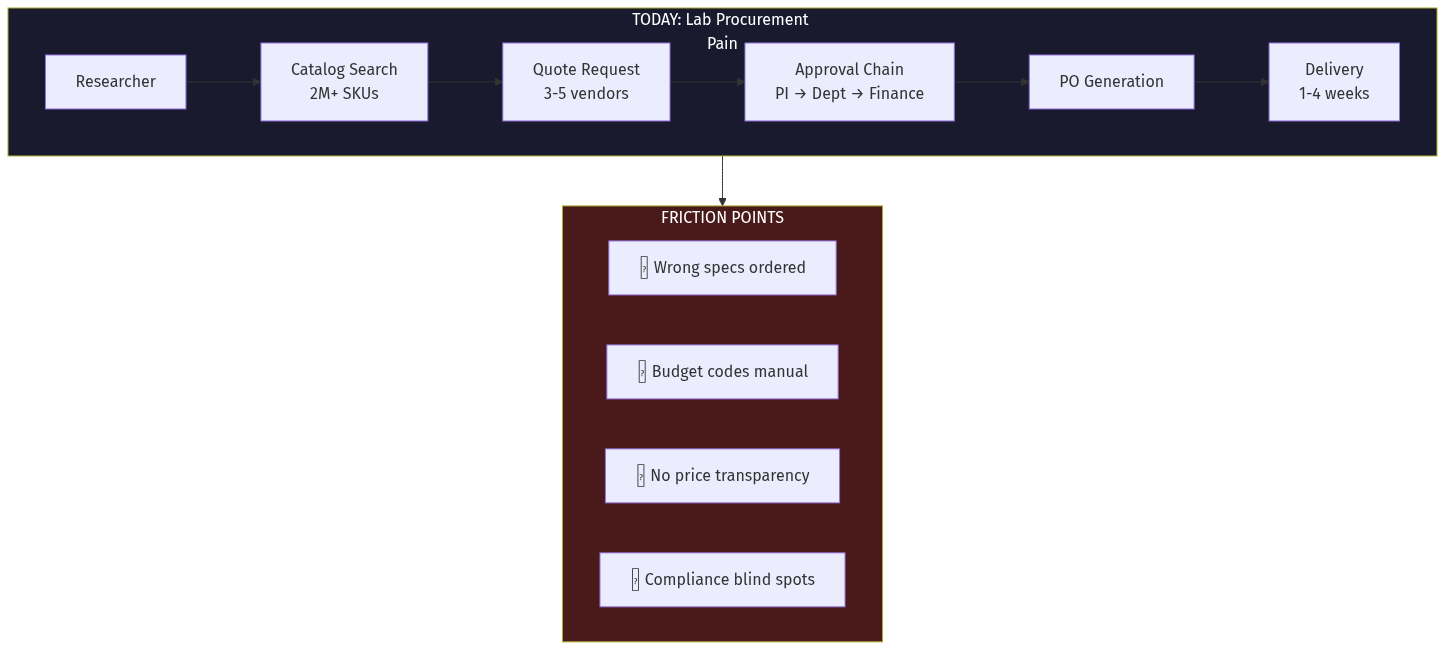
3.
Current Solutions
| Company | What They Do | Why They're Not Solving It |
|---|---|---|
| Thermo Fisher | Largest distributor, 2.5M products | Incentivized to sell their own products; search optimizes for revenue, not researcher needs |
| Merck/Sigma-Aldrich | Premium chemicals, life science focus | High prices, limited equipment; no multi-vendor comparison |
| Avantor/VWR | Full-service lab distributor | Legacy e-commerce; procurement tools require IT integration |
| Quartzy | Lab management + ordering platform | Request-based (not transactional); limited supplier integration |
| Benchling | Lab informatics + procurement lite | Core is R&D data, not procurement; add-on rather than core |
| Zageno | Life science marketplace | Niche focus on antibodies/reagents; limited equipment coverage |
| Science Exchange | Research services marketplace | Services not products; different buying motion |
Why Incumbents Won't Fix This
Zeroth Principles Analysis: Distributors profit from information asymmetry. If buyers could instantly compare prices across vendors, distributor margins collapse. Their catalogs are designed to capture demand, not optimize for buyer utility.4.
Market Opportunity
Market Size
| Segment | Global TAM | US TAM | Growth |
|---|---|---|---|
| Lab Equipment | $48B | $15B | 6.2% CAGR |
| Lab Consumables | $32B | $10B | 7.1% CAGR |
| Lab Chemicals | $12B | $4B | 5.8% CAGR |
| Total | $92B | $29B | 6.5% CAGR |
Procurement Software Opportunity
- Current spend on lab procurement software: ~$800M globally
- Potential with AI transformation: $4-5B (5% of total procurement value as software fees)
Why Now
5.
Gaps in the Market
Incentive Mapping: Who Profits from Status Quo?
- Distributors: 30-50% gross margins on consumables; lose if price transparency increases
- Sales Reps: Commissions based on account relationships, not efficiency
- Procurement Departments: Headcount justified by complexity; simpler systems = fewer jobs
- Preferred Vendor Programs: Kickbacks to institutions for volume commitments
Anomaly Hunting: What's Missing That Should Exist?
6.
AI Disruption Angle
How AI Agents Transform Lab Procurement
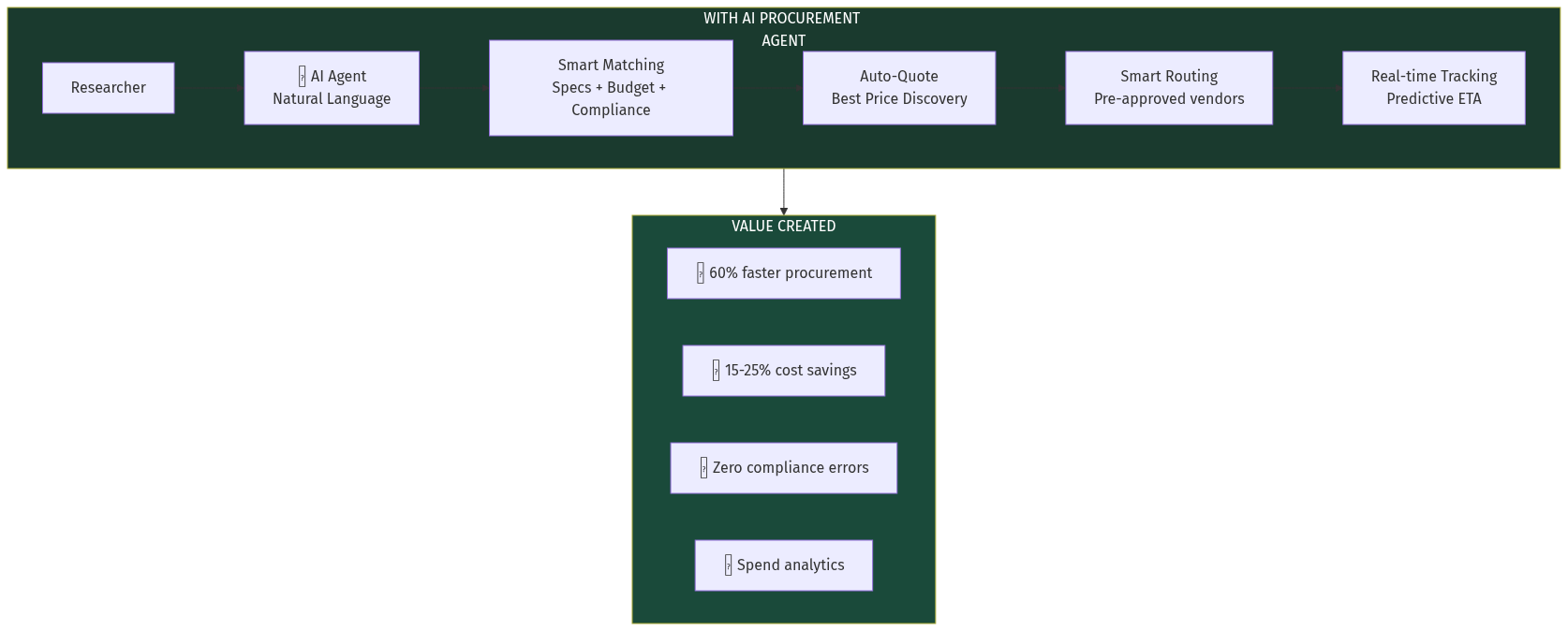
Researcher: "I need HPLC-grade acetonitrile, 4L bottles,
CAS 75-05-8, compatible with our Agilent 1260 system,
delivery by Friday, on grant NIH-R01-GM123456"

AI Agent: "Found 12 matching products from 5 vendors:
- Best price: VWR @ $89.50 (approved vendor)
- Fastest delivery: Fisher @ $94.20 (2-day)
- Your usual: Sigma @ $102.00
Grant compliance: ✓ Chemical approved
Budget remaining on grant: $4,230
Auto-route for PI approval? [Yes]"Lab procurement is structurally identical to travel booking:
- Multiple suppliers with different attributes (price, speed, quality)
- Complex preference matching (aisle seat = specific brand loyalty)
- Corporate policy compliance (travel policy = grant restrictions)
- Approval workflows (manager approval = PI signature)
Agent-to-Agent Commerce
When lab AI agents negotiate directly with supplier AI agents:
- Real-time price optimization based on demand signals
- Automatic substitution for out-of-stock items with equivalent specs
- Predictive ordering based on experimental protocols
- Cross-institutional demand aggregation for volume discounts
7.
Product Concept
Core Platform: LabAgent

8.
Development Plan
| Phase | Timeline | Deliverables |
|---|---|---|
| Discovery | 4 weeks | 50 researcher interviews, procurement workflow mapping, supplier API assessment |
| MVP | 12 weeks | Single-institution pilot: catalog aggregation (3 vendors), basic AI matching, Slack/Teams integration |
| V1 | 8 weeks | Multi-vendor quoting, approval workflows, grant compliance, 10-university rollout |
| V2 | 12 weeks | Demand aggregation, inventory sharing, analytics dashboard, enterprise features |
| Scale | Ongoing | Additional suppliers, international expansion, protocol-based auto-ordering |
Technical Architecture
- Catalog Layer: Unified product graph with embedding-based similarity search
- AI Layer: Fine-tuned LLM for scientific product understanding + specification parsing
- Integration Layer: Pre-built connectors for Fisher, VWR, Sigma APIs + EDI fallback
- Compliance Engine: Rule engine for grant restrictions, institutional policies, hazmat handling
9.
Go-To-Market Strategy
Phase 1: Academic Land (Months 1-12)
Phase 2: Biotech Bridge (Months 6-18)
Phase 3: Pharma Enterprise (Months 12-24)
Customer Acquisition Cost Model
| Segment | CAC | LTV | LTV:CAC |
|---|---|---|---|
| Single Lab (SMB) | $200 | $2,400 | 12x |
| Department (Mid) | $2,000 | $48,000 | 24x |
| Institution (Ent) | $50,000 | $2M+ | 40x+ |
10.
Revenue Model
Transaction-Based (Primary)
- Supplier Fees: 2-4% of GMV from winning supplier
- Estimated GMV Year 3: $500M → $15M revenue
Subscription (Secondary)
| Tier | Features | Price |
|---|---|---|
| Free | Basic catalog, 5 users | $0 |
| Pro | AI agent, unlimited users | $299/lab/mo |
| Enterprise | Analytics, compliance, SSO | Custom |
Demand Aggregation (Future)
- Group purchasing programs with negotiated discounts
- 5-10% of savings shared with platform
| Year | GMV | Revenue | Model Split |
|---|---|---|---|
| Y1 | $20M | $800K | 70% SaaS, 30% transaction |
| Y2 | $150M | $6M | 50% SaaS, 50% transaction |
| Y3 | $500M | $20M | 40% SaaS, 60% transaction |
11.
Data Moat Potential
Proprietary Data Assets That Accumulate
Network Effects
- Demand Side: More labs → better demand aggregation → lower prices
- Supply Side: More transaction data → better AI matching → higher conversion
- Data Side: More purchases → better recommendations → higher retention
12.
Why This Fits AIM Ecosystem
Direct Alignment
Cross-Pollination
- Domain Portfolio: lab.in, labsupply.in, scientificequipment.in
- Existing Verticals: Connects to industrial suppliers, chemicals, equipment rental
- Geographic Expansion: India has 2000+ universities and growing biotech sector
## Risk Analysis
Pre-Mortem: Why This Could Fail
Steelmanning the Incumbents
Why Thermo Fisher might win:
- $40B revenue = massive R&D budget for AI
- Owns the supply chain (manufacturing + distribution)
- Long-term contracts with major institutions
- Brand trust built over decades
## Verdict
Opportunity Score: 8.5/10 The Bull Case:- Massive TAM ($80B+) with clear digital transformation tailwinds
- Acute pain felt daily by high-value users (researchers)
- AI/LLM breakthrough enables previously impossible product matching
- Incumbents structurally unable to innovate on buyer experience
- Clear monetization through transaction fees + SaaS
- Enterprise sales cycles in academia are brutal
- Distributor relationships could be weaponized against platform
- Compliance complexity creates implementation drag
- Scientists are creatures of habit
## Sources
- Grand View Research - Laboratory Equipment Market Analysis
- Thermo Fisher Scientific Annual Report 2025
- Mordor Intelligence - Life Science Reagents Market
- MarketsandMarkets - Laboratory Informatics Report
- NIH Grant Spending Guidelines (NOT-OD-23-073)
- Quartzy Product Documentation
- Benchling Platform Overview
- Fisher Scientific Product Catalog
Research by Netrika Menon | Matsya Avatar | AIM.in Data Intelligence
❧