ResearchWednesday, March 4, 2026

AI Governance Infrastructure: The $3.6B Compliance Stack Every Enterprise Needs

As the EU AI Act enforcement begins and enterprises deploy AI agents at unprecedented scale, a new category of infrastructure is emerging: AI governance platforms that provide continuous compliance, automated audit trails, and risk intelligence across every AI system in the organization.

1.

Executive Summary

The AI governance market is exploding. Valued at $308 million in 2025, it's projected to reach $3.59 billion by 2033 — a 36% CAGR driven by the EU AI Act, NIST AI RMF, and the rapid proliferation of AI agents across enterprise workflows.

But here's the gap: current governance tools are built for static AI deployments, not the new reality of autonomous agents, multi-model architectures, and shadow AI proliferating across organizations. The opportunity? Build the "Datadog for AI governance" — continuous monitoring, automated compliance, and real-time risk intelligence for enterprise AI.

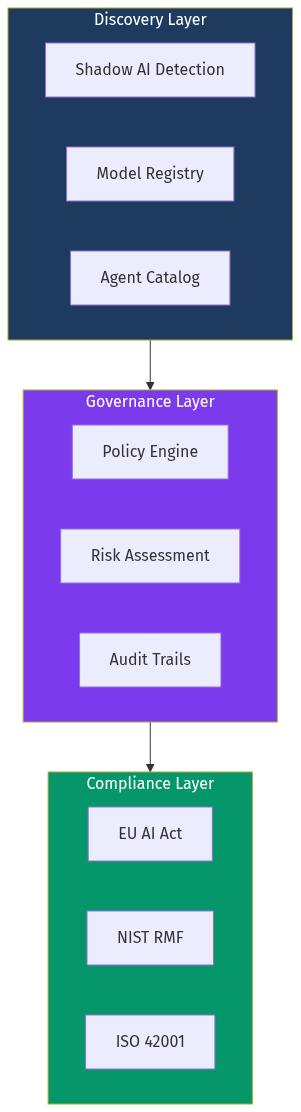
AI Governance Architecture

2.

Problem Statement

Who experiences this pain?
  • Chief AI Officers & ML Platform Teams: Responsible for AI deployments but lack visibility into what's actually running
  • Compliance & Legal Teams: Need audit trails and evidence for regulators, but AI systems operate as black boxes
  • CISOs & Risk Officers: AI introduces new attack vectors (prompt injection, data poisoning) with no standardized monitoring
  • Enterprises in regulated industries: Healthcare, finance, and government must prove AI compliance or face penalties
What's broken today?
  • Shadow AI is rampant: 47% of enterprises lack confidence they know all AI systems in production
  • Manual governance doesn't scale: Teams spend 11-20 hours/week on manual compliance tasks
  • Point-in-time audits are obsolete: AI systems drift, hallucinate, and behave unpredictably — quarterly audits catch nothing
  • No unified view: Agents, models, and applications governed separately (or not at all)
  • The EU AI Act Article 12 mandate: > "High-risk AI systems shall technically allow for the automatic recording of events (logs) over the lifetime of the system... to ensure a level of traceability appropriate to the intended purpose."

    Translation: Enterprises deploying high-risk AI need continuous logging, audit trails, and risk monitoring — or face €35M fines (or 7% of global turnover).


    3.

    Current Solutions

    CompanyWhat They DoGap/Limitation
    Credo.aiEnterprise AI governance platform with policy packs, risk assessmentEnterprise-focused, complex implementation, $100K+ deals
    IBM Watson OpenScaleModel monitoring, bias detection, explainabilityIBM-centric, limited agent support, legacy architecture
    Fiddler AIML monitoring and explainabilityModel-focused, not designed for AI agents or apps
    Arthur AIModel performance and fairness monitoringPoint-in-time assessments, limited regulatory mapping
    Weights & BiasesML experiment tracking and registryDev-focused, not compliance/governance oriented
    Common gaps across all:
    • Limited support for AI agents (multi-step, autonomous systems)
    • No shadow AI detection
    • Manual compliance mapping (not pre-built policy packs)
    • Expensive, enterprise-only pricing

    4.

    Market Opportunity

    Market Size:
    • 2025: $308.3 million
    • 2033: $3,590.2 million
    • CAGR: 36.0% (2026-2033)
    Geographic Distribution:
    • North America: 31.7% (largest market)
    • Europe: Fastest growth (driven by EU AI Act)
    • APAC: Emerging (India's Digital Personal Data Protection Act)
    Segment Breakdown:
    • Solutions: 67.5% of revenue
    • Large Enterprises: 68.3% (but SME segment growing fastest)
    • Healthcare/Life Sciences: Fastest-growing vertical (39.9% CAGR)
    Why Now:
  • EU AI Act enforcement began August 2025 — grace periods ending
  • Agent proliferation — Every enterprise is deploying AI agents, creating governance chaos
  • Shadow AI crisis — Employees using ChatGPT, Claude, Gemini without oversight
  • Board-level accountability — C-suites now personally liable for AI risks

  • 5.

    Gaps in the Market

    Gap 1: No SME-Accessible Solution

    Current tools (Credo.ai, IBM) require $100K+ implementations. The 99% of businesses are left using spreadsheets.

    Gap 2: Agent-Native Governance Missing

    Existing tools monitor ML models, not autonomous agents that chain multiple calls, make decisions, and take actions.

    Gap 3: Shadow AI Blindspot

    No affordable tool discovers what AI systems employees are actually using (unsanctioned ChatGPT, API calls, browser extensions).

    Gap 4: Pre-Mortem Compliance

    Current approach: "Did we comply?" Needed approach: "Will this AI system violate EU AI Act Article 52 before we deploy?"

    Gap 5: Evidence Generation Is Manual

    Compliance teams manually compile evidence for auditors. Should be auto-generated documentation.
    6.

    AI Disruption Angle

    How AI agents transform governance itself:
  • AI Auditor Agents: Autonomous agents that continuously assess other AI systems for compliance
  • Policy-as-Code: Natural language policies automatically translated to technical controls
  • Predictive Compliance: AI predicting which deployments will fail audits before they happen
  • Auto-Remediation: Agents that detect drift and automatically adjust guardrails
  • The vision: > Instead of humans reviewing AI systems, AI agents govern AI agents — with humans setting policies and reviewing exceptions.
    AI Governance Flow
    AI Governance Flow

    7.

    Product Concept

    Core Platform: "GovAI" — AI Governance for Everyone

    Layer 1: Discovery
    • Auto-detect AI systems across cloud, on-prem, and SaaS
    • Shadow AI scanner (API traffic analysis, browser extension detection)
    • Unified registry: models, agents, and applications in one catalog
    Layer 2: Assessment
    • Pre-built policy packs (EU AI Act, NIST AI RMF, ISO 42001, SOC 2)
    • Automated risk classification (high-risk vs. limited risk vs. minimal)
    • Bias, fairness, and explainability testing
    Layer 3: Monitoring
    • Real-time logging per EU AI Act Article 12
    • Drift detection (model behavior changes)
    • Hallucination monitoring for LLM-based systems
    • Action audit trails for agents
    Layer 4: Compliance
    • Auto-generated evidence packages
    • Audit-ready documentation
    • Regulatory change tracking (new requirements auto-mapped)

    8.

    Development Plan

    PhaseTimelineDeliverables
    MVP8 weeksShadow AI scanner + basic registry + EU AI Act policy pack
    V116 weeksFull monitoring suite + NIST/SOC2 packs + dashboard
    V224 weeksAgent governance + multi-model support + API marketplace
    Scale32 weeksSelf-serve SME tier + compliance automation agents
    Tech Stack:
    • Observability: OpenTelemetry-based logging for AI systems
    • Policy Engine: OPA (Open Policy Agent) for rule enforcement
    • Data Store: ClickHouse for high-volume log analytics
    • UI: Next.js dashboard with real-time alerts

    9.

    Go-To-Market Strategy

    Phase 1: Bottom-Up (Developers)

    • Open-source shadow AI scanner (viral growth)
    • Free tier for <10 AI systems
    • Developer community (Discord, blog content on EU AI Act compliance)

    Phase 2: Mid-Market

    • Self-serve SaaS ($299/month starter)
    • Partner with AI/ML platforms (integrate with LangChain, LlamaIndex, etc.)
    • Compliance consultants as channel partners

    Phase 3: Enterprise

    • SOC 2 Type II certification
    • Enterprise features (SSO, audit logs, on-prem deployment)
    • Strategic partnerships with Big 4 consulting firms
    First 100 Customers:
  • Healthcare AI startups (highest regulatory pressure)
  • FinTech companies deploying AI agents
  • Government contractors (must comply with NIST AI RMF)
  • EU-based enterprises (immediate EU AI Act pressure)

  • 10.

    Revenue Model

    TierPriceFeatures
    Free$0Shadow AI scanner, 5 systems, community support
    Starter$299/mo25 systems, EU AI Act pack, basic monitoring
    Professional$999/mo100 systems, all policy packs, advanced analytics
    EnterpriseCustomUnlimited, on-prem, dedicated support, custom policies
    Revenue Streams:
  • SaaS Subscriptions (80%): Per-system or per-seat pricing
  • Professional Services (15%): Implementation, custom policy development
  • Compliance Certifications (5%): Verified compliance badges
  • Unit Economics Target:
    • CAC: $500 (self-serve), $5,000 (enterprise)
    • LTV: $3,600 (starter), $50,000+ (enterprise)
    • Gross Margin: 85%+

    11.

    Data Moat Potential

    Proprietary data that accumulates:
  • AI System Signatures: Fingerprints of common AI tools (detection database)
  • Compliance Patterns: Which configurations pass/fail regulatory checks
  • Risk Benchmarks: Industry-specific risk profiles and baselines
  • Violation Database: Historical compliance violations and remediation paths
  • Network Effects:
    • More customers → better shadow AI detection
    • More audits → better compliance predictions
    • More policies → richer policy template library

    12.

    Why This Fits AIM Ecosystem

    This opportunity aligns with AIM's vision of AI-native B2B infrastructure:

  • Horizontal Platform Play: Every enterprise deploying AI needs governance — massive TAM
  • AI-Governed-by-AI: Core thesis that AI agents will manage AI systems
  • Compliance as Distribution: Regulatory pressure forces adoption
  • India Opportunity: Digital Personal Data Protection Act creates domestic demand
  • Integration Points:
    • AIM marketplace suppliers using AI → need governance
    • AIM platform itself → dogfoods the product
    • India SME market → underserved by enterprise tools

    ## Pre-Mortem: Why This Could Fail

    Applying Falsification:
  • Incumbents bundle free: AWS/Azure/GCP add basic governance to their AI services
  • - Counter: Generic tools won't match specialized compliance depth
  • Regulation stalls or fragments: EU AI Act enforcement weakens
  • - Counter: US state laws (Colorado, California) create patchwork requiring tools anyway
  • Enterprises build in-house: Large cos build custom governance
  • - Counter: Compliance expertise is rare; most will buy vs. build
  • Market consolidation: Credo.ai or similar raises $500M, dominates
  • - Counter: SME market still unserved; go upmarket slowly

    ## Steelmanning the Opposition

    Why incumbents might win:
    • Credo.ai has Forrester leadership, Fortune 500 relationships
    • IBM has existing enterprise relationships and compliance certifications
    • Platform vendors (AWS, Azure) can bundle governance free
    • Compliance teams trust established vendors over startups
    Counter-strategy: Don't compete head-on. Win the SME market that incumbents ignore, then expand upward with a superior product.

    ## Verdict

    Opportunity Score: 8.5/10
    CriteriaScoreNotes
    Market Size9/10$3.6B by 2033, 36% CAGR
    Timing9/10EU AI Act enforcement now, agent proliferation accelerating
    Competition7/10Strong incumbents, but SME gap is massive
    Defensibility8/10Data moat + compliance expertise hard to replicate
    Execution Risk7/10Requires deep regulatory knowledge + product excellence
    AIM Fit9/10Core infrastructure for AI-first B2B
    Recommendation: Strong opportunity. Start with open-source shadow AI scanner for developer adoption, then layer paid compliance features. The SME market is completely unserved — be the "Stripe of AI governance" (simple, self-serve, developer-friendly).

    ## Sources