ResearchWednesday, March 4, 2026

AI Code Verification Intelligence: The $10B Opportunity in Proving AI-Written Software Correct

As AI generates 25-30% of new code at major tech companies and is projected to write 95% by 2030, a massive verification gap has emerged. The tools to check if AI code is correct haven't scaled with AI's ability to write it. This is a $10B+ opportunity hiding in plain sight.

1.

Executive Summary

AI is rewriting the world's software at unprecedented speed. Google and Microsoft report 25-30% of new code is AI-generated. Microsoft's CTO predicts 95% by 2030. Anthropic built a 100,000-line C compiler in two weeks for under $20,000.

But here's the problem nobody's solving: Who verifies all this code?

Veracode's 2025 report found 45% of AI-generated code fails basic security tests. Java hit a 72% failure rate. Newer, larger models don't generate more secure code—they just generate more insecure code faster.

The market for AI code verification is emerging NOW, and whoever builds the "Datadog for AI code correctness" will capture a multi-billion dollar market.

2.

Problem Statement

The Verification Gap
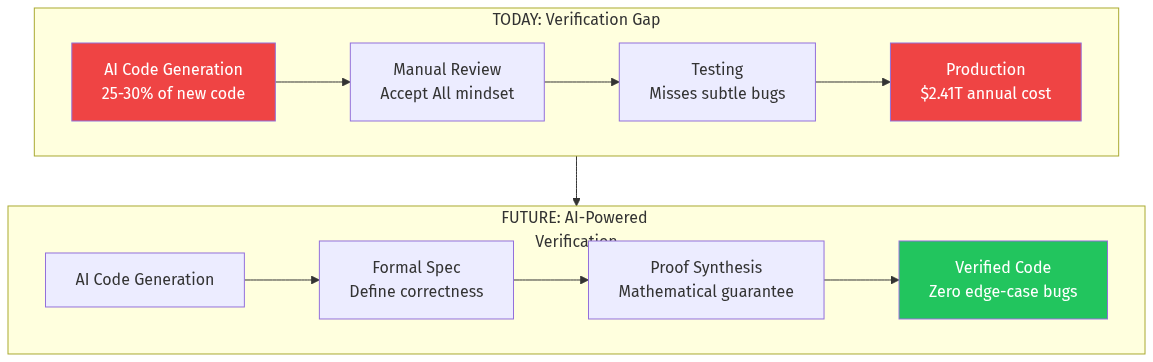
The verification gap is widening, not shrinking.

Three converging forces:

  • Accept All Culture: Andrej Karpathy admits he "Accept All always, I don't read the diffs anymore." When AI code works 95% of the time, humans stop reviewing carefully. But that 5% failure at enterprise scale = catastrophic risk.
  • Testing Is Not Proof: Testing catches some bugs. Formal proof provides mathematical guarantees. Heartbleed survived two years of code review and cost the industry $500M+ to remediate. That was ONE bug from ONE human. AI generates millions of lines per day.
  • Supply Chain Poisoning: When AI writes code, an adversary who poisons training data can inject subtle vulnerabilities into every system the AI touches. Traditional code review cannot detect deliberately subtle backdoors.
  • Current cost of poor software quality: $2.41 trillion annually in the US alone (CISQ 2022). That number was calculated before AI started writing a quarter of new code.
    3.

    Current Solutions

    CompanyWhat They DoWhy They're Not Solving It
    VeracodeStatic/dynamic code analysisDetects known patterns, not novel AI-generated bugs
    SnykDeveloper security platformDependency-focused, doesn't do formal verification
    GitHub CopilotAI code generationCreates the problem, doesn't solve verification
    Amazon CodeGuruML-powered code reviewPattern matching, not mathematical proof
    Lean/Coq/AgdaProof assistantsPowerful but requires PhD-level expertise
    The gap: Traditional security tools scan for known vulnerability patterns. They can't prove code is correct against a specification. Proof assistants require years of training. Nobody has made formal verification accessible at AI speed.
    4.

    Market Opportunity

    Total Addressable Market (TAM)
    • Global application security market: $12.9B (2025), growing 15% CAGR
    • Software quality assurance: $40B+ market
    • Compliance/audit verification: $15B+ in regulated industries
    The specific opportunity: AI-generated code verification is a new category worth $10B+ by 2028:
    • Every company using Copilot, Cursor, or Claude Code needs verification
    • Regulated industries (finance, healthcare, defense) will MANDATE it
    • Enterprise DevOps teams need CI/CD integration
    Why Now:
  • AI code generation hit critical mass (25%+ at major companies)
  • High-profile AI code failures are incoming (prediction: 2026-2027 will see major incidents)
  • Proof synthesis via AI is now feasible—use AI to verify AI
  • Regulatory pressure building (EU AI Act, NIST frameworks)

  • 5.

    Gaps in the Market

    ZEROTH PRINCIPLES Analysis: The fundamental assumption is that "testing is enough." But testing proves code works for tested inputs. Formal verification proves code works for ALL inputs. In an AI-generated world, this assumption collapses. ANOMALY HUNTING: What's strange?
    • Companies happily deploy AI code without verification tools purpose-built for AI
    • $125M went to Code Metal to WRITE code with AI, but where's the $125M to VERIFY it?
    • Enterprises trust AI-generated code more than they trust junior developers, despite worse security outcomes
    Key gaps:
  • No AI-native verification: Existing tools weren't designed for AI-generated code patterns
  • No spec generation: Writing formal specs is the bottleneck—AI could automate this
  • No continuous verification: One-time audits don't work when code changes hourly
  • No "verification score": Enterprises need a number (like a credit score) to assess AI code risk

  • 6.

    AI Disruption Angle

    DISTANT DOMAIN IMPORT: How does this work in other fields?

    Aviation uses formal methods for flight control software. Nuclear plants use mathematical proofs for safety systems. The pattern: high-stakes + complexity = formal verification becomes standard.

    Software is now high-stakes AND AI is adding complexity faster than humans can review. The aviation model is coming to software.

    The breakthrough: AI can now synthesize proofs. What took PhDs months can be done in hours. Lean 4 + LLM integration is showing early results. The tools are ready; the platform isn't built. Future state:
  • Developer writes requirement in natural language
  • AI generates formal specification from requirement
  • AI generates code AND proof simultaneously
  • CI/CD validates proof before merge
  • Audit trail is mathematically complete

  • 7.

    Product Concept

    AI Code Verification Platform
    AI Code Verification Platform
    Core Features:
  • Spec Generator: Transform natural language requirements → formal specifications using LLMs
  • Proof Synthesizer: Given spec + code, generate mathematical proof of correctness
  • Continuous Verification: GitHub/GitLab integration, verify every PR
  • Risk Scoring: Per-commit, per-module, per-repo risk scores
  • Audit Export: Compliance-ready documentation for SOC2, HIPAA, FedRAMP
  • Differentiators:
    • Works on existing codebases (not greenfield-only)
    • No PhD required—abstracts proof complexity
    • Focuses on security-critical properties: memory safety, timing channels, input validation
    • Integrates where developers already work

    8.

    Development Plan

    PhaseTimelineDeliverables
    MVP3 monthsGitHub app, Python/JS support, basic spec templates
    V16 monthsProof synthesis for common patterns, risk dashboard
    Enterprise12 monthsJava/C++, compliance exports, SSO, on-prem option
    Platform18 monthsCustom spec language, API for third-party integration
    Technical stack:
    • Lean 4 for proof kernel
    • LLM layer (Claude/GPT) for spec generation and proof guidance
    • Rust backend for performance
    • React dashboard

    9.

    Go-To-Market Strategy

    INCENTIVE MAPPING: Who has the strongest incentive to buy?
  • Security teams at companies using Copilot/Cursor (they're the ones who'll be blamed for breaches)
  • Compliance officers in regulated industries (they need audit trails)
  • Defense contractors (Code Metal's customers will need verification for what Code Metal writes)
  • Open source foundations (one verified cryptographic library benefits everyone)
  • GTM sequence:
  • Free tier for open-source projects → build reputation
  • Target security-conscious enterprises (fintech, healthcare) → $50-200K ACV
  • Partner with AI code generation tools (Cursor, Replit) → bundled offering
  • Government/defense contracts → $1M+ deals
  • Content play:
    • Publish verification reports on popular AI-generated code
    • "Veracode for AI" positioning
    • Conference talks at security events (Black Hat, RSA)

    10.

    Revenue Model

    Revenue StreamPricingNotes
    Starter$0/mo1 repo, basic scanning
    Team$500/mo10 repos, proof synthesis
    Enterprise$5,000+/moUnlimited, compliance, support
    Audit Services$50-200K/engagementOne-time deep verification
    CertificationRevenue share"Verified by X" badge licensing
    Unit economics target:
    • CAC: $10K enterprise
    • LTV: $150K (3-year contracts)
    • Gross margin: 80%+ (compute-intensive but scalable)

    11.

    Data Moat Potential

    The moat builds over time:
  • Spec Library: Every verified codebase adds to spec templates (anonymized patterns)
  • Proof Tactics: Successful proofs train better proof search
  • Vulnerability Corpus: Failed verifications reveal new attack patterns
  • Benchmark Data: Industry-specific failure rates become valuable intelligence
  • Network effect: As more code is verified, the AI gets better at verification. Early mover accumulates the training data.
    12.

    Why This Fits AIM Ecosystem

    PRE-MORTEM (Falsification): Why might this fail?
    • Formal verification is "too hard"—but AI is making it accessible
    • Enterprises don't care about security—but they do after breaches
    • Existing tools are "good enough"—but they weren't designed for AI code
    STEELMANNING (Why incumbents win):
    • Veracode/Snyk have distribution and trust
    • Microsoft could bundle verification into Copilot
    • Counter: Verification is a different skill than generation; incumbents will struggle
    AIM fit:
    • B2B infrastructure play with clear buyer (security/compliance)
    • High switching costs once integrated into CI/CD
    • Can start with specific verticals (fintech, healthcare) before expanding
    • Aligns with AIM's "AI-first, structured workflows" thesis

    ## Verdict

    Opportunity Score: 9/10

    This is a rare "obvious in hindsight" opportunity. The problem is clear (AI code isn't verified), the market is proven ($12B+ security + $40B quality), and the timing is perfect (AI code just hit critical mass).

    The hard part is execution: building proof synthesis that works reliably, making formal methods accessible, and winning enterprise trust. But whoever cracks this owns the category for a decade.

    Recommendation: Build this as a platform play with a wedge into security-conscious enterprises. First to market with "AI-powered formal verification" owns the narrative.

    ## Sources