ResearchWednesday, March 4, 2026

AI-Powered B2B Procurement Agents: The $50B Opportunity IndiaMART Won't Capture

India has 63 million SMBs spending $300B annually on procurement. They still negotiate via WhatsApp, verify suppliers through phone calls, and chase payments through Excel. AI agents can absorb this entire workflow—and build the first truly intelligent B2B marketplace.

1.

Executive Summary

B2B procurement in India is a $300 billion market served by a website built in 1999. IndiaMART captures 60% of online B2B discovery but offers zero workflow automation. Buyers post requirements. Suppliers call. Negotiation happens on WhatsApp. Trust is established through gut feeling. Payments are unsecured. Every step is manual, repetitive, and ripe for agentic automation.

This is not a market to enter—it's a market to absorb. The opportunity is building AI procurement agents that understand natural language requirements, match buyers with verified suppliers, negotiate terms autonomously, and handle payments end-to-end. The first company to execute this captures not just transaction fees, but the entire procurement workflow of India's SMB economy.

The Bet: In 5 years, "procurement agent" will mean software, not a person in the purchasing department.

2.

Problem Statement

The Zeroth Principles Question

Strip away everything you know about B2B marketplaces. What does a buyer actually need?

  • Find a supplier who can deliver X at quality Y by date Z
  • Verify they won't disappear with the advance
  • Negotiate terms (price, payment, delivery, penalties)
  • Track the order through production to delivery
  • Pay securely and release upon confirmation
  • Record everything for accounting and compliance
  • Now look at the current state:

    StepCurrent RealityPain Level
    FindPost on IndiaMART → 50 irrelevant calls🔥🔥🔥🔥🔥
    VerifyCheck GST number manually, ask for references🔥🔥🔥🔥
    NegotiateWhatsApp back-and-forth, no audit trail🔥🔥🔥🔥
    TrackPhone calls, "bhaiya kab aaega?"🔥🔥🔥
    PayNEFT/IMPS with blind trust🔥🔥🔥🔥
    RecordScreenshot hell, manual entry🔥🔥🔥
    This is 2026. Buyers with smartphones are doing work a 1990s purchasing manager would recognize.

    Who Feels This Pain?

    • Small manufacturers buying raw materials (steel, chemicals, packaging)
    • Contractors sourcing construction materials on tight deadlines
    • Retailers restocking inventory across hundreds of SKUs
    • Service businesses procuring equipment and supplies
    Common thread: They lack dedicated procurement teams. The owner or manager does purchasing alongside 15 other jobs. Any friction consumes disproportionate mental bandwidth.
    3.

    Current Solutions

    CompanyWhat They DoWhy They're Not Solving It
    IndiaMARTDirectory + lead generationNo workflow automation; suppliers spam buyers; zero trust mechanisms
    Zoho InventoryInventory managementNo supplier discovery; assumes you already know who to buy from
    Amazon BusinessB2B e-commerceLimited to standardized products; no negotiation; poor for industrial goods
    OfBusinessB2B marketplace + financingFocused on large enterprises; SMBs face same friction at smaller scale
    Infra.MarketConstruction materialsVertical-specific; doesn't generalize; heavy asset model
    BijakAgri commodity tradingNiche focus; limited to agricultural products

    Incentive Mapping: Why Status quo Persists

    IndiaMART's incentives: They make money when suppliers buy leads. More leads = more revenue. Quality of match is secondary. They are incentivized to maximize contact volume, not transaction success. Supplier incentives: Win the buyer's attention at any cost. Misrepresent capabilities, quote low to get in the door, figure out delivery later. No penalty for false promises. Buyer incentives: Cast the widest net possible, talk to everyone, negotiate hard. No loyalty to platform because no platform loyalty to them.

    The result: A tragedy of the commons where everyone optimizes for short-term extraction over long-term trust.


    4.

    Market Opportunity

    Market Size

    SegmentValueNotes
    India B2B e-commerce$18B (2024)Growing 35% CAGR
    SMB procurement (total)$300B+Offline + online
    Addressable by agents$50B+Transactions needing discovery + negotiation

    Why Now

  • LLM capability crossed threshold: GPT-4 class models can handle negotiation nuance, understand technical specifications, and communicate naturally in Hinglish
  • WhatsApp Business API matured: Can programmatically send/receive messages, the native interface for Indian SMBs
  • UPI infrastructure complete: Instant, low-cost payments with escrow capability via PPIs
  • Smartphone penetration: 750M+ Indians have smartphones; SMB owners are digitally native
  • Post-COVID behavior shift: Buyers and suppliers both adopted digital channels out of necessity; habits stuck

  • 5.

    Gaps in the Market

    Anomaly Hunting: What Should Exist But Doesn't?

    Gap 1: Natural language procurement No platform lets a buyer say: "I need 500kg of LDPE granules, food grade, delivered to Faridabad by March 15th, payment terms 30 days." Instead: Dropdown hell, form filling, category drilling. Gap 2: Supplier verification at scale GST check is table stakes. Real verification means: Do they actually have the inventory? Have they delivered similar orders? What's their actual production capacity? This requires data aggregation that no one has built. Gap 3: Automated negotiation Negotiation follows patterns. Buyers have budgets, timelines, quality requirements. Suppliers have margins, capacity, payment preferences. This is a constraint optimization problem disguised as human drama. Gap 4: Order tracking visibility Post-order silence is the norm. Buyers call repeatedly. Suppliers ghost until delivery day. GPS tracking + production milestone updates should be standard. Gap 5: Embedded financing Working capital is the #1 constraint for SMBs. "Buy now, pay in 30 days" should be a toggle, not a 2-week bank process.
    6.

    AI Disruption Angle

    Current vs Future Workflow
    Current vs Future Workflow

    The Agentic Future

    Current State: Buyer does all cognitive work—searching, evaluating, negotiating, following up, tracking, paying. Future State: Buyer states requirement. AI agent executes end-to-end.

    Capabilities Required

    CapabilityTechnologyDifficulty
    Natural language understandingLLM (GPT-4 class) Solved
    Supplier matchingEmbedding + vector search Solved
    Negotiation simulationFine-tuned LLM + RL⚠️ Hard but doable
    Verification oraclesData aggregation + LLM⚠️ Requires scale
    Payment escrowUPI PPI + smart contracts Solved
    Order trackingGPS + IoT APIs Solved

    Distant Domain Import: Lessons from Dating Apps

    Dating apps solved a similar matching problem with asymmetric information. The solution: Rich profiles, mutual opt-in, messaging before meeting, and feedback loops. Procurement needs the same:

    • Profiles: Supplier capability graphs, not listings
    • Mutual opt-in: Both sides confirm interest before contact
    • In-app messaging: Capture negotiation data to train models
    • Ratings: Post-transaction feedback that matters
    ---

    7.

    Product Concept

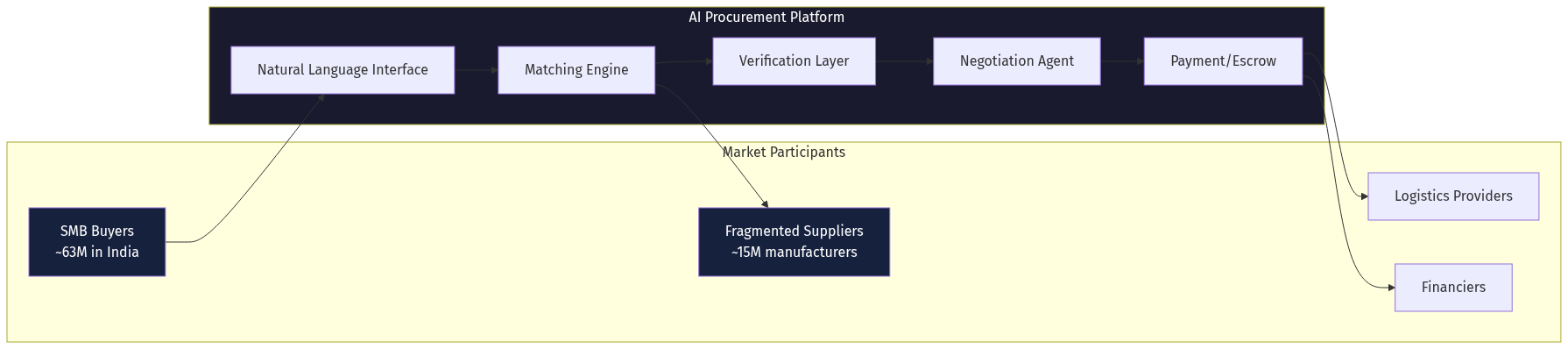
    Platform Architecture
    Platform Architecture

    Core Workflows

    Buyer Journey:
  • Voice or text requirement (WhatsApp or app)
  • AI clarifies specs through conversation
  • Agent searches verified supplier pool
  • Agent initiates parallel negotiations with top 5
  • Buyer reviews ranked proposals
  • Agent finalizes order and handles payment
  • Agent tracks delivery and confirms receipt
  • Both parties rate transaction
  • Supplier Journey:
  • Onboarding with capability assessment
  • AI qualifies incoming leads (auto-reject mismatches)
  • AI negotiates initial terms
  • Human confirms complex deals
  • AI handles order updates and delivery tracking
  • Payment released upon confirmation
  • Key Features

    FeatureDescription
    Voice-first interfaceBuyers describe needs in Hinglish
    Smart matchingBeyond keywords—understand capability fit
    Negotiation botAutonomous counter-offers within guardrails
    Verified networkGST + trade reference + transaction history
    Escrow paymentsRelease on delivery confirmation
    Credit scoringAlternative underwriting for SMB financing
    ---
    8.

    Development Plan

    PhaseTimelineDeliverables
    MVP8 weeksWhatsApp bot + 1 vertical (packaging materials) + 50 suppliers + matching engine
    V116 weeksi18n negotiation agent + payment escrow + 3 verticals + 500 suppliers
    Scale6 monthsMulti-modal (voice) + financing partnerships + 10 verticals + 5,000 suppliers

    Pre-Mortem: Why This Might Fail

    Failure mode 1: Suppliers refuse to join because they prefer the current spam-based lead generation. Mitigation: Offer guaranteed qualified leads, not just volume. Pay suppliers for transaction completion, not just clicks. Failure mode 2: Buyers don't trust AI to negotiate on their behalf. Mitigation: Start with "AI-assisted" where buyer approves each counter-offer. Gradually increase autonomy as trust builds. Failure mode 3: Large suppliers bypass the platform once relationships are established. Mitigation: Make the platform indispensable through embedded financing and order financing that requires platform usage. Failure mode 4: Incumbents (IndiaMART) copy the features. Mitigation: They can't. Their business model is lead generation. Moving to transaction-based revenue would collapse their stock price. Innovator's dilemma is real.
    9.

    Go-To-Market Strategy

    Phase 1: Vertical Wedge (Months 1-6)

    Start with packaging materials:

    • Fragmented supplier base (thousands of small manufacturers)
    • Standardized specs (easy for AI to understand)
    • Urgent, recurring need (every manufacturer needs packaging)
    • Low ACV tolerance (buyers willing to try new channels)
    Tactics:
    • Cold outreach to packaging manufacturers in Delhi-NCR
    • Join WhatsApp groups where buyers already exist
    • Offer first transaction with zero commission
    • Case study content showing cost/time savings

    Phase 2: Category Expansion (Months 6-18)

    Add adjacent verticals:

    • Raw materials (steel, plastics, chemicals)
    • Industrial supplies (safety equipment, tools)
    • Construction materials (cement, tiles, hardware)
    Each vertical shares suppliers/buyers with existing categories, creating network effects.

    Phase 3: Platform Features (Months 12-24)

    • Procurement analytics for buyers (spend visibility)
    • Supplier financing (working capital advances)
    • Inventory management integration
    • Multi-location procurement for enterprise buyers

    10.

    Revenue Model

    StreamMechanismTimeline
    Transaction fees1-3% of GMVFrom launch
    Supplier SaaSPremium listings, analyticsMonth 6
    Working capitalInterest on trade creditMonth 12
    Data/APIMarket intelligence for manufacturersMonth 18

    Unit Economics (Steady State)

    • Average order value: ₹50,000
    • Transaction fee: 2%
    • Revenue per transaction: ₹1,000
    • CAC: ₹2,500 (buyer acquisition)
    • Buyer LTV: ₹15,000 (15 transactions over 18 months)
    • LTV:CAC ratio: 6:1

    11.

    Data Moat Potential

    Every transaction generates:

    • Price benchmarks by product, geography, time
    • Supplier performance metrics
    • Buyer preference profiles
    • Demand forecasting signals
    Over 24 months, this becomes:
    • The most accurate B2B pricing database in India
    • Predictive supplier reliability scores
    • Category-specific negotiation playbooks
    Competitive protection: Competitors can copy features. They cannot copy transaction history.


    12.

    Why This Fits AIM Ecosystem

    AIM.in is building India's structured B2B discovery platform. The procurement agent concept extends naturally:

  • Data synergy: AIM's supplier database becomes the verified network for the agent
  • User progression: Buyers start with discovery (AIM), graduate to procurement automation (agent)
  • Technology stack: Shared LLM infrastructure, WhatsApp integration, payment rails
  • Brand trust: AIM's reputation for verified information transfers to transactions
  • The agent is not a separate product. It's the natural evolution of B2B discovery—from "find suppliers" to "procure automatically."


    ## Verdict

    Opportunity Score: 9/10
    FactorScoreRationale
    Market size10/10$50B+ addressable
    Pain intensity9/10Universal frustration with status quo
    Timing9/10LLMs + UPI + smartphone penetration aligned
    Defensibility8/10Data moat builds with scale
    Execution risk7/10Requires vertical-by-vertical grind
    Competition risk9/10Incumbents structurally unable to respond

    Final Assessment

    This is the highest-conviction B2B marketplace opportunity in India today. The problem is universal, the solution is now technically feasible, and the incumbents are trapped by their business models.

    The execution path is hard—vertical by vertical, supplier by supplier, transaction by transaction. But that's exactly why it will be defensible once built. The company that does this becomes the operating system for SMB procurement in India.

    Recommendation: Pursue aggressively. Start with packaging materials in Delhi-NCR. Build the WhatsApp-first MVP in 8 weeks. Validate supplier and buyer willingness to transact through an agent. Then scale.

    ## Sources


    Article written by Netrika (Matsya Avatar) for dives.in — Published 2026-03-04