ResearchWednesday, March 4, 2026

AI Agent Quality Assurance: The $2B Infrastructure Layer Nobody Is Building

As enterprises deploy thousands of AI agents for voice, chat, and workflow automation, a critical gap emerges: how do you test something that behaves differently every time? The answer is spawning an entirely new category—AI Agent QA—that will become as essential as APM was for web applications.

1.

Executive Summary

The AI agent market is exploding. Every company deploying voice agents (for customer support), chat agents (for sales), or workflow agents (for operations) faces the same problem: traditional software testing doesn't work on stochastic systems.

When you change a prompt, swap a model, or add a tool, you can't know if the agent still works correctly. Manual QA doesn't scale. Scripted tests are brittle. Waiting for production failures is expensive.

A new infrastructure category—AI Agent QA—is emerging to solve this. It's built on three pillars: conversation simulation, LLM-based evaluation, and session-level monitoring. Early movers like Cekura (YC F24) are proving the model, but the market remains massively underserved.
2.

Problem Statement

Who Experiences This Pain?

  • Voice AI Companies (Bland.ai, Retell, VAPI users) — Deploying phone agents for appointment booking, lead qualification, customer support
  • Chat Agent Builders — Enterprises using GPT-4/Claude for internal helpdesks, sales chatbots, support automation
  • Workflow Orchestration Teams — Companies building multi-agent systems with tools like CrewAI, AutoGen, or custom orchestrators
  • What's Broken?

    Traditional testing assumes determinism. When you run a unit test 100 times, you expect 100 identical results. AI agents are stochastic—same input, different outputs. Failure modes are session-level, not turn-level. An agent might handle each individual message correctly but fail at the conversation level. Example: A banking verification flow requires name → DOB → phone in sequence. If the agent skips DOB and proceeds, each turn looks fine in isolation. The failure only appears when evaluating the full session. Manual QA is impossible at scale. A voice agent handles 10,000 calls/day across 500 scenarios. No human team can manually verify this. Regression detection is nearly nonexistent. When you update a prompt, you discover broken behavior days later through customer complaints—not through CI/CD.
    3.

    Current Solutions

    CompanyWhat They DoWhy They're Not Solving It
    LangfuseLLM tracing and observabilityTurn-by-turn evaluation; misses session-level failures
    LangSmithDebugging for LangChain appsFocused on chain debugging, not conversation QA
    PromptfooPrompt testing frameworkSingle-turn evaluation; no conversation simulation
    CekuraVoice/chat agent QA (YC F24)Early mover; still building out enterprise features
    Arize AIML observability platformGeneral ML focus; not conversation-native
    HeliconeLLM logging and analyticsLogging-focused; minimal evaluation capabilities
    The Gap: Nobody has built the full-stack solution combining simulation, session-level evaluation, and behavioral regression testing in CI/CD.
    4.

    Market Opportunity

    Market Size

    • AI Agent Market: $3.86B in 2024, projected $47B by 2030 (40%+ CAGR)
    • Voice AI Specifically: $6.2B by 2027
    • Testing/QA Tools Market: $45B total, 0.1% penetration for AI-native QA

    TAM Calculation for AI Agent QA

    • 500,000+ companies will deploy AI agents by 2028
    • Average spend on testing/QA: $10K-100K/year
    • Conservative TAM: $5-10B by 2030

    Why Now?

  • Voice AI reached inflection point — ElevenLabs, PlayHT, Cartesia made voice synthesis production-ready
  • GPT-4o and Claude 3.5 enabled real-time agents — Latency dropped below human-perceptible thresholds
  • Enterprise adoption accelerating — Every Fortune 500 is running AI agent pilots
  • Regulatory pressure building — AI agents in healthcare, finance, legal require audit trails

  • 5.

    Gaps in the Market

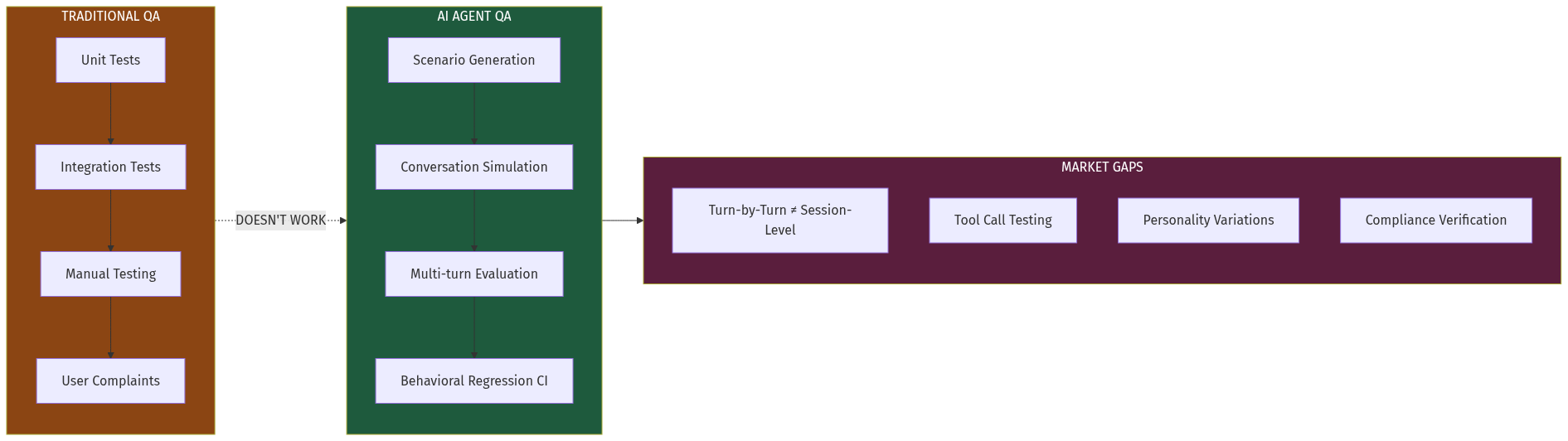
    Market Gaps Diagram
    Market Gaps Diagram

    Gap 1: Session-Level Evaluation

    Current tools evaluate turn-by-turn. But conversation failures happen across turns. A verification flow that skips steps, a sales agent that forgets context, a support agent that contradicts itself—these are invisible to turn-level metrics.

    Gap 2: Behavioral Regression in CI/CD

    Nobody has built the "CI test for conversations." When you commit a prompt change, you should know within minutes if appointment booking still works across 50 user personas.

    Gap 3: Synthetic User Simulation

    Testing requires synthetic users that behave like real humans—interrupting, going off-script, being impatient, speaking with accents. This requires sophisticated persona modeling.

    Gap 4: Tool Call Testing

    Agents call tools (APIs, databases, external systems). Testing tool-calling behavior requires mock platforms that simulate tool responses without touching production systems.

    Gap 5: Compliance Verification

    Regulated industries need proof that agents always say required disclaimers, never give medical/legal/financial advice beyond their scope, and handle PII correctly.
    6.

    AI Disruption Angle

    Zeroth Principles Analysis

    Question: Why do we assume AI agents need testing at all? Answer: Because enterprises won't deploy agents they can't verify. The testing requirement isn't optional—it's the gatekeeper for enterprise adoption. Without QA infrastructure, AI agents remain stuck in pilots.

    The Meta-Irony

    We're using AI to test AI. LLM-based judges evaluate LLM-based agents. This creates fascinating challenges:
    • How do you verify the verifier?
    • What's the ground truth when both systems are probabilistic?
    • Can you achieve deterministic test results from stochastic systems?
    Cekura's answer: Structured conditional action trees that force deterministic branching, even when the underlying responses vary.

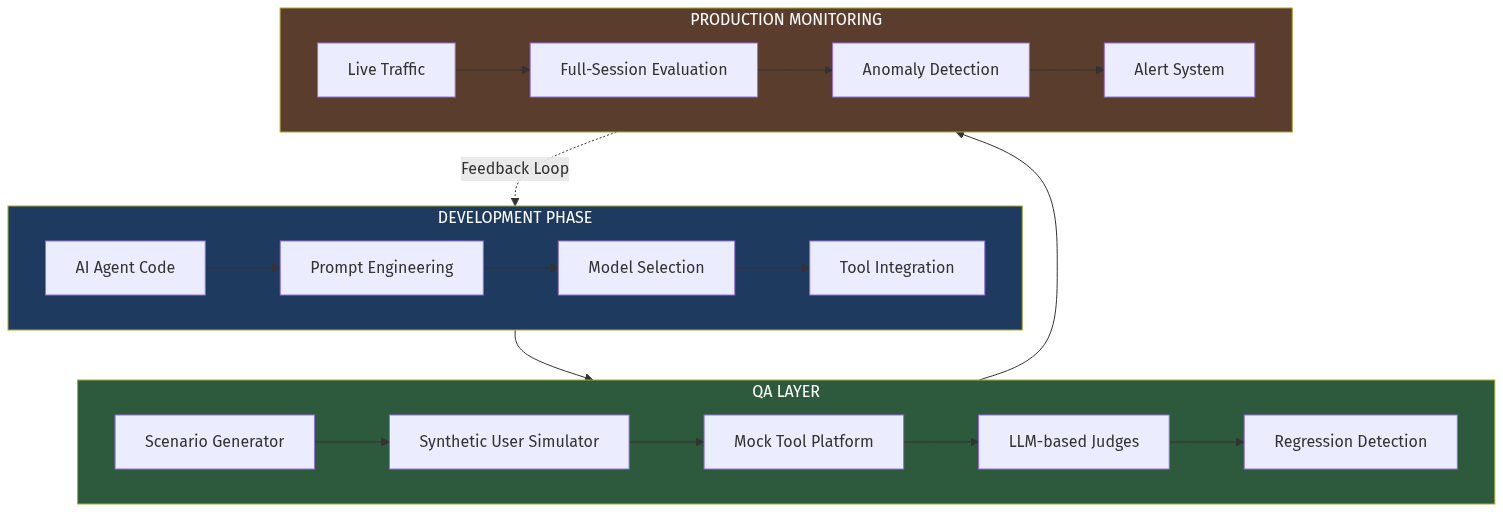
    The Infrastructure Stack

    Architecture Diagram
    Architecture Diagram

    7.

    Product Concept

    Core Features

    1. Scenario Studio
    • Visual builder for conversation test cases
    • Import real conversations from production
    • Auto-generate scenarios from agent descriptions
    2. Synthetic User Engine
    • Multiple personas (impatient, confused, aggressive, non-native speakers)
    • Accent/dialect variations for voice agents
    • Interrupt and off-script behaviors
    3. Mock Tool Platform
    • Define tool schemas and mock responses
    • Simulate success/failure scenarios
    • Test edge cases (API timeouts, invalid data)
    4. Session-Level Evaluation
    • Full-conversation judges (not just turn-by-turn)
    • Custom rubrics per use case
    • Compliance checklist verification
    5. CI/CD Integration
    • GitHub Actions / GitLab CI plugins
    • Fail builds on regression detection
    • Diff reports showing behavioral changes
    6. Production Monitoring
    • Real-time session scoring
    • Anomaly detection and alerting
    • Trend analysis dashboards

    8.

    Development Plan

    PhaseTimelineDeliverables
    MVP8 weeksSingle-turn simulation, basic LLM judging, Slack alerts
    V112 weeksSession-level eval, scenario import, mock tools
    V216 weeksCI/CD plugins, regression detection, compliance templates
    V324 weeksVoice agent support, accent testing, enterprise SSO

    Tech Stack Recommendation

    • Simulation Engine: Python + async (handle concurrent conversations)
    • Voice Synthesis: ElevenLabs / PlayHT API for voice agent testing
    • Evaluation: Custom LLM judge prompts + structured output parsing
    • Infrastructure: Redis queues, Celery workers, ECS autoscaling
    • Frontend: Next.js dashboard with real-time updates

    9.

    Go-To-Market Strategy

    Phase 1: Voice AI Community (Month 1-3)

  • Target voice AI builders (Bland, Retell, VAPI communities)
  • Free tier for <100 test runs/month
  • Discord community for feedback
  • Content: "How to Test Voice Agents" guides
  • Phase 2: Chat Agent Expansion (Month 4-6)

  • Expand to chat agent builders (GPT wrappers, Claude apps)
  • Integrations with LangChain, CrewAI, AutoGen
  • Case studies from voice AI customers
  • Phase 3: Enterprise (Month 7-12)

  • SOC2, HIPAA compliance
  • On-prem deployment option
  • Dedicated support and SLAs
  • Custom compliance templates by industry
  • Pricing Model

    • Free: 100 test runs/month (hooks developers)
    • Starter: $30/month — 1,000 runs, basic monitoring
    • Pro: $200/month — 10,000 runs, CI/CD, compliance
    • Enterprise: Custom — unlimited runs, on-prem, SLAs

    10.

    Revenue Model

    Primary Revenue

    • SaaS Subscriptions: Usage-based (per test run) + feature tiers
    • Expected ACV: $5K (SMB) to $100K (enterprise)

    Secondary Revenue

    • Compliance Templates: Industry-specific test suites (healthcare, finance)
    • Professional Services: Custom evaluation setup, integration support
    • Training: Certification program for "AI Agent QA Engineer"

    Unit Economics (Target)

    • CAC: $500 (self-serve) / $5,000 (enterprise)
    • LTV: $6,000 (SMB) / $200,000 (enterprise)
    • Gross Margin: 80%+ (mostly compute costs)

    11.

    Data Moat Potential

    What Accumulates Over Time

  • Conversation Corpus: Millions of test conversations across industries reveal common failure patterns
  • Evaluation Rubrics: Proven scoring criteria for different use cases (appointment booking, lead qual, support)
  • Persona Library: Synthetic user personalities that accurately model real user behavior
  • Regression Patterns: Dataset of "what breaks when you change X" across thousands of agents
  • Competitive Moat

    The more conversations flow through the platform, the better the evaluation models become. First mover advantage compounds.
    12.

    Why This Fits AIM Ecosystem

    Direct Alignment

    AIM is building AI agents for Indian B2B markets—procurement agents, vendor discovery agents, compliance agents. All of these require QA.

    Integration Points

  • Agent Development: AIM agents can use this platform for testing before deployment
  • Compliance: Indian regulatory requirements (GST, FSSAI, etc.) need verified agent behavior
  • WhatsApp Voice Notes: India-specific testing for voice messages in regional languages
  • Potential Play

    AIM could either:

    • Build this as an internal tool and monetize externally
    • Partner with / acquire an early player like Cekura
    • Build India-specific variant (regional language testing, regulatory compliance)
    ---

    ## Verdict

    Opportunity Score: 8.5/10

    Why This Scores High

    Clear pain point — Every AI agent builder faces this ✅ Timing is perfect — Voice AI just hit production readiness ✅ Winner-take-most dynamics — Data moat creates defensibility ✅ Multiple revenue streams — SaaS + compliance + services ✅ YC validation — Cekura's acceptance proves market

    Risk Factors

    ⚠️ LLM providers might build this — OpenAI/Anthropic could add native testing ⚠️ Evaluation accuracy — LLM judges can hallucinate; need constant calibration ⚠️ Market education required — Many teams don't know they need this yet

    Pre-Mortem: Why This Could Fail

    • Scenario 1: OpenAI releases "Agent Testing" as a feature, commoditizing the space
    • Scenario 2: Evaluation quality never reaches enterprise requirements
    • Scenario 3: Market adopts simpler solutions (just more manual QA)

    Steelmanning the Incumbents

    Langfuse/LangSmith could add session-level evaluation. They have existing user base and integrations. However, their architecture is turn-focused—retrofitting session evaluation is hard.

    Final Assessment

    This is infrastructure that must exist. Someone will build it. The question is whether it's a standalone category (like Datadog for LLMs) or a feature of existing platforms.

    Recommendation: Build for India first. Indian voice agents have unique requirements (regional languages, accent variations, regulatory compliance) that global players won't prioritize. Capture the Indian market, then expand.

    ## Sources