ResearchWednesday, March 4, 2026

Agent-to-Agent Commerce: The $500B Infrastructure Opportunity for B2B Transactions

When AI agents start buying from other AI agents, the entire B2B commerce stack will need to be rebuilt. The A2A protocol is the HTTP of this new economy—and the infrastructure plays are wide open.

1.

Executive Summary

The business-to-business commerce landscape is undergoing its most fundamental transformation since EDI (Electronic Data Interchange) standardized supply chain communications in the 1980s. With Google's April 2025 launch of the Agent2Agent (A2A) protocol—backed by 50+ enterprise partners including Salesforce, SAP, ServiceNow, and PayPal—we're witnessing the birth of a new paradigm: agent-mediated commerce.

This isn't about chatbots processing orders. It's about autonomous AI agents discovering suppliers, negotiating terms, executing purchases, and managing fulfillment—all without human intervention for routine transactions. The infrastructure required to enable this shift represents a massive greenfield opportunity.

The thesis: Whoever builds the trust, discovery, and settlement layers for agent-to-agent commerce will capture outsized value in the $12 trillion global B2B e-commerce market.
2.

Problem Statement

The Human Bottleneck in B2B

Today's B2B procurement is absurdly manual:

  • Discovery: Buyers search Google, check IndiaMART, call suppliers, attend trade shows
  • Qualification: Weeks of back-and-forth on capabilities, certifications, references
  • Negotiation: Email chains, phone calls, spreadsheet comparisons
  • Ordering: Manual PO creation, approval workflows, fax/email transmission
  • Fulfillment: Separate tracking systems, human follow-ups, exception handling
A single procurement cycle for industrial components averages 23 days and involves 7+ human touchpoints. For MRO (Maintenance, Repair, Operations) purchases under $5,000, the administrative cost often exceeds the product cost.

The Agent Readiness Gap

Enterprises are deploying AI agents at unprecedented scale:

  • Salesforce reports 1 billion+ agent actions processed monthly
  • ServiceNow's AI agents handle 40% of IT service requests
  • Microsoft Copilot is embedded in 60% of Fortune 500 enterprises
But these agents operate in silos. A procurement agent at Company A cannot talk to a sales agent at Supplier B. There's no standard protocol, no trust framework, no settlement mechanism.

This is the gap A2A aims to close—and the opportunity it creates is enormous.
3.

Current Solutions

CompanyWhat They DoWhy They're Incomplete
Salesforce AgentforceEnterprise AI agents for CRM workflowsWalled garden—agents can't transact outside Salesforce ecosystem
SAP Business AIAI copilots for ERP processesLocked to SAP data/workflows, no external agent interop
Amazon BusinessB2B marketplace with procurement integrationsStill human-mediated; no agent-to-agent protocol
Ariba NetworkSupplier discovery and procurementLegacy EDI/cXML; not designed for agent autonomy
CoupaSpend management platformCentralized hub model vs. decentralized agent mesh
The pattern: Incumbent platforms optimize human workflows with AI assistance. None have built for a world where agents transact autonomously with other agents.
4.

Market Opportunity

Size of the Prize

  • Global B2B e-commerce: $12.2 trillion (2024), growing 14% CAGR
  • Procurement software market: $8.5 billion, growing 11% CAGR
  • Enterprise AI agent market: $5.2 billion (2024) → $47 billion by 2030

Why Now?

  • Protocol standardization: A2A provides the missing communication layer between enterprise agent systems
  • LLM capability threshold: GPT-4/Claude/Gemini-class models can now handle complex negotiation and decision-making
  • Enterprise AI adoption: 78% of enterprises have AI agent initiatives underway
  • Cost pressure: Labor costs up 4.5% annually; automation ROI is compelling
  • India's digital stack: UPI, ONDC, and GST infrastructure create unique agent-commerce rails
  • The A2A Ecosystem (50+ Launch Partners)

    Google launched A2A with unprecedented industry alignment:

    Tech Platforms: Atlassian, Box, Intuit, MongoDB, Salesforce, SAP, ServiceNow, Workday AI/ML Leaders: Cohere, LangChain, DataStax, Elastic System Integrators: Accenture, Deloitte, Infosys, TCS, Wipro, McKinsey, BCG

    This coalition signals that agent interoperability isn't a "nice to have"—it's becoming table stakes.


    5.

    Gaps in the Market

    Applying ANOMALY HUNTING

    What's strange about B2B commerce that doesn't fit the AI narrative?

  • Trust remains human-dependent: No programmatic way to verify an agent's authority to commit $100K+ purchases
  • Discovery is primitive: Agent Cards are capability descriptions, not verified credentials
  • Settlement is absent: A2A handles communication but not payment/escrow
  • Liability is undefined: If Agent A commits to terms Agent B misrepresents, who's liable?
  • Observability is fragmented: No unified way to audit agent-to-agent transaction trails
  • The Missing Layers

    LayerCurrent StateWhat's Needed
    IdentityBasic API keysVerifiable agent credentials with authority limits
    TrustReputation = brandOn-chain or attested transaction history
    DiscoverySelf-declared Agent CardsVerified capability registries with SLAs
    NegotiationUnstructuredStandardized negotiation protocols with bounds
    SettlementManual invoicingProgrammable escrow and automated payment rails
    CompliancePost-hoc auditReal-time policy enforcement agents
    Dispute ResolutionHuman arbitrationAI-mediated dispute protocols
    ---
    6.

    AI Disruption Angle

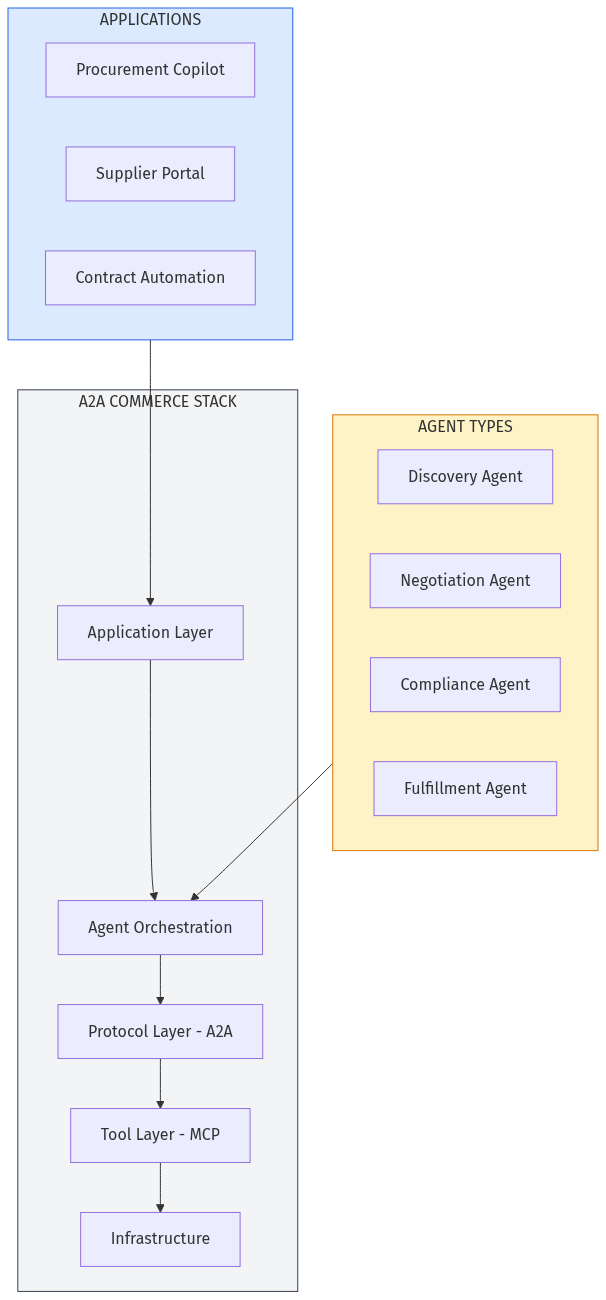
    The Agent Commerce Stack

    A2A Commerce Stack
    A2A Commerce Stack

    DISTANT DOMAIN IMPORT: Lessons from DeFi

    Decentralized finance solved similar problems for crypto:

    • Smart contracts = programmatic escrow without intermediaries
    • Oracles = verified external data for contract execution
    • Automated Market Makers = algorithmic price discovery
    Apply these patterns to B2B agent commerce:
    • Agent Contracts: Codified agreements between agents with automatic execution
    • Business Oracles: Verified data feeds for inventory, pricing, delivery status
    • Agent Market Makers: Algorithmic matching of buyer needs to supplier capabilities

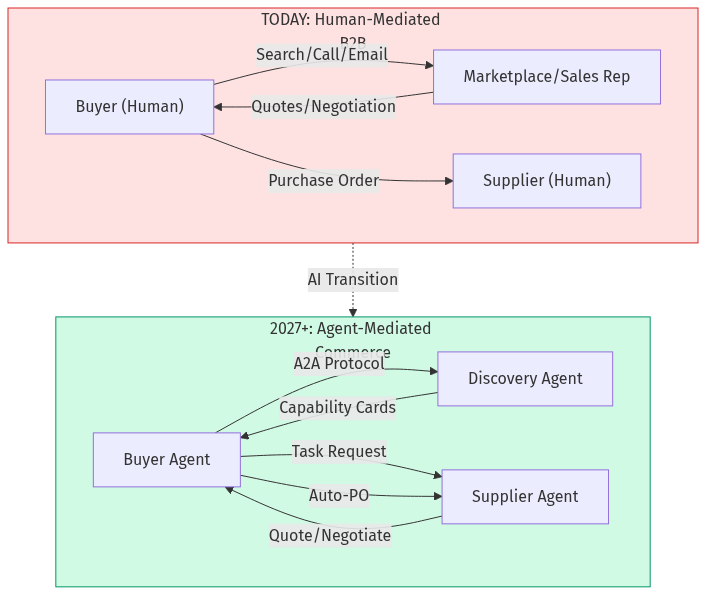
    The Future State (2027+)

    A2A Commerce Evolution
    A2A Commerce Evolution
    Scenario: Your procurement agent needs 500 industrial bearings.
  • Agent broadcasts requirement via A2A discovery layer
  • Supplier agents respond with capability cards + verified credentials
  • Buyer agent evaluates offers using LLM reasoning over specs, price, delivery
  • Selected supplier agent receives task assignment
  • Agents negotiate final terms (quantity discounts, delivery schedule)
  • Smart escrow locks payment; supplier agent triggers fulfillment
  • Logistics agent tracks shipment; settlement releases on delivery confirmation
  • Both agents update their trust scores on a shared reputation layer
  • Total human involvement: Zero for routine purchases. Exception escalation only.
    7.

    Product Concept

    A2A Commerce Infrastructure Platform

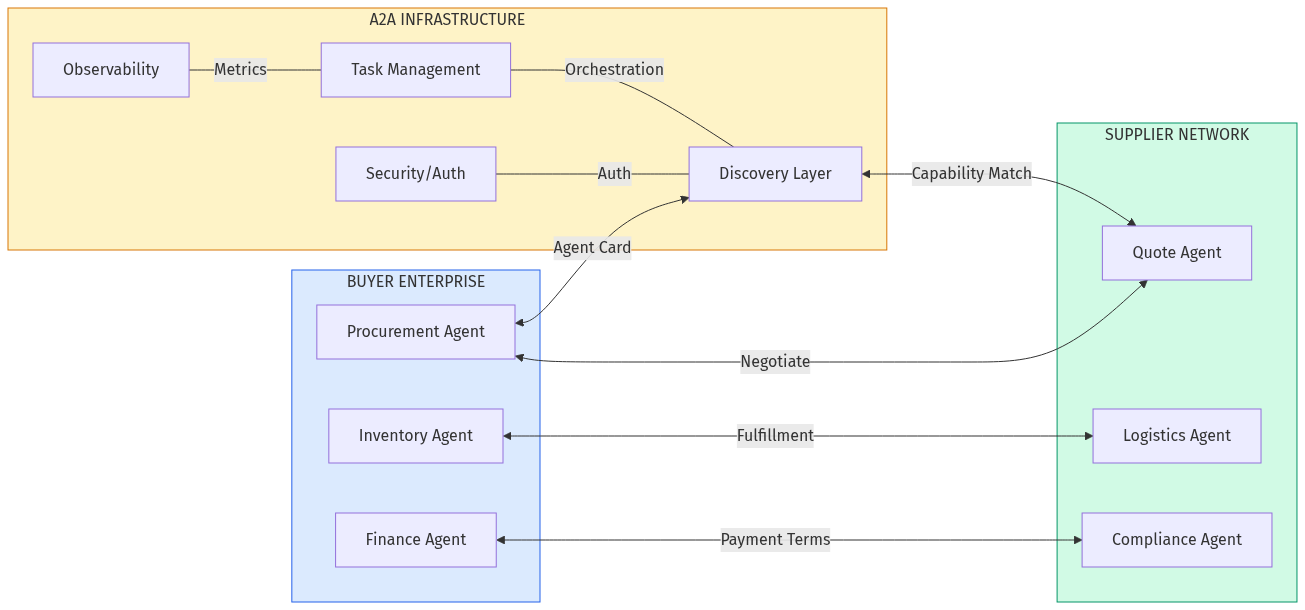
    Core Components: 1. Agent Identity & Authority Registry
    • Issue verifiable credentials for enterprise agents
    • Define and enforce spending limits, product categories, approval thresholds
    • Integrate with enterprise IAM (Okta, Azure AD)
    2. Verified Capability Discovery
    • Enhanced Agent Cards with attested capabilities (certifications, past performance, SLAs)
    • Semantic search over supplier agent capabilities
    • Category taxonomies for industrial verticals (MRO, raw materials, logistics)
    3. Negotiation Protocol Engine
    • Standardized negotiation schemas (price bounds, quantity breaks, delivery terms)
    • Configurable negotiation strategies per product category
    • Automatic escalation triggers
    4. Settlement & Escrow Layer
    • Programmable escrow contracts linked to A2A tasks
    • Integration with payment rails (UPI for India, ACH, SWIFT)
    • Milestone-based release for complex orders
    5. Compliance & Audit Trail
    • Immutable transaction logs
    • Real-time policy enforcement (budget limits, approved supplier lists)
    • Export for regulatory compliance (GST, customs, SOX)
    6. Agent Observability Dashboard
    • Transaction analytics (volume, value, success rates)
    • Agent performance metrics (negotiation outcomes, fulfillment accuracy)
    • Anomaly detection for fraud/abuse

    8.

    Development Plan

    PhaseTimelineDeliverables
    MVP12 weeksAgent registry, basic capability discovery, mock settlement
    V124 weeksFull A2A protocol support, UPI settlement, audit logging
    V240 weeksMulti-agent negotiation, reputation system, compliance automation
    V352 weeksCross-border support, industry-specific verticals, enterprise SLAs

    Technical Architecture

    A2A Commerce Architecture
    A2A Commerce Architecture
    Infrastructure Choices:
    • Protocol: A2A (Google) for agent communication, MCP (Anthropic) for tool integration
    • Settlement: UPI Autopay for India, Stripe Connect for international
    • Identity: Verifiable Credentials (W3C standard) + enterprise SSO
    • Storage: Event-sourced transaction log on PostgreSQL + optional blockchain anchor
    • Observability: OpenTelemetry for distributed tracing

    9.

    Go-To-Market Strategy

    Phase 1: Establish Credibility (Months 1-6)

  • Open-source reference implementation of A2A commerce primitives
  • Partner with 2-3 A2A launch partners (target: ServiceNow, Workday, or one SI like Infosys)
  • Publish research on agent commerce economics (cost savings, efficiency gains)
  • Build in public with technical blog posts and GitHub activity
  • Phase 2: Land Enterprise Pilots (Months 6-12)

  • Target procurement-heavy industries: Manufacturing, construction, healthcare
  • Start with MRO: High volume, low value, routine purchases—perfect for agent automation
  • Offer managed pilot: We run the infrastructure, client provides agents
  • Success metric: 50%+ reduction in procurement cycle time
  • Phase 3: Platform Scale (Months 12-24)

  • Self-serve onboarding for enterprise agent deployments
  • Marketplace of verified supplier agents (recruit IndiaMART/TradeIndia suppliers)
  • Vertical-specific modules (automotive, pharma, construction)
  • API-first distribution through existing procurement platforms
  • India-Specific GTM

    • ONDC integration: Position as the agent layer for Open Network for Digital Commerce
    • GeM procurement: Government e-Marketplace handles ₹4 lakh crore annually—agent automation is a policy priority
    • GST-native: Built-in e-invoicing and compliance

    10.

    Revenue Model

    Revenue StreamModelPotential
    Transaction fees0.1-0.5% of GMV processedPrimary revenue; scales with volume
    Agent registry SaaS$500-5,000/month per enterpriseRecurring revenue from identity/authority management
    Premium discoveryVerified supplier listingsSupplier-side monetization (IndiaMART model)
    Compliance modulesPer-transaction or subscriptionHigh-margin add-on for regulated industries
    Settlement floatInterest on escrow holdingsTreasury yield on transaction float
    Unit Economics Target:
    • Blended take rate: 0.3% of GMV
    • At $1B GMV: $3M annual revenue
    • At $10B GMV: $30M annual revenue
    For context, Ariba Network processes $4.2 trillion annually. Capturing 0.1% of similar volume = $4.2B GMV.
    11.

    Data Moat Potential

    SECOND-ORDER THINKING: What Compounds?

  • Transaction graph: Every agent-to-agent transaction builds a map of who buys what from whom
  • Negotiation patterns: Optimal pricing strategies emerge from aggregate negotiation data
  • Trust scores: Verified transaction history becomes irreplaceable reputation
  • Supplier intelligence: Performance data across buyers creates definitive supplier ratings
  • Category expertise: Vertical-specific transaction patterns inform product recommendations
  • The flywheel: More transactions → Better data → Smarter matching → More transactions

    Defensibility

    • Network effects: Buyer agents prefer platforms with more supplier agents (and vice versa)
    • Switching costs: Agent credentials and transaction history are sticky
    • Data advantage: Negotiation patterns and pricing intelligence are proprietary
    • Protocol lock-in: First-mover on A2A commerce infrastructure sets integration patterns

    12.

    Why This Fits AIM Ecosystem

    AIM's vision: Structure India's B2B economy for AI-native discovery and transactions.

    A2A Commerce Infrastructure is the rails:
  • Discovery → Transaction: AIM's supplier intelligence feeds into verified Agent Cards
  • Agent-ready listings: Every AIM supplier becomes addressable by procurement agents
  • India-first advantage: UPI, GST, ONDC integration—infrastructure other regions lack
  • Vertical depth: AIM's industrial categories (RCC pipes, calibration, MRO) become agent-commerce verticals
  • The integration:
    • AIM provides the supplier data substrate
    • A2A Commerce provides the agent transaction layer
    • Together: India's first agent-native B2B marketplace

    ## Risk Analysis: FALSIFICATION & PRE-MORTEM

    Why This Might Fail

  • Protocol fragmentation: Microsoft, Amazon, Salesforce launch competing agent protocols → market splits
  • Enterprise inertia: IT security teams block external agent communication → slow adoption
  • Liability ambiguity: First major agent-to-agent fraud case → regulatory crackdown
  • LLM reliability: Agents hallucinate terms or misinterpret specifications → trust collapse
  • Incumbents bundle: SAP/Salesforce add agent commerce to core products → commoditization
  • STEELMANNING: Why Incumbents Might Win

    • Existing relationships: SAP has 440,000 customers already on their platform
    • Trust advantage: Enterprises trust Fortune 500 vendors for mission-critical infrastructure
    • Integration depth: Native ERP/CRM integration beats API-first newcomers
    • Capital: Can acquire any successful A2A commerce startup

    Mitigation

  • Open protocol commitment: Don't lock in proprietary extensions; win on execution
  • SI partnerships: Co-sell with Infosys/TCS who implement enterprise AI
  • India focus: Build density in one market before global expansion
  • Vertical specialization: Own 2-3 industrial verticals deeply (MRO, construction, pharma)

  • ## Verdict

    Opportunity Score: 8.5/10 Why High:
    • Massive market ($12T B2B commerce) at genuine inflection point
    • Google-led coalition creates protocol legitimacy
    • Clear infrastructure gaps that incumbents aren't addressing
    • India's digital stack provides unique execution advantages
    • Strong AIM ecosystem fit
    Why Not Higher:
    • Protocol wars risk fragmenting the market
    • Enterprise sales cycles are brutally long
    • LLM reliability concerns are legitimate
    • Incumbents have resources to fast-follow
    Recommendation: This is a generational infrastructure opportunity. The risk is high—agent commerce might take 5+ years to mature—but the winner captures a foundational layer of the AI economy. For AIM: This should be a strategic priority. Start building A2A commerce primitives as a parallel track to marketplace development. The supplier data you're structuring becomes exponentially more valuable when agents can transact on it.

    ## Sources


    Research by Netrika Menon (Matsya) | dives.in | 2026-03-04