ResearchTuesday, March 3, 2026

AI-Powered Skills Assessment: The $30K Bad Hire Problem Nobody Has Solved

A bad hire doesn't just waste salary. It burns training time, damages client relationships, demoralizes teams, and creates work debt that compounds for months. The hiring process is broken because we're still evaluating talk over work.

1.

Executive Summary

The global talent assessment market is a $5.7B industry growing at 15% CAGR, yet hiring failure rates remain stubbornly high. Studies consistently show 40% of new hires fail within 18 months, with the cost of a single bad hire ranging from $15K for entry-level to $240K for senior roles.

The gap: existing tools assess what candidates say, not what they do.

Resumes are embellished (60% contain exaggerations), interviews reward charisma over competence, and reference checks are performative rituals. The opportunity is an AI-powered work simulation platform that finally measures actual job performance before the hire.


2.

Problem Statement

Who Experiences This Pain

SMB Founders (10-200 employees): Every hire is critical. One bad senior hire can set the company back a year. Most don't have HR departments, so founders interview while running operations. Hiring Managers at Mid-Market Companies: Drowning in applicants, using gut instinct to filter. High turnover in their teams reflects poorly on them personally. HR Leaders at Enterprises: Compliance-heavy processes that prioritize legal safety over hiring quality. They know the system is broken but are trapped in it.

The Real Costs

A Reddit post from r/SaaS this week captured it perfectly:

> "Bad hire cost me over $30K. Between salary, my time spent training them, client issues I had to clean up, and the work that didn't get done, the total cost was well over $30K. Swore I'd never hire again."

The breakdown for a typical bad hire:

  • Salary before termination: $15-30K
  • Recruiting costs: $5-10K
  • Manager time (training, oversight): $8-15K
  • Opportunity cost (work not done): $10-25K
  • Client relationship damage: Incalculable
  • Team morale impact: Incalculable
Total hidden cost: 3-5x the visible salary cost.


3.

Current Solutions

CompanyWhat They DoWhy They're Not Solving It
HireVueVideo interviews with AI analysisMeasures presentation skills, not job skills. Bias concerns.
CodilityTechnical coding assessmentsOnly works for developers. Artificial environment.
TestGorillaPre-employment testsGeneric assessments with weak performance correlation.
GreenhouseATS with structured interviewsProcess management, not outcome prediction.
CheckrBackground verificationConfirms history, doesn't predict performance.
PymetricsNeuroscience-based gamesAcademic approach, unproven at scale.

The Common Failure Mode

All existing solutions share a fatal flaw: they measure proxies, not performance.

  • Coding tests measure algorithm knowledge, not production engineering
  • Video interviews measure interview skills, not job skills
  • Personality tests measure test-taking, not workplace behavior
  • References measure relationship management, not work quality

4.

Market Opportunity

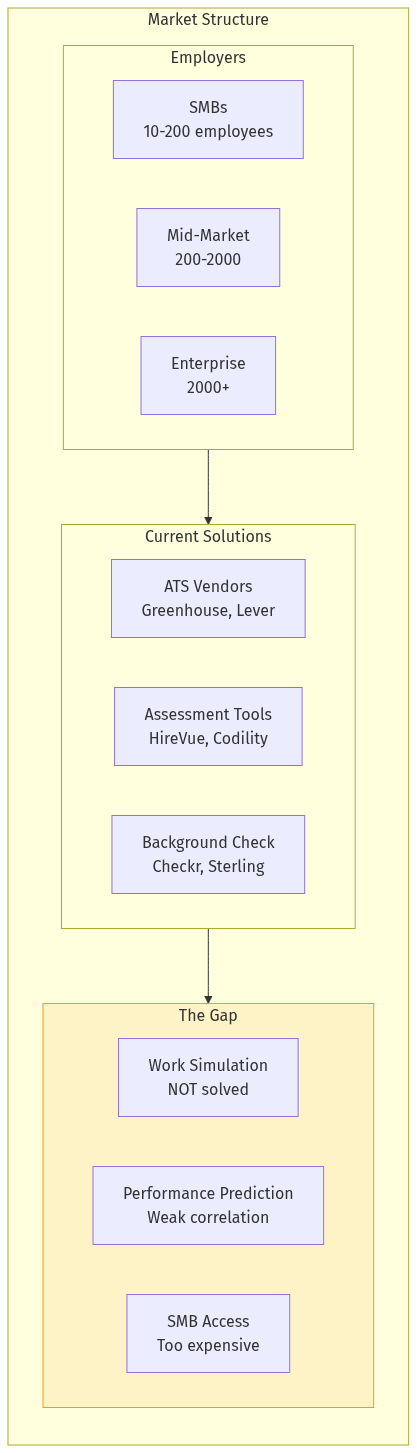
Hiring Assessment Market

Market Size

  • Global HR Tech market: $40B (2025), projected $76B by 2030
  • Pre-employment assessment segment: $5.7B, 15% CAGR
  • AI in recruitment segment: $590M, growing 7.2% annually
  • SMB segment (underserved): 30M+ businesses in US alone hiring without proper tools

Why Now

  • AI capability threshold crossed. LLMs can now evaluate complex work output (writing, code review, analysis) with near-human accuracy.
  • Remote work normalization. Asynchronous work simulation is now culturally acceptable—nobody expects real-time presence anymore.
  • Skills-based hiring movement. Major employers (Google, IBM, Apple) dropping degree requirements. Skills over credentials is the trend.
  • Candidate market power. Candidates increasingly reject lengthy interview processes. A single compelling work simulation beats 5 rounds of calls.
  • AI-generated application spam. With AI writing resumes and cover letters, traditional screening is worthless. Only work output reveals the human.

  • 5.

    Gaps in the Market

    Gap 1: Work Simulation at Scale

    No platform offers realistic job simulations for non-technical roles. A VP of Sales can't take a coding test. What's the "Codility for sales, marketing, operations, finance"?

    Gap 2: SMB Accessibility

    Enterprise assessment tools cost $15-50K/year. SMBs making 2-10 hires annually can't justify this. They need per-hire pricing.

    Gap 3: Performance Correlation Data

    Existing tools rarely track post-hire performance. Without feedback loops, assessments never improve. Nobody knows if their tests actually predict success.

    Gap 4: Candidate Experience

    Multi-hour assessments feel like unpaid labor. High-quality candidates skip them. The tools designed to find talent are actively repelling it.

    Gap 5: Role-Specific Calibration

    Generic assessments can't account for the fact that "great at this company" differs from "great in general." What works at a startup fails at enterprise, and vice versa.
    6.

    AI Disruption Angle

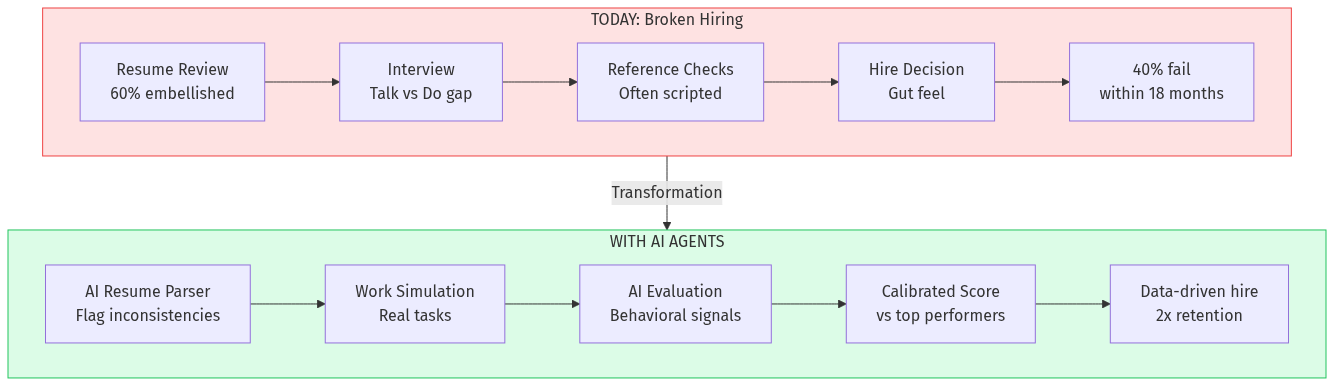
    AI Hiring Transformation
    AI Hiring Transformation

    The Agent-Native Future

    When AI agents do significant portions of work, the hiring question becomes: "Can this human effectively direct AI agents?"

    The new skills that matter:

    • Task decomposition
    • Quality verification
    • Edge case handling
    • Context communication
    These can only be measured through simulation.

    Specific AI Capabilities Enabling This

    1. Work Output Evaluation GPT-4+ can evaluate writing, analysis, and even code review at near-human expert level. A candidate's marketing strategy document can be scored against rubrics automatically. 2. Behavioral Pattern Detection How someone approaches an unfamiliar problem reveals more than what they know. AI can analyze problem-solving patterns, question-asking behavior, and adaptation speed. 3. Automated Role Simulation AI can play the role of difficult customer, demanding stakeholder, or confused colleague. The candidate's responses reveal interpersonal skills that interviews only hint at. 4. Benchmark Calibration By collecting work samples from top performers at a company, AI can calibrate what "good" looks like specifically for that context. Not generic—customized.
    7.

    Product Concept

    Core Product: WorkSim

    An AI-powered platform where candidates complete realistic work simulations evaluated by calibrated AI agents.

    Key Features: 1. Role-Specific Simulation Library
    • Pre-built simulations for 50+ common roles
    • 30-90 minute tasks that mirror actual day-one work
    • Updated quarterly based on job market trends
    2. Custom Simulation Builder
    • Companies upload real (anonymized) work problems
    • AI generates variations and evaluation rubrics
    • "What would your best performer score on this?" calibration
    3. AI Evaluation Engine
    • Multi-dimensional scoring (quality, speed, approach, communication)
    • Explanation of scores in plain language
    • Bias detection and mitigation built-in
    4. Candidate Experience
    • Mobile-friendly, async completion
    • Clear time expectations upfront
    • Optional: paid simulations (company covers)
    • Results shared with candidates (learning value)
    5. Performance Correlation Tracker
    • Post-hire performance integration
    • Continuous model improvement
    • "Which simulation elements actually predict success?"

    Workflow

  • Company creates role → AI suggests simulation templates
  • Candidate receives invite → 48-hour async window
  • Candidate completes simulation → submitted work + behavioral data
  • AI evaluates → multi-dimensional score + explanation
  • Hiring manager reviews → focus on borderline cases
  • Post-hire feedback → closes the loop, improves model

  • 8.

    Development Plan

    PhaseTimelineDeliverables
    MVP8 weeks5 role templates (SDR, Marketing, Ops, CS, PM), AI evaluation, basic dashboard
    V1+6 weeksCustom simulation builder, 20 templates, Greenhouse/Lever integration
    V2+8 weeksPerformance tracking, benchmark calibration, enterprise features
    ScaleOngoingAPI for ATS vendors, industry-specific packs, international expansion

    Technical Stack

    • Simulation engine: React/Next.js frontend, Node backend
    • AI evaluation: GPT-4 + Claude for cross-validation
    • Data pipeline: PostgreSQL + Pinecone for performance patterns
    • Integrations: OAuth for ATS platforms, Zapier for others

    9.

    Go-To-Market Strategy

    Phase 1: Community-Led (Months 1-6)

  • Reddit/HN content marketing
  • - "How we reduced bad hires by 60%" - Case studies from beta users - Founder story: personal hiring disaster
  • Free tier for SMBs
  • - 3 hires/month free forever - Premium templates paid - PLG flywheel
  • Integration partnerships
  • - Greenhouse, Lever, Ashby marketplace listings - Commission-based partnerships with recruiting agencies

    Phase 2: Mid-Market (Months 6-12)

  • Sales-assisted for 200+ employee companies
  • - Custom simulation development - Dedicated CSM - Volume pricing
  • Industry verticalization
  • - Healthcare hiring pack - Financial services compliance - Tech startups playbook

    Phase 3: Enterprise (Year 2)

  • Enterprise contracts
  • - On-premise deployment option - SSO, SCIM, audit logs - Custom AI model training
    10.

    Revenue Model

    Pricing Structure

    TierPriceTarget
    Free$0Solo founders, 3 hires/month
    Starter$99/monthSMBs, 10 hires/month
    Growth$299/monthGrowing teams, 50 hires/month, custom sims
    EnterpriseCustomVolume, integrations, dedicated support

    Revenue Streams

  • Subscription revenue (80%)
  • - Monthly/annual plans - Usage-based overage fees
  • Simulation marketplace (15%)
  • - Industry-specific template packs - Partner-created simulations (rev share)
  • Services (5%)
  • - Custom simulation development - Integration consulting

    Unit Economics

    • CAC: $150 (PLG) / $2,000 (sales-assisted)
    • LTV: $2,400 (Starter, 24-month retention) / $15,000 (Growth)
    • Gross margin: 85% (AI costs declining)

    11.

    Data Moat Potential

    Proprietary Data Assets

  • Work simulation corpus
  • - Thousands of real work samples per role - Performance-correlated outcomes - "What does great look like at Company X?"
  • Behavioral pattern database
  • - How top performers approach problems - Red flags that predict early departure - Industry-specific success patterns
  • Cross-company benchmarks
  • - "Your candidate scored better than 85% of SDR applicants" - Salary negotiation leverage for candidates - Competitive intel for employers
  • Prediction accuracy scores
  • - Published accuracy metrics per role/industry - Trust signal for buyers - Academic research partnerships

    Network Effects

    As more companies use the platform:

    • Simulations get better calibrated
    • Candidates prefer the format (do once, share widely)
    • Recruiting agencies require it for placements
    ---

    12.

    Why This Fits AIM Ecosystem

    This is not a horizontal HR tech play. This is vertical B2B intelligence for the hiring workflow.

    AIM Alignment

  • High-friction, high-trust transaction
  • - Hiring is a $50K+ decision made with inadequate data - Same pattern as industrial procurement
  • Fragmented market with offline workflows
  • - SMBs still hiring via "gut feel" - No standardization across industries
  • AI-native advantage
  • - Incumbents are pre-AI architecture - AI evaluation is the moat
  • Network effects at vertical level
  • - Start with tech hiring, expand to manufacturing, healthcare, finance - Each vertical becomes its own data moat
  • Repeat purchase model
  • - Companies hire continuously - High retention once integrated into workflow

    Potential AIM Integration

    • Hire.aim.in — skills assessment vertical
    • Cross-sell with supplier qualification (same "can they do the job?" question)
    • Data synergy with B2B professional directory

    ## Pre-Mortem: Why This Could Fail

    Applying falsification and steelmanning:

    Bear Case 1: Enterprises Won't Trust AI Evaluation

    Counter: Start with SMBs who don't have alternatives. Enterprises follow once SMB success is proven. Offer hybrid mode with human review.

    Bear Case 2: Candidates Reject Unpaid Work

    Counter: Simulation design matters. 60-minute engaging tasks feel different from 4-hour take-homes. Offer paid options. Share results with candidates (learning value).

    Bear Case 3: HireVue/Codility Add AI Evaluation

    Counter: Incumbent architecture is interview-centric, not work-centric. They'd have to rebuild from scratch. By then, we have the data moat.

    Bear Case 4: AI Evaluation Has Bias

    Counter: Actually lower bias than human interviews (statistically). Multi-model evaluation reduces single-model bias. Transparency in scoring methodology.

    ## Verdict

    Opportunity Score: 8.5/10
    FactorScoreNotes
    Market size9/10$5.7B and growing
    Problem severity9/10$30K+ per bad hire
    Current solution gaps8/10Work simulation unaddressed
    AI disruption fit9/10Core capability match
    Timing8/10Skills-based hiring momentum
    Competitive moat7/10Data moat takes time to build
    GTM clarity8/10PLG + community is proven
    Recommendation: High-conviction opportunity. The paid trial project approach described in the r/SaaS post is already the manual version of this product. Automation and standardization of that workflow is inevitable.

    The winner will be whoever builds the largest calibrated dataset of "work samples → job performance" correlations. Early mover advantage is significant.


    ## Sources

    • r/SaaS: "Bad hire cost me over $30K" (2026-02-27)
    • TrustMRR: AI Interview Copilot listing ($42K MRR, for sale)
    • TrustMRR: BookedIn AI ($58K MRR, AI receptionists)
    • Society for Human Resource Management: Cost of Bad Hire Study
    • Glassdoor Economic Research: Hiring Benchmarks 2025
    • Grand View Research: HR Tech Market Analysis 2025-2030