ResearchTuesday, March 3, 2026

AI Sales Development Representatives: The End of Human SDRs?

The SDR role—once the entry point to tech sales careers—is being automated faster than anyone predicted. AI agents now research prospects, write personalized emails, make phone calls, and book meetings at 10x the capacity and 1/10th the cost. This isn't disruption coming. It's here.

1.

Executive Summary

The $15 billion sales development industry is experiencing its most significant disruption since the invention of the CRM. AI SDRs—autonomous agents that prospect, personalize, and engage at superhuman scale—are replacing entry-level sales roles faster than any previous automation wave.

Companies like 11x.ai, Artisan, and Regie.ai have raised over $300M combined to build "digital workers" that don't sleep, don't need training, and don't quit after 14 months (the average SDR tenure). The economics are brutal: a human SDR costs $60-80K annually plus benefits; an AI SDR costs $1-3K/month for unlimited capacity.

The opportunity isn't building another AI SDR. It's building the picks-and-shovels: the data infrastructure, verification systems, and vertical-specific agents that these platforms desperately need.
2.

Problem Statement

The Human SDR Bottleneck

Traditional sales development is fundamentally broken:

  • Inefficiency: SDRs spend 65% of their time on non-selling activities—research, data entry, and administrative tasks
  • High turnover: Average tenure is 14 months; companies lose their investment just as reps become productive
  • Scaling costs: Doubling outbound capacity means doubling headcount, training, and management overhead
  • Inconsistency: Performance varies wildly between reps; top performers are 5x more effective than average

The Buyer's Nightmare

From the buyer's perspective, the current system is equally broken:

  • Spam overload: Decision-makers receive 100+ cold emails daily, mostly generic templates
  • Poor timing: Outreach rarely aligns with actual buying intent
  • No value: Most cold outreach provides zero insight or relevance
Zeroth Principles Check: The fundamental assumption we should question is whether outbound sales development should exist at all. In an AI-native world, shouldn't buyers be able to find sellers when they're ready? The answer is nuanced: while inbound is ideal, most B2B purchases still require vendor education and timing intervention. The question isn't whether to do outbound—it's how to do it without being annoying.
3.

Current Solutions

The AI SDR landscape has exploded in 2024-2026. Here are the major players:

CompanyWhat They DoFundingApproach
11x.ai"Alice" the AI SDR + "Julian" AI phone agent$50M+Full-stack digital workers
Artisan"Ava" the AI BDR + 300M contact database$25M+Consolidation platform
Regie.aiAI-powered sales engagement platform$40M+AI + human hybrid
ClayGTM data enrichment + AI workflows$60M+Data layer for GTM
Apollo.ioContact database + sequences$100M+Traditional + AI

Why Current Players Leave Gaps

Incentive Mapping: The venture-backed AI SDR companies are optimized for:
  • Maximum email volume (not quality)
  • Enterprise contracts (not SMB accessibility)
  • Horizontal expansion (not vertical depth)
This creates predictable blind spots: verticalized expertise, SMB-friendly pricing, and quality-over-quantity optimization.
4.

Market Opportunity

Market Size

  • Global SDR market: $15B annually (salary + tools + overhead)
  • Sales automation software: $8.5B in 2025, growing 12% CAGR
  • AI in sales: $5.2B in 2025, growing 28% CAGR
  • Total addressable market for AI SDRs: $20-25B by 2028

Why Now?

  • LLM capabilities crossed the threshold: GPT-4 and Claude can write genuinely personalized emails that match or exceed human quality
  • Cost arbitrage is massive: $80K/year human vs. $24K/year AI = 70% cost reduction
  • Integration infrastructure exists: CRMs, email APIs, and LinkedIn automation are mature
  • Buyer tolerance is shifting: Decision-makers increasingly prefer AI-driven outreach that's relevant over human spam that isn't

  • 5.

    Gaps in the Market

    Gap 1: Vertical-Specific AI SDRs

    Current AI SDRs are horizontal—they work across all industries with generic personalization. But B2B sales is inherently vertical:

    • A construction equipment SDR needs to understand project cycles, equipment categories, and regional regulations
    • A healthcare SaaS SDR must navigate HIPAA, understand clinical workflows, and speak the language of healthcare administrators
    • A manufacturing SDR needs knowledge of supply chains, quality certifications, and procurement processes
    Opportunity: Vertical AI SDRs trained on industry-specific data, using industry-specific triggers, and writing in industry-specific language.

    Gap 2: SMB-Accessible Pricing

    Current AI SDR platforms charge $2-5K/month—affordable for funded startups but prohibitive for SMBs who most need sales automation. The median small business can't justify $36K/year for outbound automation.

    Opportunity: Usage-based AI SDR pricing that scales with company size. Pay per meeting booked, not per seat.

    Gap 3: Quality Over Quantity

    Every AI SDR platform optimizes for volume: more emails, more calls, more touches. But the real problem isn't reach—it's relevance. Buyers don't want more outreach; they want better outreach.

    Opportunity: AI SDRs that prioritize signal-based timing and hyper-relevance over spray-and-pray volume.

    Gap 4: Multi-Language / Multi-Region

    Current AI SDRs are optimized for US English and Silicon Valley sales culture. Global markets—especially India, Southeast Asia, and Latin America—have different communication norms, relationship expectations, and decision-making processes.

    Opportunity: Culturally-aware AI SDRs for non-US markets.

    Gap 5: Verification and Deliverability Infrastructure

    As AI email volume explodes, deliverability is collapsing. Email providers are increasingly aggressive about filtering AI-generated content. The AI SDR platforms need:

    • Real-time email verification
    • Domain reputation monitoring
    • Deliverability optimization
    • Anti-spam compliance
    Opportunity: B2B infrastructure for AI-powered outbound deliverability.
    6.

    AI Disruption Angle

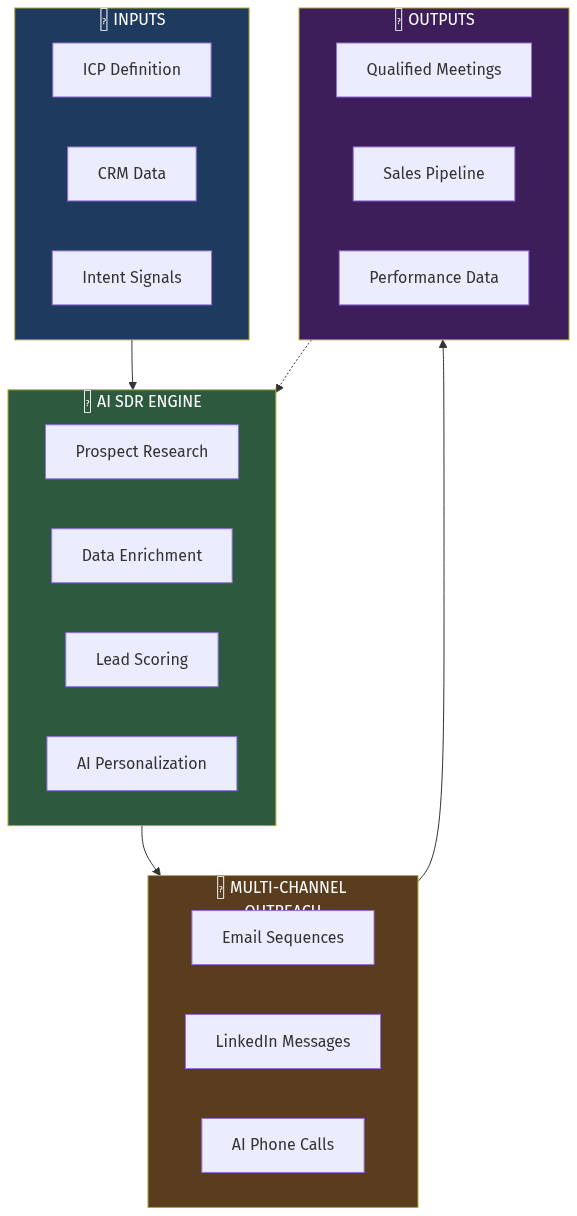
    AI SDR Architecture
    AI SDR Architecture

    The Current State: AI Augmentation

    Today's AI SDRs augment human workflows:

    • AI researches → Human reviews
    • AI drafts → Human edits
    • AI suggests → Human decides

    The Near Future: Full Autonomy

    By 2027, the human-in-the-loop disappears for most SDR functions:

    • AI identifies intent signals
    • AI researches and enriches
    • AI writes and sends
    • AI follows up and nurtures
    • AI books meetings directly into calendar
    • Human only appears for the actual sales conversation

    The Agent-to-Agent Future

    The real disruption is when buyers have AI agents too. In this world:

    • Seller AI agents publish capabilities and pricing
    • Buyer AI agents scan the market when purchase intent exists
    • Agent-to-agent negotiation handles initial qualification
    • Humans only enter for final decision-making
    Second-Order Thinking: If AI SDRs become ubiquitous, what happens?
  • Email effectiveness drops (everyone has AI → spam filters adapt)
  • Phone becomes more valuable (harder to automate, higher signal)
  • Community and content become differentiated (AI can't build genuine relationships)
  • First-party data becomes critical (third-party data is commoditized)

  • 7.

    Product Concept

    Opportunity: Vertical AI SDR Platform for India B2B

    Why India?
    • 63M SMEs with minimal sales automation
    • English + regional language requirements
    • WhatsApp-first communication culture
    • Relationship-driven sales processes
    • Price-sensitive market needs usage-based pricing
    Product: "Arjun" - The Indian AI SDR

    Core features:

  • WhatsApp-native outreach: Because Indian B2B happens on WhatsApp, not email
  • Regional language support: Hindi, Tamil, Telugu, Marathi, Bengali
  • Relationship-aware sequencing: Respects Indian business culture (festivals, working hours, relationship warmth)
  • IndiaMART/TradeIndia integration: Pulls buyer intent from Indian B2B marketplaces
  • Usage-based pricing: ₹500/meeting booked, not monthly subscriptions

  • 8.

    Development Plan

    PhaseTimelineDeliverables
    MVP8 weeksWhatsApp-based AI SDR for one vertical (e.g., manufacturing)
    V112 weeksMulti-vertical support, Hindi language, IndiaMART integration
    V220 weeksFull regional language support, voice calling, analytics dashboard
    Scale6 monthsAPI for agencies, white-label for B2B platforms

    Technical Architecture

    WhatsApp Business API → AI Engine (Claude/GPT) → CRM Sync
                                    ↓
                        Intent Signals (IndiaMART, Website, etc.)
                                    ↓
                        Personalization Layer (Industry + Language)
                                    ↓
                        Scheduling Engine (Cultural Awareness)

    9.

    Go-To-Market Strategy

    Phase 1: Single Vertical Dominance (Months 1-3)

    Target: Manufacturing companies in Gujarat/Maharashtra

  • Partner with 5 industrial associations for credibility
  • Offer free pilot to 50 companies
  • Case study-driven content marketing
  • WhatsApp group community building
  • Phase 2: Horizontal Expansion (Months 4-6)

    Target: Additional verticals (construction, textiles, chemicals)

  • Template each vertical's SDR playbook
  • Channel partnerships with industry consultants
  • IndiaMART seller community outreach
  • Phase 3: Platform Play (Months 7-12)

    Target: Become the India B2B sales automation layer

  • API access for agencies and system integrators
  • White-label for B2B marketplaces
  • Integration marketplace for Indian CRMs

  • 10.

    Revenue Model

    AI SDR Cost Comparison
    AI SDR Cost Comparison

    Primary Revenue: Performance-Based Pricing

    • ₹500/qualified meeting booked (~$6 USD)
    • ₹2,000/deal closed (optional success fee)

    Secondary Revenue: Platform Fees

    • Data enrichment: ₹2/contact enriched
    • WhatsApp message credits: ₹0.50/message beyond free tier
    • Premium integrations: ₹5,000/month for ERP/CRM connectors

    Unit Economics

    • CAC: ₹5,000 (WhatsApp + content marketing)
    • LTV: ₹60,000 (12-month average customer lifetime)
    • LTV/CAC: 12x (healthy SaaS ratio)

    11.

    Data Moat Potential

    What accumulates over time:
  • Industry-specific email/message templates: Which approaches work for which verticals
  • Buyer response patterns: When do Indian buyers engage? What triggers response?
  • Contact accuracy: Verified phone numbers and WhatsApp availability
  • Intent signal mapping: Which IndiaMART/TradeIndia behaviors predict purchase intent
  • Language models: Hindi/regional language sales communication fine-tuning
  • Moat depth: Medium. Data is defensible but not impenetrable—requires continuous investment in verification and vertical expertise.
    12.

    Why This Fits AIM Ecosystem

    Integration Points

    • AIM.in supplier database: Verified manufacturers become AI SDR customers
    • Domain portfolio: Industry-specific domains for vertical AI SDR brands
    • WhatsApp infrastructure: Shared messaging layer across AIM products
    • India B2B focus: Aligned geographic and market positioning

    Strategic Value

    An AI SDR product creates:

  • Demand generation flywheel: AI SDRs book meetings → meetings happen on AIM → more suppliers join AIM
  • Data enrichment: Every AI SDR interaction improves AIM's buyer intent signals
  • Revenue diversification: SaaS revenue complements marketplace transaction fees

  • ## Verdict

    Opportunity Score: 8/10

    Strengths

    • Massive market ($15B+ globally, rapidly growing)
    • Clear technology inflection point (LLMs crossing quality threshold)
    • India-specific opportunity is underserved
    • Strong fit with AIM ecosystem

    Risks (Pre-Mortem Analysis)

    • WhatsApp policy risk: Meta could restrict business automation
    • Deliverability arms race: AI spam → filter improvements → lower effectiveness
    • Price sensitivity: Indian SMBs may resist even usage-based pricing
    • Competition: Well-funded players could localize to India

    Steelmanning the Incumbents

    Why might 11x/Artisan win globally, including India?
    • Deeper pockets for R&D
    • Enterprise relationships that extend internationally
    • Better AI models from more training data
    Counter: Their economics don't work for Indian SMBs, and their products assume email-first culture. WhatsApp-native is a genuine wedge.

    Final Assessment

    The AI SDR wave is inevitable and accelerating. Building a horizontal competitor to 11x or Artisan is suicide. But a vertical, India-specific, WhatsApp-native AI SDR—integrated with AIM's B2B marketplace—has genuine defensibility and clear path to $10M ARR.

    Recommendation: Build as an AIM ecosystem product, starting with manufacturing vertical. Launch within 90 days with usage-based pricing.

    ## Sources

    • 11x.ai - AI digital workers
    • Artisan - AI BDR platform
    • Regie.ai - AI sales engagement
    • Clay - GTM data enrichment
    • TrustMRR - Startup revenue data
    • Gartner Sales Development Report 2025
    • McKinsey "Future of Sales" 2025
