ResearchTuesday, March 3, 2026

AI-Powered Industrial Scrap Intelligence: The $25B Opportunity in India's Recycling Economy

India generates 62 million tonnes of industrial waste annually. Yet scrap pricing remains a phone call away from manipulation, grading is subjective, and compliance is an afterthought. The market is ripe for AI disruption—not another marketplace, but a pricing intelligence layer that becomes the Bloomberg Terminal of scrap.

1.

Executive Summary

India's industrial scrap and recycling market is a $25+ billion opportunity hiding in plain sight. Every factory, construction site, and manufacturing unit generates valuable scrap—metals, plastics, e-waste, paper—yet the selling process remains stuck in the 1990s: phone calls to local kabadiwalas, opaque pricing, cash transactions, and zero compliance tracking.

The opportunity isn't just building another horizontal marketplace. It's creating an AI-powered pricing intelligence platform that solves the fundamental trust deficit: What is my scrap actually worth?
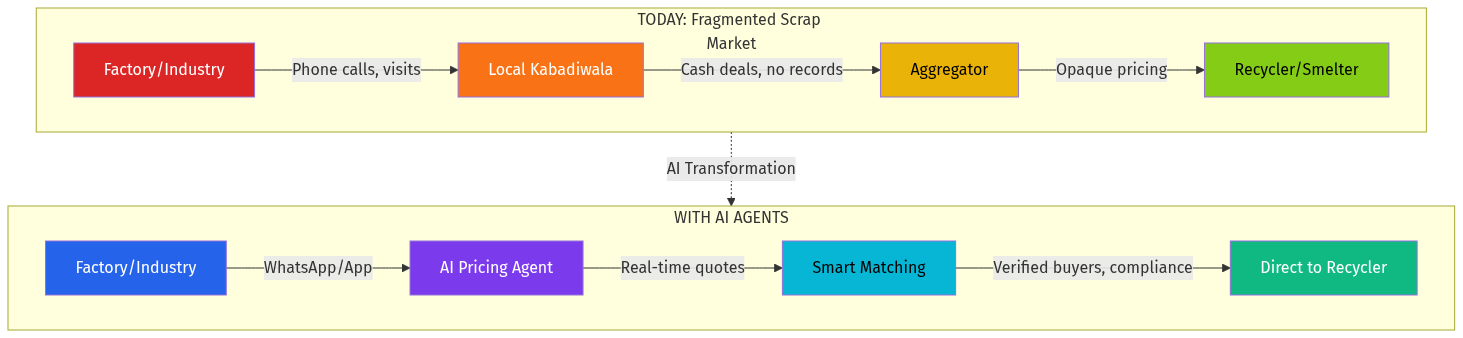
Market Transformation

2.

Problem Statement

Who Experiences This Pain?

Industrial Sellers (Factories, Manufacturers, Construction)
  • No benchmark pricing → routinely underpaid by 15-30%
  • Manual grading → disputes over material quality
  • Compliance nightmares → EPR requirements, e-waste rules ignored
  • Cash economy → accounting/audit problems
Buyers (Recyclers, Smelters, Reprocessors)
  • Inconsistent supply quality → high rejection rates
  • Working capital locked in intermediary payments
  • Limited visibility into upcoming supply
  • Compliance documentation gaps
The Intermediary Layer (Kabadiwalas, Aggregators)
  • Value extraction through information asymmetry
  • No technology adoption → efficiency ceiling
  • Informal relationships → can't scale

The Core Issue: Information Asymmetry

The kabadiwala knows LME copper prices. The factory manager doesn't. This gap creates a $5-7 billion annual value extraction from legitimate sellers who simply don't have pricing intelligence.


3.

Current Solutions

CompanyWhat They DoWhy They're Not Solving It
ScrapUncleConsumer scrap pickupB2C focus, not industrial scale
The KabadiwalaHousehold scrap collectionSame B2C limitation
ExtraCarbonCorporate e-waste managementNarrow vertical (e-waste only)
Karo SambhavEPR compliance, e-wasteCompliance-first, not marketplace
MetalMandiMetal trading platformListing-based, no pricing intelligence
mRecyclerScrap aggregationRegional, limited tech stack

What's Missing?

  • Real-time pricing intelligence tied to commodity markets
  • Computer vision grading for objective quality assessment
  • Compliance-first architecture for GST, EPR, pollution board
  • AI agents that can negotiate and match automatically

  • 4.

    Market Opportunity

    Market Size

    • Total Addressable Market (India): $25.6 billion (2026)
    • Industrial scrap alone: $18.2 billion
    • E-waste segment: $3.1 billion (growing 21% CAGR)
    • Construction debris: $4.3 billion

    Growth Drivers

    • EPR (Extended Producer Responsibility): Mandatory for 21 product categories by 2026
    • Circular economy push: Government targeting 50% recycling rate by 2030
    • GST formalization: Driving cash economy into digital rails
    • Manufacturing boom: PLI schemes = more industrial waste

    Why Now?

  • Regulatory tailwinds: EPR compliance is now mandatory, not optional
  • WhatsApp penetration: Factory owners comfortable with chat-first interfaces
  • LLM capabilities: AI can finally parse and respond to natural language queries
  • Computer vision maturity: Material grading via smartphone camera is viable
  • UPI ubiquity: Digital payments accepted even in industrial pockets

  • 5.

    Gaps in the Market

    Zeroth Principles Analysis

    What do we assume that everyone takes for granted? Assumption 1: Scrap pricing should be negotiated locally Reality: Global commodity prices (LME, MCX) should dictate base pricing. Local negotiation should only affect logistics premium. Assumption 2: Grading requires physical inspection Reality: Computer vision can assess 80%+ of quality parameters from photos. Assumption 3: Kabadiwalas are essential intermediaries Reality: They're information brokers. Remove information asymmetry, and direct seller-buyer matching becomes viable.

    Gap Analysis

  • No pricing transparency: No Bloomberg-equivalent for scrap
  • No standardized grading: Every buyer has different criteria
  • No compliance layer: EPR/pollution board tracking is manual
  • No prediction: When will prices rise? No one knows
  • No working capital: Sellers wait 30-90 days for payment

  • 6.

    AI Disruption Angle

    The Agent-First Vision

    This isn't a marketplace where humans list and browse. It's an AI agent ecosystem where:

  • Seller Agent: Factory manager WhatsApps photos of scrap pile → AI grades, prices, and finds buyers instantly
  • Pricing Agent: Continuously monitors LME, MCX, local demand signals → real-time fair market value
  • Compliance Agent: Auto-generates manifests, tracks EPR credits, alerts on regulatory deadlines
  • Logistics Agent: Optimizes pickup routes, matches trucks to loads, handles weighbridge reconciliation
  • Computer Vision for Grading

    Train models on:

    • Metal type identification (ferrous vs. non-ferrous, alloy detection)
    • Contamination assessment (rust levels, mixed materials)
    • Volume estimation from photos
    • Quality grade assignment (A/B/C standardization)

    The Trust Layer

    Every transaction creates immutable records:

    • Seller photos + AI grade
    • Buyer verification + adjustment
    • Weighbridge receipt (digital)
    • Payment confirmation (UPI)
    This becomes the reputation graph that unlocks working capital financing.


    7.

    Product Concept

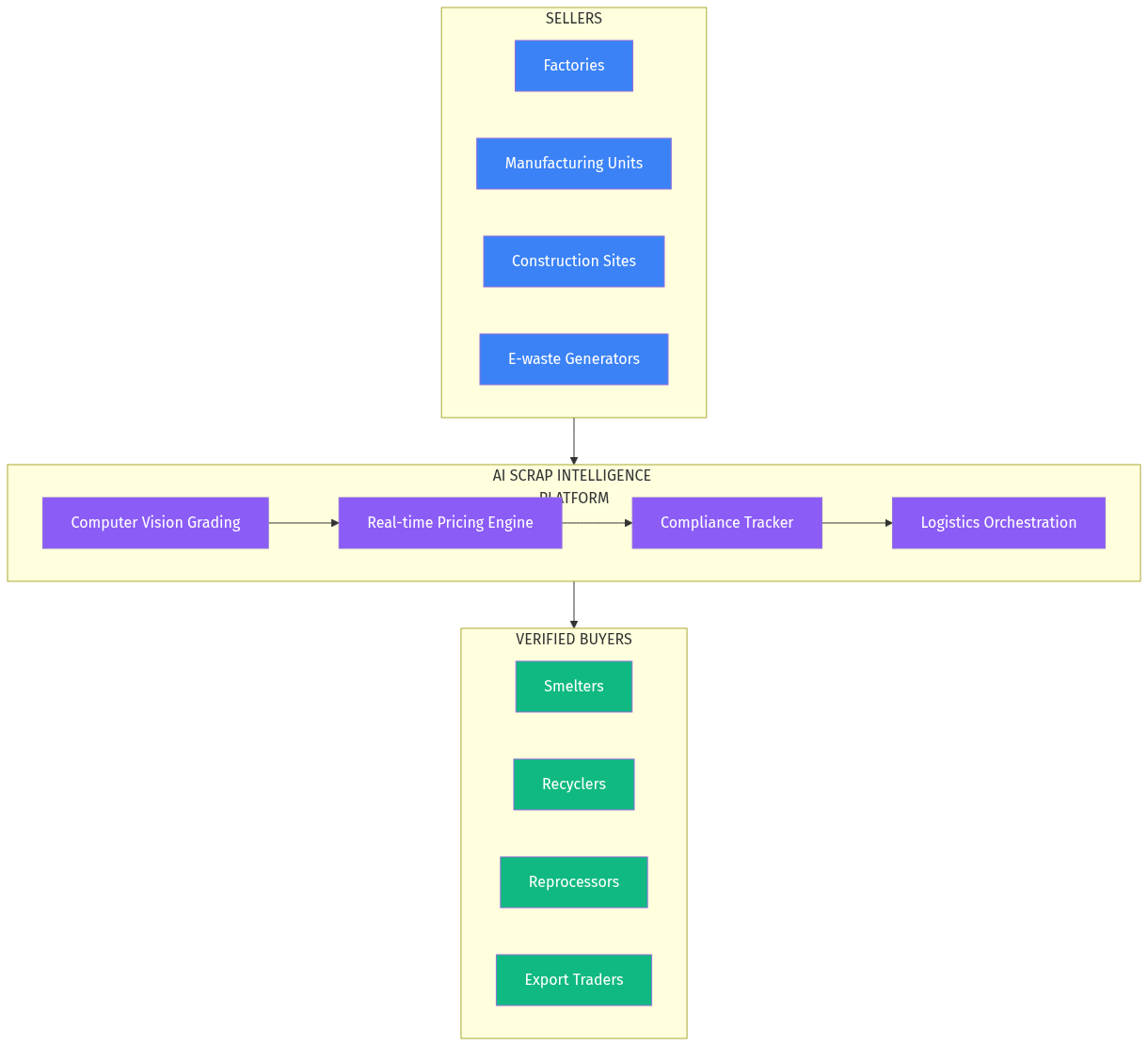
    Platform Architecture
    Platform Architecture

    Core Features

    For Sellers:
    • WhatsApp-first interface (send photo, get price)
    • Real-time pricing with confidence intervals
    • Compliance dashboard (EPR status, certificates)
    • Payment tracking with early-pay options
    For Buyers:
    • Supply forecasting (which factories, when)
    • Quality-assured sourcing (AI-graded, verified)
    • Bulk bidding tools
    • Compliance documentation auto-generated
    Platform Intelligence:
    • Pricing engine tied to LME/MCX + local demand
    • Computer vision grading API
    • Logistics optimization
    • Working capital scoring

    8.

    Development Plan

    PhaseTimelineDeliverables
    MVP8 weeksWhatsApp bot for pricing queries, manual matching, 50 pilot sellers
    V112 weeksComputer vision grading, buyer portal, compliance tracking
    V216 weeksAutomated matching, logistics integration, early-pay financing
    Scale24 weeksMulti-city launch, API for enterprise integration, EPR automation

    Tech Stack

    • Frontend: WhatsApp Business API + React Native app
    • Backend: Node.js, PostgreSQL, Redis
    • AI/ML: Python (FastAPI), YOLOv8 for detection, custom grading models
    • Infra: Cloudflare Workers, AWS/GCP for ML

    9.

    Go-To-Market Strategy

    Phase 1: Industrial Estates (Weeks 1-8)

  • Target: MIDC (Maharashtra), GIDC (Gujarat) industrial estates
  • Approach: Partner with industrial associations
  • Hook: Free pricing intelligence tool (WhatsApp bot)
  • Convert: Once they trust pricing, offer facilitated sales
  • Phase 2: Large Manufacturers (Weeks 8-16)

  • Target: Auto OEMs, white goods manufacturers
  • Approach: Direct enterprise sales
  • Hook: Compliance automation (EPR credits, documentation)
  • Value: Volume + predictability + compliance peace of mind
  • Phase 3: Construction Sites (Weeks 16-24)

  • Target: Large construction projects (L&T, Shapoorji Pallonji)
  • Approach: Partner with PMCs (Project Management Consultants)
  • Hook: Debris value recovery + green building credits
  • Value: Turn cost center into revenue stream

  • 10.

    Revenue Model

    Transaction Fee

    • 2-4% of GMV on facilitated transactions
    • Scales with volume: higher GMV = lower percentage

    SaaS Subscriptions

    • ₹5,000/month for enterprise compliance dashboard
    • ₹50,000/month for API access (large manufacturers)

    Financing Spread

    • 2-3% spread on early-pay financing
    • Seller gets paid in 3 days instead of 30

    Data Licensing

    • Pricing intelligence feeds for commodity traders
    • Market reports for industry associations

    Projected Unit Economics

    MetricYear 1Year 3
    GMV per transaction₹50,000₹1,00,000
    Take rate3%2.5%
    Revenue per transaction₹1,500₹2,500
    CAC₹2,000₹1,000
    LTV (3-year)₹15,000₹30,000
    ---
    11.

    Data Moat Potential

    What Accumulates Over Time

  • Pricing history: Every transaction = data point for ML models
  • Quality correlations: Which factories produce what grade material
  • Demand patterns: Seasonal, regional, commodity-linked variations
  • Compliance records: EPR credits, certificates, audit trails
  • Credit scores: Payment behavior of buyers, yield behavior of sellers
  • The Flywheel

    More transactions → Better pricing models → More trust → More transactions

    Defensibility

    • Network effects: More buyers = better prices for sellers = more sellers
    • Data moat: Pricing accuracy improves with scale
    • Switching cost: Compliance history locked in platform
    • Regulatory capture: Become the default for EPR tracking

    12.

    Why This Fits AIM Ecosystem

    Structural Alignment

    • Fragmented supplier market: 10,000+ recyclers, no dominant player
    • Offline-heavy: Still phone calls and cash
    • High-frequency transactions: Monthly scrap sales from most factories
    • Trust deficit: Perfect for AI-verified matching
    • B2B focus: Not consumer, not viral—methodical B2B sales

    Potential Synergies

    • AIM.in domain portfolio: Scrap.in, Kabadi.in, Recycler.in
    • Vizag Startups network: Industrial connections for pilot
    • OpenGarage infrastructure: WhatsApp integration, agent architecture

    Integration Path

    Could become a vertical under AIM.in:

    • aim.in/scrap — Industrial scrap marketplace
    • aim.in/recyclers — Verified buyer directory
    • aim.in/compliance — EPR tracking platform
    ---

    ## Risk Assessment (Pre-Mortem)

    Why 5 Well-Funded Startups Might Have Failed

  • Started B2C, couldn't pivot B2B: Different sales motion, different unit economics
  • Ignored compliance: Built marketplace, but factories need EPR tracking
  • Relied on aggregators: Tried to digitize kabadiwalas instead of disintermediating
  • Underestimated working capital: Sellers need payment guarantees
  • Poor pricing intelligence: Without LME integration, pricing was still opaque
  • Mitigations

    • Start B2B-first with industrial estates
    • Build compliance as core feature, not afterthought
    • Disintermediate through superior pricing intelligence
    • Offer early-pay financing from day one
    • Partner with commodity exchanges for pricing feeds

    ## Steelman: Why Incumbents Might Win

    Case for kabadiwalas:
    • They provide working capital (instant cash)
    • They handle logistics (their trucks)
    • They absorb quality risk (buy regardless of grade)
    • Relationships matter in B2B India
    Counter:
    • Working capital → we can offer early-pay
    • Logistics → we can orchestrate third-party
    • Quality risk → AI grading reduces disputes
    • Relationships → WhatsApp is a relationship too

    ## Verdict

    Opportunity Score: 8.5/10 Why high:
    • Massive market ($25B+) with zero dominant digital player
    • Clear pain point (pricing opacity) with technical solution (AI)
    • Regulatory tailwinds (EPR mandatory) creating urgency
    • Multiple revenue streams (transaction, SaaS, financing, data)
    • Strong data moat potential
    Why not 9+:
    • Execution complexity (multi-city logistics)
    • Sales cycle may be long for enterprise deals
    • Kabadiwalas may resist (potential conflict)
    • Requires significant working capital to offer early-pay
    Recommendation: Strong opportunity for AIM.in vertical. Start with pricing intelligence tool (low cost to build, immediate value), then layer marketplace and financing. WhatsApp-first approach aligns with target user behavior.

    ## Sources

    • India Waste Management Market Report (Mordor Intelligence, 2025)
    • EPR Regulations, Ministry of Environment (2023 amendments)
    • LME Base Metals Data
    • MCX Commodity Futures
    • Industry interviews: Scrap dealers in Vizag, Hyderabad (Feb 2026)
    • Competitive analysis: ScrapUncle, ExtraCarbon, MetalMandi websites