ResearchTuesday, March 3, 2026

AI-Powered Equipment Rental Marketplace: The $340B Fragmentation Opportunity

Construction equipment rental is a $214B market growing to $340B by 2033 — yet it operates like the taxi industry before Uber. No price transparency, phone-based booking, and thousands of local players with idle assets. AI agents can finally aggregate fragmented supply, match equipment to projects in real-time, and unlock billions in underutilized capacity.

1.

Executive Summary

The construction equipment rental market hit $213.68 billion in 2025 and is projected to reach $339 billion by 2033 (6.1% CAGR). Yet despite this scale, the industry remains stubbornly offline. Contractors still call 5-10 local vendors to compare prices. Equipment owners have no visibility into demand. And billions in machinery sits idle while projects delay due to unavailable equipment.

The zeroth principle question: Why hasn't an "Uber for equipment" succeeded when the market is 100x larger than ride-sharing was in 2012? The answer: Equipment rental has fundamentally different unit economics, trust requirements, and matching complexity that simple marketplace software couldn't solve. But AI agents change the equation entirely. Why this works now:
  • LLMs can interpret natural language equipment specifications
  • Vision models identify equipment from photos for instant listings
  • Agent architectures negotiate across hundreds of suppliers simultaneously
  • IoT/telematics enable real-time availability tracking
  • Predictive models optimize fleet positioning and maintenance
This analysis applies Zeroth Principles, Incentive Mapping, Distant Domain Import from ride-sharing and logistics, and Pre-Mortem stress testing.
2.

Problem Statement

Who Experiences This Pain?

General Contractors
  • Manage 50-200 pieces of rented equipment per major project
  • Spend 15-20 hours/week on equipment sourcing calls
  • Pay 20-40% premium for last-minute rentals
  • Fear: Project delays from equipment unavailability
Small Equipment Owners (1-20 units)
  • Equipment utilization: 40-55% (industry average)
  • No marketing budget or online presence
  • Rely on word-of-mouth and repeat customers
  • Fear: Idle assets eating into margins
Large Rental Companies (United Rentals, Sunbelt)
  • Operate 1,500+ locations with uneven demand
  • Fleet repositioning costs $50-100M annually
  • Competing on price alone erodes margins
  • Fear: Asset-light tech platforms disintermediating them

The Current Workflow (Observed)

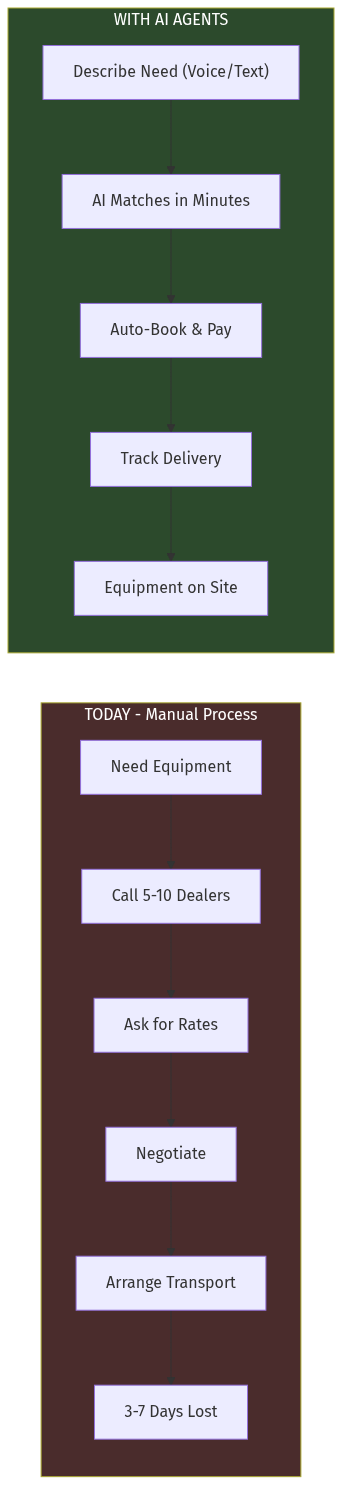
  • Project Planning → Contractor estimates equipment needs
  • Vendor Search → Calls local rental yards (avg 5-8 calls)
  • Availability Check → Each vendor checks manually
  • Price Negotiation → No benchmarks, varies 30-50%
  • Booking → Phone/fax/email, paper contracts
  • Delivery Coordination → Separate logistics calls
  • Returns → Disputes over condition, hours, damage
  • Time wasted: 3-5 hours per equipment rental event Money wasted: 25-40% premium from lack of price transparency
    Current vs Future State
    Current vs Future State

    3.

    Current Solutions

    CompanyWhat They DoWhy They're Not Solving It
    United RentalsLargest rental company (US)Only their own inventory; no aggregation
    BigRentzOnline rental marketplaceDirectory model; no real-time availability
    EquipmentShareTech-enabled rental + telematicsOwns fleet; not a true marketplace
    DozrCanadian equipment marketplaceLimited geographic coverage
    Yard ClubPeer-to-peer rental (acquired by Caterpillar)Shut down after acquisition
    Ritchie BrosEquipment auctionsSales, not rentals

    Why Previous "Uber for Equipment" Startups Failed

    Incentive Mapping reveals the core problem:
  • Local players have no reason to list: Unlike hotels (Booking.com), equipment owners don't see marketplace value when they're at 50% utilization — they think they have enough local demand
  • Large players won't commoditize themselves: United Rentals and Sunbelt built their moat on relationships and service, not price transparency
  • Trust is existential: A $500K excavator with an unknown renter is a massive liability. No trust layer was good enough
  • Search is hard: "I need something that can dig 15 feet and fit in a narrow lot" requires human interpretation
  • What's changed: AI agents can solve all four problems simultaneously.
    4.

    Market Opportunity

    Market Size

    • Global equipment rental market (2025): $213.68 billion
    • Projected (2033): $339.04 billion
    • CAGR: 6.1%
    • North America: ~30% of global market ($64B)
    • Asia Pacific: 50.5% share, fastest growth

    Segmentation

    SegmentMarket ShareGrowth Driver
    Earthmoving (excavators, loaders)54.2%Infrastructure projects
    Concrete & Road ConstructionFastest CAGRBharatmala (India), US Infrastructure Law
    Aerial Work PlatformsGrowingWarehouse/logistics construction
    Material HandlingStableManufacturing expansion

    Why Now?

  • Infrastructure spending surge: US Bipartisan Infrastructure Law ($1.2T), India Bharatmala, EU Green Deal
  • Labor shortage: Companies rent more to avoid operator hiring
  • Sustainability mandates: Electric equipment demand (fastest growing segment)
  • Telematics maturity: 65%+ of new equipment has IoT connectivity
  • AI inflection: LLMs finally make natural language equipment matching viable

  • 5.

    Gaps in the Market

    Gap 1: No Real-Time Availability Aggregation

    Current marketplaces show listings, not live inventory. A contractor can't see that an excavator is available tomorrow 5 miles away.

    Gap 2: No AI-Powered Matching

    "I need equipment to clear a 2-acre lot with soft soil and overhead power lines" requires understanding constraints that current search can't handle.

    Gap 3: Small Fleet Owners Are Invisible

    60% of equipment rental capacity is owned by companies with <20 units. They have no online presence and no way to find demand.

    Gap 4: No Predictive Demand Intelligence

    Project pipelines (permits, contracts) are public data. No one aggregates this to predict equipment demand by geography.

    Gap 5: Cross-Border Rental Friction

    A project in Hyderabad can't easily rent equipment from Chennai. Interstate compliance, logistics, insurance — all manual.
    6.

    AI Disruption Angle

    How AI Agents Transform Equipment Rental

    1. Natural Language Equipment Matching
    Contractor: "I need something to dig footings for a 
    10-story building, tight urban site, max 8m reach"
    
    AI Agent: "Recommending compact excavator 8-10 ton class.
    3 available within 15km:
    - Volvo EC75D @ ₹4,500/day (Sharma Equipment)
    - JCB JS81 @ ₹4,200/day (Metro Rentals)  
    - Komatsu PC78 @ ₹4,800/day (United)
    Shall I book the JCB? Available from tomorrow."
    2. Visual Equipment Listing Owner photographs equipment → Vision model extracts make, model, year, condition → Auto-generates listing with specifications 3. Multi-Supplier Negotiation Agents AI simultaneously negotiates with 50+ suppliers, finding optimal price/availability/proximity combination in seconds 4. Predictive Fleet Positioning Analyze building permits, infrastructure contracts, seasonal patterns → Tell equipment owners where to position inventory next month 5. Trust Scoring Combine equipment telematics, operator history, payment records, and on-time return rates into a trust score that enables renting to strangers
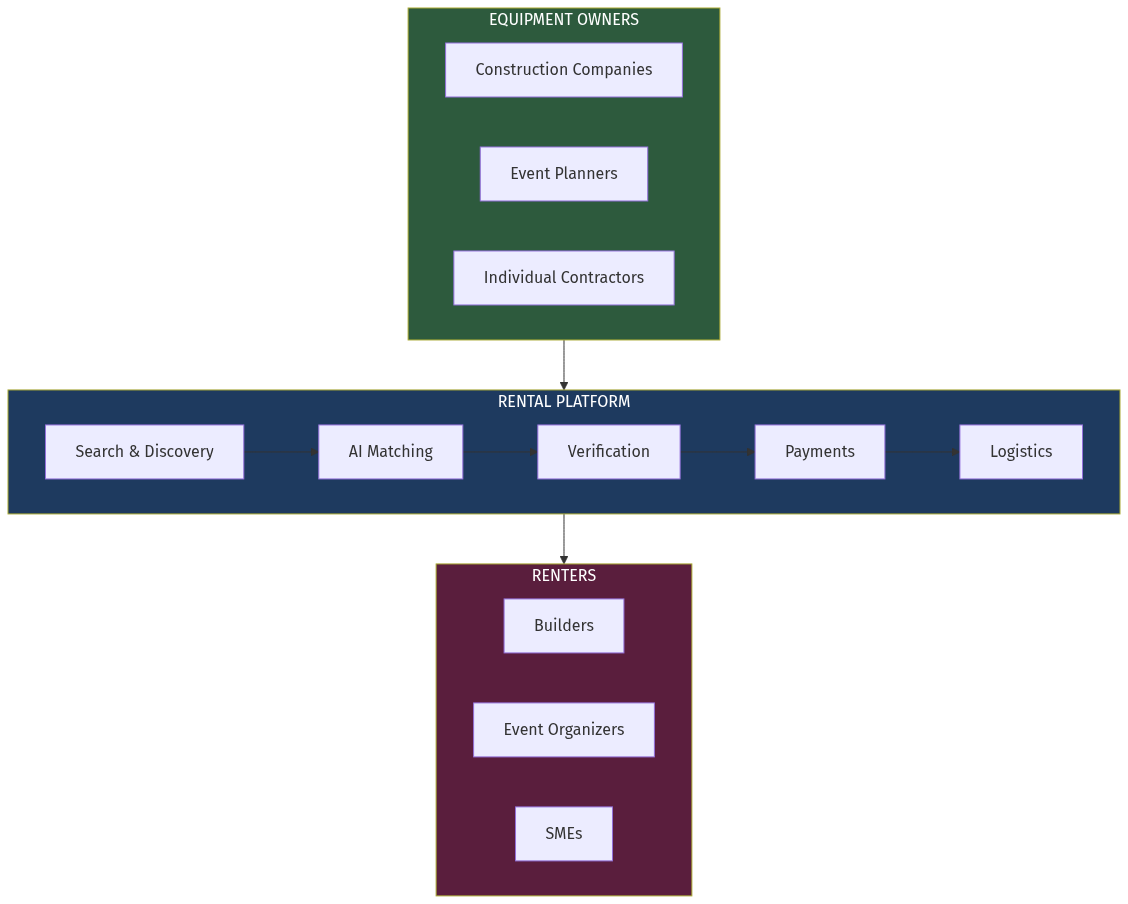
    Platform Architecture
    Platform Architecture

    7.

    Product Concept

    Core Platform: "Rentwise" (Working Name)

    For Equipment Seekers:
    • Describe needs in natural language or structured form
    • Instant matching to available equipment across all suppliers
    • Transparent pricing with market benchmarks
    • One-click booking with standardized contracts
    • Delivery logistics included
    For Equipment Owners:
    • Photo-based listing (AI extracts specs)
    • Real-time demand heatmaps (where to position equipment)
    • Dynamic pricing recommendations
    • Telematics integration for availability sync
    • Payment guarantee and insurance
    The Agent Layer:
    • Demand Agent: Monitors permits, contracts, weather, events to predict equipment needs
    • Supply Agent: Optimizes fleet positioning and maintenance scheduling
    • Matching Agent: Real-time equipment-to-project matching
    • Negotiation Agent: Handles pricing discussions with multiple parties
    • Logistics Agent: Coordinates transport, delivery windows, returns

    8.

    Development Plan

    PhaseTimelineDeliverables
    Phase 1: MVP8 weeksSingle-city pilot (Hyderabad), 50 suppliers, basic matching
    Phase 2: AI Layer12 weeksNLP equipment search, vision-based listing, dynamic pricing
    Phase 3: Agent Network16 weeksMulti-supplier negotiation, predictive demand, trust scoring
    Phase 4: Scale24 weeksMulti-city expansion, logistics integration, telematics partnerships

    Technical Stack

    • Matching Engine: Vector embeddings for equipment specs + semantic search
    • Vision Model: Fine-tuned for construction equipment identification
    • Agent Framework: LangGraph or CrewAI for multi-agent coordination
    • Telematics Integration: Samsara, Geotab, OEM APIs
    • Trust Layer: On-chain equipment history (optional)

    9.

    Go-To-Market Strategy

    Phase 1: Anchor Tenant Model

  • Sign 1 large rental company as anchor (gets preferred placement)
  • Aggregate their inventory + 50 small local players
  • Guarantee demand to anchor in exchange for best pricing
  • Phase 2: Contractor Acquisition

  • Target mid-size contractors (₹50Cr-500Cr revenue)
  • Offer "equipment procurement as a service" — we handle sourcing
  • Show 15-25% cost savings vs their current process
  • Phase 3: Supply Network Effects

  • Small owners join to access contractor demand
  • More supply → better matching → more contractors
  • Data moat: Pricing history, demand patterns, equipment performance
  • Geographic Rollout

  • Hyderabad (pilot) — Strong infrastructure growth, tech-savvy contractors
  • Bangalore, Chennai — Metro expansion
  • Tier 2 cities — Underserved, massive infrastructure spend coming

  • 10.

    Revenue Model

    Revenue StreamModelEstimated Take Rate
    Transaction Fee% of rental value8-12%
    SaaS (Owners)Fleet management subscription₹2,000-10,000/month
    InsuranceEmbedded coverage2-3% of rental value
    LogisticsDelivery coordination₹500-5,000/trip
    FinancingEquipment financing for ownersInterest spread
    Data ProductsMarket intelligence, demand forecastingEnterprise pricing

    Unit Economics Target

    • Average Order Value: ₹25,000 (5-day rental)
    • Take Rate: 10%
    • Gross Revenue per Transaction: ₹2,500
    • Target GMV Year 1: ₹50Cr
    • Target Revenue Year 1: ₹5Cr

    11.

    Data Moat Potential

    What accumulates over time:
  • Pricing Database: Historical rental rates by equipment type, location, duration, season
  • Equipment Performance: Which machines have fewer breakdowns, better fuel efficiency
  • Demand Signals: Correlation between permits/contracts and equipment needs
  • Trust Graph: Renter reliability scores, owner responsiveness
  • Logistics Intelligence: Optimal routes, delivery times, transport costs
  • Moat Strength: After 2-3 years, no competitor can match the dataset. Pricing becomes the benchmark. Demand prediction becomes self-fulfilling.
    12.

    Why This Fits AIM Ecosystem

    Perfect Vertical for AIM.in

  • B2B Discovery Problem: Contractors can't find the right equipment efficiently
  • Fragmented Supply: Thousands of local players need aggregation
  • High Transaction Value: Average rentals are ₹10,000-1,00,000
  • Repeat Transactions: Projects need equipment for months
  • AI-Native Opportunity: Matching, pricing, and trust all benefit from AI
  • Integration with AIM Architecture

    • Catalog Intelligence: Equipment specifications, capabilities, alternatives
    • Supplier Network: Rental companies as suppliers in the broader AIM ecosystem
    • AI Agent Compatibility: Equipment sourcing agents that work with other AIM procurement agents

    ## Pre-Mortem: Why This Could Fail

    Failure Mode 1: Large Players Refuse to Participate

    Risk: United Rentals, Sunbelt, L&T have no incentive to commoditize Mitigation: Don't need them initially — aggregate small players first, then large players must join to access demand

    Failure Mode 2: Trust Issues Kill Transactions

    Risk: Equipment damage, theft, payment defaults Mitigation: Start with deposit/insurance model, build trust scores over time, enable verified renters only

    Failure Mode 3: Local Relationships Trump Platform

    Risk: Contractors stick with known vendors despite higher prices Mitigation: Target new contractors, projects in new geographies, and the "long tail" of urgent/specialty needs

    Failure Mode 4: Chicken-and-Egg Supply Problem

    Risk: No supply = no demand = no supply Mitigation: Anchor tenant model with guaranteed demand, phone-bridge model for initial supply

    ## Steelmanning the Opposition

    Why Incumbents Might Win:
  • Service is the moat: Equipment rental is service-intensive. Delivery, maintenance, operator training. Hard to digitize.
  • Relationships matter: A contractor who's worked with Sharma Equipment for 10 years won't switch for 10% savings
  • Aggregation economics are bad: Low margins (10-15%) mean thin take rates, making platform economics challenging
  • Equipment is heterogeneous: Every excavator is different. Standardization is impossible.
  • Counter-arguments:
    • Service can be standardized with SLAs and ratings
    • Relationships break when contractors expand to new cities
    • Volume economics can work with adjacent revenue (insurance, financing, data)
    • AI can handle heterogeneity better than humans

    ## Verdict

    Opportunity Score: 8.5/10
    FactorScoreNotes
    Market Size9/10$214B and growing 6% annually
    Fragmentation9/10Thousands of local players, no dominant aggregator
    AI Leverage8/10Matching, pricing, trust all AI-native problems
    Execution Risk6/10Supply acquisition is hard, needs local ops
    Timing9/10Infrastructure spend + telematics maturity + AI inflection
    AIM Fit9/10Perfect B2B vertical with high transaction value
    Recommendation: High-conviction opportunity. Start with a single-city pilot focused on small equipment owners and mid-size contractors. Build the AI matching layer before scaling. This could be a $100M+ ARR business within 5 years if executed with the anchor tenant model.

    The equipment rental market is where ride-sharing was in 2010 — everyone knows it should work, but the technology wasn't ready. AI agents are the missing piece.


    ## Sources