ResearchTuesday, March 3, 2026

AI Construction Site Intelligence: The $600B Trust Problem Waiting for Computer Vision

In a country where 80% of construction projects face delays and homebuyers routinely discover their "contractor relative" has been cheating them, there's a massive opportunity for AI to bring transparency to India's most opaque industry.

1.

Executive Summary

India's construction industry is a $600 billion behemoth plagued by a fundamental trust deficit. Homeowners can't verify progress. Developers can't hold contractors accountable. Banks can't confirm milestone completion before releasing tranches. The solution isn't more project managers—it's AI-powered site intelligence that makes construction progress objectively measurable.

This article examines the opportunity for an AI construction site monitoring platform that uses computer vision, IoT sensors, and drone imagery to create an immutable record of construction progress—turning a high-trust, relationship-dependent industry into a data-driven, verifiable one.


2.

Problem Statement

The Trust Catastrophe

A recent Reddit thread titled "How a well-wisher relative almost scammed me while building my new house" captures the essence of India's construction problem. The post describes a common scenario: a trusted relative/contractor inflating bills, using substandard materials, and exploiting the homeowner's inability to verify claims.

This isn't anecdotal—it's systematic:

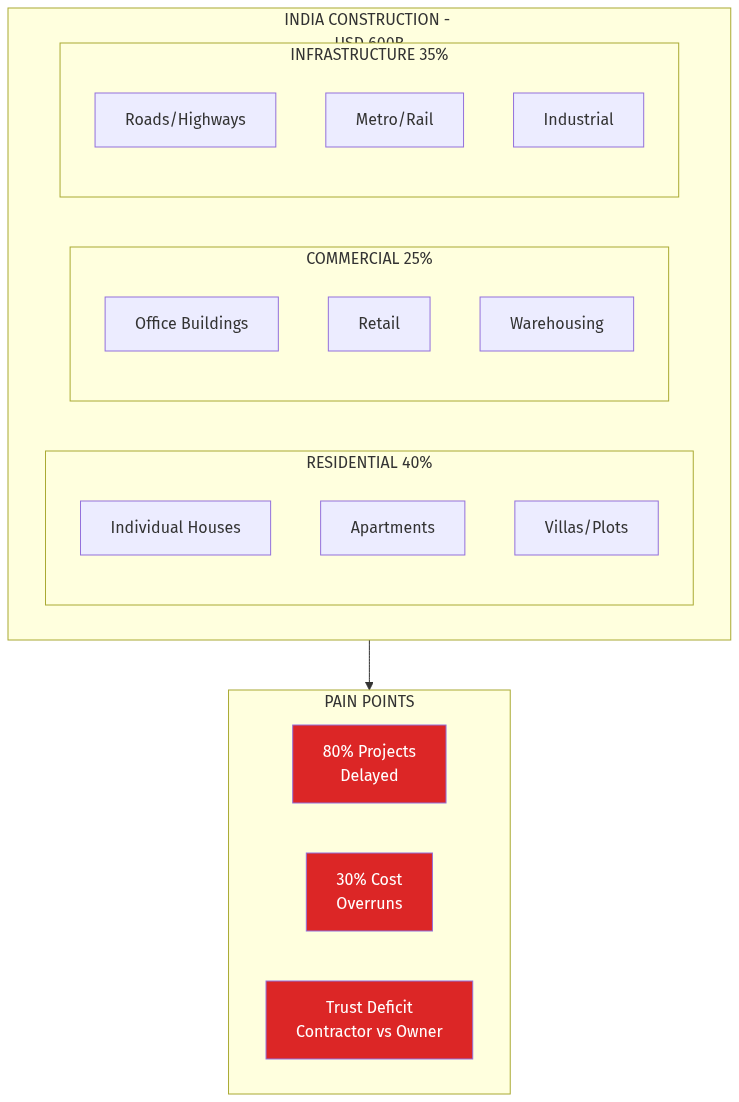
  • 80% of residential projects face significant delays
  • 30% average cost overruns due to poor project management
  • Zero real-time visibility for property owners
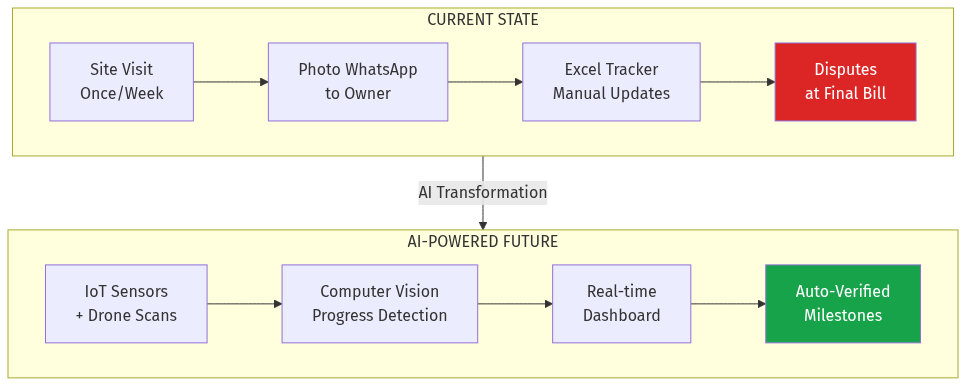
  • WhatsApp photos remain the "state of the art" for progress updates

Who Experiences This Pain?

StakeholderPain PointCurrent Workaround
Individual homeownersCan't verify contractor claimsSite visits, trust
Real estate developersContractor accountability gapsManual supervision
Banks/NBFCsCan't verify milestone completionPhysical inspections
ArchitectsQuality deviations undetectedPeriodic visits
Government bodiesProject delays, fund misusePaper-based audits
Construction AI Transformation

3.

Current Solutions

CompanyWhat They DoWhy They're Not Solving It
ProcoreEnterprise construction managementUS-focused, enterprise pricing, not India-localized
PowerplayConstruction project managementSaaS tool, no computer vision, manual data entry
Infra.MarketConstruction materials marketplaceSupply-side only, no monitoring
BuildnextIndividual home constructionHuman-based verification, not scalable
PlanGridDocument managementAcquired by Autodesk, focused on blueprints not progress
The Gap: None of these use AI/computer vision for automated progress verification. They're all either:
  • Manual data entry tools
  • Enterprise-only (too expensive for individual homeowners)
  • Supply-side focused (materials, not monitoring)

4.

Market Opportunity

  • Market Size: $600 billion (India construction industry 2025)
  • Residential segment: $240 billion (40% of market)
  • Individual home construction: ~$50 billion annually (8M+ houses built per year)
  • Growth: 7-8% CAGR through 2030
  • Digital penetration: Less than 5% of projects use any digital monitoring

Why Now?

  • Smartphone ubiquity — Site workers have phones with cameras
  • Drone costs collapsed — Sub-$500 drones can survey sites
  • Computer vision maturity — Object detection, 3D reconstruction are production-ready
  • Trust erosion — Post-COVID, buyers demand more transparency
  • RERA enforcement — Regulatory push for project accountability
  • Construction Market Structure
    Construction Market Structure

    5.

    Gaps in the Market

    Mental Model: Zeroth Principles

    Before solving "construction monitoring," question the axioms:

    Axiom 1: "Construction progress requires human judgment" Challenge: Progress against architectural plans is objectively measurable. Did the wall reach 10 feet? Is the rebar placed correctly? These are computer vision problems, not subjective assessments. Axiom 2: "Contractors can't be held accountable" Challenge: They can't be held accountable because there's no objective record. An immutable, timestamped visual record changes everything.

    Identified Gaps

  • No consumer-grade solution — Enterprise tools exist; nothing for the homeowner building their first house
  • No automated progress detection — Current tools require manual entry
  • No milestone-to-payment automation — Progress verification isn't connected to payment release
  • No material verification — No way to confirm the cement bags on site match invoices
  • No historical contractor scoring — No reputation system based on verified data
  • Mental Model: Incentive Mapping

    Who profits from opacity?

    • Contractors: Benefit from ambiguity in scope, materials, timelines
    • Material suppliers: Can substitute lower-grade materials
    • Middlemen/relatives: Earn commissions on inflated bills
    Who loses?
    • Homeowners: Pay more, get less
    • Banks: Release funds for incomplete work
    • Good contractors: Can't differentiate from bad ones
    Insight: The players who benefit from transparency (homeowners, banks, good contractors) outnumber those who profit from opacity—but they're not organized.
    6.

    AI Disruption Angle

    What AI Changes

    Computer Vision Applications:
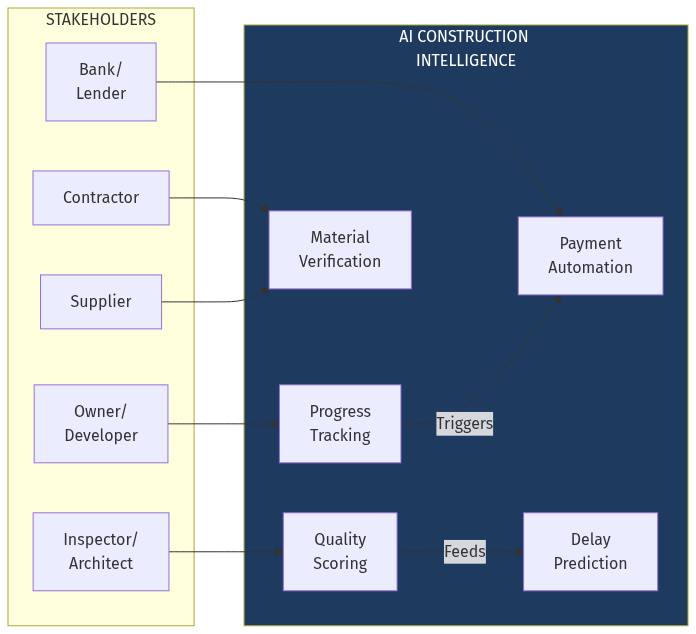
    • Progress tracking — Compare current site images against BIM/plans, calculate % completion
    • Material verification — Count cement bags, steel bundles, match against invoices
    • Quality detection — Identify cracks, improper curing, alignment issues
    • Safety monitoring — Detect missing safety gear, hazards
    • Timeline prediction — Based on current progress, predict completion dates
    How It Works:
    Phone Camera / Drone → Edge Processing → Cloud Analysis → Dashboard
        ↓                     ↓                  ↓               ↓
     Daily uploads      Object detection    Progress %      Owner/Bank app
                        3D reconstruction   Quality score
                        Material count      Delay alerts

    Distant Domain Import: Gaming + Logistics

    From gaming: Real-time 3D environment reconstruction. Games like Fortnite build and modify structures in real-time. The same spatial computing can track construction. From logistics: Package tracking changed shipping forever. "Where's my package?" became answerable. Construction needs "Where's my house?"
    Construction AI Architecture
    Construction AI Architecture

    7.

    Product Concept

    Core Product: "BuildTrack AI"

    For Individual Homeowners (B2C):
    • Weekly drone/phone scan of construction site
    • AI-generated progress report (% complete vs plan)
    • Photo comparison: this week vs last week
    • Automatic delay alerts
    • Payment recommendation: "Release 30% of next milestone"
    For Banks/NBFCs (B2B):
    • Automated milestone verification before tranche release
    • Risk scoring based on construction progress
    • Portfolio-level dashboard across all funded projects
    • API integration with loan management systems
    For Developers (B2B):
    • Multi-site dashboard
    • Contractor performance analytics
    • Predictive delays
    • Automated reporting to RERA

    Key Features

    FeatureWhat It DoesAI Component
    Progress Tracker% complete against planImage comparison, 3D reconstruction
    Material AuditVerify materials on-siteObject detection, counting
    Quality ScoreDetect defects, issuesAnomaly detection
    Timeline PredictorForecast completionTime-series prediction
    Payment GateLink milestones to paymentsProgress threshold triggers
    ---
    8.

    Development Plan

    PhaseTimelineDeliverables
    MVP12 weeksMobile app for photo upload, basic progress detection, manual plan input
    V124 weeksDrone integration, automated plan parsing from CAD/BIM, bank API
    V240 weeksMaterial verification, quality detection, contractor scoring
    V352 weeksPredictive analytics, RERA compliance automation

    Technical Stack

    • Computer Vision: YOLOv8/9 for object detection, Segment Anything for segmentation
    • 3D Reconstruction: NeRF-based or photogrammetry
    • Mobile: React Native (cross-platform)
    • Backend: Node.js/Python, PostgreSQL, TimescaleDB for time-series
    • ML Pipeline: MLflow, AWS SageMaker
    • Drone Integration: DJI SDK, Skydio API

    9.

    Go-To-Market Strategy

    Phase 1: Individual Homeowners (0-12 months)

  • Launch in tier-2 cities — Hyderabad, Pune, Ahmedabad (high individual construction)
  • Partner with architects — Offer free tool for their clients
  • WhatsApp-first UX — "Send site photos to this number, get progress report"
  • Pricing: ₹999/month during construction (12-24 month lifecycle)
  • Phase 2: Banks/NBFCs (6-18 months)

  • Target housing finance companies — HDFC, ICICI Home, LIC HFL
  • Offer risk reduction — "Verify before you disburse"
  • Revenue share model — Per-verification fee or portfolio subscription
  • Pricing: ₹500-2000 per milestone verification
  • Phase 3: Developers + Government (12-24 months)

  • Target mid-size developers — 50-500 unit projects
  • RERA compliance automation — Auto-generate required reports
  • Government contracts — Infrastructure project monitoring
  • Pricing: Enterprise SaaS (₹50k-5L/month based on project count)

  • 10.

    Revenue Model

    Revenue StreamTarget SegmentPricingYear 1 Potential
    Consumer subscriptionsHomeowners₹999/month₹2 Cr
    Bank APINBFCs, HFCs₹500-2000/verification₹5 Cr
    Developer SaaSReal estate developers₹50k-2L/month₹3 Cr
    Government contractsSmart city projectsPer-project₹2 Cr
    Year 1 target: ₹12 Cr ARR Year 3 target: ₹100 Cr ARR (with bank partnerships scaled)
    11.

    Data Moat Potential

    What Accumulates Over Time

  • Construction patterns — How long does X type of work take in Y city?
  • Contractor profiles — Performance data on 10,000+ contractors
  • Material pricing — Real-time material costs across regions
  • Quality benchmarks — What does "good construction" look like at scale?
  • Delay predictors — Which combinations of factors cause delays?
  • Network Effects

    • More homeowners → more contractor data → better contractor scoring → more homeowners trust it
    • More bank integrations → more verified projects → more data → better predictions → more bank trust
    Pre-Mortem (Falsification):

    Why might this fail?

  • Adoption friction — Contractors resist monitoring
  • Technical accuracy — CV models not accurate enough for construction
  • Price sensitivity — Homeowners won't pay for monitoring
  • Relationship-first culture — "I trust my contractor"
  • Mitigation:
    • Make contractors look good (verified completion = faster payment)
    • Start with coarse-grained progress, refine over time
    • Bank-funded model (homeowner pays nothing, bank verifies)
    • Position as "insurance" not "surveillance"

    12.

    Why This Fits AIM Ecosystem

    Direct Alignment

  • B2B Discovery — Banks finding verified contractors
  • Structured Data — Construction progress becomes queryable
  • Repeat Purchase — 12-24 month engagement per project
  • High Trust Need — Exactly where AIM adds value
  • Integration Points

    • AIM Construction vertical — Featured contractors with BuildTrack scores
    • Material suppliers — Verified material usage creates procurement data
    • Service providers — Architects, surveyors, inspectors integrated

    Domain Opportunity

    • buildtrack.in — Available for registration
    • constructionai.in — Brandable alternative
    • sitewatch.in — Consumer-friendly name

    ## Verdict

    Opportunity Score: 8.5/10

    Why High Score

    ✅ Massive market ($600B construction, $50B individual homes) ✅ Clear pain point with emotional resonance (trust/scam stories) ✅ AI/CV technology is mature enough today ✅ Multiple revenue streams (B2C, B2B, B2G) ✅ Strong data moat potential ✅ Regulatory tailwinds (RERA)

    Why Not 10/10

    ⚠️ Behavior change required (contractors, homeowners) ⚠️ India's relationship-based culture may resist ⚠️ Technical accuracy needs validation ⚠️ Long sales cycles for bank/developer segments

    Recommendation

    Build this. Start with the WhatsApp-first consumer product, prove accuracy, then expand to banks. The trust deficit in construction is so severe that even a 60% accurate solution is better than the current zero-visibility status quo. The pre-mortem risks are real but surmountable.

    The company that builds India's "construction credit score" will own the industry's data layer for the next 20 years.


    ## Sources

    • Economic Times - Property & Construction coverage (March 2026)
    • Reddit r/india - Construction contractor discussions
    • IBEF India Construction Industry Report 2025
    • KPMG India Real Estate Report 2025
    • RERA compliance guidelines
    • Procore, Powerplay, Infra.Market company profiles