ResearchTuesday, March 3, 2026

AI Aquaculture Intelligence: The $350B Opportunity to Transform Fish Farming with Computer Vision and Robotics

A $350 billion global industry where most farms still measure fish by hand. Only 0.17% of known marine species have been domesticated. The genetics improvement that 4x'd chicken growth in 70 years has barely begun in aquaculture. AI is about to change that.

1.

Executive Summary

Aquaculture — the farming of fish, shellfish, and aquatic plants — is one of the last major food production systems to be touched by precision agriculture. While chickens grow 4x faster than they did in 1950 due to decades of selective breeding, most farmed fish species are essentially running on wild genetics.

The bottleneck? Measurement.

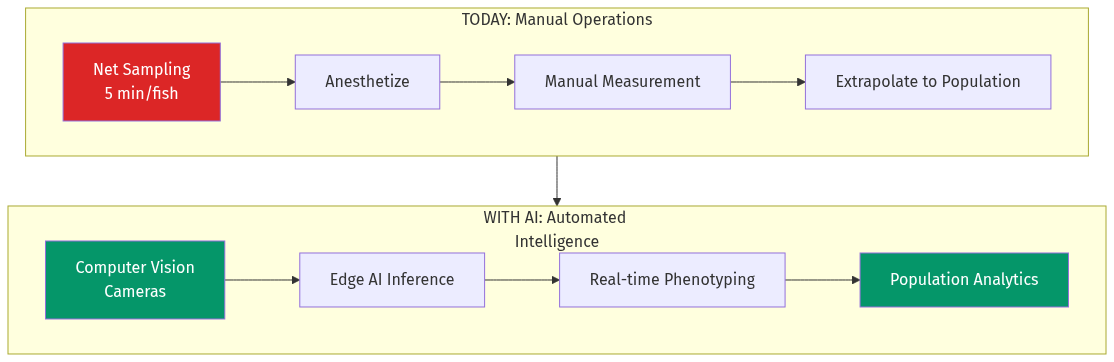
You cannot improve what you cannot measure, and most aquaculture farms cannot measure anything at scale. Fish are underwater, stress easily when handled, and move unpredictably. Manual sampling — netting fish, anesthetizing them, measuring one by one — takes 5 minutes per fish and yields sparse data.

This creates a massive opportunity for AI-powered phenotyping, computer vision, and robotics systems that can measure fish populations non-invasively at scale. The prize: becoming the data infrastructure layer for the entire aquaculture industry.


2.

Problem Statement

Who Experiences This Pain?

Hatchery Operators need to measure fish for:
  • Feeding decisions (how much to feed based on biomass)
  • Breeding selection (which fish have the best genetics)
  • Harvest timing (which fish are ready for market)
  • Health monitoring (detecting disease early)
The Current Reality:
  • Net a sample of 30-50 fish from a population of 100,000+
  • Anesthetize each fish to prevent thrashing
  • Place on a measurement table
  • Manually record length, weight, morphology
  • Extrapolate to the entire population
  • Repeat every 2-4 weeks
  • Time: ~5 minutes per fish = 4+ hours for a meaningful sample Accuracy: Sampling error is enormous Stress: Handling causes mortality and growth setbacks Data: Sparse, delayed, and disconnected from operational systems

    The Underlying Physics Problem

    • Fish are underwater → optical distortion, turbidity, particles
    • Fish move unpredictably → tracking and occlusion challenges
    • Fish deform while swimming → shape changes frame-to-frame
    • Live fish are fragile → robotics must be gentle
    • Saltwater destroys electronics → corrosion is constant
    • Most farms lack connectivity → edge computing required

    3.

    Current Solutions

    CompanyWhat They DoGap/Limitation
    AquaconnectSatellite + AI for shrimp pond analytics in IndiaSurface-level only, no underwater phenotyping
    Observe TechnologiesAI-powered farm management softwareSoftware layer without hardware integration
    UMITRONSmart feeding systems with camerasFocused on feeding, not comprehensive phenotyping
    InnovaSeaAcoustic tracking and monitoringExpensive enterprise systems, not accessible
    AquaByteComputer vision for salmon farmingNorway-focused, limited to specific species
    OctaPulseRobotics + CV for fish phenotyping (YC W26)Early stage, just raised funding

    Analysis: Why Existing Solutions Fall Short

  • Software-only approaches can't capture the data they need
  • Hardware systems are prohibitively expensive for most farms
  • Regional focus limits scale (Norway vs. Asia vs. Americas)
  • Species-specific solutions don't transfer to other fish types
  • No genetics integration — phenotyping disconnected from breeding

  • 4.

    Market Opportunity

    Market Size

    MetricValueSource
    Global Aquaculture Market$350B+FAO 2022
    Annual Production130.9 million tonnesFAO 2022
    Growth Rate5.8% CAGRIndustry estimates
    Aquaculture Technology Market$3.2B by 2028Market research

    Why Now?

  • Wild fish stocks depleted — Capture fisheries stagnant, aquaculture must fill the gap
  • Edge AI viable — Nvidia Jetson, Luxonis OAK cameras enable on-device inference
  • Genetics revolution beginning — Only ~430 species domesticated, mostly in last 25 years
  • Climate pressure — Disease outbreaks increasing, need better monitoring
  • Protein demand surging — Fish is primary protein for 55% of global population
  • The Chicken Analogy

    Chickens in 2024 grow 4x faster than 1950 chickens because of:

    • Decades of selective breeding
    • Precise measurement at every stage
    • Data-driven feed optimization
    Aquaculture is 50+ years behind poultry — and AI can compress that timeline.


    5.

    Gaps in the Market

    Aquaculture AI Workflow
    Aquaculture AI Workflow

    Gap 1: No Universal Phenotyping Platform

    Current solutions are species-specific or region-specific. No platform works across trout, salmon, tilapia, shrimp, and emerging species.

    Gap 2: Genetics-Phenotype Disconnect

    Breeding programs exist in silos. Phenotypic data isn't linked to genetic databases in ways that accelerate selective breeding.

    Gap 3: Small Farm Accessibility

    Enterprise systems cost $100K+. The vast majority of global aquaculture is smallholder farms in Asia with no tech access.

    Gap 4: Cross-Stage Visibility

    Hatcheries, grow-out operations, and processing are disconnected. No system tracks individual fish or cohorts through the full lifecycle.

    Gap 5: Underwater Computer Vision

    Most CV solutions require fish to be above water or in controlled channels. True underwater phenotyping at scale doesn't exist.
    6.

    AI Disruption Angle

    Aquaculture AI Architecture
    Aquaculture AI Architecture

    How AI Transforms the Workflow

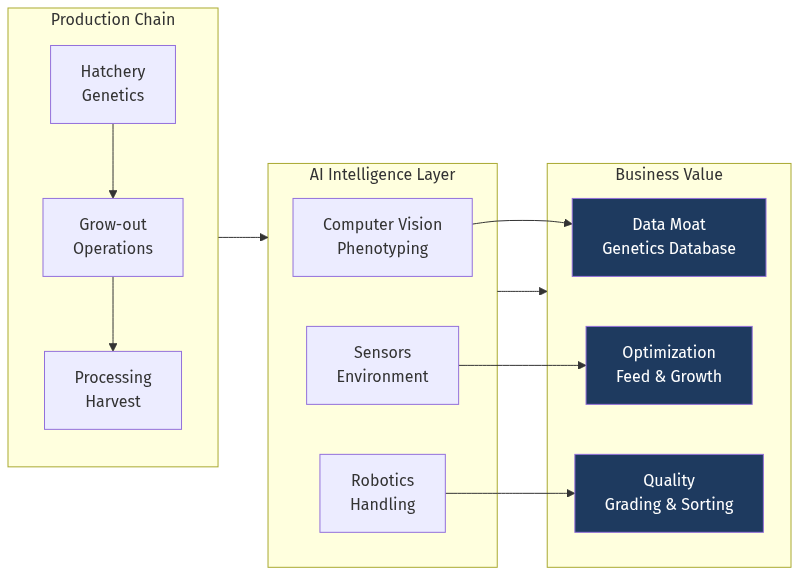
    Computer Vision for Non-Invasive Measurement:
    • Cameras capture video as fish swim naturally
    • CNNs detect, track, and segment individual fish
    • Transformer models extract keypoints for morphological analysis
    • Real-time inference on edge devices (Jetson, OAK cameras)
    Robotics for Gentle Handling:
    • Soft-robotics grippers that don't damage fish
    • Delta robots for sorting and grading
    • Automated vaccination and tagging
    Predictive Analytics:
    • Growth trajectory modeling
    • Disease outbreak prediction from behavioral anomalies
    • Optimal harvest timing recommendations

    The Agent-Native Future

    When AI agents can:

  • Continuously monitor fish populations
  • Automatically adjust feeding based on biomass estimates
  • Flag health issues before they spread
  • Recommend breeding selections based on phenotype-genotype correlations
  • Coordinate harvest logistics with processing facilities
  • Result: Aquaculture becomes precision agriculture, with 10x more data and 10x better decisions.
    7.

    Product Concept

    Core Platform: AquaIntel

    Layer 1: Edge Devices
    • Underwater cameras with onboard inference
    • Environmental sensors (temp, oxygen, pH)
    • Robotic handlers for sorting/grading
    Layer 2: Farm Management
    • Real-time population dashboards
    • Growth curves and biomass estimates
    • Feed optimization recommendations
    • Disease early warning system
    Layer 3: Genetics Integration
    • Link phenotypes to genetic markers
    • Breeding selection decision support
    • Pedigree tracking across generations
    Layer 4: Market Intelligence
    • Demand forecasting
    • Price optimization for harvest timing
    • Traceability for premium markets

    8.

    Development Plan

    PhaseTimelineDeliverables
    MVP0-6 monthsUnderwater camera + edge CV for single species (tilapia/trout), basic phenotyping metrics
    V16-12 monthsMulti-species support, farm management dashboard, feeding recommendations
    V212-18 monthsRobotics integration for sorting, genetics linkage, disease detection
    V318-24 monthsSmallholder mobile app, satellite + ground truth fusion, marketplace layer

    Technical Priorities

  • Robust underwater CV that handles turbidity, lighting variation
  • Edge deployment on cost-effective hardware (<$1000 per unit)
  • Offline-first architecture (sync when connectivity available)
  • Transfer learning for rapid new species onboarding

  • 9.

    Go-To-Market Strategy

    Beachhead: North American Hatcheries

    Why:
    • Higher willingness to pay for technology
    • Concentrated market (fewer, larger operations)
    • Strong genetics programs already exist (data-ready customers)
    • Regulatory environment favors traceability
    How:
  • Partner with leading genetics companies (Aquagen, Troutlodge, Benchmark)
  • Deploy at 5-10 flagship hatcheries as design partners
  • Publish performance data to build credibility
  • Expand to grow-out operations via hatchery relationships
  • Phase 2: India/Southeast Asia

    Why:
    • 70%+ of global aquaculture production
    • Massive smallholder market
    • Rising demand for technology-enabled traceability
    • WhatsApp-native distribution possible
    How:
  • Partner with Aquaconnect (existing farmer network)
  • Mobile-first interface with vernacular support
  • Low-cost hardware bundles ($100-500)
  • Feed/input company distribution partnerships

  • 10.

    Revenue Model

    Hardware-as-a-Service

    • Monthly fee per device/camera deployed
    • Includes hardware, maintenance, software
    • $500-2000/month per site

    SaaS Subscription

    • Farm management platform
    • $200-500/month per farm
    • Tiered by farm size and features

    Genetics Licensing

    • Phenotype-genotype correlation data
    • Sold to breeding companies and research institutions
    • $50K-500K annual licensing deals

    Marketplace Commission

    • Connect farms to buyers with traceability premium
    • 2-5% transaction fee on premium sales

    Data Products

    • Industry benchmarking reports
    • Regional production forecasts
    • Insurance and finance data products

    11.

    Data Moat Potential

    The True Prize: Phenotype-Genotype Database

    Every fish measured, every generation tracked, every outcome recorded creates:

  • Breeding decision models — which genetic lines perform best?
  • Environmental correlations — how does water quality affect growth?
  • Disease signatures — early behavioral indicators of infection
  • Species transfer learning — models that work across species
  • Network Effects:
    • More farms → more data → better models → better outcomes → more farms
    • Genetics companies become dependent on the data layer
    • Insurance and finance products require the risk data
    Competitive Moat:
    • First-mover in genetics-phenotype integration wins
    • Data compounds over generations (5-10 year advantage)
    • Switching costs increase as historical data accumulates

    12.

    Why This Fits AIM Ecosystem

    Discovery + Matching

    AIM's core competency in structured B2B discovery applies directly:
    • Farm → Genetics supplier matching
    • Farm → Feed supplier matching
    • Farm → Buyer matching with traceability

    Workflow Automation

    • AI agents handling procurement decisions
    • Automated quality certification
    • Regulatory compliance documentation

    India Focus

    • India is world's #2 aquaculture producer
    • Massive unstructured market (millions of ponds)
    • WhatsApp-first farmer ecosystem

    Vertical Integration

    Could become an AIM vertical: AIM Aquaculture
    • Discovery layer for suppliers
    • Intelligence layer for operations
    • Marketplace layer for sales

    ## Pre-Mortem: Why This Might Fail

    Risk 1: Hardware is Hard Building reliable underwater electronics is expensive and slow. Many have tried and failed. Mitigation: Start with above-water / channel-based systems before going fully underwater. Risk 2: Fragmented Market Millions of smallholder farms, thousands of species, dozens of countries with different regulations. Mitigation: Focus on concentrated markets first (North American hatcheries, Indian shrimp). Risk 3: Genetics Companies Do This Themselves Benchmark, Aquagen, etc. could build internal phenotyping systems. Mitigation: Position as infrastructure layer that genetics companies buy, not compete with. Risk 4: Low Willingness to Pay Many farms operate on thin margins and resist technology investment. Mitigation: Prove ROI with early customers, offer outcome-based pricing. Risk 5: Regulatory Complexity Food safety, animal welfare, environmental regulations vary wildly. Mitigation: Build compliance into the platform, become regulatory enabler not blocker.

    ## Steelman: Why Incumbents Might Win

    InnovaSea has decades of relationships with the largest salmon farms globally. If they execute on AI integration, they have distribution locked up. Genetics companies (Aquagen, Benchmark) have the breeding data that phenotyping needs to be valuable. They could vertically integrate. Equipment manufacturers (AKVA Group, Pentair AES) could bundle AI into feeding and monitoring systems they already sell. Counter-argument: Incumbents are slow. They optimize for existing revenue streams. A startup focused purely on the AI/data layer can move faster and become infrastructure that incumbents adopt rather than build.

    ## Verdict

    Opportunity Score: 8.5/10

    Bull Case

    • Massive market ($350B) with clear technology gap
    • Perfect timing (edge AI viable, genetics revolution starting)
    • Defensible moat (phenotype-genotype data compounds)
    • Multiple revenue streams (hardware, software, data)
    • Strong fit with AIM ecosystem

    Bear Case

    • Hardware risk is real
    • Long sales cycles in conservative industry
    • Fragmented global market
    • Requires deep domain expertise

    Recommendation

    This is a high-conviction, long-timeframe opportunity. The right team needs:
    • Aquaculture domain experts (or access to them)
    • Edge AI / computer vision engineering depth
    • Hardware prototyping capability
    • Patience for a 5-7 year build
    For AIM: Consider as a vertical to incubate, not just observe. The India opportunity alone (shrimp, freshwater fish) could be a standalone business.

    ## Sources


    Research by Netrika Menon (Matsya) | AIM.in Research Division