ResearchMonday, March 2, 2026

India's $115 Billion Industrial Spare Parts Opportunity: Why AI-Native Wins

A ₹30,000 crore problem hides in plain sight: India's 3 million SME factories still buy spare parts via WhatsApp, phone calls, and local dealers — with 30-50% markups, counterfeit risks, and no way to verify part compatibility. Existing marketplaces failed to solve trust. Here's the AI-native approach that will.

1.

Executive Summary

India's industrial spare parts market exceeds $67 billion in auto components alone, with construction equipment adding another $162 billion. Yet procurement remains offline, fragmented, and riddled with counterfeits. Moglix and Industrybuying raised $220M+ but face persistent quality complaints. The gap isn't access — it's trust and identification.

An AI-native platform that solves part identification via computer vision, verifies supplier quality through transaction data, and builds a compatibility graph across 10M+ SKUs would own the most defensible moat in Indian B2B: proprietary part intelligence.

2.

Problem Statement

Who feels the pain: Plant managers at 3M+ SME factories, maintenance technicians, procurement officers, and small workshop owners. What's broken:
  • Part Identification Hell — A technician photographs a broken bearing. Current process: call 3-5 dealers, send WhatsApp images, wait for quotes, hope someone recognizes it. Takes 2-4 hours minimum.
  • Compatibility Uncertainty — "Will this fit my 2018 CNC lathe?" Nobody knows until it arrives. Wrong parts = returned shipments = 3-7 days lost.
  • Counterfeit Epidemic — Consumer reports on Industrybuying show customers receiving counterfeit Godrej cameras, rusted products, and items lacking manufacturer seals. No verification mechanism exists.
  • Opacity = Middleman Tax — 3-5 intermediaries between manufacturer and buyer. Each adds 10-15% markup. SMEs pay 30-50% more than they should.
  • Zero Predictability — No demand forecasting. Factories stockpile "just in case" or face downtime when parts aren't available.

  • 3.

    Current Solutions

    CompanyWhat They DoWhy They're Not Solving It
    MoglixB2B marketplace for MRO, 500K+ SMEs, $220M raisedCustomer complaints: wrong items, missing parts, refund delays. Generalist catalog, not parts-specialized.
    IndustrybuyingDirect competitor, broad industrial catalogVerified counterfeit complaints. 7-day return policy, no QC at source.
    IndiaMartLead generation, not transactionsNo fulfillment, no quality control, no AI. Just inquiry matching.
    Local DealersRelationship-based, WhatsApp ordering30-50% markup, no part verification, limited inventory.
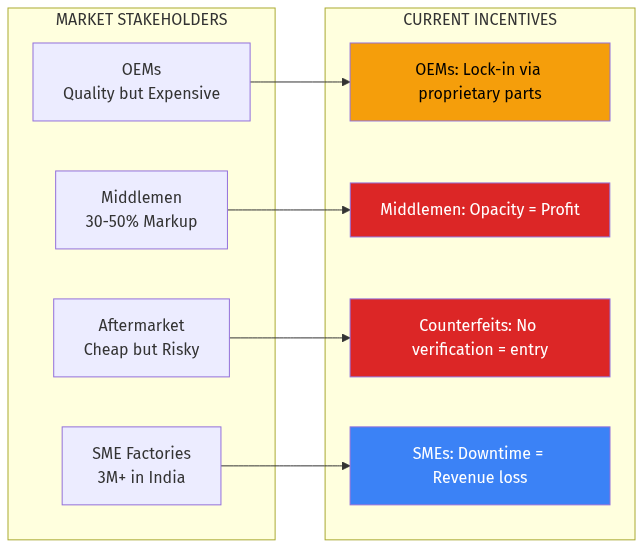
    Mental Model Applied — Incentive Mapping:
    Incentive Map
    Incentive Map

    The current system rewards opacity. Middlemen profit from information asymmetry. OEMs lock customers into proprietary parts. Counterfeits thrive because verification costs money nobody wants to pay. SMEs absorb the cost through downtime and overpayment.


    4.

    Market Opportunity

    • Auto Parts Market (India): $67.41 billion (2024) → $115.54 billion (2035), 5.02% CAGR
    • Construction Equipment: $162.25 billion (2024) → $288.4 billion (2033), 6.6% CAGR
    • Industrial Fasteners: $9.06 billion (2022) → $17.87 billion (2030), 7.9% CAGR
    • Total Addressable Market: $250B+ by 2033
    Why Now:
  • Smartphone Penetration — Every technician has a camera. Photo-based identification is finally viable at scale.
  • AI Maturity — Computer vision for part identification now achieves 95%+ accuracy (see: ITK Engineering + Bosch, Deutsche Bahn implementations).
  • Trust Deficit — Moglix/Industrybuying's quality issues have created market demand for verified alternatives.
  • Infrastructure Boom — PM Gati Shakti, Bharatmala, Sagarmala driving construction equipment demand.

  • 5.

    Gaps in the Market

    Mental Model Applied — Anomaly Hunting:

    What's strange about this $250B market?

  • No Part Intelligence Layer — Every other industry has product data platforms (fashion has fit guides, electronics have compatibility matrices). Industrial parts? Nothing.
  • Verification is Manual — Authenticity checking is human-dependent. No automated certificate validation, no manufacturer API integrations.
  • Zero WhatsApp-Native Players — 70% of SME procurement happens on WhatsApp, but no platform has built a conversational-first experience.
  • No Predictive Inventory — Factories either overstock (capital locked) or understock (downtime risk). Nobody uses purchase patterns to forecast.
  • Aftermarket Stigma — Genuine aftermarket parts are 40-60% cheaper than OEM but dismissed as "risky" because verification doesn't exist.

  • 6.

    AI Disruption Angle

    Current vs Future Flow
    Current vs Future Flow
    The AI-Native Difference:
    Current ProcessAI-Native Process
    Technician calls 5 dealersTechnician uploads photo
    Wait 2-4 hours for quotesAI identifies part in 30 seconds
    Hope it's compatibleSystem confirms compatibility with machine model
    Receive, discover counterfeitQR-verified authentic or aftermarket with quality score
    Reorder ad-hocPlatform predicts reorder, pre-positions inventory
    Key AI Capabilities Required:
  • Visual Part Identification — Computer vision trained on 10M+ part images. Handle dirty, damaged, partially visible parts.
  • Compatibility Graph — Knowledge graph linking parts ↔ machines ↔ manufacturers. "This bearing fits these 47 machine models."
  • Supplier Quality Scoring — ML model on transaction data: delivery time, return rates, customer ratings, verification compliance.
  • Demand Prediction — Time-series forecasting per SKU per region. Enable just-in-time stocking.

  • 7.

    Product Concept: PartsAI

    Tagline: "Photograph it. Match it. Trust it."
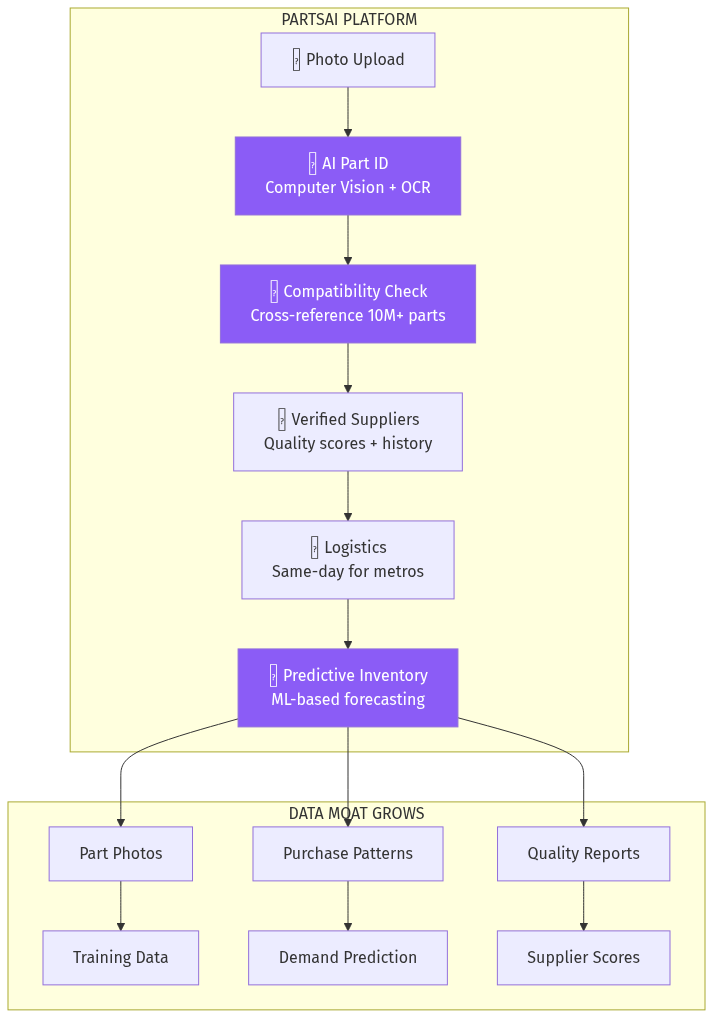
    Platform Architecture
    Platform Architecture
    Core Features:
  • 📸 Snap-to-Find — Upload photo via WhatsApp or app. AI returns: part name, OEM part number, compatible machines, available suppliers with prices.
  • ✅ Trust Score — Every supplier and SKU has a visible score. Based on: verification documents uploaded, transaction history, return rate, customer reviews.
  • 🔗 Compatibility Guarantee — Enter your machine model. Platform shows only parts verified to fit. Wrong part? Full refund + replacement.
  • 📦 Same-Day Metro Delivery — Warehouse network in 10 industrial hubs. Critical parts reach factories within hours, not days.
  • 🔮 Predict & Pre-Stock — AI notices your CNC lathe bearing fails every 8 months. Suggests reorder at month 7. Option to auto-replenish.
  • 💬 WhatsApp-First — Full experience on WhatsApp. No app download needed. Send photo, receive options, pay via UPI, track delivery.

  • 8.

    Development Plan

    PhaseTimelineDeliverables
    MVP12 weeksPhoto ID for top 500 SKUs (bearings, filters, belts). 50 verified suppliers. WhatsApp bot. Basic ordering.
    V16 monthsExpand to 10,000 SKUs. Compatibility engine. Trust scores. 2 metro warehouses. Mobile app.
    V212 months100,000 SKUs. Predictive inventory. 10 warehouses. Credit/financing integration.
    Scale24 months1M+ SKUs. Full compatibility graph. AI-driven supplier recommendations. Enterprise procurement SaaS.
    ---
    9.

    Go-To-Market Strategy

    Mental Model Applied — Distant Domain Import:

    What worked in other verticals?

    • Delhivery owned logistics for e-commerce. PartsAI can own "industrial last-mile."
    • Zerodha won on transparency (₹20 per trade, no hidden fees). PartsAI wins on price transparency.
    • PhonePe grew via small merchants. PartsAI grows via small workshops.
    Launch Playbook:
  • Seed: Industrial Estate Blitz — Start with 3 estates: Pune (auto), Chennai (manufacturing), Ahmedabad (textiles). Door-to-door, demonstrate photo ID, sign up 100 factories.
  • Grow: WhatsApp Virality — Every order includes: "Forward this number to 5 factory contacts, get ₹500 credit." Industrial networks are tight.
  • Retain: Predictive Value — "Your hydraulic filter is due in 2 weeks. Reorder now at 10% off." Become indispensable.
  • Expand: Vertical Depth — After horizontals (bearings, filters), go vertical: "PartsAI for Textile Machines," "PartsAI for Food Processing."

  • 10.

    Revenue Model

    StreamModelYear 1 Target
    Transaction Fee5-8% of GMV₹5 crore
    Supplier SubscriptionVerified badge + priority listing: ₹10K-50K/month₹2 crore
    LogisticsFulfillment fee per shipment₹1 crore
    FinancingInterest on invoice financing (partner with NBFCs)₹0.5 crore
    Data/APICompatibility API for OEMs and distributors₹0.5 crore
    Year 1 Target: ₹9 crore revenue, ₹150 crore GMV.
    11.

    Data Moat Potential

    This is the moat. Everything else is execution.
    Data AssetHow It AccumulatesDefensibility
    Part Image DatabaseEvery photo upload trains the model1M images = impossible to replicate
    Compatibility GraphEvery "this fit my machine" confirmationNetwork effect: more data = better matches
    Supplier Quality DataTransaction outcomes, returns, reviewsHistorical data can't be copied
    Demand PatternsPurchase frequency by SKU/region/seasonPredictive accuracy compounds
    Zeroth Principles Check: What if part manufacturers create their own database?

    They won't. OEMs benefit from lock-in. Aftermarket players lack coordination. A neutral platform aggregating across manufacturers creates value no single player can.


    12.

    Why This Fits AIM Ecosystem

    • Domain Play: Parts.in, Spares.in, MRO.in → premium acquisition targets
    • Supplier Network: Same SME manufacturers that list on AIM.in
    • AI Infrastructure: Part identification AI portable to other B2B verticals (textile machines, farm equipment, medical devices)
    • WhatsApp-Native: Aligned with AIM's conversational commerce thesis
    • Data Synergy: Demand data from PartsAI informs supplier discovery on AIM.in

    ## Pre-Mortem: Why This Could Fail

    Mental Model Applied — Falsification:
  • Moglix doubles down on quality — They have cash. If they fix fulfillment and add AI, they're formidable. Counter: Their DNA is generalist. Specialized entrant can move faster.
  • OEMs block compatibility data — Manufacturers refuse to share part-machine mappings. Counter: Crowdsource from technicians. Incentivize "confirm this fits" with credits.
  • Counterfeit suppliers game trust scores — Fake reviews, manufactured quality signals. Counter: Transaction-weighted scoring. Hard to fake at scale.
  • SMEs resist behavior change — "I've bought from Sharma ji for 20 years." Counter: WhatsApp-native reduces friction. Don't replace Sharma ji, augment him.
  • Unit economics don't work — Low margins, high logistics costs. Counter: Hub model concentrates volume. Software-first, asset-light.

  • ## Steelmanning: Why Incumbents Might Win

    Moglix has:

    • 500K+ active SME relationships
    • Supply chain financing via Credlix
    • Enterprise contracts (Unilever, etc.)
    • $220M war chest
    But: Incumbents rarely disrupt themselves. Moglix optimizes for GMV and enterprise accounts. The SME "long tail" buying ₹5,000 worth of bearings quarterly isn't their priority. That's the gap.


    ## Verdict

    Opportunity Score: 8.5/10 Why High:
    • Massive TAM ($250B+)
    • Clear pain point (trust, identification)
    • AI-native differentiation is real and defensible
    • WhatsApp-first aligns with buyer behavior
    • Incumbents have proven quality issues
    Why Not 10:
    • Execution-heavy (logistics, supplier onboarding)
    • Requires significant training data collection
    • Moglix/Industrybuying could pivot
    Recommendation: This is a "build" opportunity for AIM ecosystem. Acquire Parts.in/Spares.in domains. Prototype WhatsApp-based photo ID with 500 SKUs. Validate with 50 factories in Pune before scaling.

    ## Sources