ResearchMonday, March 2, 2026

AI-Powered Corporate Meal Marketplace: The Untapped SMB Opportunity in India's $4B Catering Market

While HungerBox serves enterprises and Sodexo feeds Fortune 500 cafeterias, millions of SMB employees cobble together lunch through chaotic WhatsApp groups and inconsistent tiffin services. The gap? A $1.5B market with no AI-native solution.

1.

Executive Summary

India's corporate catering market is valued at $4 billion (INR 33,000 crore) and growing at 5.2% CAGR. But here's the anomaly: while enterprises have HungerBox (831 cafeterias, preparing for IPO) and global players like Sodexo/Compass, SMBs with 50-500 employees remain completely underserved.

These companies don't have cafeterias. They don't qualify for enterprise catering contracts. Their employees rely on fragmented tiffin services, random caterers, or expensive food delivery apps. The coordination happens on WhatsApp groups. The quality is inconsistent. The billing is manual.

The opportunity: An AI-powered marketplace connecting SMB offices with verified local food suppliers—tiffin services, cloud kitchens, home chefs, and caterers—with subscription management, demand prediction, and WhatsApp-first ordering.
2.

Problem Statement

Who Feels This Pain?

HR Managers at SMBs who spend 5-10 hours monthly coordinating lunch arrangements, managing complaints, and chasing vendors for invoices. Office Admins fielding daily questions: "What's for lunch today?" "Why is the food cold?" "Can we get something different?" Employees who either overspend on Swiggy/Zomato (₹200-300/meal) or eat inconsistent tiffin food with no way to give feedback. Tiffin Service Operators who lose clients due to communication gaps, late payments, and inability to scale beyond word-of-mouth.

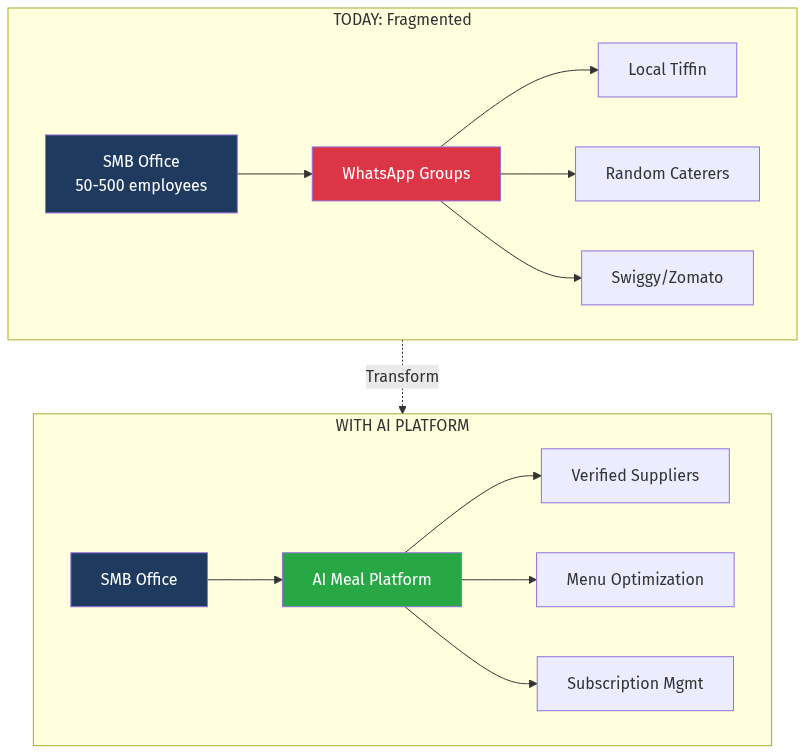
The Chaos Today

Current vs Future State
Typical SMB lunch workflow:
  • Someone creates a WhatsApp group
  • They find a local tiffin service through referrals
  • Orders are collected manually via chat
  • Vendor delivers; no tracking, no feedback loop
  • Billing happens end-of-month via bank transfer
  • Quality drops after 2 months; cycle repeats
  • Result: 78% of corporate decision-makers report rising cafeteria costs, and 50% of the market remains self-operated due to lack of good alternatives.
    3.

    Current Solutions

    CompanyWhat They DoWhy They're Not Solving SMB
    HungerBoxTech-enabled cafeteria management for enterprisesMin. 500+ employees, requires physical cafeteria, 831 locations only
    Sodexo IndiaGlobal contract cateringEnterprise-focused, minimum contract size ~₹50L/year
    Compass Group600K meals daily across 450+ locationsHealthcare, education, large corporates only
    Elior India110K meals daily, 8 brandsPremium pricing, enterprise contracts
    Swiggy CorporateMeal vouchers/creditsPer-meal basis, no supplier aggregation, expensive
    Local Tiffin ServicesHome-cooked meals deliveredNo tech, no scale, inconsistent quality

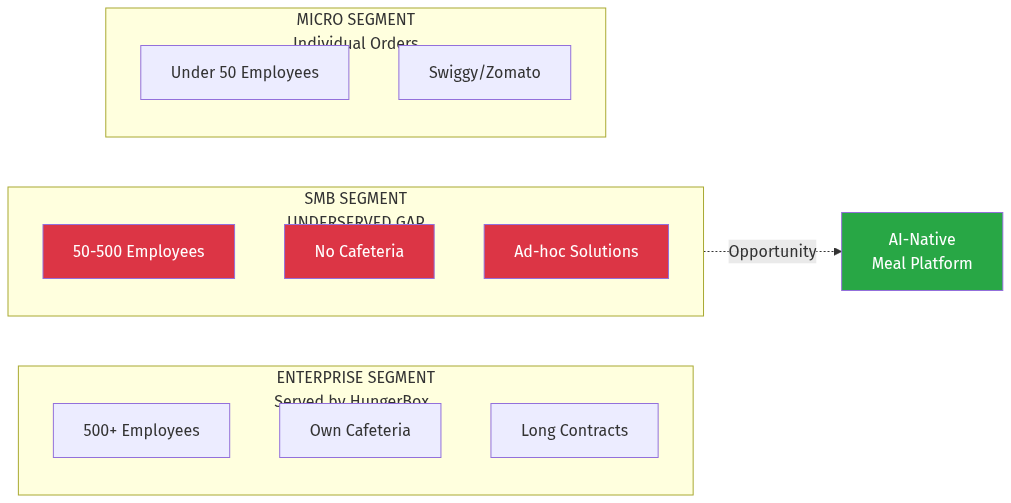
    The Missing Middle

    Market Segmentation
    Market Segmentation
    Enterprises (500+ employees): Well-served by HungerBox, Sodexo, Compass Micro (under 50): Individual Swiggy/Zomato orders work fine SMBs (50-500): THE GAP. Too small for enterprise solutions, too large for individual ordering chaos.
    4.

    Market Opportunity

    Market Size

    • Total B2B Catering Market: $4 billion (INR 33,000 crore) in 2025
    • Growing to: $6.3 billion by 2034 (5.2% CAGR)
    • SMB Segment (50-500 employees): Estimated 35-40% of market = $1.4-1.6 billion
    • Currently served by organized players: Less than 10%

    India's SMB Landscape

    • 63 million MSMEs in India
    • ~2 million have 50-500 employees (target segment)
    • Average meal spend: ₹100-150/employee/day
    • Working days: ~22/month
    • Per-company opportunity: ₹1-3 lakh/month
    • Total addressable market: ₹20,000-50,000 crore annually

    Why Now?

  • Post-COVID hybrid work created flexible dining needs—employees don't come every day
  • Cloud kitchen boom (30-40% growth 2019-2024) created supply-side capacity
  • WhatsApp Business API enables B2B ordering without app downloads
  • AI can now predict demand, optimize menus, match suppliers intelligently
  • Employee wellness is top priority—companies invest in better food

  • 5.

    Gaps in the Market

    Gap 1: No Unified Marketplace

    Tiffin services operate hyperlocal. A startup in Whitefield can't find reliable suppliers in Koramangala. There's no Swiggy-equivalent discovery for B2B meal subscriptions.

    Gap 2: Zero Demand Intelligence

    Suppliers cook the same quantity daily. If 40% of employees work from home on Fridays, food gets wasted. No system predicts attendance-based demand.

    Gap 3: Manual Everything

    Orders via WhatsApp messages. Payments via bank transfer. Feedback via angry calls. Billing via Excel. The entire workflow is 2010-era.

    Gap 4: Quality Control Vacuum

    No ratings. No hygiene scores. No standardized SLAs. The tiffin service that delivered great food last month might have changed cooks.

    Gap 5: Dietary Fragmentation

    Modern offices have vegetarians, vegans, Jains, keto dieters, diabetics, and everything in between. Suppliers struggle to manage variety; offices struggle to communicate preferences.
    6.

    AI Disruption Angle

    What AI Enables

    Demand Prediction:
    • Integrate with company HRMS/attendance systems
    • Predict office attendance based on calendar events, holidays, weather
    • Reduce food waste by 25-40%
    Menu Optimization:
    • Analyze order patterns: which dishes get reordered vs. which get complaints
    • Auto-generate weekly menus balancing nutrition, variety, and cost
    • Personalize recommendations per employee based on dietary history
    Supplier Matching:
    • Match offices with suppliers based on cuisine, capacity, location, ratings
    • Dynamic routing: if primary supplier can't fulfill, auto-assign backup
    • Quality scoring based on delivery time, temperature, feedback
    WhatsApp-First UX:
    • Employees order via WhatsApp: "Tomorrow's lunch: Paneer butter masala meal"
    • Admins manage subscriptions without downloading apps
    • Suppliers receive consolidated orders, not 200 individual messages

    Distant Domain Import: Airline Catering

    Airlines solved this decades ago: predict passenger counts, manage dietary preferences (Hindu/Jain/Diabetic/Kosher), optimize menus by route, maintain quality across suppliers globally.

    Translate to corporate meals:
    • Passenger count → Office attendance prediction
    • Flight manifest → Employee dietary profiles
    • Catering load → Supplier capacity management
    • Meal service timing → Delivery windows

    7.

    Product Concept

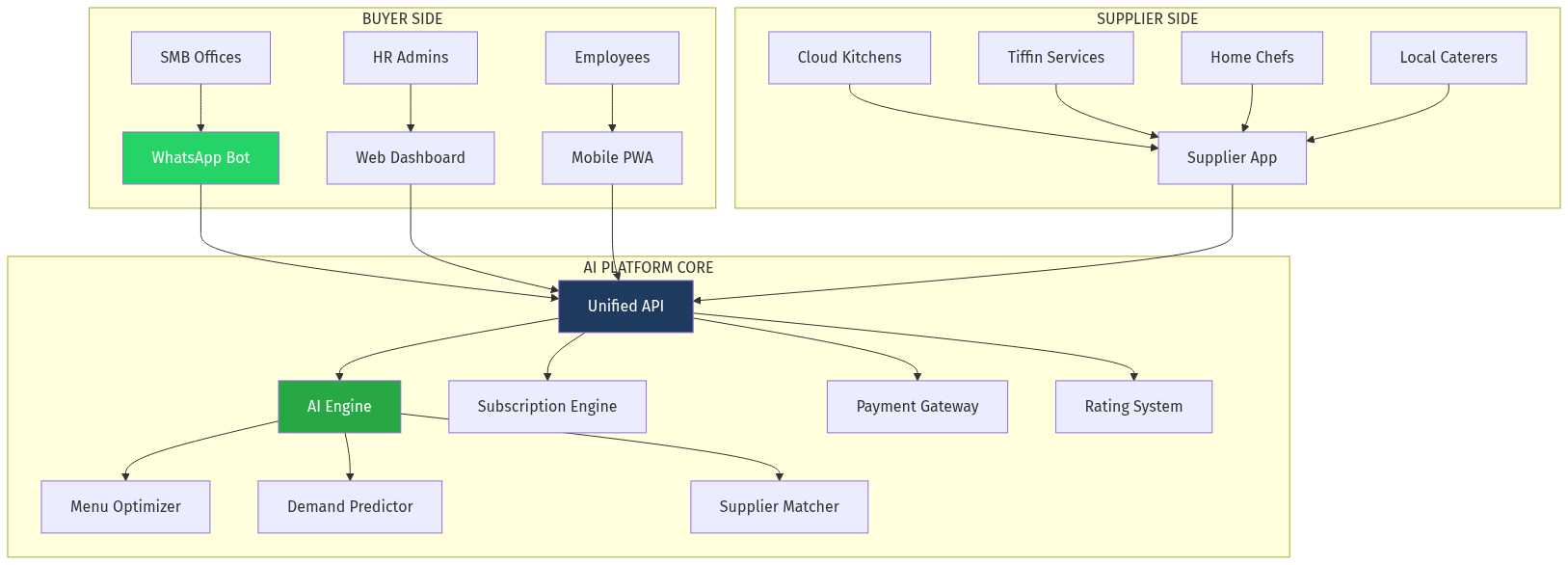
    Architecture

    Platform Architecture
    Platform Architecture

    Core Features

    For Office Admins:
    • One-click signup for company
    • Browse/filter suppliers by cuisine, price, ratings, capacity
    • Set weekly/monthly subscription plans
    • Manage employee dietary preferences
    • Track orders, payments, complaints in dashboard
    • Monthly invoices with GST
    For Employees:
    • WhatsApp-based ordering (no app needed)
    • View menu, customize meal, provide feedback
    • Save dietary preferences (Jain, low-carb, allergies)
    • Rate each meal (1-5 stars + quick tags)
    For Suppliers:
    • Supplier app for order management
    • Demand forecast: "Tomorrow expect 85 orders (±10)"
    • Menu performance analytics
    • Quality score and improvement suggestions
    • Automated payment settlement

    AI Engine

  • Attendance Predictor: ML model trained on historical attendance + calendar data
  • Menu Recommender: Collaborative filtering on meal ratings
  • Supplier Ranker: Multi-factor scoring (quality, reliability, price, capacity)
  • Waste Optimizer: Match predicted demand with supplier capacity

  • 8.

    Development Plan

    PhaseTimelineDeliverables
    MVP8 weeksWhatsApp bot for ordering, basic admin dashboard, 10 pilot suppliers in Bangalore
    V14 weeksSubscription management, payment integration (Razorpay), supplier app
    V26 weeksAI demand prediction, menu optimization, multi-city launch (Hyderabad, Pune)
    V38 weeksHRMS integrations, dietary preference engine, enterprise tier

    Tech Stack

    • Backend: Node.js/Fastify on Railway/Fly.io
    • Database: PostgreSQL (Supabase) + Redis for caching
    • WhatsApp: WhatsApp Cloud API via Kapso
    • AI/ML: Python microservice for predictions, OpenAI for menu generation
    • Payments: Razorpay
    • Frontend: Next.js PWA

    9.

    Go-To-Market Strategy

    Phase 1: Bangalore Pilot (Month 1-3)

  • Partner with 10 cloud kitchens/tiffin services in Whitefield, Koramangala, HSR
  • Onboard 20 SMB offices (target: tech startups, coworking spaces)
  • Offer free 2-week trial with subsidized pricing
  • Gather feedback obsessively — iterate weekly
  • Phase 2: Prove Unit Economics (Month 4-6)

    • Target: 100 offices, 5,000 daily meals
    • Commission: 12-15% from suppliers
    • Gross margin target: 18-20%
    • Focus metric: Repeat subscription rate >80%

    Phase 3: City Expansion (Month 7-12)

    • Launch Hyderabad (strong startup ecosystem)
    • Launch Pune (IT services hub)
    • Hire city managers for local supplier onboarding

    Acquisition Channels

  • Coworking partnerships: WeWork, Awfis, 91springboard offer meal services to members
  • HR SaaS integrations: Partner with Darwinbox, Keka, Zoho People
  • LinkedIn targeting: HR managers, office managers at Series A-C startups
  • Referrals: ₹5,000 credit for each referred company

  • 10.

    Revenue Model

    Revenue StreamDescriptionTarget
    Supplier Commission12-15% per orderPrimary revenue
    Subscription SaaS Fee₹5-10/employee/month for admin dashboardSecondary
    Premium ListingsSuppliers pay for visibility boostTertiary
    Fintech FloatHold payments for 7 days before settlementInterest income

    Unit Economics (Per Company)

    • Average company: 100 employees
    • Active orderers: 60%
    • Orders/month: 60 × 22 = 1,320
    • Average order value: ₹120
    • GMV/month: ₹1,58,400
    • Commission (13%): ₹20,592
    • SaaS fee (₹7 × 100): ₹700
    • Revenue/company/month: ₹21,292
    • CAC target: ₹25,000 (payback in 1.2 months)

    11.

    Data Moat Potential

    Over 24 months, the platform accumulates:
  • Meal preference data: What 50,000+ employees eat, when, and how often
  • Attendance patterns: Which companies have Friday WFH, which have Monday spikes
  • Supplier performance: Granular quality scores based on millions of data points
  • Pricing intelligence: What companies pay per meal across geographies
  • Menu optimization data: Which dishes work for which demographics
  • This data enables:
    • Predictive analytics sold to suppliers (forecast demand)
    • Benchmarking reports for HR teams (compare meal costs)
    • Private-label meal kits (eventually)

    12.

    Why This Fits AIM Ecosystem

    Domain Portfolio Leverage

    • meals.in — Brand domain
    • corporatefood.in — SEO play
    • officelunch.in — Exact match keyword

    AI-Native From Day One

    Unlike HungerBox (which added tech to existing cafeteria operations), this platform is AI-first: built around predictions, recommendations, and automation.

    Vertical Integration Path

    Start with meal aggregation → move to:

    • Office pantry supplies (snacks, beverages)
    • Corporate wellness services
    • Event catering marketplace

    AIM Thesis Alignment

    "Help buyers DECIDE, not just ASK." An HR manager asking "Who can cater 100 meals daily in Whitefield under ₹100/meal?" gets an instant, ranked answer—not a lead form.


    13.

    Risk Assessment (Pre-Mortem)

    Why Might This Fail?

  • HungerBox goes downmarket: They have ₹32M funding and IPO plans. Could they target SMBs?
  • - Counter: Their model requires physical cafeterias. SMBs don't have them.
  • Swiggy launches B2B subscriptions: They have supply, distribution, and capital.
  • - Counter: Their economics don't work at ₹100/meal. They optimize for ₹300+ orders.
  • Suppliers prefer direct relationships: Why pay 13% commission?
  • - Counter: Demand aggregation + payment guarantee + reduced coordination overhead.
  • Quality consistency is unsolvable: Tiffin services are inherently variable.
  • - Counter: Rating systems + SLAs + multiple supplier options per office.

    Steelmanning the Incumbents

    "Sodexo/Compass could create SMB-focused offerings."

    True, but:

    • Their cost structures require minimum contracts of ₹50L+/year
    • Their salesforce targets enterprise procurement, not startup HR
    • Their tech is legacy—bolted on, not AI-native
    • They've had 20 years to do this and haven't
    ---

    14.

    Verdict

    Opportunity Score: 8.5/10

    The Bull Case

    • Large market ($1.5B SMB segment) with zero dominant player
    • Clear pain point experienced by millions daily
    • AI creates genuine differentiation (demand prediction, menu optimization)
    • WhatsApp-first UX reduces adoption friction to near-zero
    • Strong unit economics at scale (13% take rate, 80% retention)
    • Multiple expansion vectors (pantry, wellness, events)

    The Bear Case

    • Operationally intensive (supply quality is hard to control)
    • City-by-city expansion required (supply is hyperlocal)
    • Dependency on supplier reliability
    • Competition from well-funded cloud kitchens if they pivot B2B

    Final Take

    This is a "boring" opportunity—food logistics, local operations, daily grind. But boring is underrated. HungerBox built to ₹900 crore GTV serving enterprises. The SMB segment is larger, more fragmented, and waiting for someone to bring AI-native intelligence to the chaos.

    The winner will be whoever builds the tightest supplier network in 5 key cities and creates genuine demand prediction capabilities. It's not a winner-take-all market, but a winner in each geography will be defensible.

    Recommended next step: MVP in Bangalore with 10 suppliers, 20 offices, WhatsApp-first ordering. Prove 80% retention in 90 days.

    ## Sources