ResearchMonday, March 2, 2026

AI Sales Agents: The $50B Race to Replace Human SDRs

The sales development rep (SDR) is the most expensive, repetitive, and soon-to-be-automated role in B2B sales. With 11x reaching $350M valuation and ElevenLabs hitting $11B, we're witnessing the birth of an entirely new category: autonomous digital workers that prospect, call, and book meetings while you sleep.

1.

Executive Summary

The global SDR/BDR market represents $50B+ in annual salary spend. Companies pay $80-150K per SDR in the US ($8-15K in India) for humans who spend 70% of their time on repetitive tasks: scraping leads, writing emails, making cold calls, and logging CRM data.

AI sales agents promise to collapse this cost structure by 90% while multiplying output by 10x. The question isn't whether this happens—it's who captures the value.

The opportunity: Build AI-native sales infrastructure for markets where current solutions don't work (Indian languages, regional compliance, SMB pricing) while the giants fight over enterprise logos.

2.

Problem Statement

Who feels the pain?
  • Founders: Can't afford $100K SDRs but need pipeline
  • Sales leaders: Manage teams with 80% turnover, inconsistent performance
  • SDRs themselves: Burning out on 100 calls/day with 2% connection rates
What's broken today:
  • Unit economics: Full-loaded SDR cost = $120K/year. Average meetings booked = 8-12/month. Cost per meeting = $800-1,200.
  • Scale constraints: Hiring an SDR takes 2-3 months. Training takes another 3. Ramp to productivity = 6 months. Turnover = 14 months average.
  • Quality variance: Top 20% of SDRs generate 80% of pipeline. The rest are expensive noise.
  • Data decay: Contact databases decay at 30%/year. Manual research can't keep pace.

  • 3.

    Current Solutions

    CompanyWhat They DoWhy They're Not Solving It
    11x.aiAutonomous SDR (Alice) + phone rep (Jordan)$350M valuation = enterprise pricing. No Indian language support.
    ArtisanAI employee "Ava" for outboundEarly stage, limited voice capabilities.
    Regie.aiAI content + sequencesAugmentation, not replacement. Still needs humans.
    AiSDRYC W24, automated outreachEmail-focused, no voice.
    OutreachSales engagement platformEnterprise tool, not AI-native. Augments, doesn't replace.
    The gap: These tools optimize for US enterprise. Nobody is building for:
    • SMBs who can't afford $2K/month/seat
    • Indian/regional language voice agents
    • Markets where email deliverability is already dead (India, LATAM)

    4.

    Market Opportunity

    • Global SDR/BDR salary market: $50B+ annually (estimated 500K SDRs worldwide × $100K avg)
    • India SDR market: ~₹7,000 Cr ($800M) — 100K+ SDRs at ₹7L average
    • AI sales tools TAM: $15B by 2028 (Gartner)
    • Voice AI market: $8B by 2027 (45% CAGR)
    Why now:
  • LLM capabilities: GPT-4 class models can research companies, personalize messaging, handle objections
  • Voice quality: ElevenLabs, Sarvam, Deepgram have made AI voice indistinguishable from human
  • Cost collapse: Running an AI agent costs $0.10-0.50 per conversation vs $10+ for human
  • Buyer behavior shift: 80% of B2B buyers prefer digital-first engagement (Gartner)

  • 5.

    Gaps in the Market

    Applying Anomaly Hunting:
  • The India paradox: India exports 100K+ SDRs to US companies but has no domestic AI SDR product. Why? Because existing tools don't support Hindi/regional voices, and pricing assumes US budgets.
  • The WhatsApp blindspot: 500M Indians use WhatsApp for business. AI SDR tools focus on email+phone. Nobody is building WhatsApp-native sales agents.
  • The SMB desert: 11x charges $2K+/month. Indian SMBs need $200/month solutions. The gap is 10x.
  • The voice localization gap: Sarvam AI has 30+ Indian voices but no sales agent product. ElevenLabs has sales integrations but no Indian language support. Someone needs to bridge this.
  • The compliance void: India's TRAI regulations require consent for commercial calls. AI agents need built-in DNC checking, time restrictions, consent tracking. Nobody does this well.

  • 6.

    AI Disruption Angle

    AI SDR Evolution
    AI SDR Evolution
    The transformation:
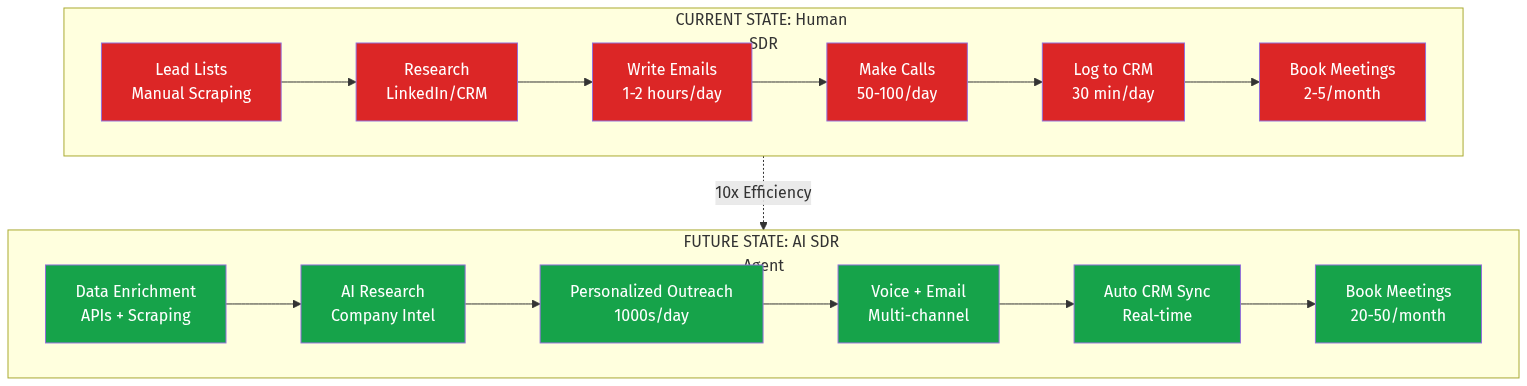
    MetricHuman SDRAI SDR Agent
    Calls/day50-1001,000+
    Emails/day50-1005,000+
    Research time2 hrs/dayReal-time
    CRM loggingManual, 30 minAutomatic
    Cost/meeting$800-1,200$50-100
    Availability8 hrs/day24/7
    Language support1-230+
    The AI agent stack:
  • Data layer: Intent signals + enrichment APIs (Bombora, Apollo, ZoomInfo)
  • Intelligence layer: LLM for research, personalization, objection handling
  • Voice layer: TTS/STT with natural conversation (ElevenLabs, Sarvam)
  • Orchestration: Multi-channel sequences with adaptive timing
  • Integration: CRM sync, calendar booking, handoff to humans

  • 7.

    Product Concept: "Bharat SDR"

    What it does: AI-native sales development platform for Indian markets with:
  • WhatsApp-first outreach: Voice notes, text sequences, catalog sharing
  • Indian language voice calls: Hindi, Tamil, Telugu, Kannada, Bengali (via Sarvam)
  • TRAI-compliant calling: Built-in DNC checking, consent management, time restrictions
  • SMB pricing: ₹15,000/month for unlimited conversations (vs $2K+ for 11x)
  • Vertical templates: Real estate, education, financial services, manufacturing
  • Key differentiators:
    • WhatsApp Business API integration (nobody else does this)
    • Regional voice with cultural context (not American accent speaking Hindi)
    • Pay-per-meeting pricing option for SMBs
    • Instant CRM sync with Zoho/Freshsales (India's dominant CRMs)

    8.

    Development Plan

    PhaseTimelineDeliverables
    MVP8 weeksWhatsApp text sequences + basic voice calls + Zoho integration
    V112 weeksMulti-language voice (5 languages) + CRM auto-sync + meeting booking
    V216 weeksFull autonomy: research, personalization, objection handling, handoffs
    Scale24 weeksEnterprise features, compliance certifications, white-label
    Tech stack:
    • Voice: Sarvam AI (Indian languages) + ElevenLabs (English)
    • LLM: Claude/GPT-4 for intelligence, fine-tuned models for domain knowledge
    • Orchestration: Custom workflow engine with human-in-loop controls
    • Infrastructure: India-hosted for latency + data residency

    9.

    Go-To-Market Strategy

    Phase 1: Prove the model (Months 1-3)
  • Partner with 5 real estate developers in Hyderabad/Bangalore
  • Replace 2-3 SDRs per developer with AI agent
  • Track: meetings booked, conversion rate, cost savings
  • Target: 50% cost reduction, 2x meetings
  • Phase 2: Vertical expansion (Months 4-6)
  • Education (coaching institutes, ed-tech)
  • Financial services (insurance, mutual funds)
  • Manufacturing (industrial equipment, raw materials)
  • Phase 3: Platform play (Months 7-12)
  • Open self-serve platform
  • Reseller/agency program
  • API for developers
  • Acquisition channels:
    • WhatsApp groups (Vizag Startups, local business groups)
    • Case study content on LinkedIn
    • Partnerships with CRM vendors (Zoho, Freshsales)
    • Integration with existing sales tools

    10.

    Revenue Model

    ModelPriceTarget Segment
    Starter₹15,000/monthSMBs, 1-5 salespeople
    Growth₹50,000/monthMid-market, 5-20 salespeople
    EnterpriseCustomLarge teams, custom integrations
    Pay-per-meeting₹500/meetingRisk-free trial for skeptics
    Unit economics at scale:
    • CAC: ₹30,000 (heavily referral-driven)
    • LTV: ₹3,60,000 (24-month average retention × ₹15K)
    • LTV/CAC: 12x
    • Gross margin: 80% (compute is cheap, voice API costs declining)

    11.

    Data Moat Potential

    What accumulates over time:
  • Conversation data: Every call, every objection, every successful close. Fine-tune models on what works in Indian sales contexts.
  • Industry playbooks: "What works in Hyderabad real estate" becomes proprietary IP.
  • Voice models: Custom voices trained on successful sales conversations (with consent).
  • Intent signals: If a lead opened 3 WhatsApp messages but didn't respond to calls, that's behavioral data competitors don't have.
  • Compliance database: DNC lists, consent records, TRAI exemptions—operational data that's painful to rebuild.

  • 12.

    Why This Fits AIM Ecosystem

    AI SDR Landscape
    AI SDR Landscape
    Direct alignment:
  • B2B marketplace thesis: AIM helps buyers decide. AI SDR is the seller-side counterpart—helping suppliers reach buyers efficiently.
  • Distribution leverage: 5,000 domains, Vizag Startups network, existing relationships with SMBs = instant GTM channel.
  • Data synergy: AIM accumulates buyer intent data. Feed that into AI SDR for hyper-targeted outreach.
  • Agent orchestration: This becomes another avtar in the Dashavatara—"Vamana" the expansion agent, reaching markets AIM cannot directly serve.
  • Vertical specialization: Start with verticals AIM already covers (construction materials, RCC pipes, industrial equipment).

  • ## Pre-Mortem: Why This Could Fail

    Applying Falsification:
  • Voice quality backlash: If AI calls feel robotic or manipulative, regulatory crackdown could kill the category. Mitigation: Transparency ("This is an AI assistant"), human handoff for interested leads.
  • WhatsApp policy risk: Meta could restrict business API access or increase costs 10x. Mitigation: Multi-channel from day 1, don't be WhatsApp-dependent.
  • Spam fatigue: If everyone uses AI SDRs, response rates collapse industry-wide. Mitigation: Focus on quality signals, not volume. AI should be better at targeting, not just faster at spamming.
  • Incumbents pivot: 11x launches Hindi support, Zoho builds in-house AI SDR. Mitigation: Move fast, lock in vertical expertise, build relationships incumbents can't replicate.
  • Unit economics don't scale: Sarvam/ElevenLabs increase API pricing, margins compress. Mitigation: Build proprietary voice models as you scale.

  • ## Steelmanning: Why Incumbents Might Win

    The case for 11x/Artisan:
    • $74M+ in funding = infinite runway to add languages
    • Enterprise relationships = credibility with CFOs
    • Existing data moat = years of conversation training data
    • Talent density = top AI researchers, not available in India
    Counter-argument:
    • Enterprise focus is a feature, not a bug. They won't chase ₹15K/month SMBs—the unit economics don't work for them.
    • Indian language voice requires cultural context, not just translation. Outsiders consistently underestimate this.
    • Distribution in India requires ground game (WhatsApp groups, local events, relationship sales). VC-funded US startups won't do this.

    ## Verdict

    Opportunity Score: 8.5/10 Why high:
    • Massive market ($50B globally, $800M India)
    • Clear technology unlock (voice AI quality + LLM intelligence)
    • Defensible gap (Indian languages, WhatsApp-native, SMB pricing)
    • AIM ecosystem synergy (distribution, data, vertical expertise)
    Why not 10:
    • Execution risk is high (voice AI is hard, sales automation is crowded)
    • Regulatory uncertainty (TRAI, WhatsApp policies)
    • Competition from well-funded incumbents expanding into India
    Recommendation: This is a "build" opportunity, not "wait and see." The window for regional AI SDR players is 18-24 months before 11x/Artisan localize. Move now with vertical focus (real estate, education), prove unit economics, then expand.

    The best outcome: AIM acquires this capability as a product line, turning the marketplace into a full-stack B2B platform—helping buyers decide AND helping sellers reach them.


    ## Sources