ResearchMonday, March 2, 2026

AI-Powered Industrial Water Treatment Marketplace: India's $6B Compliance Crisis Opportunity

India's industrial water treatment market hits $3.3B in 2024, growing to $6.1B by 2033. Yet 72% of industrial wastewater goes untreated. SMEs struggle with fragmented vendors, opaque pricing, and CPCB compliance nightmares. No dominant B2B platform exists. This is a $6 billion opportunity hiding in plain sight.

1.

Executive Summary

India's industrial water treatment sector is a paradox: critical infrastructure supporting $350B+ in manufacturing, yet operating through WhatsApp groups and phone calls. Zero Liquid Discharge (ZLD) mandates are tightening. Pollution Control Boards are getting aggressive. SMEs face closure threats for non-compliance.

The opportunity: Build the "Infra.Market for industrial water" — an AI-powered B2B marketplace connecting factories with ETP installers, chemical suppliers, and O&M providers, while automating the compliance nightmare that keeps plant managers awake at night.

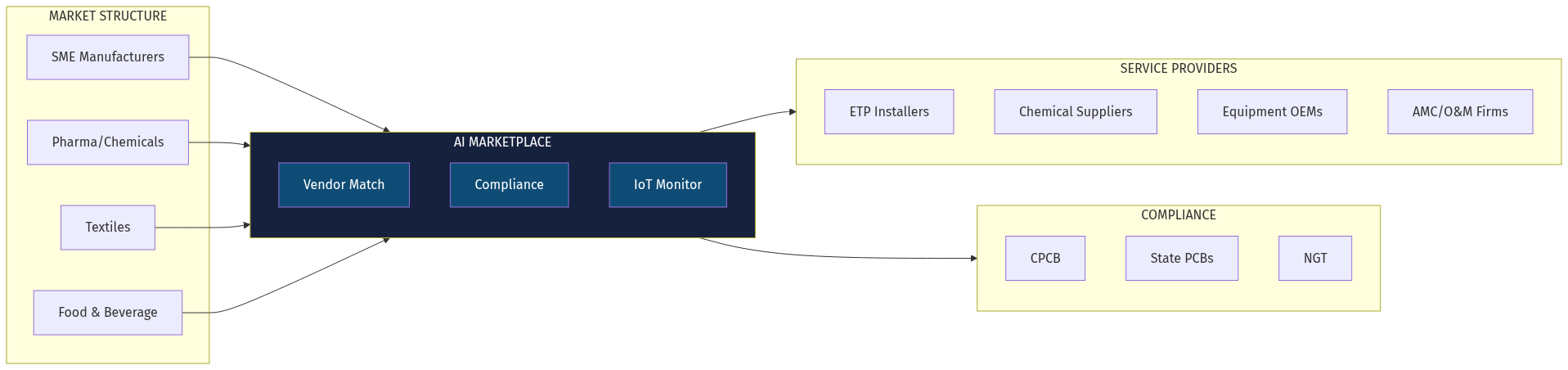
Market Flow
Market Flow

2.

Problem Statement

Who feels this pain?
  • 63,000+ registered factories under pollution control mandates
  • SME manufacturers (textiles, pharma, chemicals, food processing)
  • Plant managers juggling production AND environmental compliance
What's broken?
  • Vendor Discovery is Medieval: Finding an ETP installer means asking neighbors, calling 10 vendors, comparing incompatible quotes
  • Compliance is a Black Box: CPCB/SPCB norms change frequently; SMEs don't know what hit them until NGT issues closure notices
  • Pricing Opacity: Same membrane filter — 3x price variance between suppliers
  • Zero Predictive Maintenance: Plants run ETPs till failure, triggering emergency repairs and compliance violations
  • Documentation Hell: Monthly CPCB returns, CTO renewals, Form V submissions — all manual, error-prone
  • The Zeroth Principle question: Why do factories treat water treatment as a grudge purchase instead of a strategic asset? Answer: Because the infrastructure to make it easy doesn't exist. No price transparency. No performance benchmarks. No compliance autopilot.
    3.

    Current Solutions

    CompanyWhat They DoWhy They're Not Solving It
    Indra WaterPatented ElectroX tech, 99% water recyclingTechnology-first, not marketplace; serves enterprise clients
    ThermaxFull-stack ETP solutionsEnterprise-focused; SMEs can't afford ₹50L+ turnkey projects
    IndiaMARTListings for ETP equipmentLead gen only; no compliance, no verification, no transaction layer
    Ion ExchangeChemicals and equipmentProduct company, not platform; regional presence gaps
    Bariflo LabsIndustrial wastewater recyclingEarly-stage; focused on tech not aggregation
    Gap: No platform that combines vendor discovery + price transparency + compliance automation + IoT monitoring.
    4.

    Market Opportunity

    Market Size

    • 2024: USD 3.3 billion (industrial water treatment, India)
    • 2033: USD 6.1 billion (7.1% CAGR)
    • Addressable segment: Effluent treatment growing fastest at 6.2% CAGR

    Growth Drivers

    DriverImpact
    ZLD mandates expanding17 polluting sectors under strict norms
    Water scarcity crisis40% freshwater deficit projected by 2030
    NGT activism₹100Cr+ penalties issued in 2024-25
    Make in IndiaNew factories need compliant ETPs from Day 1

    Why Now?

  • Regulatory inflection: 2026 brings mandatory online monitoring (CEQMS) for all polluting industries
  • Technology readiness: IoT sensors now cost <₹5K; real-time compliance is feasible
  • SME digitization: Post-COVID, factory owners use apps for everything except water treatment
  • Startup precedent: Infra.Market proved B2B construction marketplaces work at scale

  • 5.

    Gaps in the Market

    Market Architecture
    Market Architecture

    Anomalies Worth Investigating

  • No verification layer: Any vendor can claim "ISO certified ETP solutions" — zero validation
  • No performance data: Unlike construction (where you can see a building), ETP performance is invisible until failure
  • Compliance outsourcing vacuum: Factories hire consultants for ₹50K/year who file forms manually — ripe for automation
  • Chemical procurement chaos: Factories don't know if they're overpaying 200% for the same PAC/alum
  • AMC market is WhatsApp-driven: Annual maintenance contracts negotiated via chat, no SLAs, no accountability
  • Incentive Map

    StakeholderCurrent IncentivePlatform Disruption
    ETP vendorsMaximize project costPerformance-based pricing visible
    Chemical suppliersLock in repeat ordersTransparent pricing breaks lock-in
    Compliance consultantsBill hourly, keep clients dependentAutomation commoditizes their work
    Factory ownersAvoid fines, minimize spendPredictive compliance saves money
    ---
    6.

    AI Disruption Angle

    How AI Agents Transform This Workflow

    Today:
    Factory → Calls 5 vendors → Gets 5 incompatible quotes → 
    Negotiates for weeks → Signs contract → 
    Installs ETP → Forgets about it → 
    Gets NGT notice → Panics → Emergency fixes
    With AI Agents:
    Factory → Describes requirement → AI matches 3 verified vendors →
    Standardized quotes auto-generated → AI negotiates best terms →
    Installation tracked → IoT monitors 24/7 →
    AI files CPCB returns automatically → Predicts failures before they happen

    Specific AI Applications

    FunctionAI Role
    Vendor MatchingSemantic search on requirements, verified ratings, project history
    Quote NormalizationConvert varied quote formats into comparable spec sheets
    Compliance AutopilotParse CPCB norms, auto-generate Form V, flag renewal deadlines
    Predictive MaintenanceIoT sensor data → ML models predict membrane fouling, chemical depletion
    Price IntelligenceTrack chemical prices across suppliers, alert on anomalies

    Distant Domain Import

    From logistics: Delhivery tracks parcels in real-time. Why can't we track ETP performance? From fintech: Credit scoring for vendors based on project completion rates, compliance history
    7.

    Product Concept

    Core Platform: "AquaHub.in"

    For Factories:
    • Post water treatment requirement
    • Get matched with 3 verified vendors
    • Compare standardized quotes
    • Track installation progress
    • Monitor ETP via IoT dashboard
    • Auto-file CPCB/SPCB returns
    For Vendors:
    • Verified profile with project portfolio
    • Lead qualification (no more tire-kickers)
    • Digital quote submission
    • Payment protection (milestone-based)
    • Performance ratings visible
    For Regulators:
    • Real-time compliance data via API
    • Authenticated submissions
    • Anomaly detection on self-reported data

    Key Differentiators

  • Compliance-first: Every feature ties back to regulatory compliance
  • IoT-native: Sensors + platform = closed loop
  • Verified vendors only: Site visits, project verification, reference checks
  • Transaction layer: Escrow, milestone payments, dispute resolution

  • 8.

    Development Plan

    PhaseTimelineDeliverables
    MVP12 weeksVendor directory, quote requests, basic matching
    V18 weeksCompliance module, CPCB form generator, renewal alerts
    V210 weeksIoT integration, predictive dashboards, chemical procurement
    ScaleOngoingAI agents for negotiation, full transaction layer

    Tech Stack

    • Frontend: Next.js (fast, SEO-friendly for vendor profiles)
    • Backend: Node.js + PostgreSQL (compliance audit trails)
    • IoT: MQTT broker, TimescaleDB for sensor data
    • AI: LLM for document parsing, time-series models for predictions

    9.

    Go-To-Market Strategy

    Phase 1: Industrial Clusters (Months 1-6)

  • Start with one cluster: Ankleshwar (Gujarat) — 500+ chemical factories, strict GPCB oversight
  • Partner with local ETP vendors: Onboard 20 verified installers
  • Compliance hook: "Free CPCB compliance audit" — drives factory sign-ups
  • Referral loop: Factory managers know each other; one success spreads
  • Phase 2: Vertical Expansion (Months 6-12)

    • Add textile clusters (Surat, Tirupur)
    • Pharma hubs (Hyderabad, Ahmedabad)
    • Food processing zones (Punjab, Maharashtra)

    Phase 3: Platform Effects (Year 2)

    • Chemical suppliers compete on platform
    • IoT partnerships with sensor manufacturers
    • Integration with state pollution control portals

    Distribution Insight

    Who influences the buyer?
    • Plant managers (execution)
    • EHS officers (compliance)
    • Chartered engineers (technical sign-off)
    • CA firms (for environmental audit)
    Unconventional channel: Partner with CA firms who do environmental audits — they see non-compliance first.
    10.

    Revenue Model

    StreamModelPotential
    Lead fees₹2,000-10,000 per qualified lead to vendors₹10Cr/year at scale
    Transaction cut2-3% on equipment/installation₹15Cr/year
    Compliance SaaS₹5,000/month per factory₹12Cr/year
    IoT subscription₹3,000/month for monitoring₹8Cr/year
    Chemical marketplace5% take rate on orders₹20Cr/year
    Total addressable revenue: ₹65Cr/year at 5,000 active factories.
    11.

    Data Moat Potential

    What Accumulates Over Time

  • Vendor performance data: Completion rates, quality scores, compliance violations — no one else has this
  • Pricing intelligence: Real transaction data across 1,000s of quotes normalizes the market
  • Compliance patterns: Which factories struggle with what norms — regulatory advisory service
  • IoT sensor data: Anonymized patterns predict failures across factory types
  • Chemical consumption benchmarks: Industry-specific usage patterns enable optimization
  • Network Effects

    • More factories → more vendors compete → better prices → more factories
    • More IoT data → better predictions → lower downtime → more factories adopt monitoring

    12.

    Why This Fits AIM Ecosystem

    Direct Alignment

  • Industrial B2B: Core AIM thesis — structured marketplaces for fragmented industries
  • Compliance layer: Regulatory tech is a moat; factories can't leave once integrated
  • Recurring revenue: SaaS + marketplace = predictable cash flows
  • Data exhaust: Every transaction feeds AIM's industrial intelligence layer
  • Cross-sell: Water treatment vendors also sell to construction, pharma — AIM expansion paths
  • Synergies with Existing Verticals

    • RCC/Construction: Same factories that need pipes also need ETPs
    • MRO Procurement: Overlap in industrial buyers
    • GeM Intelligence: Government factories also need water treatment compliance

    ## Pre-Mortem: Why This Could Fail

  • Sales cycles too long: Enterprise water projects take 6-12 months; SME focus mitigates this
  • Vendor resistance: Incumbents benefit from opacity; verification + ratings may face pushback
  • Regulatory capture: Large players may lobby against digital compliance (unlikely — government wants transparency)
  • Execution complexity: IoT + marketplace + compliance = three products; sequence matters
  • Steelman: Why Incumbents Win

    • Thermax bundles financing + equipment + AMC — hard to unbundle
    • IndiaMART has distribution; could add verification layer
    • Government portals (CPCB's own submission system) could improve
    Counter: Incumbents are too profitable in current model to disrupt themselves. CPCB portal is for submission, not discovery.

    ## Verdict

    Opportunity Score: 8.5/10 Why High:
    • Large market ($6B by 2033) with clear fragmentation
    • Regulatory tailwind (ZLD mandates, CEQMS requirements)
    • No dominant platform despite obvious pain points
    • AI-native from Day 1 (compliance automation + IoT predictions)
    • Strong data moat potential
    Why Not 9+:
    • Enterprise segment dominated by Thermax/Ion Exchange (avoid)
    • Requires IoT partnerships to differentiate (execution dependency)
    • Regional playbooks needed for each state PCB
    Recommendation: Build. Start with compliance-first positioning in one industrial cluster. Prove that automated CPCB filing + vendor matching reduces factory compliance risk. Expand from there.

    ## Sources