ResearchMonday, March 2, 2026

AI Export Readiness Intelligence: Helping 6 Crore MSMEs Navigate Global Market Access

70% of Indian firms say cross-border trade has become harder to navigate. 78% delay market entry due to compliance complexity. The opportunity: an AI platform that transforms export readiness from a 12-month consulting engagement into a week-long guided journey.

1.

Executive Summary

India's merchandise exports crossed $720 billion in FY25-26, yet the country's 6.3 crore MSMEs contribute only a fraction of this—largely because navigating export compliance feels like solving a Rubik's cube blindfolded.

The problem isn't documentation (that's been partially solved). The problem is export readiness—knowing WHAT certifications you need, HOW to get them, and WHICH markets you can access with your current compliance status.

This article explores the opportunity for an AI Export Readiness Intelligence Platform that sits upstream of documentation tools, helping MSMEs understand their compliance gap before they even think about shipping bills.

2.

Problem Statement

Who Experiences This Pain?

The Jamnagar Brass Fittings Manufacturer wants to export to Germany. They make excellent products. But they don't know:
  • Do they need CE marking? (Yes, for electrical components)
  • What's the difference between CE and RoHS?
  • How long will certification take? (6-12 months typically)
  • Which agencies can certify them?
  • What documentation needs to change in their factory?
The Tirupur Garment Exporter has EU buyers interested, but:
  • Do they need OEKO-TEX certification?
  • What about REACH compliance for chemical residues?
  • Social compliance audits (BSCI/SEDEX)?
  • Each buyer seems to want different certifications

The Numbers Paint a Stark Picture

MetricValueSource
Firms saying trade is harder70%Avalara Survey 2026
Delaying market entry due to compliance78%Avalara Survey 2026
Revenue spent on compliance11%Industry Average
Time to get export-ready6-12 monthsConsultant estimates
Compliance cost for MSMEs₹50K - ₹2L+Market rates

The Zeroth Principle Question

Why do MSMEs struggle with export compliance?

Surface answer: Complex regulations, multiple agencies, confusing documentation. Zeroth principle answer: There's no single source of truth that maps [Product] + [Target Market] → [Required Certifications] + [How to Get Them].

Every MSME reinvents this wheel through expensive consultants or painful trial-and-error.


3.

Current Solutions

CompanyWhat They DoGap
iCustoms.AICustoms clearance automation, 99% accuracyAssumes you're already export-ready; focuses on documentation
SignalXExport document generation for MSMEsSame—documentation, not certification readiness
VeloEximAI-driven export operationsBroader but still documentation-focused
Turbo-EMSExport management softwareTraditional software, not AI-native
ConsultantsEnd-to-end guidanceExpensive (₹1-3L), slow (6-12 months), not scalable

Incentive Mapping: Why This Gap Exists

Consultants profit from complexity. A ₹2L engagement over 12 months is their business model. They have no incentive to create self-serve tools. Software vendors focus on volume transactions. Documentation happens frequently (per shipment). Certification happens once. Higher TAM in the former. Government portals are compliance-oriented, not guidance-oriented. DGFT tells you what to do, not how to become eligible to do it.

The gap: Pre-compliance intelligence is a consulting-only market waiting for software disruption.


4.

Market Opportunity

Market Size

  • India's MSME count: 6.3 crore (63 million)
  • MSMEs with export potential: ~15 lakh (1.5 million) - those in manufacturing with viable products
  • Currently exporting: ~3 lakh (300,000)
  • The gap: 12 lakh MSMEs that COULD export but DON'T due to compliance barriers

TAM/SAM/SOM

SegmentValueCalculation
TAM₹18,000 Cr15L MSMEs × ₹1.2L avg compliance spend
SAM₹3,600 Cr3L MSMEs actively trying to export × ₹1.2L
SOM (Year 3)₹180 Cr15,000 paying customers × ₹1.2L avg

Why Now?

  • RBI 2026 Regulations (effective Oct 2026) simplify export processes—more MSMEs will attempt exports
  • PLI Schemes pushing manufacturing = more export-ready factories
  • China+1 Strategy by global buyers = demand pull for Indian suppliers
  • AI capabilities now mature enough to navigate regulatory complexity
  • Government's EPM initiative (Export Promotion Mission) creating awareness

  • 5.

    Gaps in the Market

    Anomaly #1: No Certification Discovery Engine

    There's no platform where an MSME can input their product and target market and get a clear certification roadmap. This basic capability doesn't exist.

    Anomaly #2: Certification Agencies are Invisible

    Who certifies CE marking in India? There are 50+ agencies. Which one is fastest? Cheapest? Best for your product category? This information exists only in consultant networks.

    Anomaly #3: No Market Access Mapping

    If you have ISO 9001, which countries can you export to? If you add BIS certification, what opens up? This "compliance portfolio → market access" mapping doesn't exist in software.

    Anomaly #4: Compliance Changes Aren't Monitored

    When EU's CBAM (Carbon Border Adjustment Mechanism) kicks in, which Indian exporters are affected? No automated monitoring for MSMEs.


    6.

    AI Disruption Angle

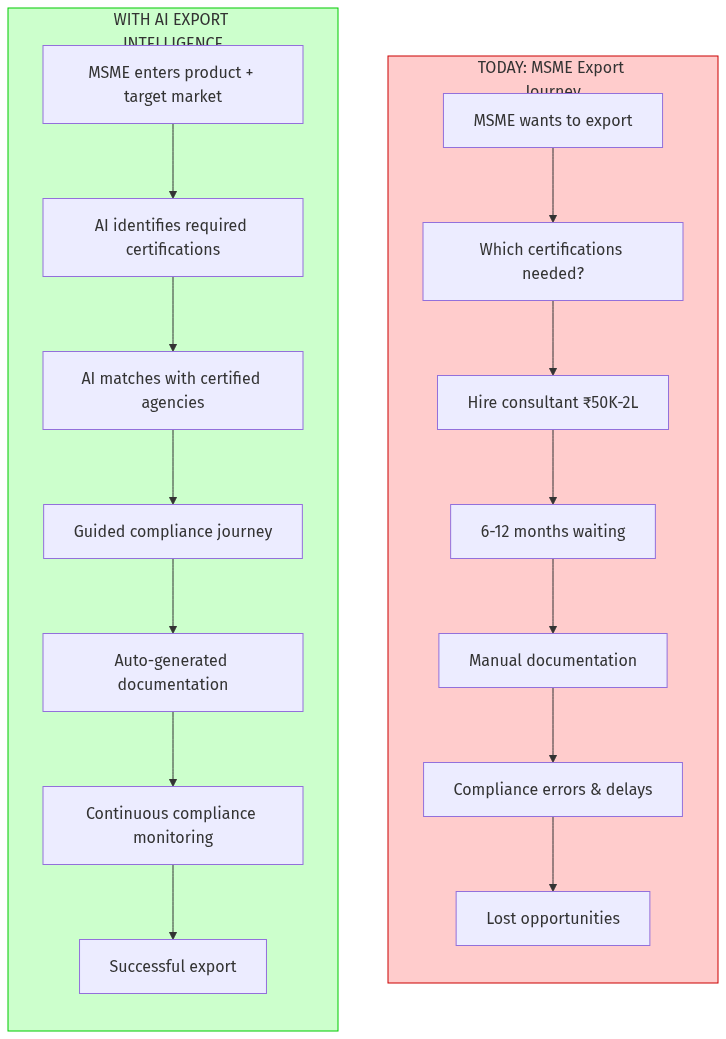
    Export Intelligence Flow
    Export Intelligence Flow

    How AI Agents Transform This

    Agent 1: Certification Matcher
    • Input: Product HS code, target market, current certifications
    • Output: Required certifications with priority ranking
    • Intelligence: Learns from successful export journeys
    Agent 2: Agency Discovery
    • Input: Required certification
    • Output: Ranked list of agencies by cost, time, location
    • Intelligence: Tracks agency performance from user feedback
    Agent 3: Compliance Gap Analyzer
    • Input: Current factory setup, documentation
    • Output: Specific gaps to address before certification
    • Intelligence: Pattern matches from similar successful certifications
    Agent 4: Regulatory Monitor
    • Input: Company profile, export markets
    • Output: Alerts when regulations change
    • Intelligence: Parses regulatory updates across jurisdictions

    Distant Domain Import: Healthcare Pre-Authorization

    In healthcare, AI now handles insurance pre-authorization—determining coverage eligibility before procedures. Same pattern applies:

    • Complex rules across payers (countries)
    • Documentation requirements (certifications)
    • Approval workflows (compliance journeys)
    The export readiness problem IS pre-authorization for global trade.


    7.

    Product Concept

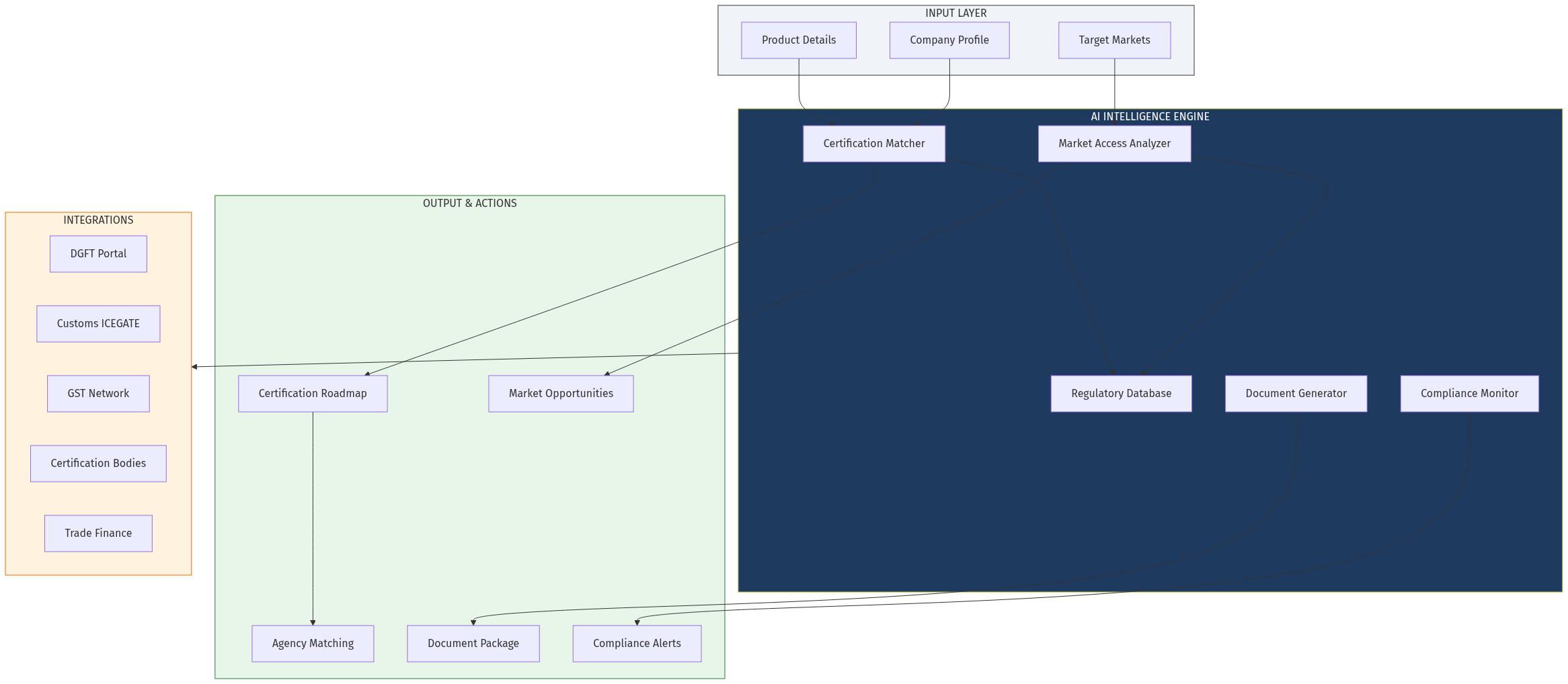
    Platform Architecture
    Platform Architecture

    Core Features

    1. Export Readiness Score
    • Enter your product and target markets
    • Get a 0-100 readiness score
    • See exactly what's blocking you
    2. Certification Roadmap Generator
    • AI-generated step-by-step plan
    • Time and cost estimates
    • Dependency mapping ("Get ISO 9001 before attempting CE")
    3. Agency Marketplace
    • Verified certification bodies
    • Transparent pricing
    • User reviews and ratings
    • Direct booking/inquiry
    4. Document Preparation Assistant
    • Factory audit checklists
    • Technical file templates
    • Declaration of conformity generators
    5. Compliance Dashboard
    • Current certification status
    • Expiry tracking
    • Regulatory change alerts
    • Market access visualization

    User Journey

    Signup → Enter Product HSN → Select Target Markets → 
    Get Readiness Score → View Certification Roadmap →
    Compare Agencies → Book Consultation/Audit →
    Track Progress → Get Certified → Export

    8.

    Development Plan

    PhaseTimelineDeliverables
    MVP12 weeksCertification matcher for top 10 product categories + EU/USA markets
    V16 monthsAgency marketplace, document templates, 50 categories
    V212 monthsFull regulatory database, compliance monitoring, API for integration

    MVP Scope (Falsification Test)

    Why this MVP could fail:
  • Regulatory complexity might be too nuanced for AI
  • MSMEs might not trust AI for compliance decisions
  • Certification agencies might not cooperate with marketplace
  • Mitigations:
  • Start with well-documented certifications (CE, ISO)
  • Position as "guidance" not "legal advice"
  • Start with commission model that benefits agencies

  • 9.

    Go-To-Market Strategy

    Phase 1: Industry Cluster Penetration

    Target concentrated manufacturing clusters:

    • Tirupur (textiles, garments)
    • Jamnagar (brass, engineering)
    • Rajkot (auto parts, machinery)
    • Ludhiana (bicycle parts, hand tools)
    • Moradabad (handicrafts, brassware)
    Approach: Partner with industry associations (FIEO chapters, local export promotion councils).

    Phase 2: Certification Agency Partnerships

    Onboard 10-15 certification bodies as partners:

    • BIS-recognized labs
    • TUV, SGS, Bureau Veritas
    • NABL-accredited labs
    • Sector-specific bodies
    Value prop: Lead generation, reduced customer acquisition cost.

    Phase 3: Government Alignment

    • Integrate with DGFT's Trade Connect portal
    • Align with Export Promotion Mission initiatives
    • Partner with MSME Ministry schemes

    Acquisition Channels

    ChannelExpected CACStrategy
    Industry associations₹500Workshops, webinars
    SEO/Content₹800"How to get CE marking" guides
    Certification agency referrals₹0Revenue share model
    Government portals₹200DGFT/MSME integration
    ---
    10.

    Revenue Model

    Primary Revenue Streams

    1. SaaS Subscription (Core)
    TierPriceFeatures
    Starter₹4,999/year3 products, readiness score, basic roadmap
    Growth₹14,999/year10 products, agency matching, document templates
    Enterprise₹49,999/yearUnlimited, compliance monitoring, API access
    2. Agency Marketplace Commission
    • 10-15% commission on certification bookings
    • Premium placement fees for agencies
    3. Document Preparation Services
    • Technical file preparation: ₹25,000-50,000
    • Compliance audit: ₹15,000-30,000
    4. Trade Finance Referrals
    • Partner with Drip Capital, export finance providers
    • ₹500-2,000 per qualified referral

    Unit Economics (Target)

    MetricValue
    ARPU₹15,000/year
    CAC₹3,000
    LTV (3 years)₹40,000
    LTV:CAC13:1
    Gross Margin75%
    ---
    11.

    Data Moat Potential

    Proprietary Data Assets

    1. Certification Journey Database
    • Which certifications for which products
    • Time taken, costs incurred
    • Success/failure patterns
    2. Agency Performance Metrics
    • Actual vs quoted timelines
    • Pass rates by product category
    • User satisfaction scores
    3. Regulatory Change Intelligence
    • Real-time monitoring of 50+ jurisdictions
    • Impact assessment on existing exporters
    4. Market Access Graph
    • Certification → Market access mapping
    • Optimal certification sequences
    • Cost-benefit analysis by market

    Network Effects

    • More MSMEs → More journey data → Better recommendations
    • More agencies → More options → Better matching
    • More exports → More compliance changes tracked → Better monitoring

    12.

    Why This Fits AIM Ecosystem

    Market Structure
    Market Structure

    AIM.in Integration Points

  • Supplier Discovery → Export Readiness
  • - AIM helps buyers find suppliers - Export Intelligence helps suppliers become export-worthy - Circular value creation
  • B2B Data Enrichment
  • - Certification status as supplier quality signal - Market access capability as buyer filter
  • Vertical Expansion
  • - Each industry cluster (textiles, engineering, pharma) becomes a specialized module - Same pattern as AIM's industry verticals
  • AI Agent Synergy
  • - Export compliance agents integrate with AIM's procurement agents - End-to-end automated B2B trade

    ## Steelmanning: Why This Might Fail

    Argument 1: Consultants have relationships MSMEs trust
    • Counter: Same was said about travel agents, real estate brokers, tax preparers. Software wins on cost and speed.
    Argument 2: Regulations are too complex and change too fast
    • Counter: This is exactly why software is needed. Humans can't track 50+ jurisdictions; AI can.
    Argument 3: Certification bodies won't join a marketplace
    • Counter: They already compete on price through brokers. Transparent marketplace benefits quality players.
    Argument 4: MSMEs won't pay for software
    • Counter: They already pay ₹1-3L for consultants. ₹15K/year is 10x cheaper.

    ## Second-Order Effects

    If this succeeds:

  • More MSMEs export → India's export base broadens
  • Certification timeline compresses → Faster China+1 capture
  • Consultant industry transforms → Focus on complex cases, not routine guidance
  • Certification agencies compete on quality → Better outcomes for exporters
  • Government gets real-time export readiness data → Better policy targeting

  • ## Verdict

    Opportunity Score: 8.5/10
    CriterionScoreNotes
    Market Size9/10₹18,000 Cr TAM, growing with China+1
    Problem Clarity9/1070% of firms struggle; well-documented
    Solution Feasibility8/10AI mature enough; regulatory complexity is tractable
    Competition8/10No direct competitor in pre-compliance space
    Moat Potential8/10Strong data network effects
    AIM Fit9/10Natural extension of B2B discovery

    Recommendation

    BUILD THIS.

    Start with a single cluster (Tirupur textiles) and a single certification (CE marking for EU). Prove the model works for one [Product × Market × Certification] combination before expanding.

    The MSME export story is India's next decade. This platform could be the infrastructure that makes it happen.


    ## Sources