ResearchMonday, March 2, 2026

AI-Powered Equipment Rental Marketplace: India's $13 Billion Fragmented Opportunity

India's construction equipment rental market is a $13+ billion behemoth running on WhatsApp messages and handshake deals. 70% operates on spreadsheets. Equipment sits idle 60% of the time. An AI-native marketplace could double utilization, cut downtime by half, and capture the infrastructure boom's tailwinds.

1.

Executive Summary

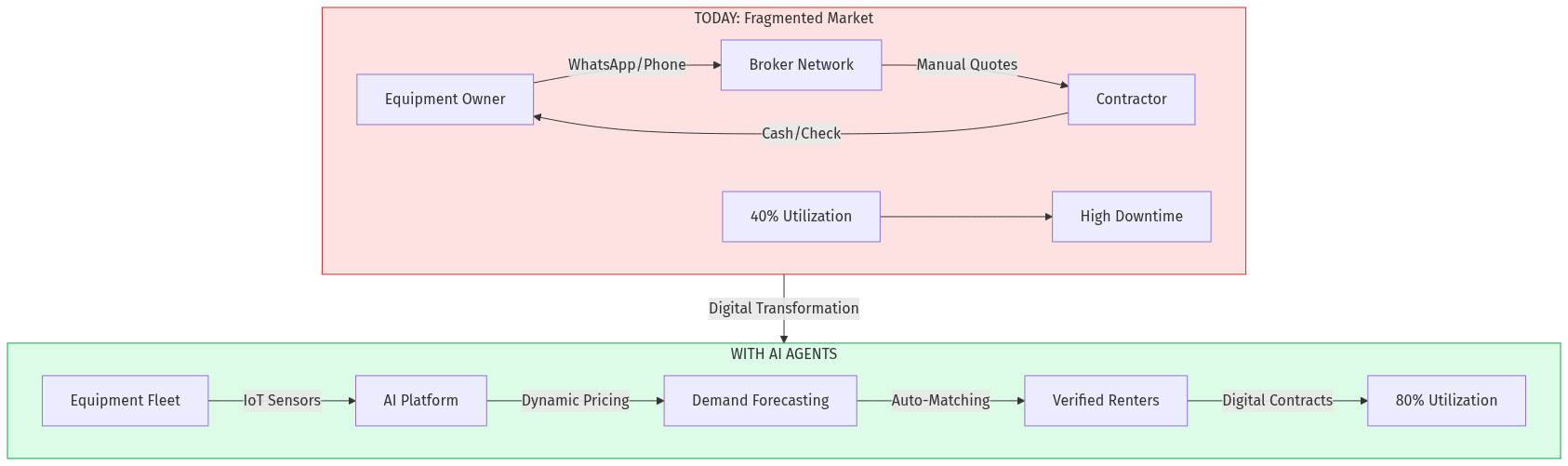
India's construction equipment rental market is projected to hit $18-20 billion by 2030-2035, growing at 5-6% CAGR. Yet 70% of this massive market operates informally—spreadsheets, WhatsApp groups, and cash transactions dominate. Equipment utilization hovers around 40%, meaning $7+ billion worth of heavy machinery sits idle at any given time.

The opportunity: Build "Airbnb for bulldozers" or "Uber for excavators"—an AI-native platform that connects equipment owners with contractors through real-time availability, dynamic pricing, predictive maintenance, and digital contracts. Early movers like Infrabid and PAN Rentals have validated demand but lack the AI sophistication to truly transform the market.
2.

Problem Statement

Who Experiences This Pain?

Equipment Owners (Supply Side)
  • Own fleets worth crores but can't find consistent renters
  • Equipment sits idle 60% of the time = dead capital
  • No visibility into maintenance schedules; reactive repairs cost 3x preventive ones
  • Manual billing leads to delayed payments and disputes
Contractors (Demand Side)
  • Need excavators, dozers, cranes for specific project phases (2-6 weeks)
  • Buying equipment = Rs. 50 lakh-2 crore locked up; renting makes economic sense
  • Finding reliable equipment through broker networks takes days
  • No standardized pricing; getting three quotes requires 10 phone calls
  • Quality unpredictable; equipment arrives and doesn't work
The Informal Market Tax
  • Brokers capture 15-25% of rental value
  • No insurance standardization; disputes common
  • Cash transactions limit scale and financing options
  • Zero data on equipment history or reliability
Market Transformation

3.

Current Solutions

CompanyWhat They DoWhy They're Not Solving It
InfrabidB2B marketplace for construction equipment listing, rental, biddingEarly stage; lacks IoT integration, AI matching, or predictive features
PAN Rentals"One-Nation, One-Network" supplier aggregationLimited to listing; no dynamic pricing or utilization analytics
InfraAidBuy/sell/rent heavy equipmentTransactional focus; no ongoing fleet management
IndiaMARTGeneral B2B listings (8.2M suppliers)No specialization; rental is afterthought; no equipment-specific workflows
AntMyERPRental software with WhatsApp integrationPoint solution for existing fleets; not a marketplace
Gap Analysis: All existing players are either (a) general marketplaces treating equipment as another category, or (b) fleet management software for existing operators. None combine marketplace liquidity with AI-native intelligence.
4.

Market Opportunity

  • Market Size: USD 13-14 billion (2025) → USD 18-25 billion (2030-2035)
  • Growth: 5-6.5% CAGR, accelerating with infrastructure push
  • Segment Leader: Earth-moving equipment (excavators, dozers) = 63% of market
  • Organized vs. Unorganized: Only 30% operates with formal systems

Why Now?

  • National Infrastructure Pipeline: Rs. 111 lakh crore ($1.3T) committed through 2025
  • Smart Cities Mission: 100 cities = massive concurrent construction
  • PM Gati Shakti: Integrated infrastructure planning = predictable demand
  • Cost Pressure: Input costs up 20-30%; contractors can't afford to own
  • IoT/Telematics Maturity: Sensor costs down 80% in 5 years; integration viable
  • AI Infrastructure: LLMs can now handle complex matching and negotiation

  • 5.

    Gaps in the Market

    Applying Anomaly Hunting

    What's strange that doesn't fit?
  • The Utilization Paradox: Equipment worth crores sits idle 60% while contractors struggle to find available machines. Information asymmetry, not supply shortage.
  • The Broker Premium: 15-25% goes to middlemen who add no value beyond contact lists. Pure rent-seeking from information scarcity.
  • The Maintenance Black Hole: Owners don't know equipment health until breakdown. Preventive maintenance could save 3x but requires data nobody collects.
  • The Pricing Chaos: Same excavator, same city—prices vary 40% based on negotiating skill. No market-clearing price discovery.
  • The Trust Deficit: First-time rentals require personal introductions. No reputation system means repeat relationships > optimal matches.
  • The WhatsApp Trap: Transactions happen on WhatsApp but die there. No structured data, no analytics, no automation possible.

  • 6.

    AI Disruption Angle

    Applying Distant Domain Import

    What field has already solved this? → Logistics (Uber Freight), Cloud Computing (AWS spot pricing), Hospitality (Airbnb dynamic pricing)
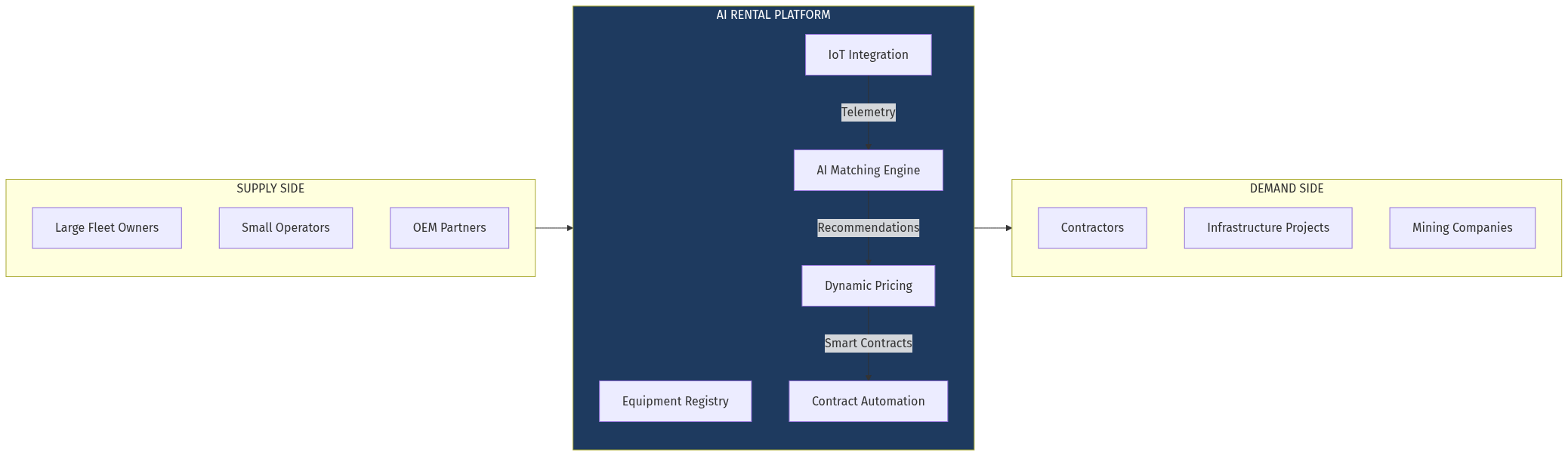
    Platform Architecture
    Platform Architecture

    AI Agent Capabilities

    1. Intelligent Matching Engine
    • Natural language job descriptions → equipment recommendations
    • Factor in: location, timeline, equipment specs, operator availability, project history
    • Predict compatibility based on past successful rentals
    2. Dynamic Pricing Oracle
    • Real-time supply/demand in geography
    • Seasonal adjustments (monsoon → lower rates)
    • Equipment condition scoring → price modulation
    • Competitor rate monitoring via public listings
    3. Predictive Maintenance Agent
    • IoT telemetry from equipment sensors
    • Predict failures 2-4 weeks in advance
    • Auto-schedule maintenance during low-demand periods
    • Notify renters of potential issues before contract signing
    4. Contract Negotiation Agent
    • WhatsApp-native conversational interface
    • Handle standard negotiations (duration, pricing, delivery)
    • Escalate complex requests to human operators
    • Generate digital contracts with e-signatures
    5. Fleet Optimization Agent
    • Analyze utilization patterns across fleet
    • Recommend repositioning of equipment
    • Identify underperforming assets for sale
    • Model optimal fleet composition

    The Future State

    > A contractor in Pune opens WhatsApp at 6 AM: "Need 2 excavators for 3 weeks starting Monday, highway project." By 6:05 AM, the AI agent has identified 7 available machines within 50km, ranked by reliability score and price. By 6:10 AM, a digital contract is signed. By Monday morning, GPS-tracked excavators arrive with maintenance logs and operator ratings visible. The contractor pays 20% less than broker rates. The owner achieves 75% utilization instead of 40%.


    7.

    Product Concept

    Core Features

    For Equipment Owners (Supply)
    • One-click fleet listing with photo/spec capture
    • IoT device integration (telematics, GPS, hours tracking)
    • Utilization dashboard with revenue analytics
    • Automated invoicing and payment collection
    • Maintenance scheduling with vendor network
    For Contractors (Demand)
    • Natural language search ("excavator near Mumbai next week")
    • Instant availability and pricing comparison
    • Equipment history: hours used, maintenance records, past ratings
    • Digital contracts with embedded insurance
    • Real-time delivery tracking
    For Both
    • WhatsApp-native interface (no app download required)
    • Escrow payments for trust
    • Dispute resolution with evidence trail
    • Reputation scores based on transaction history

    Differentiators

  • AI-First, Not AI-Added: Matching, pricing, and contracts are AI-native, not bolted on
  • WhatsApp as Primary Channel: Meet users where they are; 99% penetration
  • IoT Integration Required: Equipment without telemetry can't list; data is mandatory
  • Operator Marketplace: Bundle operators with equipment for turnkey rentals

  • 8.

    Development Plan

    PhaseTimelineDeliverables
    MVP8 weeksWhatsApp bot for listing/search in one city (Hyderabad); manual matching
    V112 weeksAI matching engine; digital contracts; payment escrow
    V220 weeksIoT integration SDK; predictive pricing; operator marketplace
    V332 weeksPredictive maintenance; fleet analytics dashboard; multi-city expansion

    Tech Stack

    • Frontend: WhatsApp Business API (primary), React Native (secondary app)
    • Backend: Node.js/Python, PostgreSQL, Redis
    • AI/ML: OpenAI for NLP, custom models for pricing/matching
    • IoT: MQTT protocol, partnerships with telematics providers (Trackunit, etc.)

    9.

    Go-To-Market Strategy

    Phase 1: Supply-First in One City (Hyderabad)

    Why Hyderabad?
    • Massive infrastructure projects (Metro expansion, Pharma City)
    • Existing equipment rental clusters (Uppal, Shamshabad)
    • Tech-savvy SMB population
    • Lower customer acquisition costs than Mumbai/Delhi
    Tactics:
  • Partner with 10 large fleet owners (100+ machines each)
  • Offer free IoT devices for first 6 months
  • Guarantee minimum utilization or subsidize gap
  • Build case studies with data: "Utilization up 40%, revenue up 25%"
  • Phase 2: Demand Aggregation

  • Target EPC contractors and infrastructure companies
  • Offer procurement dashboard for fleet requirements
  • Volume discounts for committed monthly hours
  • Integrate with project management tools (Procore, etc.)
  • Phase 3: Expansion Playbook

  • City-by-city rollout following infrastructure project pipelines
  • State-level partnerships (NHAI, state housing boards)
  • OEM partnerships (Tata Hitachi, JCB) for new equipment listings
  • Financing partnerships for equipment upgrades

  • 10.

    Revenue Model

    Revenue StreamDescriptionTake Rate
    Transaction FeeCommission on successful rentals8-12%
    Premium ListingsFeatured placement, priority matchingRs. 5,000-20,000/month
    IoT SubscriptionTelematics hardware + analyticsRs. 1,000/machine/month
    Insurance CommissionEmbedded equipment insurance15-20% of premium
    Financing ReferralsEquipment loans, working capital1-2% of loan value
    Operator PlacementCommission on operator bookings5-8% of wages

    Unit Economics Target

    • Average rental value: Rs. 50,000/week
    • Platform take: Rs. 5,000-6,000
    • Customer acquisition cost: Rs. 2,000 (amortized)
    • Lifetime value: Rs. 50,000+ (repeat rentals)
    • LTV:CAC > 20:1 at maturity

    11.

    Data Moat Potential

    Proprietary Data Accumulation

  • Equipment Performance Data: Hours logged, failure patterns, maintenance history
  • Pricing Intelligence: Real-time market rates by geography, equipment type, season
  • Demand Forecasting: Project pipeline data, contractor capacity, seasonal patterns
  • Reliability Scores: Equipment and operator ratings based on transaction outcomes
  • Utilization Benchmarks: Fleet performance metrics by segment
  • Network Effects

    • Same-Side: More equipment listed → better pricing → more equipment listed
    • Cross-Side: More contractors → higher utilization → more owners list
    • Data: More transactions → better AI predictions → better matching → more transactions

    Defensibility

    After 2-3 years, competitors face:

    • Cold-start problem (no data, poor AI)
    • Trust deficit (no reputation scores)
    • Supply lock-in (IoT devices installed, historical data valuable)
    ---

    12.

    Why This Fits AIM Ecosystem

    Structural Parallel to AIM.in Vision:

    > IndiaMART helps buyers ASK. AIM.in helps buyers DECIDE.

    This equipment rental marketplace embodies the same transformation:

    • From fragmented listings → structured, comparable inventory
    • From phone-tag negotiations → instant, transparent pricing
    • From trust via relationships → trust via data and ratings
    • From reactive matching → predictive, AI-driven allocation
    Integration Points:

  • Equipment rental as vertical within broader B2B infrastructure
  • Shared supplier identity and verification
  • Cross-sell to equipment buyers (when rental economics justify purchase)
  • Construction materials + equipment as bundled offering

  • ## Risk Assessment (Pre-Mortem)

    Applying Falsification: "Why did 5 funded startups fail here?"

  • Supply Acquisition Hell: Fleet owners are relationship-driven; digital-first companies failed to build trust. Mitigation: Boots on ground, free IoT devices, guaranteed minimums.
  • Offline Transaction Leakage: Parties meet on platform, transact off-platform to avoid fees. Mitigation: Escrow required; IoT tracks actual usage for billing.
  • Quality Control Nightmare: Equipment condition varies wildly; disputes kill NPS. Mitigation: Mandatory inspection checklist; IoT health monitoring; dispute resolution fund.
  • Cash Economy Stickiness: Construction runs on cash; digital payments friction. Mitigation: UPI integration; flexible payment schedules; finance partnerships.
  • Regional Fragmentation: Equipment types, pricing, operator availability vary by region. Mitigation: City-by-city rollout; local ops teams; vernacular support.
  • Steelmanning Incumbents

    Why might IndiaMART or existing rental companies win?
    • IndiaMART: Already has traffic, trust, and suppliers. Could launch rental vertical tomorrow.
    • Counter: Rental requires operational depth (logistics, insurance, disputes) that IndiaMART's lead-gen model can't support.
    • Large Rental Companies (Quess, TVS Sundaram): Own equipment, have relationships, can add tech.
    • Counter: Marketplace model doesn't compete; it aggregates their supply. Partnership > competition.

    ## Verdict

    Opportunity Score: 8.5/10 The Case For:
    • Massive market ($13B+) with clear inefficiency (40% utilization)
    • Proven models in adjacent sectors (logistics, hospitality)
    • AI/IoT maturity finally enables differentiation
    • Infrastructure tailwinds for next 5-10 years
    • No dominant digital player despite market size
    The Case Against:
    • Operationally intensive (not pure software)
    • Regional fragmentation requires boots on ground
    • Cash economy and relationship stickiness
    • Multi-sided marketplace cold-start challenge
    Recommendation: This is a venture-backable opportunity for a team with construction industry experience and operational execution capability. The AI angle is real but requires IoT integration to capture data. Start in one city, prove utilization improvement, then scale.

    ## Sources