ResearchMonday, March 2, 2026

AI-Powered Diagnostic Lab Procurement: The $10B Opportunity India's 100,000 Labs Are Waiting For

India has 100,000+ pathology labs. Less than 2% are NABL accredited. 80% of reagents are imported. 15-20% of inventory gets wasted. There is no dedicated B2B marketplace solving this. The opportunity is enormous.

1.

Executive Summary

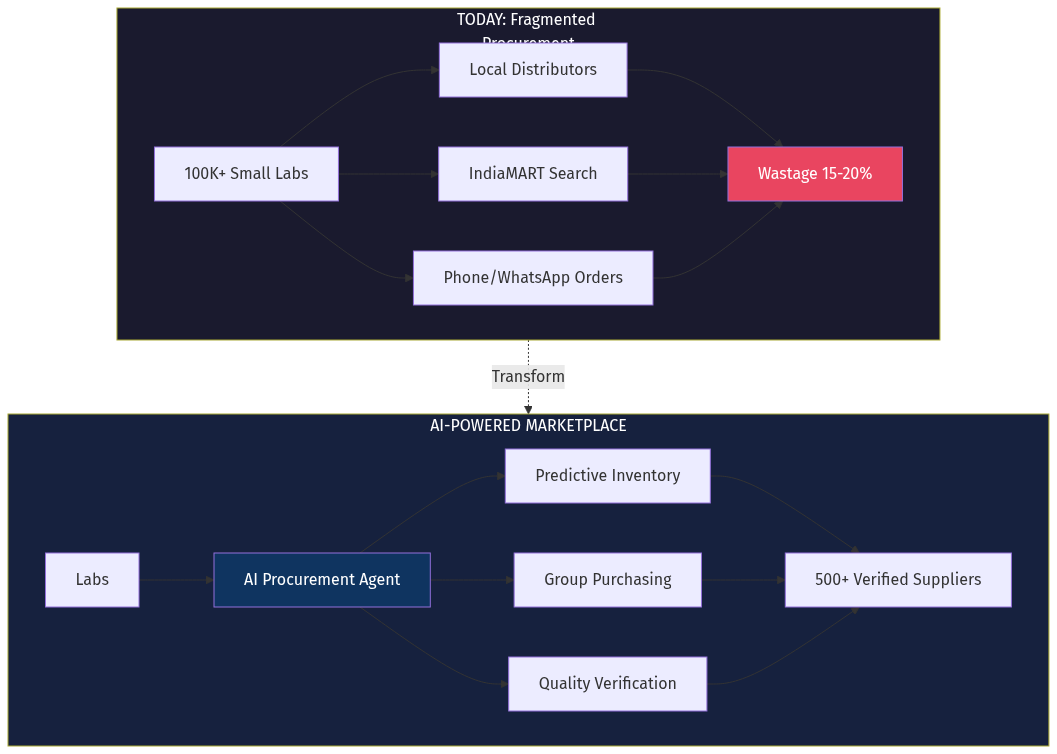
India's diagnostic labs market hit $11 billion in 2025 and is growing at 11%+ CAGR. Yet the procurement layer—how 100,000+ labs buy reagents, consumables, and equipment—remains stuck in the 1990s: phone calls, WhatsApp messages, local distributors with opaque pricing, and zero demand forecasting.

An AI-powered B2B marketplace for diagnostic lab procurement could capture this fragmentation, reduce 15-20% reagent wastage, enable group purchasing for small labs, and build a proprietary data moat on consumption patterns across India's healthcare infrastructure.
2.

Problem Statement

Who Experiences This Pain?

Small and mid-sized pathology labs (the 98% that aren't NABL accredited) face:
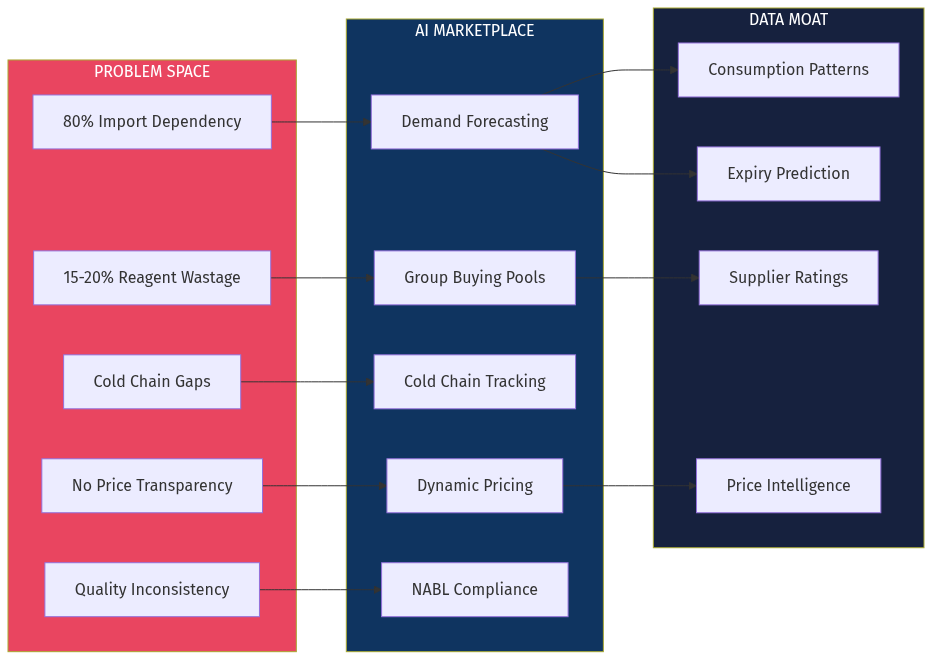
  • No price transparency: Same reagent kit varies 20-40% across distributors
  • Cold chain failures: Temperature-sensitive reagents (PCR, ELISA) arrive degraded
  • Expiry wastage: 15-20% of inventory expires unused due to poor demand forecasting
  • Import dependency: 80% of medical devices/reagents imported; supply chain shocks hit hard
  • NABL compliance burden: Quality documentation and supplier verification is manual
  • Zeroth Principles Analysis:
    • Assumption challenged: "Labs must buy from whoever their local distributor knows." Why? Because there's no aggregated view of verified suppliers, pricing, and quality.
    • Hidden constraint: Labs operate on thin margins. They can't afford procurement staff. They need automation, not another portal to manually browse.

    3.

    Current Solutions

    CompanyWhat They DoWhy They're Not Solving It
    DxkartOnline IVD supplies, COD, 22K pincodesCatalog-only; no demand forecasting, no group buying
    BiomallLife science reagent marketplaceResearch-focused; not optimized for clinical lab workflows
    IndiaMARTGeneral B2B directoryNo verification, no cold chain, no lab-specific features
    CPC DiagnosticsIVD manufacturerSells direct but no marketplace aggregation
    Hospital chains (Dr Lal, Thyrocare)Internal procurementWalled gardens; don't serve independent labs
    Incentive Mapping: Current distributors profit from opacity. They buy from importers at X, sell to labs at 1.4X, and pocket the difference. Price transparency threatens their margins. This is why no incumbent builds it.
    4.

    Market Opportunity

    • Market Size: $10.95 billion (2025), growing to $28.53 billion by 2034
    • Growth: 11.23% CAGR
    • Labs: 100,000-110,000 across India
    • NABL Certified: <2% (opportunity to help others qualify)
    • Import Dependency: 80% of reagents/devices imported
    • Reagent Wastage: 15-20% industry average

    Why Now?

  • PLI 2.0 for IVD: Government pushing local manufacturing, creating new supplier base
  • ABDM Integration: Digital health infrastructure enables lab data interoperability
  • Post-COVID Awareness: Labs expanded but procurement stayed manual
  • AI Maturity: Demand forecasting models are production-ready
  • Architecture Diagram
    Architecture Diagram

    5.

    Gaps in the Market

    Anomaly Hunting Findings:

  • No aggregated pricing intelligence: Labs have no visibility into fair market rates
  • Zero demand prediction: Every lab guesses inventory needs independently
  • Missing group purchasing: Small labs can't access bulk discounts that chains get
  • Cold chain opacity: No real-time tracking for temperature-sensitive shipments
  • NABL compliance tools absent: Labs manually document supplier quality
  • No reagent-equipment matching: Proprietary kits lock labs into expensive vendors
  • Distant Domain Import:
    • From grocery delivery: Dark stores for reagent distribution in metros (2-hour delivery for urgent needs)
    • From fleet logistics: Real-time cold chain monitoring with alerts
    • From fintech: Group purchasing pools (like Slice/CRED for credit pooling, but for procurement leverage)

    6.

    AI Disruption Angle

    What AI Agents Enable:

    1. Predictive Inventory Management
    • Analyze test volume patterns across seasons, disease outbreaks, local demographics
    • Auto-generate reorder suggestions before stockouts
    • Reduce wastage from 15-20% to <5%
    2. Dynamic Pricing Intelligence
    • Crawl supplier prices, identify best deals in real-time
    • Alert labs to price spikes (import disruptions) or drops (new local suppliers)
    • Build pricing index for negotiation leverage
    3. Quality Verification
    • AI-powered document verification for NABL compliance
    • Supplier scoring based on delivery performance, expiry rates, cold chain adherence
    • Automated quality certificates and lot tracking
    4. Group Purchasing Orchestration
    • Cluster labs by region and consumption patterns
    • Aggregate demand for bulk negotiation with manufacturers
    • Auto-form purchasing pools for new product launches
    Flow Diagram
    Flow Diagram

    7.

    Product Concept

    Core Features:

    For Labs:
    • Unified catalog with real-time pricing from 500+ verified suppliers
    • AI procurement agent that learns consumption patterns
    • Group buying pools for 10-30% cost savings
    • Cold chain tracking with SLA guarantees
    • NABL compliance documentation auto-generated
    For Suppliers:
    • Demand forecasting dashboard (see what labs will need next month)
    • Direct reach to 100,000+ labs without distributor margins
    • Payment assurance via platform escrow
    • Logistics integration for cold chain

    Tech Stack:

    • WhatsApp-first ordering (meet labs where they are)
    • LIS integration APIs for auto-reorder triggers
    • GPS + IoT cold chain tracking
    • ML demand forecasting models trained on aggregated consumption

    8.

    Development Plan

    PhaseTimelineDeliverables
    MVP8 weeksWhatsApp ordering bot, 50 suppliers, 3 metro cities
    V116 weeksFull marketplace, demand forecasting, cold chain tracking
    V224 weeksGroup purchasing, NABL compliance tools, LIS integrations
    Scale12 months500+ suppliers, pan-India, AI procurement agent
    Pre-Mortem (Falsification):
    • Why might this fail? Labs may resist platform lock-in. Distributors may undercut pricing.
    • Mitigation: Hybrid model—work WITH existing distributors initially, not against them. Offer them the platform as SaaS.

    9.

    Go-To-Market Strategy

  • Start with NABL-seeking labs: They NEED documentation, quality tracking, supplier verification—exactly what we offer
  • Partner with LIS providers: CrelioHealth, Clinicea serve thousands of labs; integrate as procurement layer
  • Piggyback on lab associations: Indian Association of Pathologists, state-level bodies
  • WhatsApp virality: "Forward this to 5 lab owners for group buying access"
  • Tier-2/3 focus: Metros have distributor relationships; smaller cities are underserved
  • Steelmanning the Competition:
    • Why incumbents might win: Relationships matter in healthcare. A local distributor who's supplied a lab for 10 years has trust.
    • Counter: Trust breaks when prices are 30% higher. Show the data. Let labs decide.

    10.

    Revenue Model

    StreamMechanismPotential
    Transaction fee2-4% on GMVPrimary revenue at scale
    SaaS for suppliersDashboard, analytics, demand forecasting₹5-20K/month per supplier
    Group buying margin5-10% of savings shared with platformHigh-volume, low-margin
    Cold chain premiumGuaranteed delivery with tracking10-15% premium on sensitive items
    NABL compliance toolsDocumentation, audit prep₹10-30K per lab annually
    Unit Economics Target:
    • AOV: ₹15,000-50,000 per order
    • Take rate: 3-5%
    • Repeat frequency: Monthly
    • LTV: ₹50,000+ per lab over 3 years

    11.

    Data Moat Potential

    What Accumulates Over Time:
  • Consumption patterns: Which tests are rising, which reagents are used together, seasonal spikes
  • Price intelligence: Historical pricing across suppliers, negotiation benchmarks
  • Supplier quality scores: Delivery times, cold chain adherence, expiry rates
  • Demand forecasting models: Train on aggregate data, sell insights back to suppliers
  • Equipment-reagent compatibility: Proprietary mapping of what works with what
  • This data becomes impossible to replicate. Every transaction makes predictions better. Network effects kick in as more labs and suppliers join.


    12.

    Why This Fits AIM Ecosystem

    Vertical Intelligence:
    • Perfect fit for AIM's "structured discovery" thesis
    • Lab owners searching "PCR reagent suppliers near me" find nothing useful today
    • AIM can build the definitive supplier discovery layer
    AI Agent Integration:
    • Labs don't want to browse catalogs. They want an agent that knows their needs and orders automatically.
    • "Vishnu, reorder our standard biochemistry consumables" → done
    Domain Leverage:
    • diagnosticsupply.in, labprocure.in, reagentmarket.in—all available for acquisition
    • Build SEO moat on long-tail diagnostic procurement queries

    ## Second-Order Thinking

    If this succeeds:
  • Data can expand to hospital procurement (10x larger market)
  • Platform becomes kingmaker for domestic IVD manufacturers (PLI beneficiaries)
  • Aggregated demand enables import substitution strategy
  • NABL certification rates increase (good for public health)
  • Smaller labs can compete with chains on cost structure
  • Unintended consequences:
    • Distributor job losses (but new logistics/cold-chain jobs created)
    • Supplier consolidation (top performers get more volume)
    • Price deflation industry-wide (good for labs, labs pass to patients)

    ## Verdict

    Opportunity Score: 8.5/10 Strengths:
    • Massive market ($10B+) with clear fragmentation
    • Obvious pain points (wastage, pricing, compliance)
    • AI-native solution with clear differentiation
    • Strong data moat potential
    • Government tailwinds (PLI, ABDM)
    Risks:
    • Healthcare sales cycles are long
    • Cold chain logistics requires capital
    • Incumbent relationships are sticky
    • Regulatory complexity in medical devices
    Recommendation: Strong opportunity for a focused vertical marketplace. Start with NABL-seeking labs as beachhead. Build WhatsApp-first to reduce adoption friction. Partner with LIS providers for embedded distribution. This is exactly the kind of "offline-to-online, fragmented-to-structured" opportunity that defines AIM's thesis.

    ## Sources