ResearchSunday, March 1, 2026

India's $21 Billion Scrap Metal Marketplace: The Missing Platform for Circular Steel

India imports 20-30 million tonnes of scrap metal annually because domestic collection is stuck in the 1980s. The informal kabadiwalla network handles 70% of recycling but operates on phone calls, cash, and handshakes. Steel mills desperately need quality scrap for green EAF production. This is a $21 billion opportunity hiding in plain sight.

1.

Executive Summary

India's metal recycling market reached USD 14.14 billion in 2024 and will grow to USD 21.38 billion by 2030. Yet there's no dominant B2B marketplace connecting scrap suppliers to steel mills and recyclers. The existing system—a fragmented chain of kabadiwallas, aggregators, and dealers—suffers from price opacity, quality disputes, and cash-only transactions.

Meanwhile, steel mills are racing to adopt Electric Arc Furnaces (EAF) for green production, which requires 65 million tonnes of scrap annually by FY30. The supply gap means India must import 20-30 million tonnes yearly.

The opportunity: An AI-powered B2B marketplace that digitizes the scrap supply chain, provides real-time pricing indexed to LME, enables quality grading via image recognition, and integrates logistics. Think "IndiaMART meets Uber Freight" for scrap metal.
2.

Problem Statement

Who Feels the Pain?

Kabadiwallas (Informal Collectors)
  • Earn ₹300-700/day collecting door-to-door
  • No visibility into fair market prices
  • Income declining as formal plants get preference
  • Excluded from formalization benefits
Small Aggregators (Local Scrap Yards)
  • Handle mixed materials with inconsistent quality
  • Negotiate prices over phone with limited market data
  • Cash-heavy operations create compliance risks
  • No access to large industrial buyers
Steel Mills & Recyclers
  • Need quality-graded scrap for EAF production
  • Can't trace material origins (compliance risk)
  • Deal with 100s of fragmented suppliers
  • Quality disputes delay production
Policy Makers
  • Steel Scrap Recycling Policy (2019) pushed formalization
  • Vehicle Scrappage Policy (2021) created new supply
  • But no digital infrastructure to track and trade

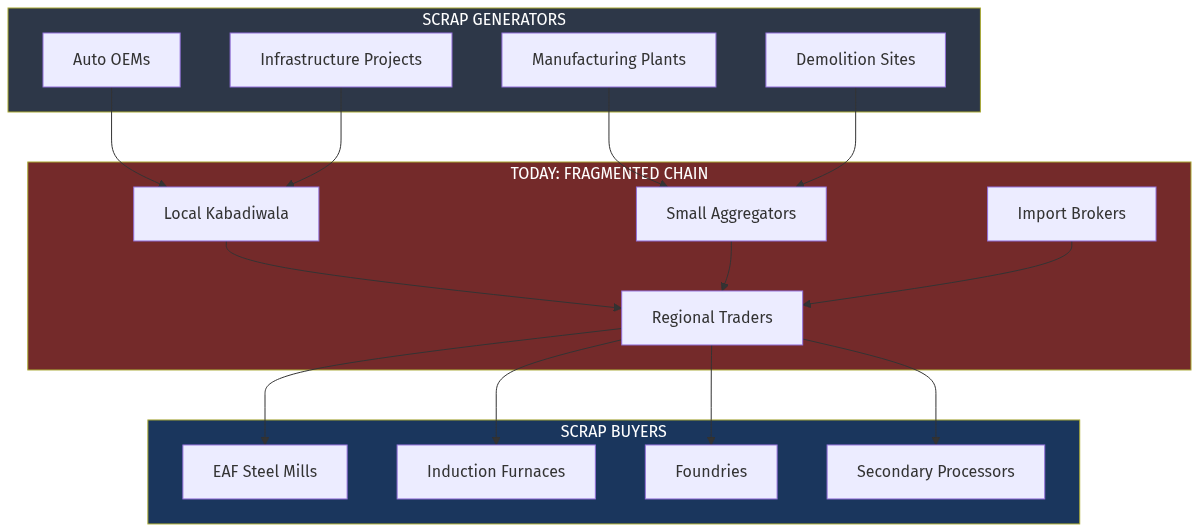
The Core Dysfunction

Current Market Structure

The chain has 4-5 intermediaries between collection and consumption. Each adds margin, reduces transparency, and introduces quality variance. A kabadiwalla selling copper wire has no idea if it's priced fairly. A steel mill buying HMS scrap can't verify it's not contaminated.


3.

Current Solutions

CompanyWhat They DoWhy They're Not Solving It
MetalshubGlobal B2B platform for metals/scrap with 2,800+ participantsEuropean focus; no India-specific features; serves large traders, not kabadiwallas
IndiaMARTGeneral B2B listings including scrap dealersNo quality grading, pricing, logistics; just lead generation
CMR GreenIndia's largest non-ferrous recycler (600K tonnes/year)Vertically integrated; not a marketplace; buys, doesn't enable others
RecyclekaroE-waste collection platformFocused on electronics; not metals
Local DealersPhone-based trading networksFragmented, no scale, opaque pricing

Why No One Has Won

  • Trust barrier: Cash transactions = no paper trail = tax evasion. Digitizing means exposure.
  • Quality problem: Scrap isn't standardized. One man's HMS1 is another's HMS2.
  • Logistics complexity: Heavy, bulky materials need specialized transport.
  • Working capital: Small players need credit; big players don't extend it.

  • 4.

    Market Opportunity

    Market Size (India Metal Recycling)
    • 2024: USD 14.14 billion
    • 2030: USD 21.38 billion (CAGR 7.1%)
    Scrap Demand Projections
    • FY25: ~35 million tonnes
    • FY30: ~65 million tonnes
    • Import dependency: 20-30 million tonnes annually
    Why Now:
  • Green Steel Mandate: EAF production (scrap-based) is the only path to decarbonization. Steel mills are desperate.
  • Policy Tailwinds: Vehicle Scrappage Policy creating 25,000 registered vehicles for dismantling. Government wants formal channels.
  • Digital Adoption: UPI penetration means even informal sector can transact digitally.
  • ESG Pressure: Global buyers demanding traceable, low-carbon steel. Supply chain transparency required.
  • Import Cost: Scrap imports are expensive. Domestic collection at scale is a cost advantage.

  • 5.

    Gaps in the Market

    Applying Anomaly Hunting

    What's strange that shouldn't be:
    • A $14B market with no marketplace unicorn
    • Government policies for 5 years with no digital infrastructure
    • Steel mills paying import premiums while domestic scrap rots uncollected
    What should exist but doesn't:
    • Real-time scrap price index (like MCX for commodities)
    • Quality certification for scrap materials
    • Logistics layer optimized for heavy materials
    • Working capital products for scrap aggregators

    Five Critical Gaps

  • No Price Discovery: Kabadiwallas don't know LME prices. Dealers exploit information asymmetry.
  • No Quality Standards: "HMS1" means different things to different people. No image-based grading.
  • No Logistics Integration: Every deal requires separately negotiating transport.
  • No Credit Rails: Small aggregators can't scale without working capital.
  • No Compliance Layer: GST invoicing, e-way bills, origin tracking all manual.

  • 6.

    AI Disruption Angle

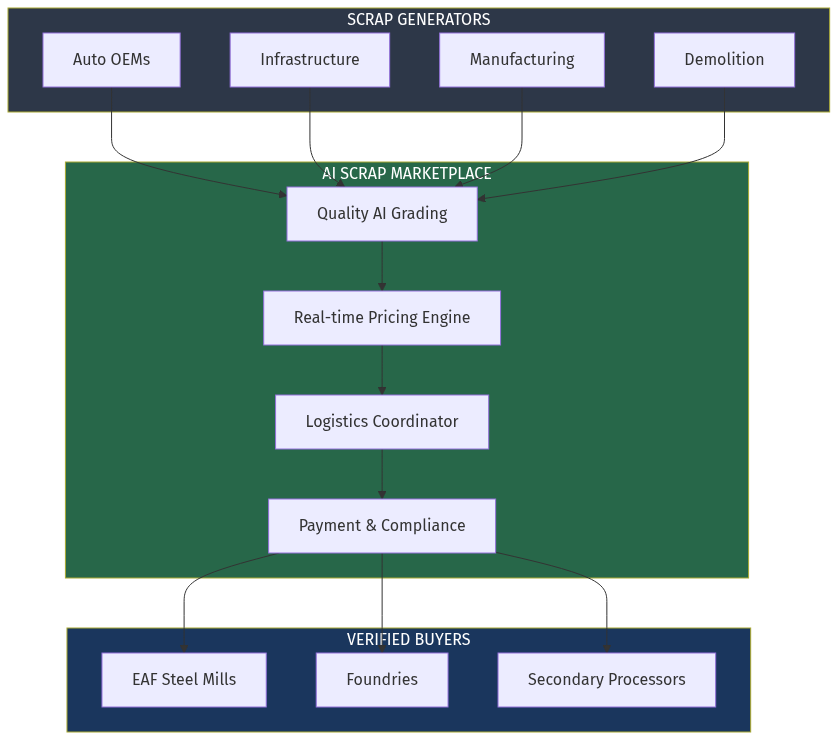
    The Vision: Agents Transact, Humans Verify

    Future State with AI Marketplace
    Future State with AI Marketplace
    AI-Powered Quality Grading
    • Supplier uploads photo of scrap pile
    • Vision model classifies material type, estimates grade
    • Reduces disputes from 30% to <5% of transactions
    Dynamic Pricing Engine
    • Index to LME + regional supply/demand
    • Show kabadiwallas what their material is worth
    • Algorithmic price recommendations within negotiation bounds
    Logistics Optimization
    • Match scrap loads to available trucks
    • Route optimization for pickups
    • Real-time tracking for compliance
    Credit Scoring
    • Transaction history → creditworthiness
    • Partner with NBFCs for working capital loans
    • Unlock scaling for aggregators
    Compliance Automation
    • Auto-generate GST invoices
    • E-way bill integration
    • Origin certificates for export

    Why AI Agents Win Here

    Traditional marketplace: List → Negotiate → Transact → Ship AI-agent marketplace: Describe → Auto-match → One-click accept → Track

    The informal sector doesn't want to learn software. They want WhatsApp voice notes that magically find buyers. An agent that speaks Hindi, shows photos of what's selling nearby, and handles paperwork will win.


    7.

    Product Concept

    "ScrapBazaar" — India's First AI Scrap Marketplace

    Core Features:
    FeatureDescriptionValue
    WhatsApp-first listingVoice note + photo → listing createdZero learning curve
    AI Quality GradingImage recognition for material classificationReduces disputes
    LME-indexed pricingReal-time fair price suggestionsBuilds trust
    Buyer matchingML-based matchmaking to relevant buyersFaster transactions
    Integrated logisticsPartner network for pickup/deliveryOne-stop shop
    Digital contractsE-sign, GST invoice, e-way billCompliance built-in
    Working capitalTransaction-based credit scoringEnables scaling
    User Personas:
  • Kabadiwalla Ramu — Collects 500kg copper wire. Takes photo, sends WhatsApp. Gets 3 offers in 2 hours. Accepts best price. Truck comes next day. Money in bank account.
  • Aggregator Suresh — Has 50 tonnes mixed ferrous. Lists on platform. AI grades as HMS1 (60%), HMS2 (40%). Steel mill in Gujarat bids. Platform arranges transport. Suresh gets invoice for GST credit.
  • Mill Procurement Raj — Needs 1000 tonnes HMS1 monthly. Sets standing bid. Platform aggregates from 20 suppliers. Quality verified at weighbridge. Single consolidated invoice.

  • 8.

    Development Plan

    PhaseTimelineDeliverables
    MVP12 weeksWhatsApp bot for listing, manual matching, basic pricing dashboard, pilot with 50 suppliers in one city
    V16 monthsAI quality grading, automated matching, logistics partnership, 500 suppliers
    V212 monthsCredit scoring, NBFC partnership, multi-city expansion, 5000 suppliers
    V318 monthsFull compliance automation, export documentation, 50,000 suppliers
    Tech Stack:
    • WhatsApp Business API (Kapso) for supplier interface
    • React dashboard for buyers
    • Vision models (GPT-4V / custom trained) for grading
    • LME API for pricing
    • Logistics API integrations (Porter, Rivigo)

    9.

    Go-To-Market Strategy

    Phase 1: Supply Acquisition (Weeks 1-12)

  • Pick one city: Start with industrial hub (Ahmedabad, Pune, or Chennai)
  • Partner with 3-5 large aggregators: Guaranteed initial supply
  • Onboard kabadiwallas through aggregators: They bring their network
  • Offer premium pricing: 5-10% above market to drive adoption
  • Phase 2: Demand Activation (Weeks 8-20)

  • Sign 2-3 steel mills: Guaranteed offtake for quality material
  • Position as compliance solution: GST invoices, origin tracking
  • Offer price stability: Lock-in contracts indexed to LME
  • Phase 3: Network Effects (Months 6-12)

  • Launch referral program: Kabadiwallas bring kabadiwallas
  • Add logistics as service: Become essential infrastructure
  • Introduce credit products: Lock in suppliers with financing
  • Phase 4: Geographic Expansion (Year 2)

  • 10 cities: Industrial clusters first
  • Vertical expansion: Non-ferrous, e-waste, plastics
  • Export channel: Connect to international buyers

  • 10.

    Revenue Model

    StreamDescriptionPotential
    Transaction fee1-2% of GMVPrimary revenue
    Logistics margin10-15% markup on transportHigh frequency
    Quality certification₹500-2000 per certificatePremium service
    Credit facilitation2-3% of loan amountHigh margin
    Data/analyticsSubscription for price intelligenceB2B SaaS
    Export servicesDocumentation, compliancePremium margin
    Unit Economics (Target):
    • Average transaction: ₹50,000
    • Take rate: 2%
    • Revenue per transaction: ₹1,000
    • Target: 10,000 transactions/month = ₹1 crore MRR in Year 2

    11.

    Data Moat Potential

    What Accumulates Over Time

  • Price history by region/material: Becomes the reference for fair pricing
  • Quality grading data: Trains models to predict grade from photos
  • Supplier reliability scores: Who delivers what they promise
  • Logistics patterns: Optimal routes, costs, timing
  • Credit performance: Who repays, who defaults
  • Why This Creates Defensibility

    After 2 years:

    • New entrant can't match pricing accuracy (no historical data)
    • New entrant can't match quality grading (no training data)
    • New entrant can't offer credit (no transaction history)
    • Suppliers won't switch (credit relationship)
    • Buyers won't switch (verified supply network)
    ---

    12.

    Why This Fits AIM Ecosystem

    Perfect Vertical for AI-Native B2B

  • Fragmented supply: Exactly what AIM is built to structure
  • Offline-heavy: WhatsApp-first approach matches the market
  • High-trust requirement: AI agents can build trust through consistency
  • Data moat: Aligns with AIM's vision of proprietary intelligence
  • Regional opportunity: Not a global play; India-first focus
  • Integration Points

    • Domain leverage: scrapmetal.in, scrapbazaar.in, metalscrap.in
    • Cross-sell: Connect to construction materials vertical
    • B2B playbook: Same supply aggregation model as other AIM verticals

    13.

    Risk Analysis (Pre-Mortem + Steelmanning)

    Why This Might Fail

    RiskLikelihoodMitigation
    Cash preference blocks digital adoptionHighStart with large aggregators who need GST invoices
    Quality disputes kill trustMediumInvest heavily in AI grading; offer dispute resolution
    Incumbent dealers sabotageMediumPartner with dealers as fulfillment agents
    Steel mills prefer direct importsLowDomestic is cheaper; position on cost advantage
    Regulatory changes hurt informal sectorMediumDesign for compliance; help formalization

    Why Incumbents Might Win (Steelman)

  • Relationships matter: 30-year dealer relationships won't break for an app
  • Credit cycles: Dealers extend 90-day credit; platform can't match
  • Local knowledge: Who has material right now is hyperlocal info
  • Resistance to change: Why would a profitable dealer digitize?
  • Counter-argument: The market is growing faster than relationships can scale. New steel capacity needs new supply channels. Digital-native players who grew up with apps will replace retiring dealers.
    14.

    Mental Models Applied

    Zeroth Principles

    "Why hasn't anyone built this?"
    • Trust is the fundamental barrier. But UPI proved Indians will transact digitally for convenience. The informal sector adopted digital payments; they'll adopt digital trading.

    Incentive Mapping

    • Kabadiwallas: Want better prices, reliable payment → Platform delivers
    • Aggregators: Want access to large buyers, credit → Platform delivers
    • Steel mills: Want quality, compliance, reliability → Platform delivers
    • Government: Want formalization, tax revenue → Platform delivers

    Distant Domain Import

    • Agriculture: Ninjacart aggregated fragmented farmers → same for scrap collectors
    • Used cars: Spinny standardized quality grading → same for scrap quality
    • Logistics: Porter matched loads to trucks → same for scrap transport

    Second-Order Effects

    • If this succeeds: Domestic scrap collection increases → Import dependency decreases → Forex savings → Policy support increases
    • If this succeeds: Kabadiwallas earn more → Formalization accelerates → Social impact recognized

    ## Verdict

    Opportunity Score: 8.5/10

    This is a massive market ($21B by 2030) with clear pain points, no dominant digital player, and strong policy tailwinds. The timing is right: UPI adoption, EAF expansion, and ESG pressure create urgency.

    The challenge is execution: navigating the informal sector requires deep on-ground presence, not just tech. Start narrow (one city, one material), prove the model, then expand.

    Recommendation: High-priority opportunity for AIM ecosystem. Consider acquiring scrapmetal.in or similar domains. Pilot in Ahmedabad or Pune where industrial density and aggregator presence enable rapid supply acquisition.

    ## Sources