ResearchSunday, March 1, 2026

India's $56B MRO Spare Parts Market: Why AI Agents Will Win Where IndiaMART Cannot

Every day, Indian factories lose ₹2.5 lakh crore to unplanned downtime. The root cause isn't equipment failure—it's procurement chaos. Finding the right spare part from the right supplier at the right price takes longer than the actual repair.

1.

Executive Summary

India's Maintenance, Repair, and Operations (MRO) procurement market is a $56 billion behemoth growing to $66 billion by 2033. Yet it remains spectacularly fragmented—manufacturing plants manage relationships with 200-500 suppliers each, price discovery happens over WhatsApp, and reactive purchasing drives 60% of all orders.

The opportunity: Build an AI-native MRO procurement platform that transforms reactive, relationship-dependent buying into predictive, transparent transactions. This isn't about listing suppliers (IndiaMART does that). It's about becoming the transactional layer that handles sourcing, negotiation, and delivery tracking—powered by AI agents that work 24/7.


2.

Problem Statement

Who Experiences This Pain?

  • Plant Maintenance Managers at 250,000+ manufacturing facilities
  • Procurement Officers at steel, cement, pharma, and oil & gas plants
  • Operations Teams managing 24/7 production lines

The Daily Reality

  • Equipment fails at 2 AM → Maintenance identifies the failed component
  • Search chaos begins → Call 5-10 suppliers, each claiming to have the part
  • Price opacity → Quotes vary 40-300% for identical parts
  • Quality roulette → No historical data on supplier reliability
  • Delivery gambling → Promised in 3 days, arrives in 15
  • Production bleeds → Each hour of downtime costs ₹5-50 lakh
  • The Numbers

    Pain PointScale
    Downtime cost to Indian manufacturing₹2.5 lakh crore/year
    Average suppliers per plant200-500
    Price variance for same part40-300%
    Orders placed reactively60%
    Parts arriving late35%
    Current vs Future MRO Procurement
    Current vs Future MRO Procurement

    3.

    Current Solutions

    CompanyWhat They DoWhy They're Not Solving It
    IndiaMARTSupplier directory with RFQDirectory, not marketplace. No transactions, no quality tracking, no price transparency
    GoosparesSurplus MRO inventory marketplaceNiche: only surplus/slow-moving stock. Doesn't solve day-to-day procurement
    Amazon BusinessB2B e-commerceGeneric catalog. Lacks industrial-specific parts, no OEM verification
    MoglixIndustrial supplies e-commerceEnterprise focus ($500K+ accounts). SME manufacturers underserved
    Local FabricatorsCustom parts manufacturingNo aggregation, no quality history, relationship-dependent

    Zeroth Principles Analysis

    What are we assuming that everyone takes for granted?

    The assumption: MRO procurement is inherently relationship-driven and cannot be disintermediated.

    Reality check: This was true when:

    • Part identification required human expertise
    • Supplier reliability was unquantifiable
    • Price negotiation needed rapport
    All three constraints dissolve with AI:
    • Vision models can identify parts from photos
    • Transaction history creates supplier scores
    • Agents negotiate based on data, not relationships
    ---

    4.

    Market Opportunity

    Market Size

    MetricValue
    India MRO Market (2024)$56.1 billion
    Projected (2033)$66.4 billion
    CAGR1.7% (market growth)
    Digital penetration<5%
    Addressable for AI platform$8-12 billion

    Why Now?

  • IoT adoption spike: 45% of large Indian manufacturers now have sensor-equipped machinery (up from 12% in 2020)
  • GST reduction: MRO services GST dropped from 18% to 5%, making compliant platforms more attractive
  • AI capability leap: Vision models can now identify industrial parts with 94% accuracy
  • WhatsApp API maturity: B2B workflows can be built natively on WhatsApp where procurement already happens
  • Make in India push: Government incentives driving local sourcing, creating need for domestic supplier discovery
  • Incentive Mapping

    Who profits from the status quo?
    • Middlemen/traders: Mark up 30-50% by exploiting information asymmetry
    • Large OEMs: Premium pricing protected by opaque markets
    • Relationship-heavy suppliers: Win on rapport, not price/quality
    Feedback loops maintaining current behavior:
    • Procurement managers incentivized to "keep suppliers happy" (job security > cost optimization)
    • No visibility into what peers pay → no benchmark for negotiation
    • Emergency orders forgive premium pricing

    5.

    Gaps in the Market

    Anomaly Hunting: What Should Be Here But Isn't?

    Market Structure
    Market Structure
  • No transactional B2B marketplace — IndiaMART is a directory. There's no Amazon for industrial spare parts with real-time inventory, verified pricing, and transaction guarantees.
  • No part identification infrastructure — A maintenance technician should be able to photograph a broken part and get matches. This doesn't exist.
  • No supplier quality scores — I can see a restaurant's rating on Zomato but not a bearing supplier's delivery reliability.
  • No price index — What should a 6205 ZZ bearing cost? No public benchmark exists.
  • No predictive procurement layer — IoT sensors generate failure predictions, but no system converts these into automated POs.
  • No surplus-to-demand matching — Plant A has 500 unused bearings; Plant B needs them urgently. They'll never find each other.
  • Distant Domain Import

    What field has already solved a similar problem? Automotive aftermarket (US): RockAuto, AutoZone, and PartsGeek built massive part catalogs with vehicle-specific fitment data. Apply this pattern: equipment model → compatible parts → verified suppliers. Freight logistics: Uber Freight and Convoy built spot markets for trucking by creating price transparency in a relationship-driven industry. MRO is ripe for the same treatment. Restaurant supplies: BlueCart built a B2B procurement platform where restaurants order from multiple distributors through one interface. Same pattern applies to factories.
    6.

    AI Disruption Angle

    How AI Agents Transform the Workflow

    Today's workflow (7-14 days):
    Failure → Manual identification → Call suppliers → Negotiate → Order → Wait → Receive → Install
    AI-enabled workflow (24-72 hours):
    Sensor predicts failure → Agent identifies part → Agent sources best option → Auto-negotiated PO → Tracked delivery → Part arrives before failure

    Specific AI Capabilities

    Agent FunctionTechnologyImpact
    Part IdentificationVision models (GPT-4V, Gemini)Photo → Part number in seconds
    Price OptimizationLLM + transaction historyBenchmark pricing, negotiate via WhatsApp
    Supplier MatchingRAG over supplier databaseBest fit based on location, reliability, price
    Predictive OrdersTime-series forecastingOrder before failure based on IoT signals
    Quality PredictionClassification modelsReject low-reliability suppliers automatically

    The Agent-to-Agent Future

    When both buyers and sellers run AI agents:

    • Buyer agent: "Need 50x 6205-2RS bearings, delivery within 72 hours to Pune, budget ₹15,000"
    • Seller agents compete: Instant quotes, automated negotiation, winning bid in minutes
    • Human involvement: Approve final PO (or auto-approve below threshold)
    ---

    7.

    Product Concept

    Core Platform

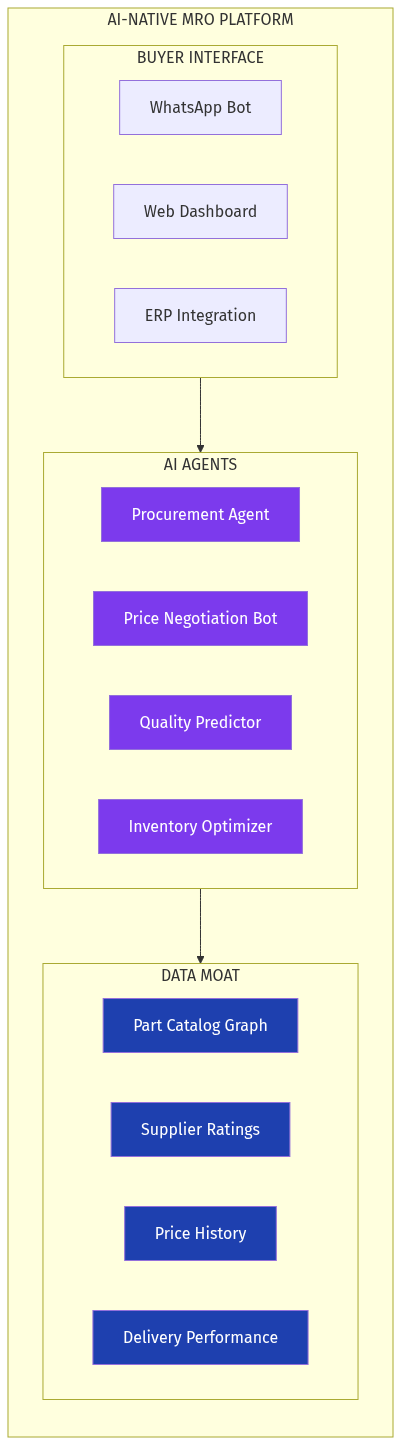
    Platform Architecture
    Platform Architecture
    Buyer Interface:
    • WhatsApp bot for instant part search and ordering
    • Web dashboard for inventory management and analytics
    • ERP plugins (SAP, Oracle, Tally) for auto-replenishment
    Seller Interface:
    • Inventory upload via CSV/API
    • Real-time demand signals
    • Automated quote response
    AI Layer:
    • Part identification from photos/descriptions
    • Supplier matching and scoring
    • Price negotiation engine
    • Delivery time prediction
    Data Moat:
    • Part compatibility graph (which parts fit which equipment)
    • Transaction history (actual prices paid, delivery times)
    • Supplier reliability scores (verified by buyers)

    Key Features

  • Snap & Source: Upload photo of broken part → Get instant matches with pricing
  • Price Benchmark: See what similar buyers paid for this part
  • Supplier Scores: Ratings based on verified transactions (delivery time, quality, disputes)
  • Predictive Procurement: Connect IoT sensors → Auto-generate POs for predicted failures
  • Surplus Exchange: List unused inventory → Match with buyers who need it

  • 8.

    Development Plan

    PhaseTimelineDeliverables
    MVP8 weeksWhatsApp bot for top 1,000 industrial parts (bearings, motors, pumps). Manual supplier matching.
    V116 weeksPart identification via image. Supplier onboarding for 3 cities. Transaction processing.
    V224 weeksSupplier scoring. Price benchmarks. ERP integrations.
    V336 weeksPredictive procurement (IoT integration). Agent-to-agent negotiation.

    Tech Stack

    • Backend: Node.js/Python, PostgreSQL
    • AI: OpenAI GPT-4V for vision, embeddings for part matching
    • Messaging: WhatsApp Cloud API (via Kapso)
    • Payments: Razorpay for escrow-based transactions

    9.

    Go-To-Market Strategy

    Phase 1: Wedge Market (Bearings)

    Start with industrial bearings—most commoditized, highest volume, price-sensitive buyers.

  • Onboard 100 bearing suppliers in Jamnagar (India's bearing hub)
  • Target 500 SME manufacturers in Gujarat industrial belt
  • WhatsApp-first acquisition: Join manufacturing WhatsApp groups, offer instant price checks
  • Phase 2: Expand Categories

    Add motors, pumps, valves, hydraulics—each with dedicated supplier onboarding.

    Phase 3: Enterprise Play

    Large plants with 500+ suppliers → Pitch "one platform, transparent procurement"

    Steelmanning: Why Incumbents Might Win

    What's the strongest argument against this opportunity?
  • Relationships matter: Procurement managers have cultivated supplier relationships over decades. A new platform threatens their network.
  • Counter: Target the 40% of new procurement managers hired each year. They have no legacy relationships.
  • Emergency orders need phone calls: When production is down, buyers want a human.
  • Counter: Provide hybrid—AI handles 80% of routine orders, humans for emergencies. The AI makes emergencies rarer through prediction.
  • OEMs control parts: Many parts are OEM-locked with authorized dealers.
  • Counter: Start with commodities (bearings, motors) where third-party supply exists. Build trust before tackling OEM parts.
    10.

    Revenue Model

    Revenue StreamModelPotential
    Transaction Fee2-5% of GMVPrimary revenue. Target 3% on $100M GMV = $3M
    Supplier Subscriptions₹5,000-50,000/month for premium listingRecurring. 1,000 suppliers × ₹20K = ₹2.4Cr/year
    Procurement SaaSEnterprise plans for large plants₹2-10 lakh/year per plant
    FinancingWorking capital for suppliersNet interest margin on float
    Data ServicesIndustry pricing reports, supplier intelligenceHigh margin, differentiator

    Unit Economics Target

    • Average Order Value: ₹25,000
    • Take Rate: 3%
    • Revenue per Order: ₹750
    • CAC: ₹2,000 (target)
    • Orders per Buyer/Year: 50+
    • LTV: ₹37,500
    • LTV:CAC: 18x

    11.

    Data Moat Potential

    What Proprietary Data Accumulates?

  • Part Compatibility Graph: Which parts work with which equipment. Irreplaceable after 10,000+ equipment profiles.
  • Transaction Prices: Actual prices paid (not list prices). Creates definitive benchmark.
  • Supplier Reliability Scores: Verified delivery times, quality ratings, dispute rates.
  • Demand Patterns: Seasonal trends, regional variations, equipment failure correlations.
  • IoT Integration Data: Equipment health signals enabling predictive procurement.
  • Defensibility

    After 2 years:

    • No new entrant can replicate the price history
    • Suppliers can't leave if 40% of orders come through platform
    • Buyers locked in by ERP integrations and workflow dependency
    ---

    12.

    Why This Fits AIM Ecosystem

    Direct Alignment

    • B2B Marketplace: Core AIM thesis—structured discovery for fragmented markets
    • AI-Native: Agents handle transactions, not just listings
    • India-First: Solving for Indian industrial reality (WhatsApp workflows, relationship culture, price sensitivity)
    • Data Moat: Transaction data creates unassailable competitive advantage

    Cross-Vertical Synergies

    • Equipment manufacturers (already in AIM ecosystem) become natural suppliers
    • Factory buyers become customers for other AIM verticals (raw materials, logistics)
    • Supplier data feeds into AIM's B2B intelligence platform

    Integration Path

    Could become mro.aim.in or be acquired/partnered after proving PMF.


    ## Verdict

    Opportunity Score: 8.5/10

    Strengths

    • Massive market ($56B) with clear pain points
    • Low digital penetration (<5%) = greenfield opportunity
    • AI capabilities now match requirements
    • Commoditized starting wedge (bearings) reduces go-to-market complexity
    • Network effects create defensibility

    Risks

    • Supplier onboarding requires feet on street
    • Relationship inertia in procurement
    • Potential OEM pushback on third-party parts
    • Moglix and others watching the space

    Pre-Mortem: Assume We Failed—Why?

  • Couldn't crack supplier onboarding: Required 3x more sales effort than budgeted
  • Buyers wanted credit, not platform: Working capital was the real need
  • IndiaMART added transactions: Incumbent moved faster than expected
  • Quality disasters: Third-party parts caused equipment failures, destroyed trust
  • Recommendation

    Build it. Start with bearings vertical in Gujarat. WhatsApp-first MVP. Validate supplier willingness to transact digitally. If 100 suppliers and 500 buyers transact ₹1Cr in 90 days, raise seed round and scale.

    The MRO procurement problem is too painful to remain unsolved, and AI finally makes a real solution possible.


    ## Sources