ResearchSunday, March 1, 2026

India's $57B MRO Procurement Problem: Why AI Agents Will Replace IndiaMART's "Call & Hope" Model

Every Indian factory runs on hope—hope that the spare part they ordered is genuine, hope that delivery happens before the machine fails, hope that they didn't overpay by 40%. A $57 billion market operating on WhatsApp messages and prayer is ripe for AI disruption.

8
Opportunity
Score out of 10
1.

Executive Summary

India's Maintenance, Repair, and Operations (MRO) market hit $56.1 billion in 2024 and will reach $66.4 billion by 2033. Yet procurement remains stubbornly offline: plant managers search IndiaMART, make 10+ phone calls, negotiate on WhatsApp, and pray the parts are genuine.

The opportunity: An AI-native MRO procurement platform that eliminates the "call and hope" model with verified suppliers, instant compatibility matching, and one-click purchase orders.

2.

Problem Statement

Who experiences this pain?
  • Plant managers at 63,000+ factories across India
  • Maintenance teams who need parts in hours, not days
  • Procurement officers managing 500+ SKUs across machines from different decades
  • CFOs losing money to unplanned downtime (avg. $260,000/hour in manufacturing)
What's broken today?
  • Part Number Hell: A bearing for a 2008 lathe vs. a 2018 CNC machine requires different specifications—but IndiaMART search doesn't know the difference
  • Fake Parts Epidemic: IndiaMART was listed in the 2024 USTR Notorious Markets report for counterfeit facilitation
  • Price Opacity: Same part, 40% price variance across suppliers—no way to benchmark
  • WhatsApp Chaos: Critical procurement happens in untracked chat threads
  • Zero Verification: No way to verify if supplier is authorized distributor or gray market
  • Current vs Future MRO Procurement
    Current vs Future MRO Procurement

    3.

    Current Solutions

    CompanyWhat They DoWhy They're Not Solving It
    IndiaMARTB2B directory with 7M+ suppliersLead marketplace, not transaction platform. Fake inquiry complaints. No quality guarantee.
    MoglixIndustrial B2B marketplace ($2.6B valuation)Focused on large enterprises. 700K SKUs feels thin for MRO. No AI-native search.
    BulkMROMRO-focused B2B platformCatalog-based, no compatibility intelligence. Limited supplier verification.
    GoosparesSurplus/slow-moving MRO inventoryNiche focus on excess inventory, not primary procurement channel.
    SparevillageIndustrial spare parts sourcingEarly stage. Limited coverage. No AI matching.
    AerchainAI procurement automationHorizontal SaaS, not MRO-specific. No supplier network.
    ---
    4.

    Market Opportunity

    • Market Size: $57 billion (2025), growing to $66.4B by 2033
    • Growth: 1.7% CAGR for general MRO; 11.8% CAGR for aviation MRO
    • Factory Count: 63,000+ registered factories; 6.3 million MSME manufacturing units
    • Digital Penetration: <15% of industrial procurement is digitized
    Why Now:
  • Make in India 2.0: Government push for 25% GDP from manufacturing by 2025
  • UPI B2B: WhatsApp payments + UPI now viable for industrial transactions
  • AI Maturity: LLMs can finally parse complex part numbers and specs
  • IndiaMART Trust Collapse: Delhi HC ruling (June 2025) and USTR report exposed platform weaknesses
  • Moglix IPO Watch: $2.6B valuation creates exit proof for industrial B2B

  • 5.

    Gaps in the Market

    Applying Zeroth Principles: Everyone assumes MRO procurement must be catalog-based. But what if it could be query-based? "I need a replacement motor for my 2012 Fanuc CNC lathe Model α-D14" should return verified options instantly—not a list of motor suppliers to call. Anomaly Hunting:
    • Why does a $57B market have no dominant platform?
    • Why do procurement teams still use WhatsApp for 80%+ of supplier communication?
    • Why hasn't Moglix (at $2.6B) captured more than 1-2% of the market?
    The Gaps:
  • No Compatibility Intelligence: Zero platforms can match part-to-machine with confidence
  • No Supplier Verification: Authorized distributor vs. gray market is undetectable
  • No Price Benchmarking: Historical transaction data doesn't exist in structured form
  • No Urgency Handling: Emergency procurement (machine down!) has no fast lane
  • No Integration: ERP/SAP connectors are afterthoughts, not core features

  • 6.

    AI Disruption Angle

    The Vision: An AI agent that understands industrial equipment better than human procurement officers. How AI Transforms MRO:
    Current StateAI-Native Future
    Search "bearing 6205" → 10,000 results"Replacement bearing for Mazak QTN-250, 2015 model" → 3 verified options
    Call 10 suppliers for quotesInstant price comparison with historical benchmarks
    WhatsApp negotiationAI agent negotiates, buyer approves
    Manual PO creationOne-click PO with auto-approval routing
    Hope for genuine partsAI verifies supplier authorization chain
    Distant Domain Import:
    • Automotive Aftermarket: Parts catalogs (like NAPA/AutoZone in US) have VIN-to-part matching. Industrial MRO has nothing equivalent.
    • Pharma Distribution: Drug authenticity verification via blockchain. Same trust layer needed for industrial parts.
    • Flight Search: Kayak/Google Flights aggregated airline pricing. MRO needs the same for supplier pricing.
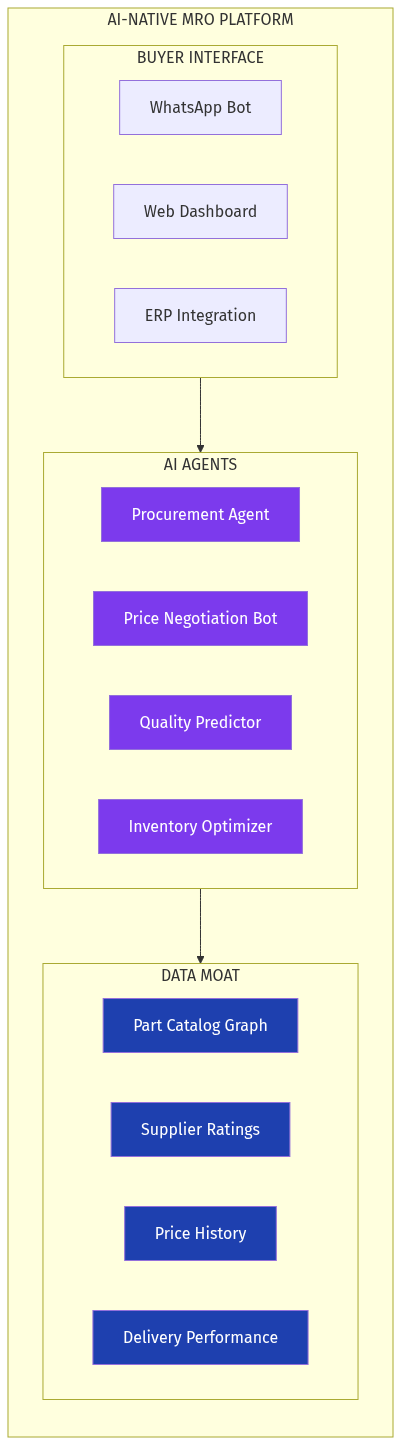
    Platform Architecture
    Platform Architecture

    7.

    Product Concept

    Core Features:
  • Natural Language Part Search
  • - Input: "Motor for HAAS VF-2 2018" - Output: Exact part numbers, verified suppliers, price comparison
  • Machine Profile Management
  • - Upload equipment list (import from ERP) - Platform knows your fleet, suggests preventive replacement
  • Supplier Verification Layer
  • - Authorization certificates on-chain - Transaction history and ratings - Geographic proximity scoring for emergency delivery
  • WhatsApp-Native Interface
  • - Procurement via WhatsApp Business API - AI agent handles RFQ, negotiation, PO - Human approval for spend >threshold
  • Price Intelligence Dashboard
  • - Historical price trends by part category - Supplier price benchmarking - Savings opportunity alerts
    8.

    Development Plan

    PhaseTimelineDeliverables
    MVP8 weeksPart search + 50 verified suppliers + WhatsApp ordering
    V116 weeksMachine profiles + Price comparison + Basic ERP export
    V224 weeksAI negotiation agent + SAP/Oracle integration + Credit terms
    Scale36 weeks5,000 suppliers + Predictive maintenance alerts + Insurance integration
    Technical Stack:
    • Part number parsing: Fine-tuned LLM on industrial catalogs
    • Compatibility engine: Graph database of machine-part relationships
    • WhatsApp: Kapso/Cloud API integration
    • Payments: Razorpay B2B + credit line partnerships

    9.

    Go-To-Market Strategy

    Phase 1: Single Vertical (Weeks 1-12)
    • Target: CNC machining shops in Pune/Chennai industrial clusters
    • Why: High part complexity, frequent purchases, price-sensitive
    • Distribution: WhatsApp groups of factory owners, IndiaMART lead lists
    Phase 2: Expand Categories (Weeks 12-24)
    • Add: Hydraulics, pneumatics, electrical panels
    • Geographic: Maharashtra → Tamil Nadu → Gujarat
    Phase 3: Enterprise Push (Weeks 24-36)
    • Target: Tata Steel, Mahindra, L&T supplier programs
    • Integration: SAP Ariba, Coupa partnerships
    • Moat: Become recommended procurement channel
    Steelmanning the Opposition: Why might incumbents win?
    • Moglix has $468M in funding and enterprise relationships
    • IndiaMART has 7M suppliers and brand recognition
    • SAP Ariba already serves Fortune 500 procurement
    Counter: All are catalog-first, not intelligence-first. None solve the compatibility problem. None operate WhatsApp-native.
    10.

    Revenue Model

    Revenue StreamModelPotential
    Transaction Fee2-5% of GMVPrimary revenue at scale
    Supplier Subscription₹5,000-50,000/month for verified badge + leadsEarly monetization
    Enterprise SaaS₹2-10L/year for procurement suiteHigh-value contracts
    Credit/FinancingInterest spread on procurement creditHigh margin
    Data LicensingPrice intelligence API for ERP vendorsPassive income
    Unit Economics Target:
    • Average order value: ₹15,000
    • Take rate: 3%
    • Revenue per order: ₹450
    • CAC target: ₹2,000 (LTV/CAC > 10x)

    11.

    Data Moat Potential

    What accumulates over time:
  • Machine-Part Graph: Every successful match trains the compatibility engine
  • Price History: Transaction-level pricing data doesn't exist anywhere
  • Supplier Quality Scores: Delivery times, defect rates, responsiveness
  • Procurement Patterns: Predictive maintenance signals from order frequency
  • Negotiation Transcripts: AI learns optimal negotiation tactics per supplier
  • Second-Order Effects:
    • If we capture 5% of transactions, we know more about part pricing than any player
    • Predictive maintenance alerts create switching costs
    • Credit terms lock in buyers for 90-180 day cycles

    12.

    Why This Fits AIM Ecosystem

    Alignment with AIM Vision:
    • Structured Discovery: Convert unstructured WhatsApp procurement into queryable transactions
    • AI-First: Natural language interface, not catalog browsing
    • Vertical Focus: MRO is a wedge into broader industrial B2B
    • India-Specific: Built for WhatsApp-first, price-sensitive, trust-deficit market
    Integration Points:
    • MRO suppliers become AIM.in listed businesses
    • Transaction data feeds into AIM's B2B intelligence layer
    • WhatsApp commerce infrastructure is reusable across verticals
    Pre-Mortem: What kills this opportunity?
    • Moglix executes AI features faster (they have cash)
    • Suppliers refuse verification (gray market profits)
    • Enterprise sales cycles exceed runway
    • Part number complexity defeats AI parsing
    Mitigation: Start with WhatsApp-first SME segment, not enterprise. Build supplier trust through lead quality, not coercion.

    ## Verdict

    Opportunity Score: 8/10 Why 8:
    • Massive market ($57B) with clear pain points ✓
    • Fragmented competition, no AI-native player ✓
    • WhatsApp distribution advantage unique to India ✓
    • Data moat potential is exceptional ✓
    Why not 10:
    • Moglix is well-funded and could pivot (-1)
    • Enterprise sales cycles are brutal for startups (-1)
    Recommendation: Build as a WhatsApp-first AI procurement agent for SME factories. Capture transaction data, build the compatibility graph, then expand to enterprise. This is a 10-year platform opportunity disguised as a B2B marketplace.

    ## Sources