Government e-Marketplace (GeM) is India's mandatory digital procurement platform for all central ministries, state governments, PSUs, and educational institutions. With ₹5.43 lakh crore in GMV for FY25 and a target of ₹7 lakh crore for 2025, it represents 15-20% of India's GDP in public procurement.
The paradox: Despite being digital-first, GeM suffers from catastrophic inefficiencies — 33.2% non-quotation rates, 53.9% fulfillment shortfalls in critical categories like medicines, and 14% price rejections. The 62 lakh registered vendors (45% MSMEs) struggle with cumbersome registration, bid discovery, and compliance. The opportunity: An AI-first vendor intelligence platform that transforms how sellers win on GeM — from automated profile optimization to predictive pricing and bid matching.1.
Executive Summary
2.
Problem Statement
Who Experiences This Pain?
Sellers (62 lakh+):- Manual registration requiring PAN, GST, Udyam documentation
- No intelligence on which bids to pursue
- Price guesswork leading to 13.8% rejection for exceeding LPP+10%
- 60-90 day payment cycles crushing cash flow
- Zero visibility into win/loss reasons
- 53.9% fulfillment gaps in critical supplies
- Order cancellations and supply non-delivery
- Difficulty finding reliable, qualified vendors
- Substandard supplies especially in scientific equipment
- 33.2% of tenders receive no quotes (logistics, disinterest)
- Technical glitches with OTP and login systems
- Category mismatches creating confusion
- Digital literacy gaps causing resistance

3.
Current Solutions
| Company | What They Do | Why They're Not Solving It |
|---|---|---|
| GeM itself | Official platform | No vendor-side intelligence, just listing infrastructure |
| GEM Managers | Consulting/training | Manual service, doesn't scale to 62L vendors |
| CA/Tax consultants | Compliance help | Transactional, no ongoing intelligence |
| Generic ERP tools | Inventory management | Not GeM-specific, no bid intelligence |
4.
Market Opportunity
- Market Size: ₹7 lakh crore ($85B+) annual GMV (2025 target)
- Addressable Vendors: 62 lakh sellers, 45% MSMEs
- Government Buyers: 1.5 lakh organizations
- Growth: FY26 already at ₹4 lakh crore (surpassing FY25 pace)
- Why Now:

5.
Gaps in the Market
Applying Anomaly Hunting:
Incentive Mapping:
- GeM's incentive: Transaction volume, not vendor success
- Consultants' incentive: Billable hours, not outcomes
- MSMEs' incentive: Win contracts, but no tools to compete with large players
- Large vendors' incentive: Status quo (they already have teams for this)
6.
AI Disruption Angle
Distant Domain Import: Apply Stock Trading Intelligence to Procurement
Stock trading platforms provide real-time signals, pattern recognition, and automated execution. GeM bidding should work the same way:
| Stock Trading | GeM Procurement Intelligence |
|---|---|
| Price alerts | Bid opportunity alerts |
| Technical analysis | Historical win pattern analysis |
| Position sizing | Bid pricing optimization |
| Portfolio tracking | Active bid dashboard |
| Algo trading | Auto-bid for matching tenders |
How AI Agents Transform the Workflow:
Today:7.
Product Concept
GemPilot: AI Copilot for Government Vendors
Core Features:8.
Development Plan
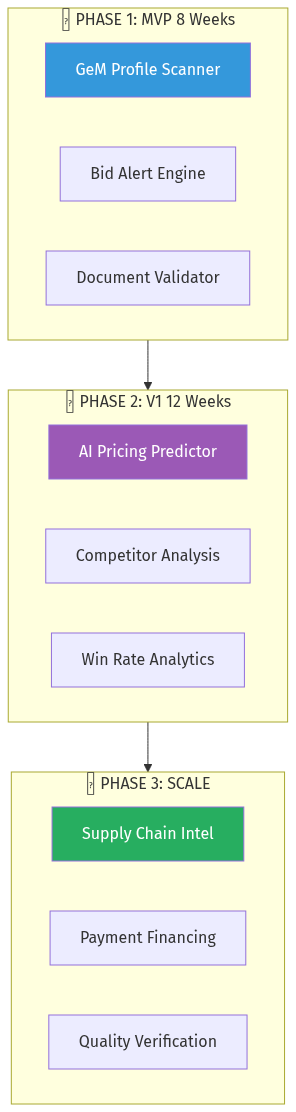
| Phase | Timeline | Deliverables |
|---|---|---|
| MVP | 8 weeks | Profile scanner, bid alerts, document validator |
| V1 | 12 weeks | AI pricing predictor, competitor analysis, win rate analytics |
| Scale | Ongoing | Supply chain intel, payment financing integration, quality verification network |
Technical Architecture:
- Data Ingestion: GeM scraper + OCR for tender documents
- Intelligence Layer: LLM for requirement extraction, ML for pricing prediction
- Delivery: WhatsApp bot (India's default B2B interface) + web dashboard
- Integration: GST portal, Udyam, bank statement parsers
9.
Go-To-Market Strategy
Pre-Mortem: Why 5 Startups Might Have Failed Here
GTM Approach:
Phase 1: Wedge (0-6 months)- Target: Pharma/medical device vendors (highest pain — 53.9% shortfall)
- Channel: WhatsApp communities, industry associations
- Pricing: Free tier (5 bids/month), ₹999/month unlimited
- Horizontal to construction, IT, office supplies
- Partner with CA/GST filing platforms (warm leads)
- Government partnerships for MSME enablement schemes
- Add buyer-side intelligence (vendor reliability scoring)
- Payment financing marketplace
- Quality verification network
10.
Revenue Model
Steelmanning the Revenue Challenge:
"MSMEs won't pay for software. They barely use computers." Counter: MSMEs do pay when the value is immediate and the interface is WhatsApp. Proof: Khatabook, Lio, and OkCredit all monetize this segment. Revenue Streams:- CAC: ₹500-1000 (WhatsApp + referral heavy)
- LTV: ₹24,000 (2 year retention @ ₹999/mo)
- LTV:CAC: 24-48x
11.
Data Moat Potential
Second-Order Thinking: What Compounds Over Time?
12.
Why This Fits AIM Ecosystem
AIM's thesis: Build vertical AI agents for India's fragmented B2B markets.
GeM Fit:- B2B: Pure B2G2B (business-to-government-to-business)
- Fragmented: 62L vendors, 4.69L product categories
- High-trust sector: Government procurement = trust signals matter
- AI-native: Document processing, pricing prediction, matching = LLM-ready
- Repeat purchase: Ongoing tender participation, not one-time sale
- WhatsApp-first interface (aligns with Bhavya/Krishna agent)
- Geo-intelligence for regional vendor discovery (Revathi/Varaha)
- Trust verification layer (Nandini/Narasimha)
## Verdict
Opportunity Score: 9/10 Why so high:- ₹7 lakh crore market with documented, quantified inefficiencies
- 53.9% fulfillment gaps = real, measurable pain
- 62L vendors = massive TAM, 45% MSMEs = underserved segment
- AI capabilities (LLM + OCR) finally mature enough
- WhatsApp distribution = low CAC path to MSMEs
- Regulatory tailwind (GFR 149 mandate)
- GeM itself could build these features (but government platforms historically don't)
- Pricing data aggregation may face legal scrutiny
- MSME willingness to pay SaaS fees (mitigated by success fee model)
## Sources
❧