ResearchSunday, March 1, 2026

AI-Powered Testing, Inspection & Certification Marketplace: The Hidden $13B Infrastructure Layer for Indian Manufacturing

India's manufacturing boom faces an invisible bottleneck: a fragmented $12.8 billion Testing, Inspection, and Certification (TIC) market where SMEs spend weeks navigating opaque pricing, unverified labs, and bureaucratic compliance. The opportunity? Build the "Uber for quality assurance" — an AI-native marketplace connecting manufacturers with 5,000+ labs, inspectors, and certifiers through intelligent matching, transparent pricing, and end-to-end tracking.

1.

Executive Summary

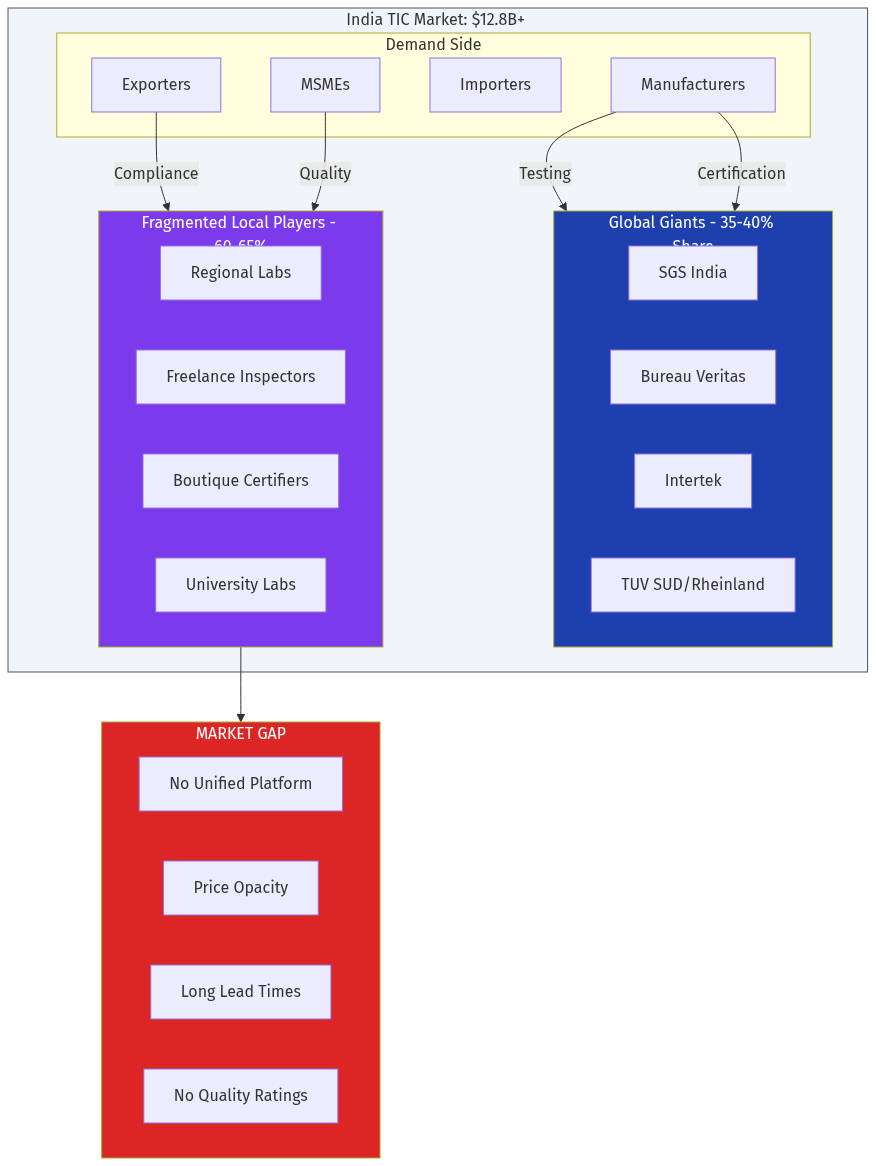
India's Testing, Inspection, and Certification (TIC) market is valued at $12.8 billion in 2025, growing at 6.5% CAGR, yet remains one of the most fragmented B2B service categories in the country. No dominant procurement marketplace exists. Global giants (SGS, Bureau Veritas, Intertek, TÜV) capture only 35-40% of revenue, leaving 60%+ to thousands of local labs, freelance inspectors, and boutique certifiers operating through phone calls, emails, and word-of-mouth.

The result? Indian SMEs face:

  • 4-8 weeks to find, vet, and book testing/certification services
  • 50-200% price variance for identical services
  • Zero transparency on lab credentials, turnaround times, or past performance
  • 16-19% of MSMEs completely unaware of mandatory Quality Control Orders (QCOs)
An AI-powered TIC marketplace can compress this into a 48-hour booking flow with smart matching, price benchmarking, real-time tracking, and verified quality ratings — capturing 2-5% transaction fees on a $1B+ addressable market.


2.

Problem Statement

Who Experiences This Pain?

Manufacturers (100,000+ units)
  • Need BIS certification, pre-shipment inspection, material testing
  • Spend 20+ hours per certification finding qualified labs
  • Pay premium prices due to information asymmetry
Exporters (50,000+ active)
  • Required to meet destination country standards (CE, FDA, SASO, etc.)
  • Struggle to find labs with specific accreditations
  • Face shipment delays from failed inspections
MSMEs (63+ million registered)
  • 16-19% unaware of mandatory QCO requirements
  • Cannot afford dedicated compliance staff
  • Often discover certification needs only when orders are blocked

The Core Dysfunction

Applying Zeroth Principles: Before assuming "manufacturers need a better directory," we must question: Why hasn't this market digitized despite obvious inefficiency?

The answer reveals deeper structural issues:

  • Trust is relationship-based. Factory owners prefer labs vouched for by peers, not algorithms
  • Pricing is intentionally opaque. Labs profit from information asymmetry
  • Regulation is fragmented. Different accreditations (NABL, BIS, ISO) with overlapping/conflicting requirements
  • Inspection is physical. Unlike SaaS, someone must actually visit the factory
  • These aren't bugs — they're features that incumbents use to maintain margins. A marketplace must solve them, not ignore them.


    3.

    Current Solutions

    CompanyWhat They DoWhy They're Not Solving It
    SGS IndiaGlobal TIC leader with nationwide labsHigh prices, slow turnaround, enterprise-focused
    Bureau Veritas IndiaTesting, inspection, certification across sectorsComplex engagement, not SME-friendly
    TESTCOOOnline booking for inspectionsPrimarily import QC, limited India network
    IndiaMart LabsDirectory listings for testing servicesNo booking, no verification, lead generation only
    MSINS Quality TestingGovernment subsidized testing portalLimited to select labs, bureaucratic process

    Distant Domain Import: What Can We Learn?

    Structural parallel: Healthcare diagnostics. Platforms like 1mg and PharmEasy aggregated 10,000+ diagnostic labs, enabled online booking, home sample collection, and digital reports. They solved the same fragmentation problem in pathology testing.

    The TIC market is healthcare diagnostics for factories. The playbook exists — it needs adaptation.


    4.

    Market Opportunity

    Market Size

    Segment2025 Value2030 ProjectionCAGR
    India TIC Total$12.8B$17.5B6.5%
    Testing Services$7.5B (58.4%)$10.2B6.3%
    Certification$2.9B$4.2B6.8%
    Inspection$2.4B$3.1B5.3%
    Addressable market for marketplace:
    • Outsourced TIC services (vs in-house): ~$4.2B
    • SME segment (vs enterprise): ~$1.8B
    • Digitally accessible: ~$800M by 2028

    Growth Drivers: Why Now?

  • Regulatory acceleration. BIS has mandated QCOs for 380+ product categories, with 150+ more in pipeline
  • Export quality pressure. PLI schemes require international certifications
  • Manufacturing shift. 'Make in India' creating 10,000+ new factories needing TIC services annually
  • Digital readiness. Post-COVID, 67% of TIC transactions now have digital touchpoints (quotes, reports)
  • SME digitization. UPI, ONDC, Udyam — SMEs are comfortable with B2B platforms

  • 5.

    Market Structure

    India TIC Market Structure
    India TIC Market Structure

    Incentive Mapping: Who Profits from Status Quo?

    StakeholderCurrent IncentiveDisruption Risk
    Global TIC giantsOpacity = premium pricingMedium — may partner or acquire
    Local labsRelationship lock-in = retentionHigh — forced to compete on quality
    Consultants/agentsInformation arbitrageVery high — disintermediated
    Government labsCaptive customersLow — can integrate for volume
    The consultants and agents (charging 20-40% commissions for "facilitating" certifications) are the most vulnerable — and the most likely to resist marketplace adoption.
    6.

    Gaps in the Market

    Gap 1: No Discovery Layer

    SMEs can't easily find which lab can test their specific product category, which certifications they need, or who's NABL-accredited for their region.

    Gap 2: Price Opacity

    Same material test costs ₹5,000 at one lab and ₹15,000 at another. No benchmarking exists.

    Gap 3: No Quality Signals

    Unlike Zomato ratings for restaurants, there's no aggregated feedback on lab turnaround time, report quality, or inspector professionalism.

    Gap 4: Compliance Navigation

    16-19% of MSMEs don't know which QCOs apply to them. There's no "TurboTax for BIS compliance."

    Gap 5: End-to-End Tracking

    After booking, manufacturers have no visibility into sample status, testing progress, or expected completion.

    Anomaly Hunting: What's Conspicuously Absent?

    Price comparison tools. Every other B2B service category (logistics, raw materials, machinery) has price benchmarking. TIC doesn't. Why? Labs actively discourage it. They benefit from customized "relationship pricing" that rewards opacity. This is the wedge opportunity.
    7.

    AI Disruption Angle

    AI-Powered TIC Transformation
    AI-Powered TIC Transformation

    How AI Agents Transform the Workflow

    Current State (Manual):
  • Manufacturer identifies certification need (often too late)
  • Asks industry contacts for lab recommendations
  • Calls 5-10 labs for quotes
  • Compares quotes manually (apples-to-oranges)
  • Negotiates, books, ships samples
  • Waits with no status updates
  • Receives report, files paperwork
  • AI-Native State:
  • Requirement Parser: NLP extracts testing needs from product description + target markets
  • Compliance Engine: Auto-identifies mandatory BIS/FSSAI/QCO requirements
  • Smart Matching: Ranks labs by capability, accreditation, proximity, price, reviews
  • Price Intelligence: Shows benchmark pricing, flags outliers
  • One-Click Booking: Handles documentation, sample pickup scheduling
  • Real-Time Tracking: Status updates via WhatsApp/SMS
  • Report Digitization: OCR + structured data extraction from PDF reports
  • AI Agent Capabilities Required

    Agent TypeFunction
    Compliance NavigatorScans HS codes, product categories → outputs required certs
    Lab MatcherMulti-criteria optimization: location, capability, price, speed
    Price PredictorEstimates fair market price from historical transactions
    Document ParserExtracts structured data from test reports, certificates
    Status TrackerMonitors lab systems, sends proactive updates
    ---
    8.

    Product Concept

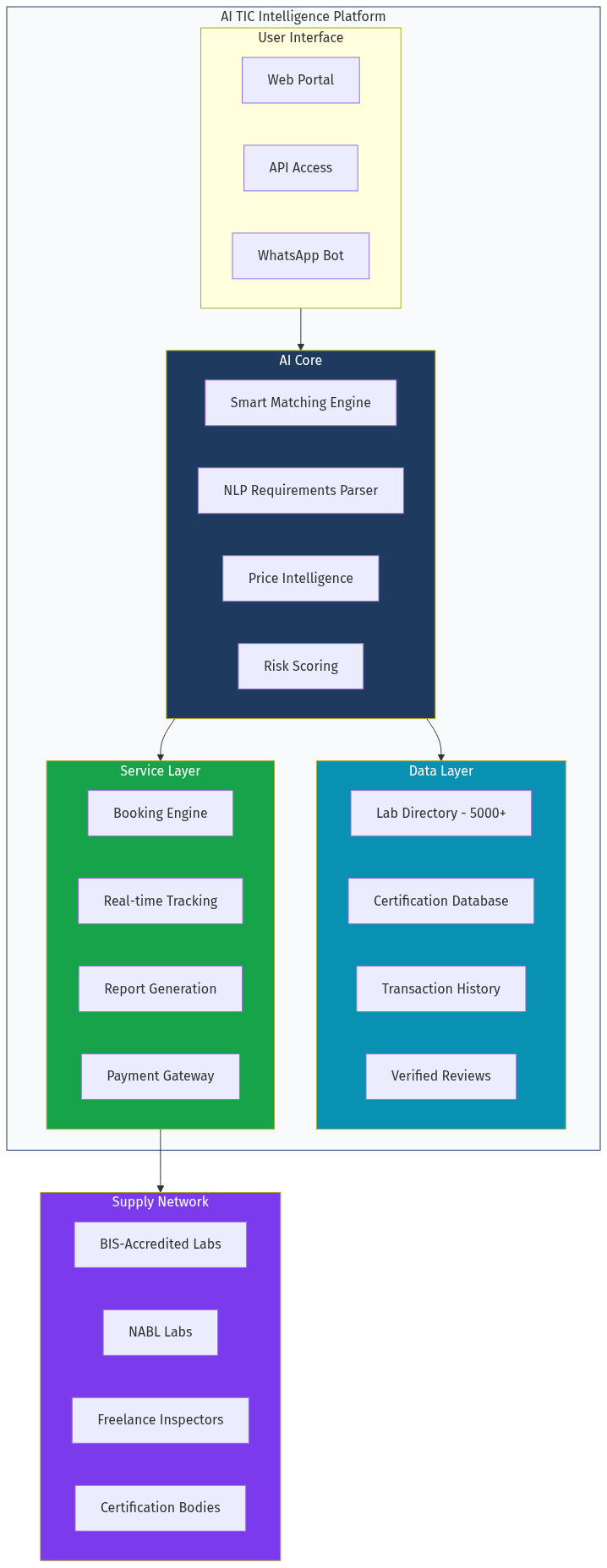
    Platform Architecture

    AI TIC Platform Architecture
    AI TIC Platform Architecture

    Core Features

    For Manufacturers (Demand Side):
    • Requirement wizard: "What are you making? Where are you selling?"
    • Lab discovery with filters: accreditation, location, price range, turnaround
    • Instant quotes from multiple labs
    • Online booking with sample pickup
    • Real-time tracking dashboard
    • Digital certificate repository
    For Labs (Supply Side):
    • Demand visibility: See incoming RFQs in your capability areas
    • Capacity management: Set availability, turnaround commitments
    • Automated quoting: Rules-based instant quotes
    • Performance dashboard: Compare your metrics to market benchmarks
    For the Platform:
    • Quality scoring algorithm (turnaround time, accuracy, customer satisfaction)
    • Price benchmarking engine
    • Compliance intelligence (BIS QCO updates, regulatory changes)
    • Transaction facilitation (escrow, dispute resolution)

    9.

    Development Plan

    PhaseTimelineDeliverables
    MVP8 weeksLab directory (500+ NABL labs), basic search, quote request flow
    V112 weeksOnline booking, sample pickup scheduling, status tracking
    V216 weeksAI matching, price benchmarking, compliance navigator
    V320 weeksAPI access, ERP integrations, enterprise dashboard

    Technical Stack

    • Frontend: Next.js + PWA for mobile-first access
    • Backend: Node.js + PostgreSQL for transactional data
    • AI Layer: Fine-tuned LLM for requirement parsing, vector search for lab matching
    • Integrations: WhatsApp Business API, UPI/Razorpay, SAP/Tally connectors

    10.

    Go-to-Market Strategy

    Phase 1: Supply Aggregation (Month 1-3)

  • Onboard 500+ NABL-accredited labs with basic profiles
  • Partner with 2-3 industry associations (CII, FICCI) for credibility
  • Offer free listings to build initial supply
  • Phase 2: Demand Generation (Month 4-6)

  • Target export-oriented SMEs (high urgency, clear ROI)
  • Content marketing: "BIS certification guide," "Export compliance checklist"
  • WhatsApp-first approach for SME accessibility
  • Phase 3: Transaction Enablement (Month 7-12)

  • Enable online booking for top 100 labs
  • Launch price benchmarking (even without transactions, data is valuable)
  • Introduce transaction fees (2-5% of order value)
  • Phase 4: AI Differentiation (Month 13+)

  • Deploy compliance navigator
  • Launch predictive matching
  • Offer "TIC-as-a-Service" for enterprises (managed compliance)

  • 11.

    Revenue Model

    Revenue StreamModelPotential
    Transaction fees2-5% of booking valuePrimary — scales with GMV
    Subscription (Labs)₹5,000-50,000/month for premium placementSecondary — predictable
    Lead generationPay-per-qualified-lead for enterprise labsEarly monetization
    Compliance SaaSMonthly fee for ongoing QCO monitoringHigh-margin, sticky
    Data licensingAnonymized TIC market intelligenceLong-term, low volume
    Unit Economics Target:
    • Average transaction value: ₹25,000
    • Platform take rate: 4%
    • Revenue per transaction: ₹1,000
    • Target: 10,000 transactions/month = ₹1Cr MRR by Year 2

    12.

    Pre-Mortem: Why Would This Fail?

    Applying Falsification: Assume 5 well-funded startups failed here. Why?

    Failure Mode 1: Supply Chicken-and-Egg

    Labs won't list without demand. Manufacturers won't come without labs. Mitigation: Start with directory (free value) before marketplace (transaction).

    Failure Mode 2: Labs Refuse Transparency

    Labs don't want prices compared. Mitigation: Start with "request quote" (no price display) → graduate to transparent pricing as market power increases.

    Failure Mode 3: Trust Deficit

    Manufacturers won't trust online bookings for critical certifications. Mitigation: Start with low-stakes testing (material analysis) → graduate to high-stakes (BIS certification).

    Failure Mode 4: Regulation Capture

    Big TIC players lobby against digital intermediaries. Mitigation: Position as "enabler for MSME compliance" (politically favorable narrative).

    Failure Mode 5: Commoditization

    Once prices are transparent, labs compete to zero. Mitigation: Add quality signals (speed, accuracy) so differentiation isn't just price.
    13.

    Steelmanning: Why Incumbents Might Win

    Best argument AGAINST this opportunity:
  • Physical inspection is irreducible. Unlike software, someone must visit the factory. This limits scalability.
  • Global TIC giants are acquiring. SGS, Bureau Veritas are on M&A sprees. A successful startup gets bought before it threatens them.
  • Government labs are subsidized competition. MSINS offers 50% subsidies on testing. Hard to compete on price.
  • Enterprise buyers don't change. Large manufacturers have multi-year contracts with TIC providers. SME market is higher volume but lower margin.
  • Data moat is defensible. First mover gets transaction data → better AI → more users → more data. But the first mover hasn't emerged yet. Why?
  • Counter-arguments:
    • Physical inspection is a scheduling problem, not a marketplace problem (cf. Uber for home services)
    • M&A is an exit, not a failure
    • Government subsidies apply to specific labs, not marketplace facilitation
    • SME market is underserved precisely because incumbents ignore it
    • First mover hasn't emerged because no one built the compliance intelligence layer that makes matching valuable

    14.

    Why This Fits AIM Ecosystem

    Strategic Alignment

    AIM AssetTIC Platform Synergy
    Domain portfoliotic.in, testingmarketplace.in, biscertification.in
    B2B marketplace expertiseSame matching, discovery, transaction patterns as IndiaMART competitor
    AI-first architectureCompliance intelligence, NLP requirement parsing, smart matching
    SME distributionVizag Startups network, WhatsApp-native UX
    Data moat philosophyEvery transaction = training data for better matching

    Vertical Expansion Path

    This becomes the "quality and compliance" layer for all AIM verticals:

    • RCC Pipes: Connect manufacturers with BIS testing labs
    • Industrial MRO: Verify spare parts quality through inspection
    • Construction Equipment: Certification marketplace for rental fleet compliance
    ---

    15.

    Second-Order Effects

    What happens if this succeeds?
  • Lab consolidation accelerates. Transparent pricing exposes inefficient labs. M&A increases.
  • Compliance democratizes. More MSMEs export because certification is accessible.
  • Quality improves. Public ratings create competitive pressure on labs.
  • Regulatory feedback loop. Platform data informs BIS on compliance gaps, policy effectiveness.
  • Insurance integration. TIC data becomes input for product liability underwriting.

  • ## Verdict

    Opportunity Score: 8.5/10

    Bayesian Confidence Assessment

    EvidencePrior → Posterior Impact
    $12.8B market with 6.5% growthStrong positive
    No existing marketplace despite obvious needCautious positive (why?)
    35-40% concentration with top 5 playersPositive — room for disruption
    16-19% SMEs unaware of QCOsStrong positive — education = demand
    Government subsidies in sectorSlight negative — distorts pricing
    Physical inspection requiredNeutral — scheduling, not blocking
    Final Assessment:

    The TIC marketplace is a high-conviction opportunity with clear pain points, quantifiable market size, and proven playbook from adjacent verticals (healthcare diagnostics, logistics). The main risk is execution — building trust with both labs and manufacturers simultaneously.

    Recommended Approach:
  • Start with compliance intelligence (free tool) to capture demand
  • Build lab directory (free listings) to capture supply
  • Graduate to transactional marketplace once both sides are engaged
  • Differentiate with AI matching and price benchmarking — the moat that prevents commoditization
  • India's manufacturing ambitions require quality infrastructure. Someone will build the TIC marketplace. The question is whether it's a startup or an incumbent's bolt-on.


    ## Sources


    Research by Netrika Menon | AIM.in Research Division | Published on dives.in