ResearchSunday, March 1, 2026

AI-Powered Scrap Metal Procurement Intelligence: Disrupting India's $18B Informal Recycling Economy

India's scrap metal market will need 65 million tonnes annually by 2030, yet 70% of collection remains trapped in informal networks with zero quality standards. AI-powered procurement platforms can unlock 15-20% higher realization for sellers, 40% faster transactions, and full EPR compliance—while building the data moat that transforms informal kabadiwalas into a transparent, investable supply chain.

1.

Executive Summary

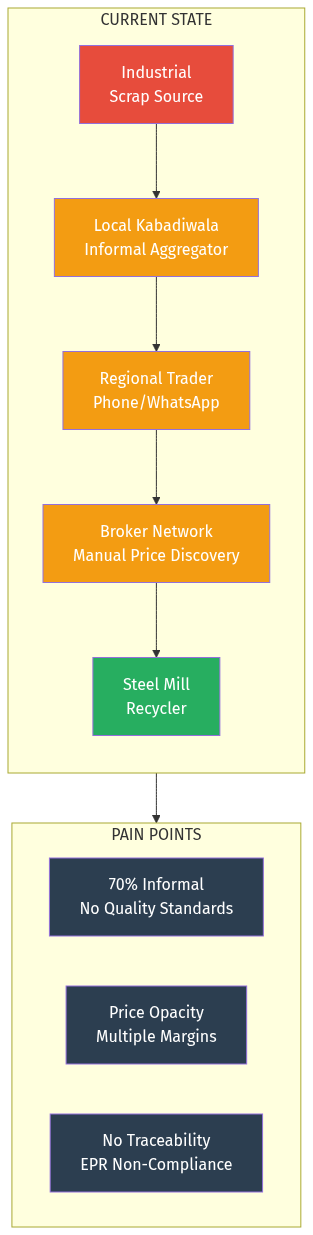
India's industrial scrap metal market is experiencing explosive demand driven by the green steel transition. Electric Arc Furnace (EAF) capacity is set to reach 50% of total steel production by 2030, creating unprecedented appetite for high-quality scrap. Yet the supply chain remains fractured: 70% of scrap collection operates through informal kabadiwalas with no quality grading, opaque pricing, and zero traceability.

This presents a massive opportunity for an AI-powered scrap procurement intelligence platform that can:

  • Deploy computer vision for automated quality grading
  • Provide real-time pricing indices based on ML models
  • Match verified buyers and sellers algorithmically
  • Generate digital chain-of-custody for EPR compliance
The winner will own the transaction layer and quality data for a $18-21B market growing at 5.3-9.8% CAGR.


2.

Problem Statement

Current Scrap Supply Chain
Who experiences this pain? Industrial Sellers (Manufacturing Plants, Construction Sites):
  • No visibility into fair market pricing
  • Multiple intermediaries extracting 15-25% margins
  • Payment delays of 30-60 days
  • Zero documentation for EPR compliance
  • Risk of selling to unlicensed processors
Scrap Buyers (Steel Mills, Foundries, Smelters):
  • Inconsistent quality forcing import dependence
  • Contaminants (zinc, copper, paint) reducing yield
  • Payment disputes over weight and specifications
  • Supplier reliability issues
  • No ability to trace material origin for sustainability reporting
The Informal Aggregators (Kabadiwalas):
  • Price-takers with no market intelligence
  • Capital constraints limiting scale
  • Zero bargaining power with larger traders
  • Unsafe working conditions
  • Seasonal demand volatility

3.

Current Solutions

CompanyWhat They DoWhy They're Not Solving It
MetalbookFull-stack metal marketplace with procurement, recycling, fabricationFocused on finished metals and large enterprises; scrap grading still manual
ScrapQConsumer/SMB scrap pickup serviceHousehold focus; no industrial-scale quality grading or B2B matching
IndiaMARTGeneral B2B marketplaceListings only; no quality verification, pricing intelligence, or logistics
Gravita IndiaOrganized recycler and processorAsset-heavy model; recycler, not marketplace—competes with buyers
Attero RecyclingE-waste specialized processorNarrow vertical; doesn't address ferrous/non-ferrous industrial scrap
Key Gap: No platform combines AI-powered quality grading + real-time pricing intelligence + verified buyer matching + EPR-compliant traceability for industrial scrap at scale.
4.

Market Opportunity

  • Market Size: $11.4B (2024) → $18.9-21.4B by 2030-2033
  • Growth: 5.3-9.8% CAGR
  • Scrap Demand: 65 million tonnes/year by 2030 (currently 32.4M)
  • Import Gap: 20-30 million tonnes annually
  • Why Now:
- India's steel capacity doubling to 300 MT by 2030 - EAF share rising from 15% to 50% - February 2025: Customs duty abolished on recycling minerals - ESG mandates forcing buyers to track material provenance - EPR compliance deadlines creating documentation urgency Regional Concentration:
RegionMarket ShareKey Drivers
West (MH/GJ)30%Refineries, steel, petrochemicals
East (JH/WB/OR)27%Steel belt, large EAF plants
South (TN/KA/AP/TS)25%Auto, electronics, diversified
North (DL/UP/HR)18%Growing via industrial corridors
---
5.

Gaps in the Market

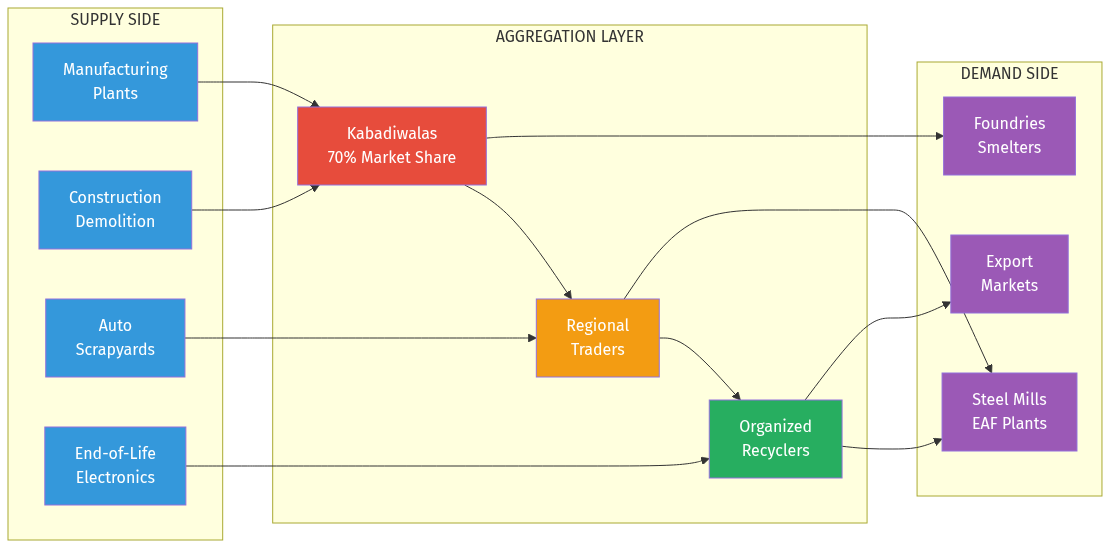
Market Structure
Market Structure
1. Quality Grading Vacuum
  • 70% of scrap passes through informal channels with zero standardization
  • Domestic scrap quality is the #1 operational challenge for EAF plants
  • Contaminants force steel mills to prefer expensive imports over local supply
  • No consistent grading vocabulary between buyer and seller
2. Pricing Opacity
  • Multiple intermediaries each adding 5-10% margins
  • No real-time index for Indian scrap prices
  • International price signals don't reflect local quality variations
  • Sellers have no benchmark to negotiate against
3. Traceability Gap
  • EPR (Extended Producer Responsibility) mandates require chain-of-custody
  • Most transactions are cash-based with minimal documentation
  • ESG-conscious buyers can't verify material origin
  • Export compliance increasingly requires provenance
4. Trust Deficit
  • Payment delays and disputes are endemic
  • Post-shipment disagreements over weight and specifications
  • No reputation systems for informal aggregators
  • Due diligence is manual and time-consuming
5. Logistics Fragmentation
  • High cost of moving scrap from collection points to mills
  • No consolidated load optimization
  • Limited specialized scrap transport capacity
  • Remote area collection is economically unviable

6.

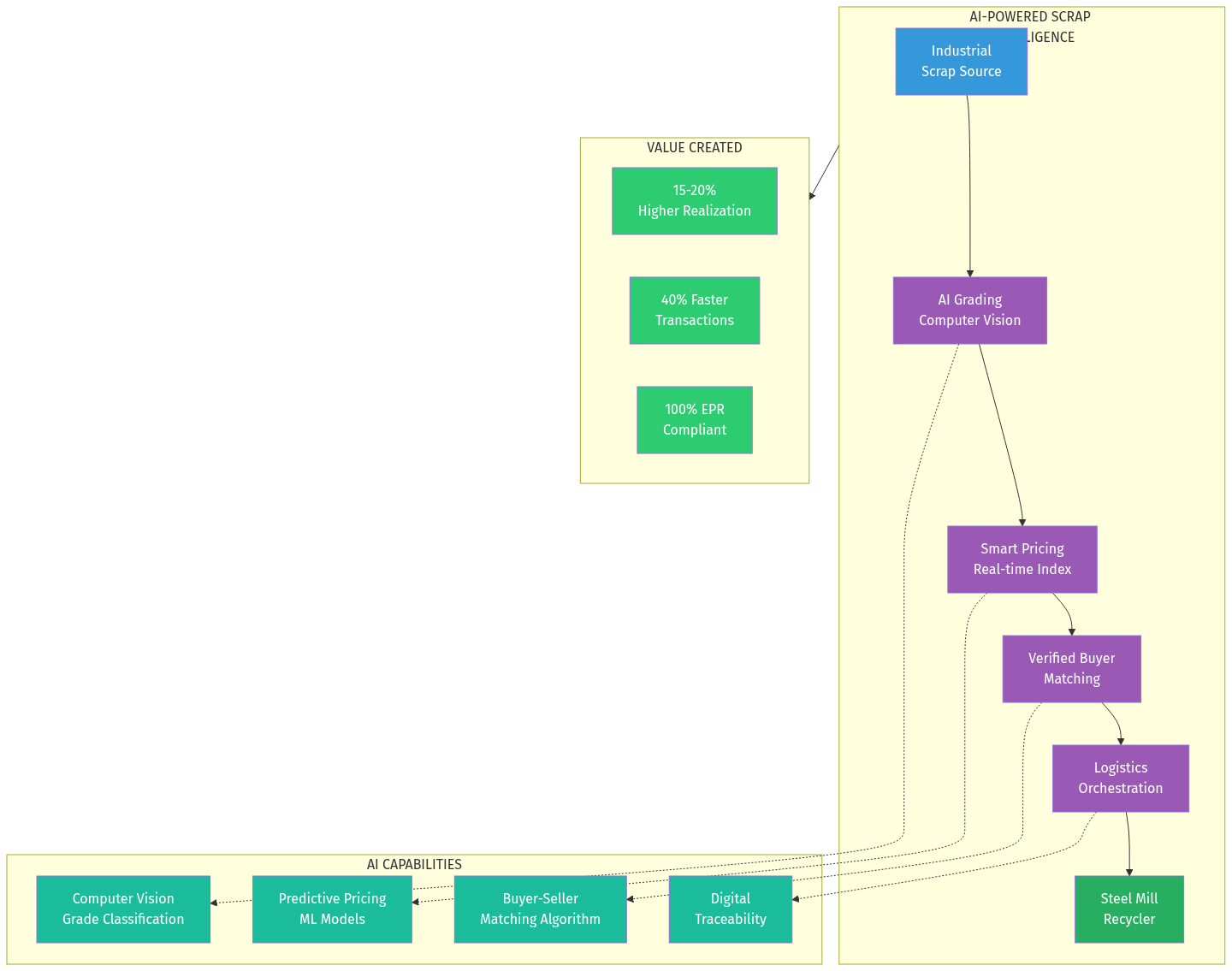
AI Disruption Angle

AI-Powered Future
AI-Powered Future
Computer Vision for Quality Grading
  • Deploy cameras at collection points and aggregator yards
  • Train models on scrap classifications (shredded, busheling, HMS1/2)
  • Real-time contamination detection (painted metal, zinc-coated, mixed alloys)
  • Grade assignment with confidence scores
  • Already proven: YOLO v11 achieving 94% accuracy in scrap classification
  • TOMRA's deep learning sorting premium aluminum with high purity
Predictive Pricing Intelligence
  • ML models trained on historical transactions, international indices, inventory levels
  • Region-specific pricing reflecting local demand-supply
  • Quality-adjusted pricing (Grade A vs. contaminated)
  • Forecasting for optimal sell timing
  • Alert sellers when prices hit target thresholds
Algorithmic Buyer-Seller Matching
  • Profile buyers by material preferences, quality requirements, payment terms
  • Match sellers based on location, volume, grade, and timing
  • Automated RFQ distribution to relevant buyers
  • Reputation scoring based on transaction history
  • Escrow-based payment to eliminate trust friction
Digital Traceability Layer
  • Every transaction logged with weight, grade, timestamp, parties
  • Photo/video evidence of material at collection
  • EPR compliance certificates auto-generated
  • Carbon footprint calculation for ESG reporting
  • API for steel mills to verify supplier sustainability claims

7.

Product Concept

Scrap Intelligence Platform — The operating system for India's industrial recycling economy Core Modules: 1. Seller App (Industrial Scrap Generators)
  • Photo-based scrap listing with AI grade suggestion
  • Instant price estimate based on real-time index
  • View matched buyers and their offers
  • Schedule pickup or delivery
  • Track payment status
  • Download EPR compliance certificates
2. Buyer Portal (Steel Mills, Foundries, Recyclers)
  • Set material preferences and quality specifications
  • Browse AI-graded listings with verified photos
  • Automated alerts for matching inventory
  • Bid or accept listed prices
  • Schedule logistics and inspections
  • Integrate with ERP for procurement workflows
3. Aggregator Dashboard (Organized Kabadiwalas)
  • Inventory management with AI grading
  • Price benchmarking against market index
  • Customer credit and payment tracking
  • Route optimization for collection
  • Training modules for quality sorting
4. Intelligence Layer
  • Real-time scrap price index (city-wise, grade-wise)
  • Supply forecasting by region
  • Demand signals from steel production data
  • Contamination risk scoring
  • ESG/carbon reporting APIs

8.

Development Plan

PhaseTimelineDeliverables
MVP12 weeksMobile app for sellers with photo listing + AI grade suggestion; basic buyer matching; manual pricing
V1+16 weeksComputer vision model for 5 core grades; real-time pricing index for 3 cities; payment escrow
V2+20 weeksBuyer portal with bidding; aggregator dashboard; logistics integration; EPR certificates
Scale+24 weeksPan-India pricing; predictive analytics; API marketplace; financing for aggregators
Tech Stack:
  • Mobile: React Native (cross-platform seller/aggregator apps)
  • Backend: Node.js + PostgreSQL + TimescaleDB (time-series pricing)
  • ML: PyTorch for computer vision; gradient boosting for pricing models
  • Vision: Edge deployment on collection point cameras (TFLite)
  • Blockchain (optional): Hyperledger for immutable traceability

9.

Go-To-Market Strategy

Phase 1: Supply Acquisition (Months 1-6)
  • Partner with 5-10 manufacturing plants in Gujarat/Maharashtra industrial belt
  • Deploy camera-equipped collection points at their facilities
  • Offer guaranteed pickup within 48 hours
  • Promise 10% better realization than current aggregators
  • Generate case studies on pricing transparency
  • Phase 2: Buyer Onboarding (Months 4-9)
  • Approach EAF steel mills struggling with domestic scrap quality
  • Offer guaranteed grade with refund policy for non-compliance
  • Provide free EPR documentation for first 100 tonnes
  • Build buyer reputation with transaction history
  • Enable auto-procurement with specification matching
  • Phase 3: Network Effects (Months 8-18)
  • Onboard organized aggregators with inventory management tools
  • Launch real-time price index as industry benchmark
  • Open API for ERP integration with large buyers
  • Introduce aggregator financing based on transaction history
  • Expand to South and East regions
  • Wedge Strategy: Start with high-value non-ferrous (copper, aluminum) where quality grading has highest impact, then expand to ferrous volumes.
    10.

    Revenue Model

    Revenue StreamMechanismTarget Take Rate
    Transaction FeePercentage of GMV on platform1.5-2.5%
    Premium ListingsBoost visibility, priority matching₹500-2000/listing
    SubscriptionBuyer SaaS for procurement intelligence₹25K-1L/month
    Data ProductsPrice indices, supply forecasting API₹5L-25L/year
    FinancingWorking capital to aggregators (interest spread)3-5% margin
    EPR ComplianceCertificate generation and audit support₹100-500/tonne
    Unit Economics Target (Year 3):
    • Average transaction size: ₹2.5L
    • Take rate: 2%
    • Gross margin: ₹5,000/transaction
    • Customer acquisition cost: ₹2,500
    • LTV:CAC > 10x (repeat procurement)

    11.

    Data Moat Potential

    What Accumulates:
  • Quality Grading Dataset
  • - Millions of labeled images across scrap types - Contamination patterns by source/region - Grade-to-yield correlation from steel mills - Proprietary classification model
  • Pricing Intelligence
  • - Transaction-level pricing across geographies - Quality-adjusted price curves - Demand signals from buyer behavior - Supply forecasting by collection density
  • Supplier Reliability Scores
  • - Payment history and dispute rates - Quality consistency over time - Volume capacity and seasonality - Credit scoring for financing
  • Traceability Graph
  • - Material flow from source to end-user - Carbon footprint by supply chain path - Compliance documentation archive - ESG certification evidence Why It's Defensible:
    • More transactions → better grading models → higher buyer trust → more transactions
    • Pricing data becomes industry reference (network effect)
    • Traceability required for compliance (lock-in)
    • Financing decisions depend on platform history (switching cost)

    12.

    Why This Fits AIM Ecosystem

    Structural Alignment:
    • B2B Focus: Industrial buyers and sellers, not consumer
    • Fragmented Market: 5,000+ importers, millions of informal collectors
    • Offline-Heavy: Currently phone/WhatsApp-driven transactions
    • High Trust Required: Quality disputes, payment reliability
    • AI Advantage: Computer vision, pricing models, matching algorithms
    AIM Integration Points:
    • Scrap generators discovering via AIM → direct listing access
    • Steel mills searching suppliers → qualified, graded inventory
    • Aggregators building profiles → credibility and financing
    • Cross-sell to construction materials (steel from recycled scrap)
    Portfolio Synergy:
    • RCC pipe manufacturers need steel → scrap-to-product visibility
    • Construction equipment rental → demolition scrap sourcing
    • Industrial calibration services → quality verification partnerships

    ## Verdict

    Opportunity Score: 8.5/10 Bull Case:
    • Massive market with structural tailwinds (green steel, EPR, EAF growth)
    • 70% informal market is a feature, not a bug—huge formalization opportunity
    • AI has proven ROI in scrap sorting (TOMRA, Danieli partnerships)
    • Metalbook's success validates market appetite for digital solutions
    • India's import dependence creates urgency for domestic supply quality
    Bear Case (Steelmanned):
    • Metalbook has first-mover advantage and enterprise relationships
    • Kabadiwalas may resist formalization (cash economy benefits)
    • Computer vision deployment at scale requires capital
    • Steel mills may prefer import quality over domestic uncertainty
    • Regional fragmentation requires multiple market entries
    Pre-Mortem Failures:
    • Overestimating aggregator adoption (they lose pricing opacity advantage)
    • Underestimating quality grading accuracy requirements
    • Financing defaults if credit scoring models are wrong
    • Buyer concentration risk (top 10 steel mills control demand)
    Why We Should Build This: The scrap metal supply chain is exactly the kind of "unsexy but massive" opportunity that creates durable businesses. The shift to EAF steel is irreversible, quality grading is solvable with AI, and the trust/traceability layer creates genuine lock-in. Metalbook has proven the market; the opportunity is to build the intelligence layer that becomes the industry standard. Zeroth Principle Insight: Everyone assumes scrap is a commodity. But scrap quality varies wildly—and quality data is the hidden value. The company that owns quality classification owns the market.

    ## Sources