ResearchSunday, March 1, 2026

AI-Powered Industrial Compressed Air Rental Intelligence: Consolidating India's $1.1B Fragmented Market

India's compressed air rental market is a case study in fragmentation: hundreds of WhatsApp-driven operators, no real-time availability visibility, and reactive maintenance causing costly downtime. AI agents can transform this into an intelligent, predictive marketplace.

1.

Executive Summary

The Indian air compressor market is valued at USD 1.13 billion in 2025, growing at 6-9% CAGR. Within this, the rental segment is highly fragmented—dominated by regional players listed on IndiaMART with no centralized intelligence layer. Buyers waste hours calling multiple vendors; suppliers have zero demand visibility; and equipment sits idle while others face downtime from leaks and failures.

An AI-native platform can aggregate fragmented supply, enable real-time fleet visibility, and deploy IoT-enabled predictive maintenance—creating a winner-take-most marketplace in industrial equipment rental.


2.

Problem Statement

The Buyer's Pain

A manufacturing plant procurement manager needs a 500 CFM oil-free compressor for a 3-week shutdown maintenance project:
  • Discovery chaos: Opens IndiaMART, finds 200+ listings, unclear which have availability
  • Manual RFQ hell: WhatsApps 5-7 vendors, gets PDFs with varying specs and pricing
  • No real-time status: "Sir, let me check and call back" — vendor calls back 4 hours later
  • Delivery uncertainty: Equipment arrives late, wrong specs, or in poor condition
  • Reactive failures: Compressor leaks 30% air, no one notices until productivity drops
  • The Supplier's Pain

    A regional compressor rental company with 40 units across Gujarat:
  • Demand blindness: No visibility into upcoming projects or seasonal patterns
  • Utilization gaps: 35% fleet sits idle while competitors are overbooked
  • Manual matching: Owner personally handles every inquiry via WhatsApp
  • Service scheduling: Reactive maintenance leads to costly breakdowns and angry customers
  • No data leverage: Years of rental history but no insights

  • 3.

    Current Solutions

    CompanyWhat They DoWhy They're Not Solving It
    Atlas Copco RentalPremium rental fleet, IoT-enabledPremium pricing, limited to major metros, enterprise-focused
    Aggreko IndiaTemporary power + compressed airOil & gas focus, not accessible to SME manufacturers
    IndiaMART ListingsDirectory of 200+ providersNo real-time availability, no quality assurance, no intelligence
    Shaktiman EquipmentsPan-India rentalsStill inquiry-based, no platform intelligence
    Local Fleet OperatorsRegional coverage, competitive pricingFragmented, no tech stack, WhatsApp-only operations
    Gap: No platform exists that aggregates fragmented supply, provides real-time availability, and enables predictive operations.
    4.

    Market Opportunity

    Market Size

    • India Air Compressor Market (2025): USD 1.13 billion
    • Rental Segment (Estimated): 15-20% of market = USD 170-225 million
    • Growth Rate: 6.2-9.16% CAGR through 2030
    • Volume: 151,000 units (2025) → 234,000 units (2030)

    Why Now

  • Infrastructure Boom: $1.4 trillion National Infrastructure Pipeline driving construction demand
  • Make in India: Semiconductor fabs, EV plants, manufacturing expansion
  • Asset-Light Preference: Companies avoiding CapEx, preferring rental models
  • IoT Cost Collapse: Sensors + connectivity now affordable for retrofit
  • AI Readiness: Predictive maintenance and demand forecasting are production-ready
  • Addressable Segments

    SegmentUse CaseRental DurationPrice Sensitivity
    ConstructionRoad projects, building sites3-12 monthsMedium
    ManufacturingShutdown maintenance, capacity overflow1-8 weeksLow
    Oil & GasOffshore, pipeline projects6-24 monthsLow
    Events/EmergencyBackup during failures1-7 daysVery Low
    ---
    5.

    Gaps in the Market

    Applying Anomaly Hunting

    What's strange about this market?
  • No aggregator has emerged despite 200+ suppliers on IndiaMART — unusual for a market this size
  • Zero IoT adoption among regional players — sensors cost <₹5,000 but no one uses them
  • Premium players (Atlas Copco) don't compete in the SME segment — leaving a vacuum
  • Energy waste is accepted: 30% of compressed air typically lost to leaks, treated as "normal"
  • No one tracks utilization data — fleet operators have no analytics
  • Structural Gaps

    • Discovery: No unified search with real-time availability
    • Quality: No standardized equipment grading or maintenance history
    • Monitoring: No remote visibility for renters during rental period
    • Prediction: No demand forecasting for suppliers
    • Efficiency: No leak detection or energy optimization services

    6.

    AI Disruption Angle

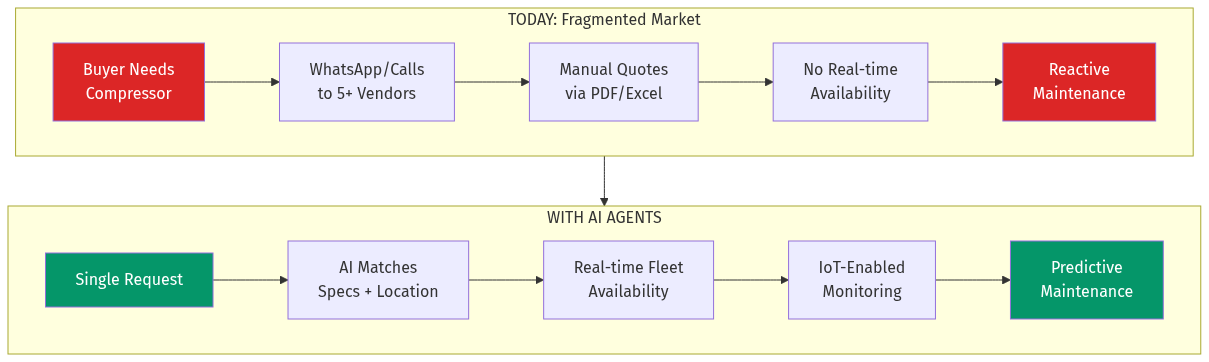
    The Workflow Transformation

    Current vs Future Flow
    Current vs Future Flow

    AI Agent Capabilities

    For Buyers:
    • Natural language spec matching: "I need a quiet oil-free compressor for a pharma cleanroom in Ahmedabad, 600 CFM, next Monday"
    • AI agent queries aggregated fleet, checks availability, returns 3 ranked options in 30 seconds
    • Real-time monitoring dashboard during rental period
    For Suppliers:
    • Demand prediction: "High probability of construction equipment demand in Nagpur next quarter due to metro project"
    • Dynamic pricing recommendations based on utilization and local supply
    • Predictive maintenance alerts: "Unit #23 showing vibration anomaly, schedule service before failure"
    For Equipment:
    • IoT sensors tracking pressure, temperature, flow, energy consumption
    • Leak detection algorithms (30% of compressed air typically wasted)
    • Usage pattern analysis for optimal maintenance scheduling

    7.

    Product Concept

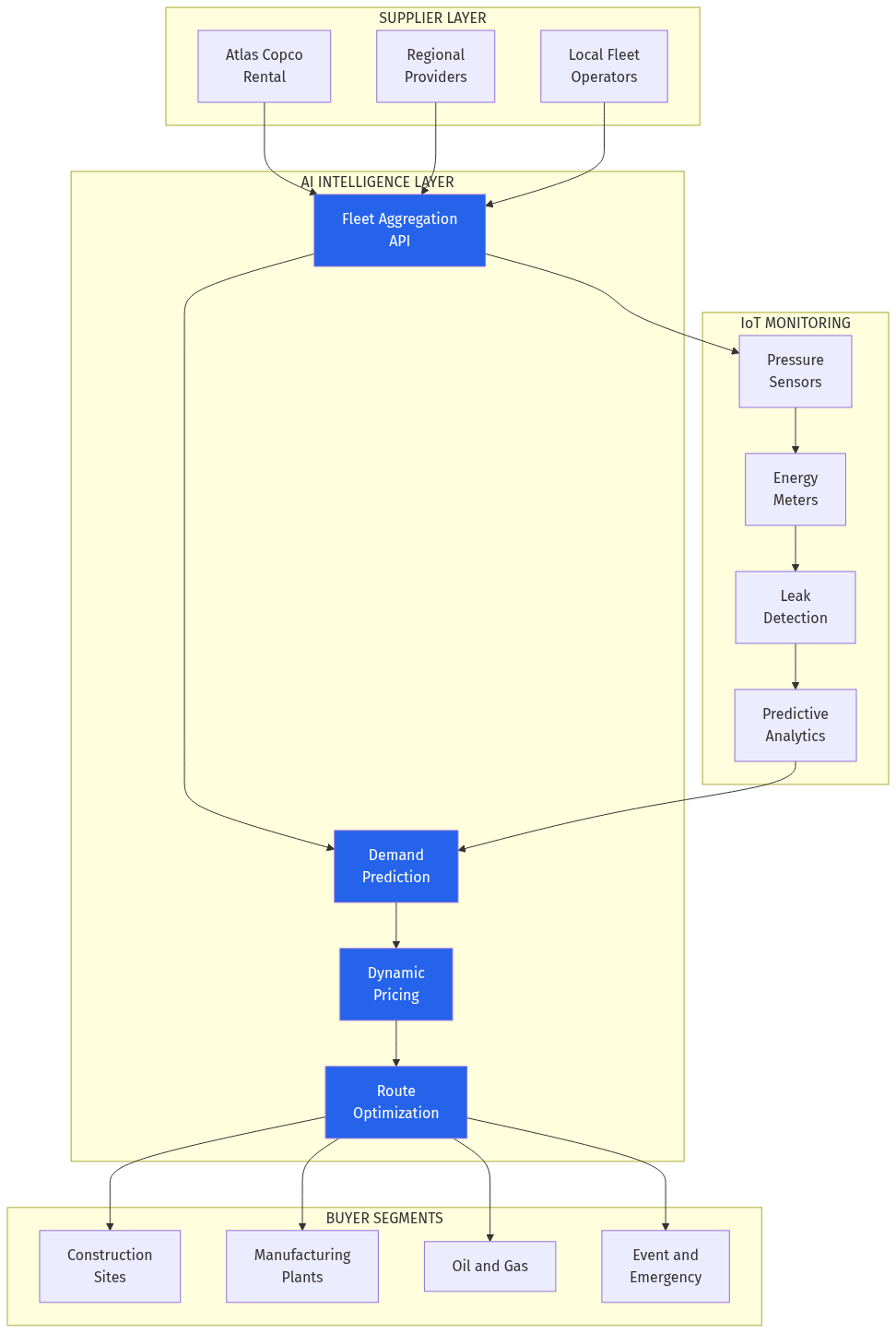
    Platform Architecture

    Platform Architecture
    Platform Architecture

    Core Features

    Supply Aggregation Layer
    • API integrations with major rental companies
    • WhatsApp-based onboarding for regional operators
    • Fleet inventory sync with real-time availability
    • Equipment grading based on age, maintenance history, IoT data
    Intelligence Layer
    • Demand forecasting using infrastructure project data
    • Dynamic pricing engine
    • Route optimization for delivery/pickup
    • Supplier performance scoring
    IoT Monitoring Layer
    • Retrofit sensor kits (₹5,000-15,000 per unit)
    • Real-time dashboard for renters
    • Leak detection and energy efficiency alerts
    • Predictive maintenance triggers
    Transaction Layer
    • Instant booking with digital contracts
    • Integrated payments (advance + usage-based)
    • Insurance and compliance documentation
    • Dispute resolution

    8.

    Development Plan

    PhaseTimelineDeliverables
    MVP8 weeksSupplier onboarding (WhatsApp bot), basic search, manual matching, 20 suppliers in Gujarat
    V112 weeksReal-time availability API, buyer dashboard, digital contracts, 100 suppliers
    V216 weeksIoT sensor pilot (50 units), predictive maintenance alerts, demand heatmaps
    V324 weeksAI agent for natural language queries, dynamic pricing, pan-India expansion

    Tech Stack

    • Backend: Node.js/Python, PostgreSQL, Redis
    • IoT: ESP32 sensors, MQTT, time-series DB (TimescaleDB)
    • AI: OpenAI API for NL matching, custom models for demand prediction
    • Integrations: WhatsApp Business API, Razorpay, logistics partners

    9.

    Go-To-Market Strategy

    Phase 1: Supply Aggregation (Gujarat Pilot)

  • Target: 50 regional operators in Ahmedabad/Surat industrial belt
  • Hook: "Free WhatsApp bot that manages your inquiries + calendar"
  • Value: Reduce owner's time on calls by 60%
  • Data capture: Build fleet inventory, availability, pricing data
  • Phase 2: Demand Generation

  • Partner with industrial associations: CII, FICCI chapters
  • SEO: "air compressor rental ahmedabad", "oil-free compressor hire"
  • Target procurement managers at shutdown-heavy industries (pharma, auto)
  • Emergency positioning: "Compressor failed? Get replacement in 4 hours"
  • Phase 3: IoT Differentiation

  • Free sensor pilot with top 20 suppliers
  • Case study: "How [Customer] saved 25% on air costs with leak detection"
  • Premium tier: Monitored rentals at 10% price premium
  • Data moat: Build largest compressed air performance dataset in India

  • 10.

    Revenue Model

    Revenue StreamModelEstimated %
    Transaction Fee8-12% of rental value60%
    SaaS (Suppliers)₹5,000-25,000/month fleet management15%
    IoT Monitoring₹1,500-3,000/unit/month15%
    Lead Generation₹500-2,000 per qualified inquiry5%
    FinancingInterest spread on rental financing5%

    Unit Economics (at scale)

    • Average rental value: ₹50,000/month
    • Platform take rate: 10%
    • Gross revenue per rental: ₹5,000
    • Customer acquisition cost: ₹3,000 (paid back in <1 rental)
    • LTV: ₹30,000+ (repeat rentals over 2+ years)

    11.

    Data Moat Potential

    Proprietary Data Assets

  • Fleet Utilization Data: Real-time status of 1,000+ compressors
  • Demand Patterns: Infrastructure project correlation with equipment needs
  • Performance Benchmarks: CFM output, energy efficiency, failure rates by make/model
  • Pricing Intelligence: Dynamic market rates by region, duration, specs
  • Maintenance Histories: Predictive models trained on actual failure data
  • Compounding Advantages

    • More suppliers → better availability → more buyers → more data → better matching
    • More IoT data → better predictions → higher uptime → premium pricing → more suppliers adopt IoT
    • Regional data → infrastructure project predictions → advance positioning → first-mover supply

    12.

    Why This Fits AIM Ecosystem

    Strategic Alignment

  • Fragmented B2B Market: Exactly the type of offline, WhatsApp-driven industry AIM targets
  • AI-Native Opportunity: Natural fit for AI agents in matching, prediction, monitoring
  • Data Play: Creates valuable industrial intelligence for broader manufacturing AI
  • Infrastructure Adjacency: Connects to construction, manufacturing verticals
  • Repeat Revenue: Rental models create ongoing relationships vs one-time transactions
  • Cross-Platform Synergies

    • Supplier profiles can be enriched with AIM business intelligence
    • Demand signals feed into broader infrastructure project tracking
    • Equipment data creates industrial IoT intelligence layer

    13.

    Risk Assessment (Pre-Mortem)

    Applying Falsification

    Assume 3 well-funded startups failed here. Why?
  • Supply aggregation is hard: Regional operators don't adopt tech easily
  • - Mitigation: WhatsApp-first, zero behavior change required
  • Low margins squeezed further: 8-12% take rate on commodity equipment
  • - Mitigation: IoT services create differentiated premium tier
  • Atlas Copco could verticalize: They have the fleet and tech
  • - Mitigation: They're focused on enterprise; SME segment is our wedge
  • IndiaMART adds real-time features: They have the suppliers
  • - Mitigation: Directory DNA ≠ marketplace DNA; they've tried and failed

    Steelmanning: Why Incumbents Win

    • Relationships matter: Plant managers trust their existing vendor's WhatsApp
    • Emergency response: Local operator can reach site in 2 hours; platform adds friction
    • Credit relationships: Established suppliers offer 30-60 day payment terms
    Counter: Platform doesn't replace relationships—it augments with intelligence, monitoring, and backup supply.

    ## Verdict

    Opportunity Score: 8/10 Strengths:
    • Clear fragmentation with no marketplace leader
    • Strong infrastructure demand tailwinds
    • AI/IoT differentiation is achievable and valuable
    • Repeat revenue model with high LTV
    Weaknesses:
    • Supplier onboarding requires feet-on-street execution
    • Commodity margins require IoT upsell to work
    • Regional relationship networks take time to penetrate
    Recommendation: Strong opportunity for a vertical marketplace focused on industrial equipment rental, starting with compressed air as the wedge category. The IoT angle transforms this from a directory into an intelligence platform. Gujarat pilot → pan-India in 18 months is achievable with ₹2-3 crore seed capital.

    ## Sources