ResearchSunday, March 1, 2026

AI Blue-Collar Worker Verification Intelligence: The $2B Trust Infrastructure Opportunity

India has 500M+ informal workers, 25M gig workers by 2030, and a chronic trust deficit. The company that builds the "CIBIL for workers" wins a massive B2B infrastructure play.

1.

Executive Summary

India's blue-collar and gig economy is exploding—delivery drivers, factory workers, security guards, domestic help, construction labor. Yet the verification infrastructure is stuck in the pre-digital era: manual calls to references, field agents visiting addresses, 5-10 day turnaround times, and results that can't travel with the worker to their next employer.

This is a $2B+ opportunity to build the trust layer for India's workforce: an AI-native background verification platform that completes checks in hours (not days), creates portable worker profiles, and enables risk-based hiring decisions through intelligent scoring.

The insight: While white-collar BGV is mature and competitive, blue-collar verification remains fragmented, manual, and ripe for AI disruption. The 7M gig workers today will become 25M by 2030. Someone needs to verify all of them—efficiently.
2.

Problem Statement

Who Experiences This Pain?

Staffing Agencies & Aggregators
  • Processing 1,000+ worker applications daily
  • Each verification costs ₹500-2,000 and takes 5-10 days
  • High dropout rates—workers leave before verification completes
  • No visibility into workers previously rejected by other agencies
Gig Platforms (Swiggy, Zomato, Urban Company, Rapido)
  • Onboarding pressure conflicts with safety requirements
  • Customer safety incidents create brand risk
  • Each platform does redundant verification for the same worker
  • No shared trust infrastructure
SME Employers (Factories, Restaurants, Security Firms)
  • Can't afford ₹2,000/verification for ₹15,000/month workers
  • Skip verification → workplace theft, safety incidents
  • Zero recourse when workers disappear with advances
The Workers Themselves
  • Get re-verified every time they switch jobs
  • No way to prove their clean history
  • Good workers can't distinguish themselves from risky ones

The Numbers

MetricScale
Blue-collar workforce500M+ workers
Gig economy workers (2026)7M
Gig economy workers (2030)25M projected
Average verification cost₹800-2,000
Average verification time5-10 business days
Verification failure rate15-20% (worker dropout)
Annual BGV market size₹8,000+ Cr ($1B+)
---
3.

Current Solutions

CompanyWhat They DoWhy They Fall Short
AuthBridgeIndia's largest BGV, AI-driven, enterprise focusEnterprise pricing (₹2,000+/check), built for white-collar, 24-48 hour turnaround
OnGridStrong blue-collar focus, 250M+ checks completedStill requires significant manual intervention, no portable worker profile
SpringVerifySMB-focused, digital-first, fast implementationLimited to basic checks, no gig economy specialization
IDfyIdentity verification, fraud detectionIdentity only—not full background checks
TartanHQEmployment verification APINarrow focus, doesn't cover criminal/address
The Gap: No one has built the end-to-end AI-native system that:
  • Completes full verification in under 4 hours
  • Creates a portable worker profile that travels between employers
  • Prices affordably for high-volume, low-wage worker segments
  • Works primarily through WhatsApp (where blue-collar workers live)

  • 4.

    Market Opportunity

    Market Size Calculation

    Direct BGV Market:
    • 500M blue-collar workers × 30% turnover × ₹500/verification = ₹75,000 Cr TAM
    • Realistic SAM (organized sector, gig economy): ₹8,000 Cr ($1B)
    Adjacent Opportunities:
    • Worker lending/credit (using verification data): ₹5,000 Cr
    • Insurance underwriting data: ₹2,000 Cr
    • Portable credential marketplace: ₹1,000 Cr
    Total Addressable Opportunity: $2B+

    Growth Drivers

  • Gig Economy Explosion: 12% CAGR, from 7M to 25M workers by 2030
  • Regulatory Pressure: DPDP Act requiring proper consent and verification
  • Platform Liability: Incidents creating legal exposure for aggregators
  • Worker Formalization: Government push for EPFO/ESIC coverage
  • Insurance Requirements: Commercial policies requiring worker verification
  • Why Now?

    • Aadhaar penetration: 99%+ coverage enables digital KYC
    • API infrastructure: eCourts, EPFO, RTO databases now accessible
    • WhatsApp Business API: Enables worker-native verification flows
    • AI cost collapse: Vision AI, OCR, risk models now affordable at scale
    • COVID hangover: Employers more paranoid about workforce trust

    5.

    Gaps in the Market

    1. No Portable Worker Profile

    Every employer re-verifies the same worker. A delivery executive verified by Swiggy gets re-verified by Zomato. Zero data portability.

    2. Pricing Not Designed for Blue-Collar Unit Economics

    At ₹2,000/verification for a ₹15,000/month worker, the math doesn't work. Need ₹99-299/verification for mass adoption.

    3. WhatsApp-Native Absent

    Workers don't download apps. The verification flow must live where they already are: WhatsApp.

    4. No Reputation Layer

    Good workers can't prove their track record. Bad workers can hop between platforms. There's no "CIBIL for workers."

    5. Manual Criminal/Address Checks Remain Bottlenecks

    Identity is fast (Aadhaar). Criminal and address verification still require 3-5 days. This is where AI agents can compress timelines.
    6.

    AI Disruption Angle

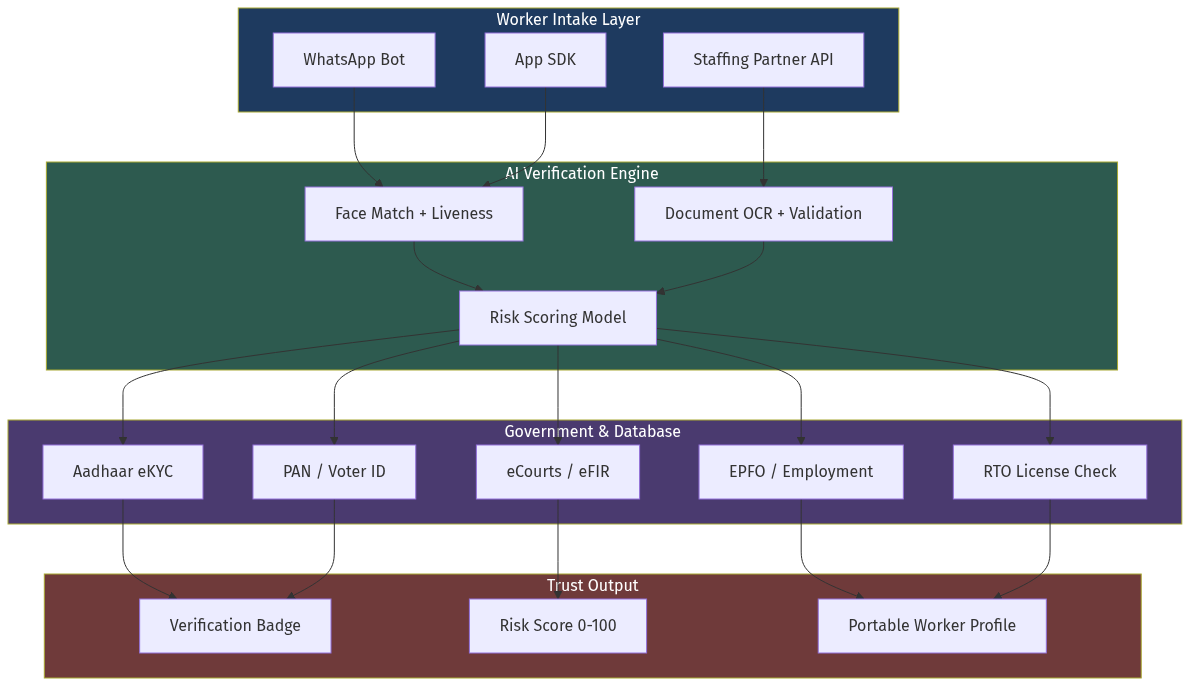
    Architecture Diagram
    Architecture Diagram

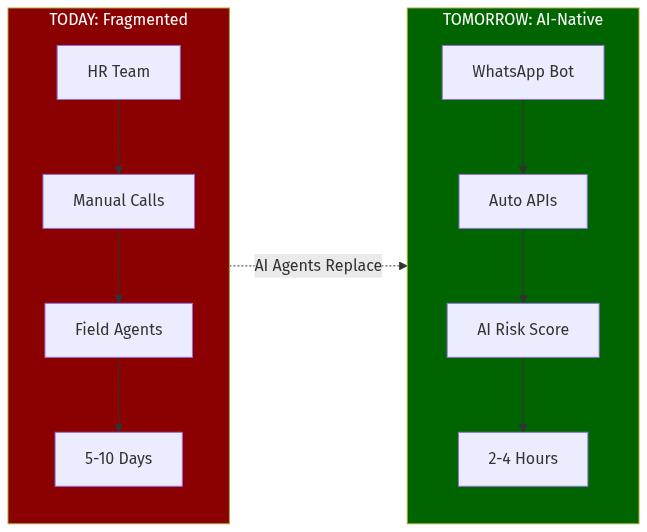
    How AI Agents Transform Verification

    Traditional Flow (5-10 days):
  • HR collects documents manually
  • Calls 2-3 references, often no answer
  • Sends field agent for address verification
  • Waits for police verification response
  • Manually compiles report
  • AI-Native Flow (2-4 hours):
  • Worker completes WhatsApp bot flow (10 minutes)
  • Face match + liveness detection validates identity
  • OCR extracts and validates documents instantly
  • API calls to Aadhaar, PAN, eCourts, EPFO, RTO
  • AI risk model scores anomalies and flags
  • Auto-generated verification report with risk score
  • Specific AI Capabilities

    CapabilityManual ApproachAI Agent Approach
    Identity verificationDocument review, 2-4 hoursFace match + Aadhaar eKYC, 30 seconds
    Address verificationField visit, 2-3 daysGeolocation + utility API + postal verification, 2-4 hours
    Criminal checkPolice station visits, 5+ dayseCourts API + eFIR database + ML pattern detection, 1-2 hours
    Employment historyPhone calls to HR, 2-3 daysEPFO API + digital references + network verification, 1 hour
    Reference checksManual calls, often unsuccessfulAI voice agents, 24/7 availability, higher completion

    The Network Effect

    Once enough workers have verified profiles, employers will prefer pre-verified candidates. Workers will self-verify to get better jobs. This creates a flywheel:

  • Employers join → demand verified workers
  • Workers verify → build portable reputation
  • More data → better risk models
  • Better risk models → lower fraud → more employer trust
  • More trust → more adoption → network effects compound

  • 7.

    Product Concept

    Core Product: "VerifiedWorker" Profile

    For Workers (WhatsApp-First):
    • Complete verification via WhatsApp bot in 15 minutes
    • Get shareable "VerifiedWorker" badge and QR code
    • Profile travels between employers
    • Build reputation over time
    For Employers:
    • API/Dashboard to verify workers
    • Risk score 0-100 with explainability
    • Instant alerts if worker profile changes
    • Bulk verification for staffing agencies
    For Platforms (B2B2C):
    • White-label verification SDK
    • Real-time webhook notifications
    • Compliance audit trails
    • Usage-based pricing

    Tiered Verification Packages

    TierChecks IncludedPriceTurnaroundUse Case
    BasicIdentity + Face Match + Phone₹49InstantQuick onboarding
    StandardBasic + Address + PAN + Criminal₹1992-4 hoursDelivery, domestic help
    PremiumStandard + Employment + References₹3994-8 hoursSecurity, drivers
    EnterpriseCustom + Ongoing Monitoring₹599/yearContinuousCritical roles

    Differentiated Features

  • WhatsApp-Native: No app download required
  • AI Voice References: Automated reference calls in 10+ Indian languages
  • Portable Profile: Worker owns their verification
  • Continuous Monitoring: Real-time alerts if criminal record appears
  • Credit Data Layer: Verification data enables worker lending

  • 8.

    Development Plan

    Process Flow
    Process Flow
    PhaseTimelineDeliverables
    MVP8 weeksWhatsApp bot, Aadhaar/PAN verification, face match, basic risk score
    V116 weekseCourts integration, address verification API, employer dashboard
    V224 weeksEPFO integration, AI voice references, continuous monitoring
    Scale32 weeksPlatform SDK, portable profile system, credit data layer

    Technical Stack

    • Frontend: WhatsApp Business API, React dashboard
    • Backend: Node.js/Python, PostgreSQL, Redis
    • AI/ML: Face match (FaceNet/ArcFace), OCR (Tesseract/Google Vision), Voice AI (multilingual ASR)
    • APIs: Aadhaar eKYC, DigiLocker, eCourts, EPFO, MoRTH
    • Infrastructure: AWS/GCP, queue-based processing for scale

    9.

    Go-To-Market Strategy

    Phase 1: Staffing Agency Partnerships (Months 1-6)

    • Target top 50 staffing agencies (TeamLease, Quess, Adecco)
    • Volume pricing: ₹149/verification for 1000+/month
    • Integration with their existing HRMS
    • Metric: 100K verifications/month

    Phase 2: Gig Platform Direct (Months 6-12)

    • Approach Urban Company, Rapido, Dunzo
    • Position as compliance + safety solution
    • White-label SDK for in-app verification
    • Metric: 2-3 platform partnerships

    Phase 3: SME Self-Serve (Months 12-18)

    • Launch direct SME product
    • WhatsApp-first acquisition
    • Freemium model: 3 free verifications/month
    • Metric: 5,000 SME customers

    Phase 4: Worker-Direct (Months 18-24)

    • Let workers self-verify and share
    • Create "VerifiedWorker" marketplace
    • Enable portable reputation
    • Metric: 1M verified worker profiles

    10.

    Revenue Model

    Primary Revenue Streams

    StreamModelYear 1Year 3
    Verification Fees₹99-599/check₹8 Cr₹80 Cr
    Enterprise SaaS₹50K-5L/month₹2 Cr₹20 Cr
    API Usage₹10-50/call₹1 Cr₹15 Cr
    Total₹11 Cr₹115 Cr

    Adjacent Revenue (Year 3+)

    • Worker Credit Data: Sell anonymized verification data to lenders (₹10-50/worker)
    • Insurance Partnerships: Underwriting data for worker insurance products
    • Job Marketplace: Connect verified workers with employers (placement fees)

    Unit Economics

    • Cost per verification: ₹30-80 (API costs + compute)
    • Average revenue: ₹150-300
    • Gross margin: 50-70%
    • CAC: ₹500-2000 (B2B sales)
    • LTV: ₹10,000-50,000 (recurring verification needs)

    11.

    Data Moat Potential

    Proprietary Data Assets

  • Verification Graph: Network of workers, employers, references
  • Fraud Patterns: ML models trained on millions of verification attempts
  • Employment History: Cross-employer work patterns (with consent)
  • Risk Signals: Predictive indicators for worker reliability
  • Geographic Data: Address verification patterns by locality
  • Network Effects

    • More employers → more workers verify → better data → better risk models
    • More verified workers → employers prefer verified → more demand
    • Cross-platform portability creates switching costs

    Defensibility Timeline

    YearMoat Strength
    Year 1Technology lead, execution speed
    Year 2Data volume, employer relationships
    Year 3+Network effects, portable profiles, regulatory compliance
    ---
    12.

    Why This Fits AIM Ecosystem

    Strategic Alignment

  • B2B Infrastructure: Foundational trust layer for workforce
  • AI-Native: Core product is AI verification agents
  • India-First: Designed for Aadhaar, WhatsApp, and Indian regulations
  • Platform Play: SDK enables ecosystem of trust-dependent apps
  • Data Moat: Creates proprietary intelligence asset
  • Cross-Portfolio Synergies

    • Construction MRO: Verified workers for contract labor
    • Facility Services: Cleaned/security staff verification
    • Logistics: Driver verification for fleet operators
    • Manufacturing: Factory worker verification

    Valuation Potential

    Comparable exits/valuations:

    • AuthBridge: ₹148 Cr valuation (20+ years)
    • Sterling (US): $2.2B acquisition by First Advantage
    • Checkr (US): $5B valuation
    Target: 10x revenue multiple = ₹1,150 Cr ($140M) valuation at Year 3 revenue


    ## Mental Models Applied

    Zeroth Principles

    Assumption challenged: "Background verification requires field agents." Reality: 80% of verification can be API-based. Field visits are a legacy artifact, not a necessity.

    Incentive Mapping

    • Workers want: Portable reputation, faster onboarding
    • Employers want: Lower cost, faster results, reduced liability
    • Status quo defenders: Field verification agencies with physical networks
    • Insight: Align incentives by making verification an asset workers own

    Distant Domain Import

    From credit bureaus: CIBIL created portable credit scores. Why not portable work verification? From ride-sharing: Driver ratings travel with drivers. Worker verification should too.

    Falsification (Pre-Mortem)

    Why might this fail?
  • Regulatory barriers to accessing government databases
  • Workers resist sharing data
  • Incumbents bundle verification with staffing
  • Mitigation: Start with public APIs, build trust gradually, differentiate on speed/price not just features.

    Steelmanning the Incumbents

    AuthBridge has 20+ years of relationships, field networks, and enterprise contracts. They could launch a low-cost tier. Counter: Enterprise DNA prevents them from pricing aggressively for blue-collar—it cannibalizes their core business.

    ## Verdict

    Opportunity Score: 8.5/10 Why this scores high:
    • Massive market (500M+ workers, growing gig economy)
    • Clear pain point (cost, time, no portability)
    • AI-native solution possible (not just automation layer)
    • Strong data moat potential
    • Regulatory tailwinds (DPDP Act, platform liability)
    Risks:
    • Government API access can be bureaucratic
    • Incumbents have enterprise relationships
    • Worker data consent complexity
    Recommendation: Build. The company that creates "CIBIL for workers" captures a critical infrastructure layer. Start with staffing agencies for volume, then expand to platforms and direct SME. The portable worker profile is the killer feature—no one else is building it.

    ## Sources