ResearchWednesday, May 6, 2026

AI-Powered Medical Laboratory Equipment & Supplies Marketplace: India's $18B Untapped Opportunity

An AI-first B2B platform connecting hospitals, diagnostic labs, and research institutions with verified medical equipment suppliers—solving a market where 70% of procurement still happens through WhatsApp calls, dealer relationships, and manual verification.

1.

Executive Summary

India's medical laboratory equipment and supplies market is an $18+ billion industry operating with 1990s-era procurement workflows. Hospitals, diagnostic labs, and research institutions still rely on phone calls, WhatsApp messages, and personal dealer relationships to source equipment worth lakhs to crores. The fragmentation is staggering—the average mid-size hospital in India manages relationships with 50-100+ equipment suppliers manually.

This article presents the opportunity for an AI-powered marketplace that:

  • Matches buyers with verified suppliers using AI agent conversation
  • Provides real-time pricing transparency across dealers
  • Verifies equipment certifications automatically
  • Enables agent-to-agent procurement negotiation
Opportunity Score: 8.5/10


2.

Problem Statement

Who Faces This Pain

  • Diagnostic lab chains (Dr. Lal PathLabs, Thyrocare, Metropolitan) sourcing equipment across 50+ cities
  • Hospital procurement managers racing against equipment breakdowns
  • Research institutions (IITs, NITs, private R&D labs) needing specialized instruments
  • Standalone pathologists outfitting new clinics
  • Government hospital administrators navigating complex tender processes

The Core Friction Points

  • Certification Chaos: Fake/counterfeit medical equipment is a serious problem. Buyers must verify:
  • - ISI marking (BIS certification) - FDA (US FDA or CDSCO approval for India) - ISO compliance - Manufacturer warranty
  • Price Opacity: The same diagnostic analyzer costs 40-80% different across dealers. No standard pricing exists.
  • Technical Knowledge Gap: Buyers often don't know which equipment meets their needs. Specifications are complex.
  • After-Sales Service Risk: Equipment worth ₹50 lakh has no standardized service guarantee.
  • Fragmented Supplier Network: A single city might have 50+ dealers, each claiming to be authorized.

  • 3.

    Current Solutions

    CompanyWhat They DoWhy They're Not Solving It
    IndiaMartGeneral B2B marketplace with medical equipment categoryNo AI verification, no certification guarantee, cluttered with intermediaries
    MedikabazaarB2B medical supplies marketplaceFocus on consumables, not high-value equipment; catalog-based, not AI
    MediBidsMedical equipment bidding platformAuction model doesn't work for standard purchases; limited reach
    PractoHealthcare platform (appointments)Consumer-focused, not B2B equipment
    WhatsApp GroupsInformal dealer networksNo verification, no standardization, no analytics

    Market Structure Today

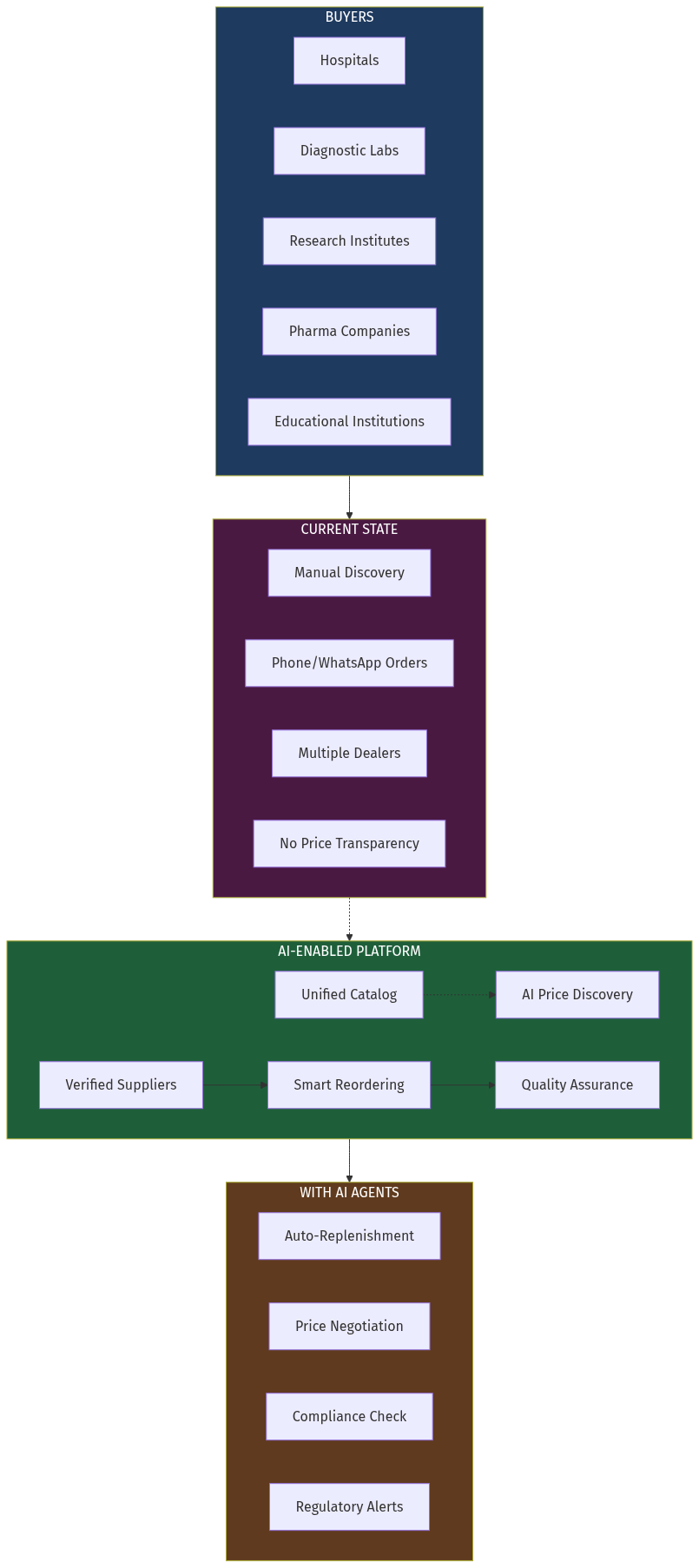
    LAB/HOSPITAL → (searches) → INDIAMART/GOOGLE → (calls) → MULTIPLE DEALERS → (negotiates) → (uncertainty) → PURCHASE

    4.

    Market Opportunity

    Market Size

    • India Medical Equipment Market: $18+ billion (2025)
    • Diagnostic Lab Market: $12 billion
    • Hospital Equipment Market: $6 billion
    • Growth: 15-18% CAGR through 2030

    Why Now

  • Regulatory Push: New CDSCO guidelines tightening medical equipment standards create verification demand
  • Quality Awareness: Post-COVID, hospitals are prioritizing certified equipment
  • Digital Maturity: Lab chains are consolidating, creating sophisticated buyers
  • WhatsApp-First: Indian buyers are comfortable with digital-first procurement
  • No AI-First Player: IndiaMart and Medikabazaar are catalog platforms, not AI agents
  • The Gap in the Market

    No platform combines:

  • AI-powered spec matching (matching equipment to buyer's actual needs)
  • Automated certification verification (verifying BIS/FDA/ISO in real-time)
  • Price intelligence (benchmarking across dealers)
  • Agent-to-agent negotiation (AI buying agents transacting on behalf of buyers)
  • Trusted supplier scores (verified review systems)

  • 5.

    AI Disruption Angle

    The Future: AI Agent Procurement

    Today's Workflow:
    Human searches → Human calls 5 dealers → Human negotiates → Human decides
    Future (AI Agent) Workflow:
    Buyer agent says: "I need a semi-auto analyzer for a 50-test/hour lab, budget ₹8 lakh"
    
    → AI verifies buyer's requirements
    → AI matches with 3-5 verified suppliers
    → AI fetches real-time pricing
    → AI verifies certifications automatically  
    → AI negotiates on buyer's behalf
    → AI places order
    → AI tracks delivery
    → AI facilitates service ticket if needed

    How AI Transforms This

  • Conversational Intake: Buyer describes need in natural language. AI recommends equipment.
  • Automated Verification: AI verifies dealer claims against CDSCO/BIS databases.
  • Price Intelligence: AI aggregates pricing across dealers, shows price history.
  • Trust Score System: AI aggregates reviews, service tickets, response times.
  • Agent Negotiation: The buyer's AI agent negotiates with supplier's AI agent.

  • 6.

    Product Concept

    Core Features

  • AI Equipment Advisor
  • - Natural language query: "I need a chemistry analyzer for 100 tests/day" - AI recommends 3-5 equipment options with specifications - Compares alternatives
  • Verified Supplier Network
  • - Dealer verification: Business registration, CDSCO license, BIS certification - Trust scores based on verified transactions - Service track record
  • Price Benchmarking
  • - Real-time pricing across verified dealers - Price history and trends - Bulk discount negotiation
  • AI Procurement Agent
  • - Buyer configures requirements once - Agent monitors market, suggests optimal purchase timing - Agent negotiates with dealers

    Technical Stack

    • Frontend: Next.js + WhatsApp integration (since 80% of buyers use WhatsApp)
    • AI Layer: Claude/GPT for conversational matching, verification automation
    • Database: PostgreSQL with equipment spec data
    • Verification: APIs with CDSCO, BIS databases

    7.

    Development Plan

    PhaseTimelineDeliverables
    MVP8 weeksEquipment catalog (top 500 items), 50 verified dealers, WhatsApp bot
    V112 weeksAI advisor, price benchmarking, supplier trust scores
    V216 weeksFull AI procurement agent, automated certification verification

    Go-To-Market

  • Target: Diagnostic lab chains (20-100 labs)
  • Onboarding: Partner with 100 verified dealers for top 1000 SKUs
  • Channel: WhatsApp-first, since Indian buyers prefer it
  • Incentive: Free verification for first 100 dealers

  • 8.

    Revenue Model

    • Commission: 3-8% on successful transactions
    • Listing Fee: ₹5,000-25,000/month for verified supplier profiles
    • Premium Verification: ₹50,000+/year for "AI Verified" badge
    • Data Revenue: Anonymized market intelligence reports (₹1-5 lakh per report)
    • Finance Integration: Equipment financing commission (3-5%)

    9.

    Data Moat Potential

    • Transaction Data: Real pricing data across dealers
    • Supplier Performance: Response times, service quality
    • Equipment Specifications: Structured data for AI matching
    • Buyer Behavior: Purchase patterns, price sensitivity
    This data compounds over time—new entrants can't replicate verified transaction history.
    10.

    Why This Fits AIM Ecosystem

    AIM AssetHow It Helps
    Domain PortfolioHospital/Clinic/Lab domains for vertical targeting
    WhatsApp IntegrationDirect buyer channel
    Trust InfrastructureVerification layer for medical equipment
    Data Platformdom.to medical equipment intelligence
    ---

    ## Verdict

    Opportunity Score: 8.5/10

    The medical equipment market is large ($18B), fragmented, and ripe for AI disruption. India's existing players (IndiaMart, Medikabazaar) are catalog platforms—not AI agents. The regulatory environment actually favors verification-first platforms.

    Strengths:
    • Massive fragmented market ($18B+)
    • Clear AI differentiation angle (verification + pricing + agent negotiation)
    • Natural WhatsApp-first distribution in India
    • High-value transactions (good commission potential)
    • Regulatory tailwind (CDSCO tightening)
    Weaknesses:
    • Trust building takes time in medical equipment
    • Certification verification is operationally heavy
    • Long sales cycles for high-value equipment
    Key Insight: The opportunity isn't just "equipment marketplace"—it's "AI-powered trust layer" on medical equipment procurement. The real moat isn't the catalog—it's the verification and price intelligence built over time.

    ## Sources


    Architecture Diagram
    Architecture Diagram