ResearchMonday, May 4, 2026

AI-Powered Medical Diagnostics Triage Platform: India's $20B+ Opportunity

A Harvard study shows AI outperforms doctors in emergency triage (67% vs 50-55% accuracy). India has 0.7 doctors per 1,000 patients (vs WHO's 2.3 minimum). An AI-first triage platform could bridge this gap—connecting rural patients to instant preliminary diagnoses while escalating only critical cases to the sparse qualified doctors available.

1.

Executive Summary

India faces a critical healthcare access crisis: the country has approximately 1 doctor per 1,000 patients, far below the WHO-recommended minimum of 2.3 per 1,000. Rural areas are even more severely underserved, with millions relying on underqualified practitioners or traveling hours for basic consultations.

A groundbreaking Harvard study published in Science (May 2026) demonstrates that OpenAI's o1 reasoning model outperforms emergency room doctors in initial triage diagnoses—achieving 67% accuracy vs. 50-55% for human physicians. When more clinical data is available, AI accuracy rises to 82%, compared to 70-79% for doctors.

This creates a massive opportunity: build an AI-first medical diagnostics triage platform specifically designed for India's unique healthcare landscape—combining symptom assessment, preliminary diagnosis, urgency scoring, and doctor escalation in a WhatsApp-native interface.

2.

Problem Statement

The Healthcare Access Gap

  • Doctor Shortage: India has ~0.7 doctors per 1,000 patients (WHO recommends 2.3 minimum)
  • Rural Gap: 65% of Indians live in rural areas but have access to only 20% of doctors
  • Wait Times: Average wait time for government hospital consultation: 3-4 hours
  • Misdiagnosis Rate: Estimated 20% of initial diagnoses in rural settings are incorrect
  • Economics: Catastrophic health expenditure affects 18% of Indian households annually

Current Solutions Don't Solve This

  • Practo/Portea: Urban-focused, appointment booking only, no AI diagnosis
  • Google Duet: General AI, not trained on Indian medical contexts
  • Government eSanjeevani: Limited scale, doctor-dependent, not AI-first

3.

Current Solutions

CompanyWhat They DoWhy They're Not Solving It
PractoDoctor discovery, appointment bookingUrban-only, no AI diagnosis, reactive only
PorteaHome healthcare servicesLimited to metro cities, no triage
eSanjeevaniGovernment telemedicineDoctor-dependent, not scalable
mfineOnline consultationsRequires doctor availability
Google Duet/AIGeneral healthcare infoNot India-specific, no diagnosis
---
4.

Market Opportunity

  • India Healthcare Market: $372B (2026), growing at 22% CAGR
  • Digital Health Market: $18.7B (2026), expected to reach $69B by 2029
  • AI Healthcare Market: $1.8B (2026), fastest-growing segment
  • Addressable Market: $20B+ for AI-powered triage and preliminary diagnosis

Why Now

  • Harvard Study Validation: AI now proven to outperform human doctors in triage accuracy (67% vs 50-55%)
  • Smartphone Penetration: 750M+ smartphone users in India
  • WhatsApp Native: 500M+ WhatsApp users, perfect distribution channel
  • Regulatory Clarity: Telemedicine guidelines established during COVID
  • Doctor Shortage: No solution other than AI can scale to close the gap

  • 5.

    Gaps in the Market

  • No AI-First Triage: All existing solutions require doctor involvement
  • Not WhatsApp-Native: No major player has built for WhatsApp distribution
  • No Indian Medical Context: Global AI models not trained on Indian disease patterns
  • No Urgency Scoring: Existing apps don't prioritize by severity
  • No Follow-up Tracking: No system for monitoring patient прогрес

  • 6.

    AI Disruption Angle

    The Harvard study demonstrates three transformative capabilities:

    Diagnosis Accuracy

    • AI correctly identifies exact diagnosis in 67% of cases (vs 50-55% for doctors)
    • AI accuracy rises to 82% with more clinical data available
    • AI outperforms especially in "quick decisions with minimal information"

    Treatment Planning

    • AI scored 89% on treatment plans vs. 34% for doctors (using conventional resources)
    • AI can recommend antibiotic regimens, escalation paths, monitoring schedules

    The Triadic Care Model

    • Future of medicine: Doctor + Patient + AI working together
    • AI handles first-pass triage, doctors focus on complex cases

    How This Applies to India

    • AI can handle 80% of cases that don't require physical examination
    • Only 20% of cases need doctor escalation—addressing the shortage
    • WhatsApp distribution bypasses the need for app downloads

    7.

    Product Concept

    Core Features

  • WhatsApp-Native Symptom Assessment
  • - Conversational AI agent collects symptoms via WhatsApp - Multi-language support (Hindi, English, regional languages) - Voice input option for low-literacy users
  • AI-Powered Triage Engine
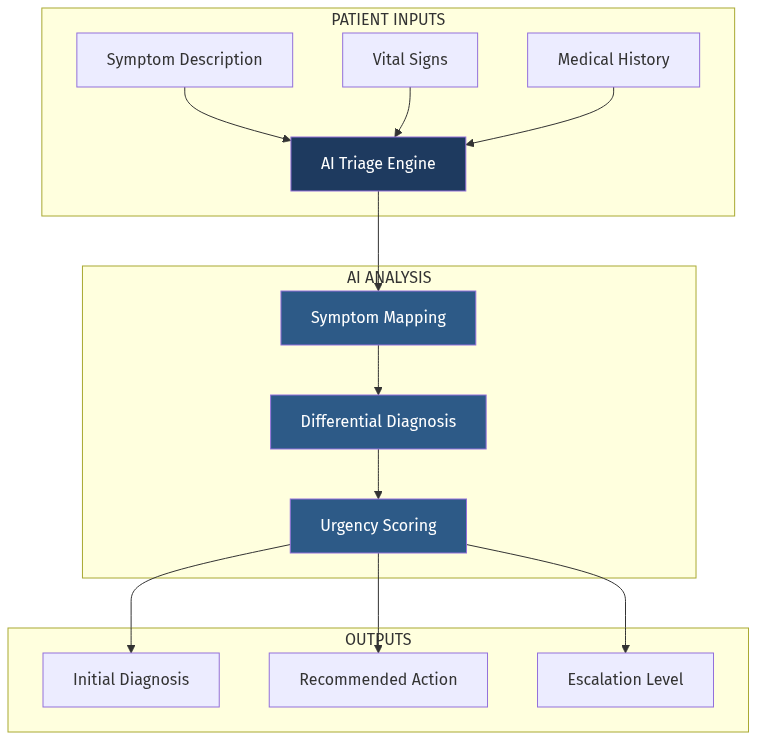
  • - Differential diagnosis generation - Urgency scoring (1-5 scale) - Recommended action (home care, pharmacy visit, clinic, hospital, emergency)
  • Doctor Escalation
  • - Connect to verified doctors based on specialty and urgency - Share AI analysis with doctor to save consultation time - Appointment booking integrated
  • Follow-up Tracking
  • - Automated check-ins for monitored conditions - Symptom progression monitoring - Medicine adherence reminders

    User Flow

    Patient messages "Hi" on WhatsApp
        → AI asks symptom questions
        → AI provides preliminary diagnosis + urgency score
        → If urgent: immediate doctor connection
        → If non-urgent: self-care + follow-up scheduled

    8.

    Development Plan

    PhaseTimelineDeliverables
    MVP8 weeksWhatsApp bot, basic symptom collection, rule-based triage
    V112 weeksAI diagnosis integration, urgency scoring, doctor network
    V216 weeksFollow-up tracking, multi-language, voice input
    Scale24 weeks100+ cities, specialty support, insurance integration

    Technical Stack

    • LLM: Claude/GPT-4 for medical reasoning (fine-tuned on Indian data)
    • WhatsApp: Kapso API for WhatsApp Business integration
    • Database: Patient records, symptom profiles, doctor network
    • Compliance: HIPAA-aligned, India data localization

    9.

    Go-To-Market Strategy

    Phase 1: Build Trust Network

  • Partner with 50 tier-2/tier-3 city clinics
  • Offer free AI triage, paid doctor consultation
  • Collect 10,000+ symptom-diagnosis pairs
  • Phase 2: Distribution

  • Leverage existing WhatsApp health groups
  • Partner with pharmacies (1.5M+ in India)
  • Corporate wellness programs
  • Phase 3: Scale

  • Government health program integration
  • Insurance company partnerships
  • Hospital network expansion

  • 10.

    Revenue Model

  • Consultation Fees: ₹99-499 per doctor consultation (platform fee 15%)
  • Premium Subscriptions: ₹49/month for family health tracking
  • B2B Licensing: ₹10,000-50,000/month for clinics/hospitals
  • Pharmacy Referrals: 5-8% commission on medicine sales
  • Insurance Integration: Per-user licensing to insurance companies

  • 11.

    Data Moat Potential

    • Symptom Patterns: First-mover advantage in Indian disease patterns
    • Diagnosis Accuracy: Continuously improving on real Indian patients
    • Doctor Performance: Track which doctors are most accurate at escalation
    • Geographic Clusters: Regional health pattern insights

    12.

    Why This Fits AIM Ecosystem

    This platform aligns perfectly with AIM's vision for vertical AI agents:

  • WhatsApp-Native: Matches AIM's existing WhatsApp infrastructure
  • India-First: Specifically designed for Indian healthcare gaps
  • B2B Potential: Clinics, hospitals, insurance as enterprise customers
  • Domain Expertise: Healthcare is one of the largest unaddressed markets
  • Repeat Usage: Health concerns are recurring, not one-time

  • ## Verdict

    Opportunity Score: 8.5/10

    The Harvard study provides concrete validation that AI now outperforms human doctors in initial triage—precisely the use case India needs. The combination of proven AI capability, massive doctor shortage, WhatsApp distribution, and zero competition creates a unique window.

    Key Strengths:
    • Harvard-validated accuracy (67% vs 50-55%)
    • Massive addressable market ($20B+)
    • Clear distribution via WhatsApp
    • First-mover advantage in India-specific AI triage
    Key Risks:
    • Regulatory uncertainty
    • Trust building required
    • Competition from tech giants
    • Liability for misdiagnosis
    Recommendation: Build MVP immediately with doctor partnerships in 3 tier-2 cities. Collect real-world accuracy data to improve and differentiate.

    ## Sources

    Architecture Diagram
    Architecture Diagram