ResearchMonday, May 4, 2026

AI-Powered Industrial Machinery Parts Marketplace: India's $40B+ Untapped Opportunity

An AI-first marketplace connecting manufacturers with genuine industrial machinery parts suppliers, solving a crisis where 60% of purchases involve excessive intermediation, price opacity, and counterfeit risks.

8
Opportunity
Score out of 10
1.

Executive Summary

India's $40+ billion industrial machinery parts market is broken. Manufacturers face a paradoxical problem: parts exist everywhere yet remain nearly impossible to source efficiently. The gap isn't supply—it's trust, transparency, and transaction facilitation.

This article presents the opportunity to build an AI-powered vertical marketplace that transforms industrial parts procurement from a headache-prone, relationship-dependent process into a streamlined, algorithmically matched transaction. The key differentiator? An AI agent layer that acts as an intelligent intermediary, verifying quality, automating price discovery, and ensuring authentic sourcing.


2.

Problem Statement

Who Experiences This Pain?

  • Mid-size manufacturers (₹5-50 Cr annual revenue) needing spare parts for CNC machines, packaging equipment, textile machinery
  • Plant maintenance managers racing against downtime—every hour of machine idle costs ₹50,000-5,00,000
  • OEM service networks sourcing genuine vs. counterfeit components
  • Repair workshops needing quick access to specialized parts

The Core Friction Points

  • Excessive Intermediation: A single part passes through 3-5 intermediaries before reaching the buyer
  • Price Opacity: No standard pricing—same bearing varies 200%+ across suppliers
  • Quality Uncertainty: Counterfeit industrial parts account for an estimated 25-30% of market transactions
  • Technical Discovery: Buyers often don't know the exact part number— they'll describe application, machine model, and symptoms
  • Inventory Asymmetry: Supplier has parts but can't find buyers; buyers need parts but can't locate suppliers

  • 3.

    Current Solutions

    CompanyWhat They DoWhy They're Not Solving It
    IndiaMartGeneral B2B marketplace with machinery parts categoryNo AI verification, no quality assurance, cluttered with intermediaries
    MFNIndustrial fasteners specializedOnly fasteners—limited category coverage
    MachineSewaService marketplace for machine repairServices only, not parts marketplace
    Gozney (global)Industrial parts cross-borderNot India-focused, Limited domestic coverage

    Market Structure Today

    MANUFACTURER → (searches) → INDIAMART/GOOGLE → (calls) → MULTIPLE DEALERS → (negotiates) → (uncertainty) → PURCHASE
                                              ↓
                                        3-5 INTERMEDIARIES ADD MARKUP
                                              ↓
                                        QUALITY VERIFICATION ABSENT

    4.

    Market Opportunity

    Market Size

    • India Industrial Machinery Market: ~$45 Billion (2025), growing at 10-12% CAGR
    • Spare Parts & Components: $12-15 Billion of total (estimated 28-33%)
    • Addressable Market (AI-matchable): $4-6 Billion (parts that can be digitized and matched)

    Why NOW?

  • Government PLI Schemes: ₹2.4 Lakh Crore Production Linked Incentive for manufacturing, driving new plant setups requiring parts ecosystem
  • MSME Digitalization: Udyam registration crossed 5 Crore enterprises—digital literacy rising
  • AI Cost Collapse: Verification, matching, and conversational AI now affordable at scale
  • Supply Chain Localization: Post-PLII (Production-Linked Incentive), domestic manufacturing rising—parts suppliers multiplying
  • No Incumbent AI-First Player: Industrial parts remains a search-based, relationship-driven market

  • 5.

    Gaps in the Market

    Where Current Players Fail

  • No quality verification layer: Anyone can list—nobody confirms authenticity
  • No conversational discovery: Buyer must know exact part number—can't describe "I have a Fanuc OM, spindle making noise, need bearing"
  • No inventory visibility: Can't see real-time stock across suppliers
  • No price standardization: No benchmark pricing data
  • No post-sale accountability: Disputes resolved poorly or not at all
  • Anomalies Worth Noting

    • Why is there no "Uber for industrial parts"? The closest analogue in transportation (Uber) solved exactly this discovery + trust problem
    • Why are catalogs still PDF-based? Most supplier catalogs exist as WhatsApp-shared PDFs rather than structured data
    • Why isn't voice-first prominent? Plant maintenance managers prefer calling/WhatsApp—they shouldn't have to adapt to text interfaces

    6.

    AI Disruption Angle

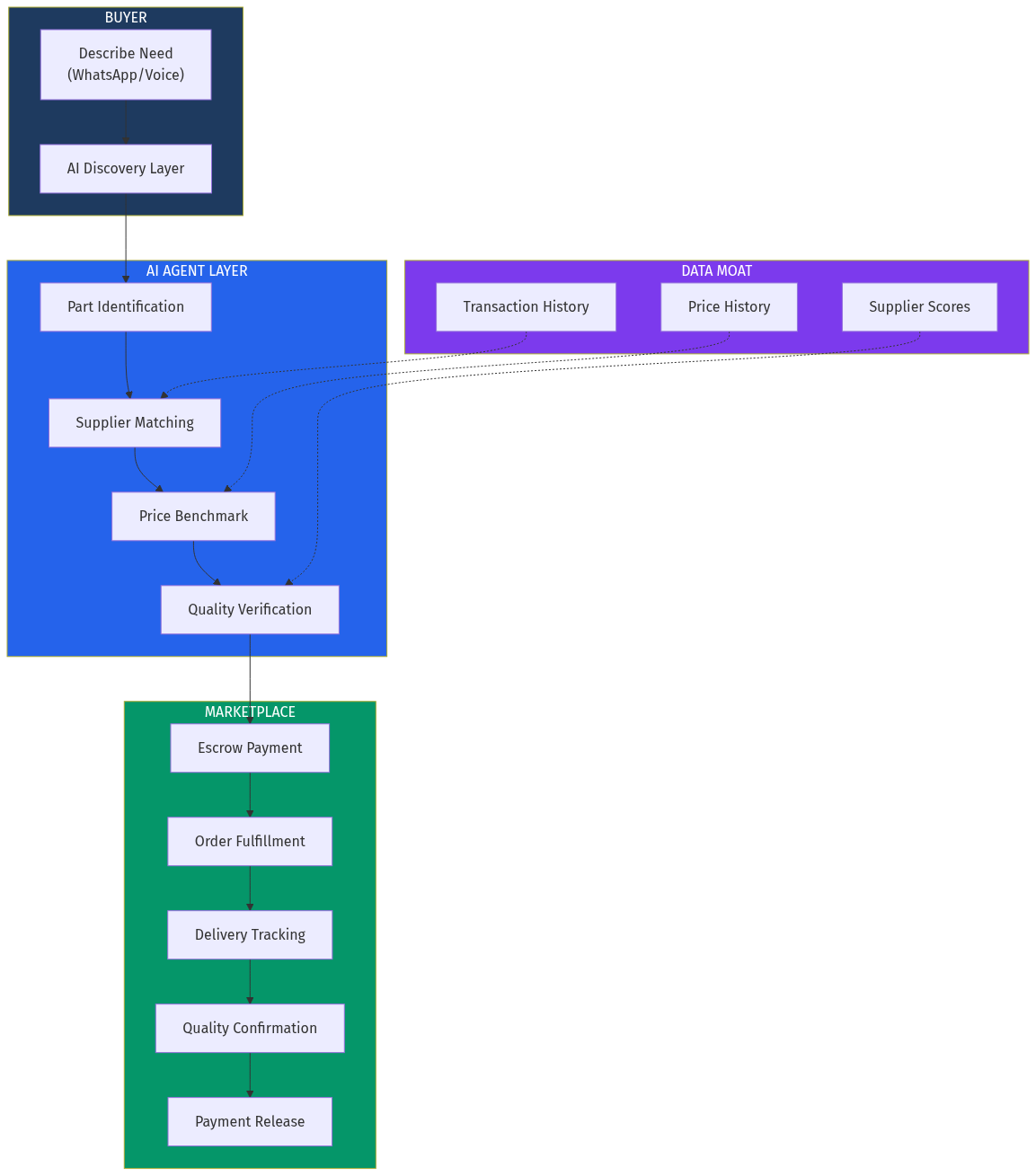
    Three AI Layers That Transform This Market

    #### Layer 1: Conversational Discovery Agent

    • Problem solved: Buyer describes application in natural language—"Hindustan 3O machine, 1OkW motor, belt slipping"
    • AI Action: Matches description to likely part number, cross-references catalog, returns candidate suppliers
    • Technology: LLM with industrial parts knowledge graph
    #### Layer 2: Quality Verification Engine
    • Problem solved: Is this part genuine?
    • AI Action:
    - Verify supplier authenticity score based on customer reviews, delivery history, return rates - Cross-reference serial numbers with manufacturer databases - Flag known counterfeit part numbers
    • Technology: Supplier scoring model + manufacturer database integration
    #### Layer 3: Intelligent Price Discovery
    • Problem solved: Am I paying fair price?
    • AI Action:
    - Price benchmark for identical/similar parts across history - Alert buyer to outliers (too high or suspiciously low) - Predict price trends based on demand signals
    • Technology: Historical transaction data aggregation + predictive pricing

    The Future with AI Agents

    TODAY: Manufacturer searches Google → calls 5 dealers → negotiates → purchases (uncertain)
    
    WITH AI AGENT: 
      "Find bearing for Bendre machine HT45O, spindle assembly, delivery within 48hrs"
      → AI queries knowledge graph → matches to 3 verified suppliers → shows price comparison → 
      → AI verifies seller authenticity score → Purchase with escrow → Delivery tracked
    7.

    Product Concept

    Core Features

  • AI Chat Interface: Natural language part discovery (text + WhatsApp voice)
  • Supplier Verification Badge: Third-party quality scoring with review history
  • Price Lookup: Historical benchmark pricing for parts
  • Catalog Digitization: AI converting supplier PDF catalogs to structured listings
  • Escrow Payments: Hold payment until part verified/received
  • Return/Dispute Resolution: AI-mediated resolution workflow
  • Platform Workflow

    AI Industrial Parts Marketplace Flow
    AI Industrial Parts Marketplace Flow
    8.

    Development Plan

    8.

    Development Plan

    PhaseTimelineDeliverables
    Phase 04 weeks3 cities, 100 suppliers, part catalog digitization
    MVP8-12 weeksChat interface + basic matching + supplier verification
    V116-20 weeksPrice benchmark + WhatsApp integration
    V224-30 weeksEscrow payments + AI dispute resolution

    MVP Components

    • WhatsApp-based part discovery (lowest friction)
    • Structured supplier database (100 verified suppliers)
    • Basic matching algorithm
    • Escrow payment system ( Razorpay/Stripe)

    GTM (Go-To-Market) Focus

    Initially focus on:
    • Vertical: Textile machinery (Coimbatore, Mumbai)
    • Persona: Maintenance managers via WhatsApp
    • Acquisition: Direct WhatsApp marketing + trade show presence

    9.

    Go-To-Market Strategy

    1. Target Vertical & Geography

    • Initial: Textile machinery parts (Coimbatore, Surat)
    • Expansion: CNC machining, packaging machinery

    2. Supplier Acquisition

    • Direct outreach to existing dealers
    • Catalog digitization as value-add (free digitization drives adoption)
    • Verification badge creates premium supplier tier

    3. Buyer Acquisition

    • WhatsApp-first: Maintenance managers already on WhatsApp
    • Trade Shows: IMTEX (Bangalore), plaspack
    • Content: YouTube/SEO for "how to identify counterfeit [part]" queries
    • Referral: Manufacturer networks

    4. Pricing Strategy

    • Commission: 8-15% on transacted value
    • Verification Fee: ₹500-2000 for high-value part verification
    • Subscription: Monthly parts catalog access for buyers (optional)

    10.

    Revenue Model

    Revenue StreamDescriptionPotential
    Transaction Commission8-15% on GMVPrimary
    Verification ServiceTiered verification for high-value partsMedium
    Premium ListingsSupplier visibility upgradesMedium
    Data ReportsMarket intelligence for enterprise buyersLow initially
    Ads/PromoBrand advertising from manufacturersLow initially

    Unit Economics

    • Average Order Value: ₹25,000-1,50,000
    • Take Rate: 10% = ₹2,500-15,000 per transaction
    • Customer Acquisition Cost: ₹3,000-8,000 (target: < 3x LTV in first year)
    • Repeat Rate: 40%+ expected (maintenance is recurring need)

    11.

    Data Moat Potential

    Proprietary Data That Accumulates

  • Supplier Performance Scores: Unique to platform—created from transaction history
  • Price Benchmarking Data: Historical transactions create pricing intelligence
  • Parts Knowledge Graph: Mapping descriptions to part numbers (builds over time)
  • Manufacturer Relationships: Supplier-buyer connection patterns
  • Why IncreasINGLY Defensible

    • More transactions → better matching → more buyers → more suppliers → more transactions (flywheel)
    • Price benchmark data compounds—competitors can't replicate cheaply
    • Parts knowledge graph improves over time—each query improves matching

    12.

    Why This Fits AIM Ecosystem

    Vertical Alignment

    • AIM.in: Can aggregate as "industrial machinery" vertical
    • Domain Portfolio: Can build landing pages for category-specific domains
    • WhatsApp Integration: Natural fit for Indian B2B buyers
    • Agent Orchestration: AI agent can manage supplier verification, buyer matching, and post-sale support

    Network Effects

    • B2B marketplace with verified suppliers creates trust flywheel
    • Geographic expansion follows existing manufacturing clusters
    • Category expansion follows supplier relationships

    ## Verdict

    Opportunity Score: 8/10

    Why 8?

    Strengths:
    • Massive fragmented market ($40B+)
    • Clear AI differentiation angle (discovery + verification + pricing)
    • Natural WhatsApp-first distribution in India
    • High repeat purchase nature (maintenance is ongoing)
    • No AI-first incumbent
    Weaknesses:
    • Trust building takes time in B2B
    • Quality verification is operationally heavy
    • Low digital literacy among some supplier segments

    Key Insight

    The opportunity isn't just "parts marketplace"—it's "AI-powered trust layer" on the fragmented parts market. The real moat isn't the marketplace—it's the verification and price intelligence built over time.


    ## Sources