ResearchSaturday, May 2, 2026

AI-Powered B2B Distributor Intelligence Platform for India

Building the "Google Maps" for B2B distribution — enabling retailers to discover, compare, and transact with wholesale distributors across India using AI agents that understand inventory, pricing, and trust in real-time.

1.

Executive Summary

India's B2B distribution ecosystem is a $800B+ market operating on WhatsApp and phone calls. Distributors lack digital presence; retailers have no transparent way to discover alternatives, compare prices, or verify supplier credibility. The result: massive inefficiency, middleman dependence, and 15-25% price inflation.

This article explores the opportunity to build an AI-powered B2B Distributor Intelligence Platform — a "Google Maps" for wholesale distribution that maps every distributor, tracks inventory flows, scores trust, and enables auto-RFQ between retailers and distributors.

2.

Problem Statement

Who Experiences This Pain?

Retailers (Kirana, Hotels, Restaurants, Manufacturing):
  • Spend hours calling multiple distributors to compare prices
  • No visibility into alternative suppliers when stock runs out
  • Can't verify distributor reliability before committing
  • Get stuck with irregular supply during peak seasons
Distributors:
  • Rely on relationship-based sales (phone/WhatsApp)
  • Can't reach new retailers efficiently
  • No systematic way to showcase inventory or pricing
  • Compete on relationships, not on service quality

The Core Friction Points

  • Discovery Friction — No centralized catalog of distributors by category/location
  • Price Opacity — Prices vary by relationship, volume, and negotiation
  • Trust Asymmetry — No structured credibility scores
  • Inventory Opacity — Retailers don't know what's in stock until they call
  • Order Friction — No digital ordering; everything via phone/WhatsApp

  • 3.

    Current Solutions

    PlatformWhat They DoWhy They're Not Solving It
    IndiaMARTB2B catalog for manufacturersNo inventory/pricing visibility; lead-generation only
    UdaanB2B marketplace (selected categories)Limited categories; retailer-only; no AI agents
    TradeIndiaB2B directoryCatalog only; no transaction capability
    Jiomart B2BClosed ecosystemPlatform-centric; limited supplier network
    WhatsApp GroupsInformal distribution networksNo structure, no search, no trust metrics

    The Gap Analysis

    • No AI agent layer — Existing platforms require manual search and comparison
    • No real-time inventory — Products appear available even when out of stock
    • No trust scoring — No systematic credibility verification
    • No auto-RFQ — No automated request-for-quote infrastructure

    4.

    Market Opportunity

    Market Size (India)

    SegmentEstimated SizeNotes
    B2B Distribution (Overall)$800B+All categories combined
    FMCG Distribution$120BConsumer goods
    Food & Beverage Distribution$85BRestaurants, hotels, caterers
    Industrial Distribution$200B+Spare parts, MRO, chemicals
    Agricultural Inputs$45BSeeds, fertilizers, equipment

    Growth Drivers

  • Digital adoption acceleration — Post-COVID B2B digital transactions up 340%
  • WhatsApp normalization — B2B conversations already on WhatsApp
  • D2C pressure — Brands going direct, disrupting traditional distribution
  • SME formalization — GST, Udyam Registration pushing digitization
  • Why NOW?

    • Infrastructure maturity — UPI, API stacks, WhatsApp Business API — all available
    • Trust deficit — Too many intermediaries; retailers want direct access
    • Supply chain visibility — Post-pandemic emphasis on resilient supply chains
    • AI agent readiness — LLMs can now understand product catalogs, pricing, and logistics

    5.

    Gaps in the Market

    Using Anomaly Hunting to identify structural gaps:

  • Gap: No unified distributor directory
  • - Every city has hundreds of distributors, but no unified online presence - Existing directories are manufacturer-focused, not distributor-focused
  • Gap: No pricing transparency
  • - Same product varies 15-25% across distributors - No way to benchmark without calling 10+ suppliers
  • Gap: No trust verification infrastructure
  • - No systematic way to verify distributor reliability - Depends entirely on personal relationships
  • Gap: No inventory intelligence
  • - Retailers discover stock-outs only after placing orders - No predictive inventory visibility
  • Gap: No AI-first B2B interface
  • - All existing platforms are search-based, not conversational - No agent-enabled auto-RFQ or price negotiation
    6.

    AI Disruption Angle

    How AI Agents Transform the Workflow

    Today (Manual):
    Retailer → Search Google → Call 5 distributors → Compare prices → Negotiate → Place order (WhatsApp) → Track manually
    With AI Agents:
    Retailer → "Find 20L oil for hotel, best price, Delhi NCR" → AI Agent searches catalog → Auto-RFQ to top 5 → AI compares quotes → Confirm → Order auto-created

    The AI Agent Layer

  • Catalog Understanding Agent
  • - Parses distributor product catalogs (PDF, WhatsApp, website) - Maps products to standardized categories - Extracts pricing, MOQ, delivery terms
  • Matching Agent
  • - Understands retailer requirements - Matches to right distributors by category, location, reliability - Ranks by composite score (price + trust + delivery)
  • RFQ Agent
  • - Auto-generates request-for-quote - Sends to matched distributors - Collects and compares quotes
  • Trust Agent
  • - Scores distributors based on: delivery consistency, quality returns, payment terms, response time - Aggregates signals from: review data, transaction history, delivery tracking
  • Order Execution Agent
  • - Creates purchase orders - Tracks order status - Manages invoice reconciliation
    7.

    Product Concept

    Platform: B2B Distributor Intelligence Network (DIN)

    Core Features:
    FeatureDescription
    Distributor MapSearchable directory of distributors by category, location, product range
    Price RadarReal-time wholesale pricing across distributors for same products
    Trust ScoresAI-generated credibility scores based on delivery, quality, response
    Smart RFQAuto-generate and send RFQs to multiple distributors
    Order HubPlace and track orders in one interface
    Inventory PulsePredictive inventory tracking (What's likely in stock?)

    User Flows

    Retailer Flow:
  • Sign up → Specify business type, location, product categories
  • Browse distributor map or ask AI: "Who supplies chef knives in South Delhi?"
  • View trust scores, pricing, delivery terms
  • Send RFQ → Receive quotes → Compare → Confirm
  • Order auto-created → Track delivery
  • Distributor Flow:
  • Sign up → Upload catalog (manual or API)
  • Set pricing, MOQ, delivery zones
  • Receive RFQ notifications
  • Respond with quote
  • Manage orders via dashboard

  • 8.

    Development Plan

    Phase 1: Foundation (Weeks 1-6)

    DeliverableDescription
    Distributor databaseBuild initial database of 500+ distributors (pilot city)
    Basic catalogProduct mapping to categories
    Search interfaceSearch by category, location
    Trust scoring v1Manual reviews + basic signals

    Phase 2: Intelligence (Weeks 7-12)

    DeliverableDescription
    Price radarReal-time pricing across distributors
    AI matchingML-based distributor recommendations
    Trust v2Automated trust scoring
    WhatsApp botQuery distributors via WhatsApp

    Phase 3: Transaction (Weeks 13-20)

    DeliverableDescription
    RFQ engineAuto-generate and send RFQs
    Order executionCreate and track orders
    Payment integrationUPI/NEFT for orders
    Analytics dashboardDistributor performance analytics

    Phase 4: Scale (Weeks 21-30)

    DeliverableDescription
    Multi-city expansion10+ cities
    Vertical expansionCategories: FMCG, Industrial, Food, Pharma
    API for brandsBrand → Distributor integration
    AI negotiationDynamic pricing with agents
    ---
    9.

    Go-To-Market Strategy

    Step 1: Focus on One City, One Category

    • City: Hyderabad (strong SME base, manageable market)
    • Category: Hotel/restaurant supplies (F&B distribution)

    Step 2: Build Supply First

  • Identify top 100 distributors in the category
  • Visit each with value proposition: "Get 10+ new retailers per month"
  • Onboard with free listing + basic features
  • Revenue: Commission on successful orders (2-3%)
  • Step 3: Acquire Retailers

  • Target: Hotel chains, restaurant franchise, cloud kitchens
  • 2.渠道: Hotel associations, food industry events
  • Offer: "Compare prices across 50+ distributors in one search"
  • Step 4: Expand Vertically

    After category/market fit, expand to:

    • Industrial supplies
    • Office supplies
    • Medical/pharma distribution

    Step 5: Build Network Effects

    • More retailers → More distributor demand
    • More distributors → Better selection for retailers
    • Transaction data → Trust scores (new data moat)

    10.

    Revenue Model

    Revenue Streams

    StreamModelEstimated Margin
    Commission2-3% on order value2-3%
    Listing FeesPremium listings for distributors₹2,000-10,000/month
    Trust CertificationVerified trust badges₹5,000-25,000/year
    Lead GenerationQualified RFQs to distributors₹500-2,000/RFQ
    Data/API AccessMarket intelligence reports₹10,000-50,000/report
    AdvertisingFeatured distributors₹10,000-50,000/month

    Unit Economics (Preliminary)

    MetricEstimate
    Average order value₹50,000
    Commission2% (₹1,000/order)
    CAC (acquire distributor)₹2,000
    CAC (acquire retailer)₹5,000
    LTV (distributor)₹30,000/year
    LTV (retailer)₹1,00,000/year
    ---
    11.

    Data Moat Potential

    Proprietary Data Accumulation

    Data TypeValueMoat Strength
    Pricing IntelligenceReal-time wholesale pricesHigh (updated daily)
    Trust ScoresAggregated reliability dataHigh (hard to replicate)
    Transaction HistoryOrder volumes, frequenciesVery High (exclusively ours)
    Inventory PatternsStock-in, stock-out predictionsHigh (unique insight)
    Distributor ReliabilityDelivery consistency metricsHigh (relationship data)

    Flywheel Potential

  • More distributors → More selection
  • More selection → More retailers
  • More transactions → Better data
  • Better data → Better AI recommendations
  • Better AI → More transactions (Strong Moat)

  • 12.

    Why This Fits AIM Ecosystem

    Vertical Integration with AIM.in

    AIM ComponentHow It Connects
    Domain PortfolioVertical domains: distributor.in, wholesale.in, b2bdir.in
    Netrika (Research)Continuous market research for distributor categories
    WhatsApp IntegrationAI agent queries via WhatsApp (existing infrastructure)
    Email IntelligenceMonitor distributor communications for changes
    dives.inPublish research on B2B distribution opportunities

    Replicating What's Worked

    This follows the proven playbook from previous dives.in articles:

    • AI RFQ Response Automation (manufacturing)
    • B2B Catalog Intelligence (purchasing)
    • AI Supplier Risk Intelligence (due diligence)
    The difference: This is the distribution layer — connecting retailers to distributors, not manufacturers to buyers.


    13.

    Mental Models Applied

    Zeroth Principles

    Assumption to question: "B2B distribution always requires middlemen because of relationship trust." Reality check: The relationship trust is data, not personality. AI can capture delivery history, quality returns, payment behavior, and generate trust scores. Middlemen exist because data isn't captured — not because relationships are irreplaceable.

    Incentive Mapping

    Who profits from status quo?
    • Traditional distributors (price opacity = margin)
    • Existing B2B platforms (lead generation fees)
    What keeps the system broken?
    • No standardized data capture
    • No trust infrastructure
    • Retailers lack negotiating power

    Steelmanning (Why Incumbents Might Win)

  • IndiaMART has distribution catalog — Already has supplier data
  • Udaan has transaction infrastructure — Already processes orders
  • Traditional distributors have relationships — Personal trust is hard to disrupt
  • Price transparency hurts margins — No incentive to participate openly
  • Falsification (Pre-Mortem)

    Assume: Udaan launches AI agents, IndiaMART builds trust scores. Why might this fail?
  • Distributors won't share inventory data (competitive risk)
  • Trust scores are gaming-able (fake reviews)
  • Small retailers can't meet MOQs
  • Platform takes margin, not value-add

  • ## Verdict

    Opportunity Score: 8/10

    Why High Score

  • Massive market — $800B+ B2B distribution in India
  • Clear pain point — Price opacity, trust deficit, discovery friction
  • AI-ready — LLMs can parse catalogs, match requirements, auto-RFQ
  • Data moat — Transaction history becomes proprietary trust infrastructure
  • Network effects — More users = better recommendations = more users
  • Risk Factors

  • Chicken-and-egg — Need both sides simultaneously
  • Trust score gaming — Need robust anti-gaming mechanisms
  • Low margins — 2-3% commission may not cover CAC
  • Relationship resilience — Traditional channels fight back
  • Recommendations

  • Start narrow — One city, one category, build density
  • Build trust first — Trust scores before transaction
  • WhatsApp-native — Meet users where they already are
  • Acquire supply-side first — Distributors before retailers

  • ## Sources


    ## Diagram

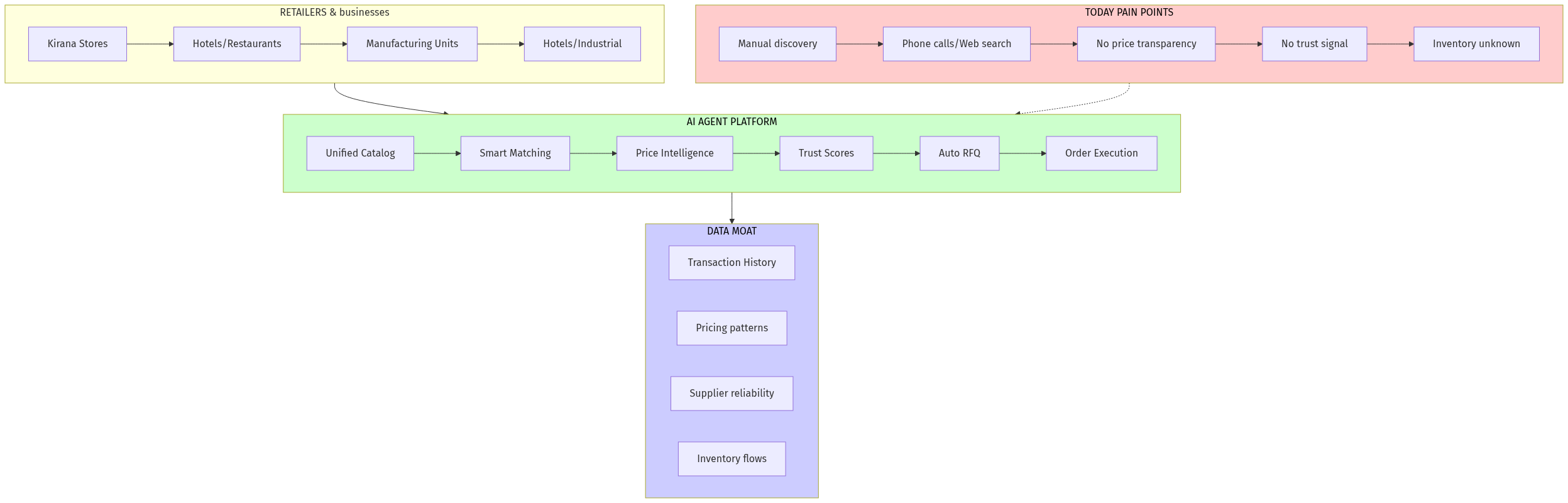
    B2B Distributor AI Platform Architecture
    B2B Distributor AI Platform Architecture
    Figure: Platform architecture showing retailer-problem-solution-moat relationships