ResearchFriday, May 1, 2026

AI-Powered B2B Vendor Qualification Platform — The Missing Link in Indian SMB Procurement

Indian SMBs spend 40%+ of procurement time hunting for verified vendors. An AI agent can automate vendor discovery, qualification, and trust scoring — creating a new category of B2B matching infrastructure.

8
Opportunity
Score out of 10
1.

Executive Summary

India's 63+ million SMBs face a fundamental problem: finding trusted vendors in unfamiliar categories takes weeks of manual research, reference calls, and site visits. Unlike enterprise buyers with established supplier networks, SMBs lack the institutional memory to know "who makes quality industrial fasteners in Kolhapur" or "which Chennai contract manufacturer does precision CNC work."

This creates a massive opportunity for an AI-powered vendor qualification platform — one that discovers, verifies, scores, and recommends vendors based on capability matching, not just SEO keyword stuffing.


2.

Problem Statement

The Vendor Discovery Gap

When an SMB in Vizag needs a new supplier for stainless steel flanges, the typical journey looks like:

  • Google search → Land on 47 supplier websites with no differentiation
  • Reference calls → Spend 3-5 days calling network contacts
  • Trust assessment → Visit factories, check certifications manually
  • Negotiation → Haggle with no price transparency
  • This process takes 2-8 weeks per new vendor relationship. Multiply by categories needed — and SMBs either delay expansion or work with suboptimal suppliers.

    Market Inefficiencies

    • Information asymmetry: Buyer doesn't know what "good" looks like
    • Trust deficit: No third-party verification of capabilities
    • Search friction: Google/IndiaMART shows suppliers who pay for visibility, not capability
    • Geographic blind spots: Best manufacturers in tier-2/3 towns are invisible

    3.

    Current Solutions

    PlatformWhat They DoWhy They're Not Solving It
    IndiaMARTProduct catalog + lead genNo verification, pay-to-play listings, buyer must qualify
    TradeIndiaB2B directorySame model — listings optimized for seller reach, not buyer fit
    Sulekha B2BDirectory + networkLimited coverage, no capability tagging
    Direct vendor huntsManual networkTime-intensive, non-scalable
    Gap: No platform provides capability-based vendor matching with verified quality indicators.
    4.

    Market Opportunity

    TAM Analysis

    • Addressable market: 63 million Indian SMBs procurement spend
    • Average vendor relationships per SMB: 12-20 active suppliers
    • Time spent per vendor discovery: 40-80 hours
    • Implied cost: Rs. 50,000-2,00,000 per discovery cycle

    India-Specific Drivers

  • PLI schemes → New categories of vendor onboarding
  • Export growth → Need ISO-certified supplier networks
  • Quality consciousness → Post-PMQF accountability expectations
  • Supply chain resilience → Dual sourcing requirements

  • 5.

    Gaps in the Market

    Gap 1: No Capability Tagging

    Current platforms tag by product category, not manufacturing capability (e.g., "CNC turning" vs. "lathe work").

    Gap 2: No Trust Infrastructure

    No standardized verification of:
    • Quality certifications (ISO 9001, IATF)
    • Production capacity
    • Financial stability
    • Delivery track record

    Gap 3: Geographic Discovery

    Best suppliers in tier-2/3 cities (Rajkot, Coimbatore, Ludhiana) remain invisible to buyers outside their region.

    Gap 4: No Matching Algorithm

    No platform matches buyer requirements to supplier capabilities using structured data.

    Gap 5: SMB Exclusion

    Enterprise-grade supplier qualification is expensive and time-prohibitive for SMB budgets.
    6.

    AI Disruption Angle

    How AI Agents Transform Vendor Discovery

    Today's manual process:
    Buyer → Google search → 100s of links → Manual filtering → Reference calls → Site visits → Trust decision
    With AI agents:
    Buyer: "Find certified CNC precision suppliers in Hosur who can handle 15mm SS shafts, 5000 units"
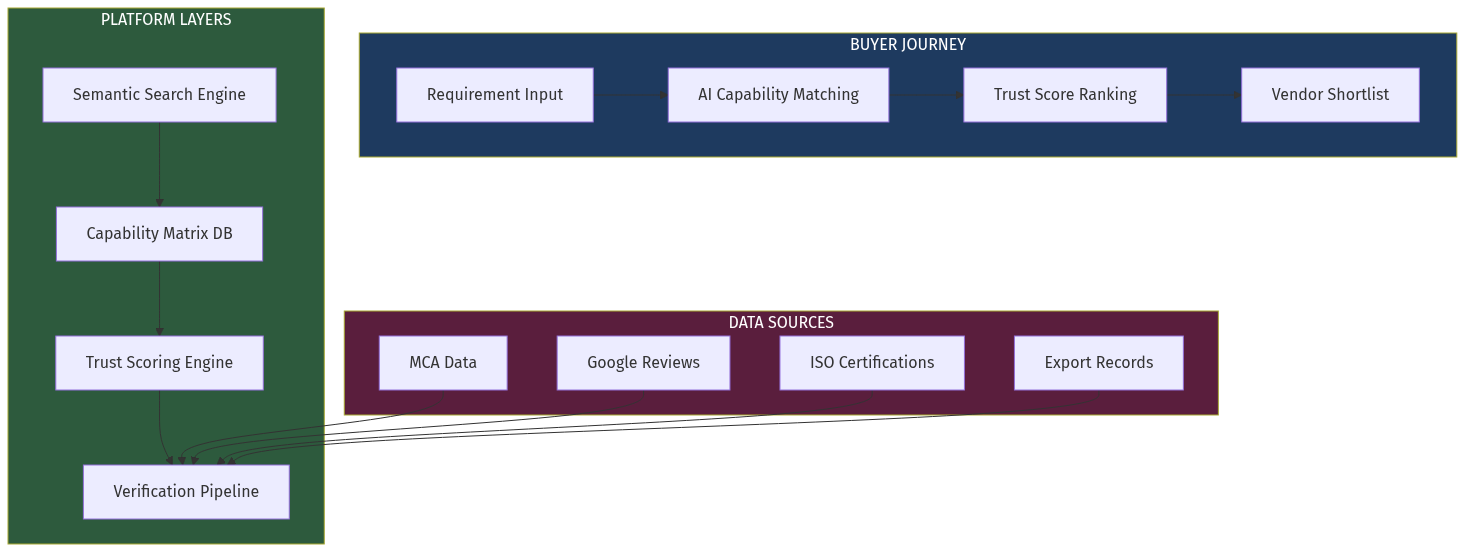
    Agent → Semantic matching → Verified profiles → Capability matrix → Trust score → Introductions

    Key AI Capabilities

  • Semantic search: Match requirements to capabilities, not keywords
  • Trust scoring: Aggregate certifications, reviews, delivery data into composite score
  • Multi-source verification: Cross-reference MCA data, Google reviews, export records
  • Conversation qualification: Interactive Q&A to narrow requirements without forms
  • Auto-RFP: Generate inquiry documents for matched vendors

  • Platform Architecture
    Platform Architecture

    7.

    Product Concept

    Core Features

    FeatureDescription
    Vendor DiscoveryNatural language search for supplier capabilities
    Trust DashboardComposite trust score (certifications, reviews, financials)
    Capability MatrixStructured tags for processes, materials, precision range
    Verification PipelineAutomated verification of ISO, export, financial status
    Match ScoringAI ranking of vendors by requirement fit
    Introduction AgentAutomated outreach, qualification, scheduling

    Revenue Model

  • Freemium discovery — 10 free inquiries/month
  • Verification add-on — Rs. 2,500-10,000 per verification report
  • Subscription — Rs. 5,000-25,000/month for unlimited AI matching
  • Transaction fee — 1-2% on introductions that convert

  • 8.

    Development Plan

    PhaseTimelineDeliverables
    MVP8 weeks3 vertical categories, 500 verified vendors, basic search
    V116 weeks20 categories, 5,000 vendors, trust scoring
    V224 weeksAI agent for qualification, auto-RFP, introductions

    Vertical Priorities

  • Industrial fasteners — High volume, fragmented
  • precision machining — Skills gap, certification-dependent
  • Sheet metal fabrication — Regional clusters, quality variance
  • Packaging — Standardized requirements, trust critical
  • Chemicals — Compliance-heavy, certification required

  • 9.

    Go-To-Market Strategy

    Phase 1: Seed with Trade Associations

    • Cluster approach: Establish presence in manufacturing hubs
    • Partner: IDP (Institute of Directors), CII, local manufacturing associations
    • Offer: Free verification for first 100 vendors in each cluster

    Phase 2: Buyer Acquisition

    • Inbound SEO: Category-specific keywords ("CNC suppliers in [city]")
    • Content: Vendor comparison guides, quality checklists
    • Network effect: More buyers → more vendor listings want to join

    Phase 3: Trust as Moat

    • Verification service: Paid verification builds trust database
    • Review ecosystem: Verified buyer reviews become proprietary data
    • Credential tracking: Real-time certification monitoring

    10.

    Data Moat Potential

    Compounding data assets:
    • Verification history — Not replicable by new entrants
    • Capability matrix — Structured supplier data improves matching
    • Trust scores — Composite historical performance data
    • Relationship graph — Who works with whom → network effects

    11.

    Why This Fits AIM Ecosystem

    This platform becomes a critical vertical discovery layer for the AIM procurement network:

    • For existing articles — Enables "Find a vendor" for each category already covered
    • For AIM agents — Provides vendor database for AI procurement agents
    • For domain strategy — Supplier discovery domains (e.g., "supplier.in") become acquisition targets

    Integration Points

    • With procurement agents: Real vendor database for RFQ responses
    • With vertical marketplaces: Discovery layer on top of transaction platforms
    • With compliance platforms: Verified vendor credentials accessible

    ## Verdict

    Opportunity Score: 8/10

    Indian SMB procurement is crying for vendor discovery reform. The combination of:

    • Information asymmetry
    • Trust deficit
    • Geographic blind spots
    • AI matching capability
    Creates a window for a new category leader. The first-mover advantage compounds through verification data, making this a defensible business with strong network effects.

    Recommendation: Build focused MVP in 2-3 verticals, validate demand, then expand. Target manufacturing clusters in Gujarat, Tamil Nadu, and Maharashtra first.

    ## Sources

    • TrustMRR startup database analysis
    • IndiaMART market positioning research
    -MCA company data availability
    • Industry cluster mapping (Coimbatore, Rajkot, Ludhiana, Hosur)