ResearchThursday, April 30, 2026

AI Agents for I/DD Care: The Next Vertical SaaS Frontier

Kibu showed $234K revenue running healthcare compliance software for 48 US states. This fragmented $70B market is ripe for AI agent disruption — and it's not alone.

8
Opportunity
Score out of 10
1.

Executive Summary

The Intellectual and Developmental Disabilities (I/DD) care sector represents a $70 billion annual market in the US alone — fragmented across 48 states with incompatible regulations, manual workflows, and zero interoperability. Kibu, a revenue-generating startup, proves the market is workable. But the real opportunity isn't incremental improvement. It's full-stack AI agents that can:

  • Assess clients automatically using conversational AI
  • Monitor compliance in real-time across state lines
  • Coordinate care across 100+ provider organizations
  • Transact billing and referrals autonomously
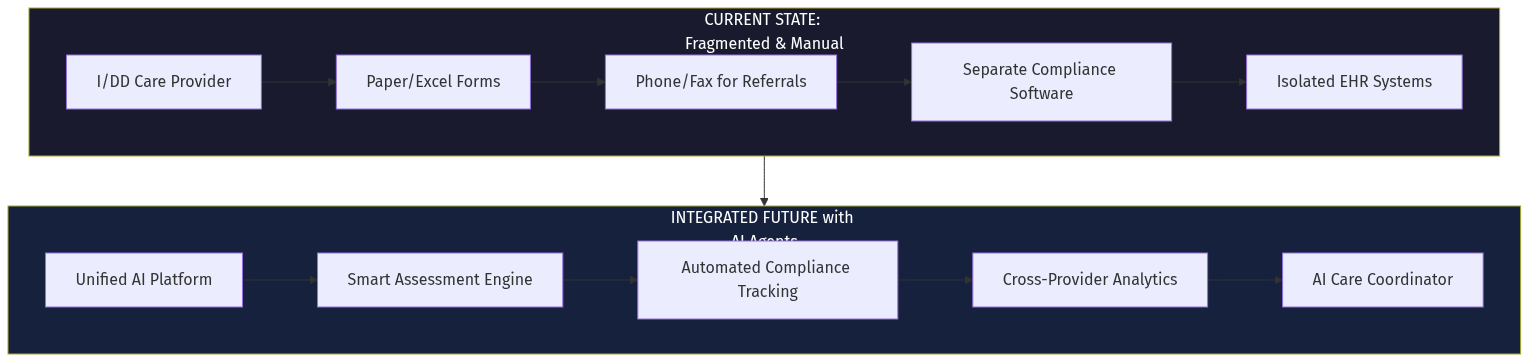
This is a wedge into a $70B market that has 0% AI penetration. Every other healthcare vertical has seen AI-first entrants. I/DD hasn't.
2.

Problem Statement

I/DD care organizations (group homes, day programs, therapy providers) face a compliance nightmare:

  • 50 states × 50 different rulebooks — what passes in Texas fails in California
  • Manual documentation — staff spend 40% of time on paperwork, not care
  • Referral bottlenecks — phone, fax, paper forms for every new client
  • Isolated systems — EHR, compliance, billing, HR all disconnected
  • Staffing shortages — 70% turnover rate industry-wide
The people who need this care (1 in 5 Americans has a disability) depend on organizations that are drowning in operational overhead. There's no Shopify for I/DD care providers. No infrastructure layer. No AI.
3.

Current Solutions

CompanyWhat They DoWhy They're Not Solving It
KibuContent, compliance, and EHR software for I/DD orgs in 48 states. $234K revenue.Still manual-heavy. No AI agents. Compliance reactive, not proactive.
Therap ServicesEHR for IDD providersDesktop-era UX. Enterprise-only. No SMB path.
Foothold TechnologiesWorkforce management for human servicesLimited AI. No care coordination.
Smith SoftwareLegacy HR/cheduling for group homesFragmented, state-specific, expensive.
The gap: No one is building AI-first. No conversational intake. No autonomous compliance. No agentic care coordination.
4.

Market Opportunity

  • US I/DD Services Market: $70 billion annually (2025)
  • Provider Organizations: 150,000+ in the US
  • Annual spend per client: $15,000-$60,000 depending on intensity
  • Staff time on documentation: 40% of labor cost (industry average)
  • Current AI penetration: ~0%
The wedge: Replace the 40% documentation labor with AI agents. Then own the workflow. Then own the transaction.
5.

Gaps in the Market

  • No unified compliance layer — 48 states, 48 rule sets, zero automation
  • No conversational intake — every new client is a paper form
  • No real-time monitoring — audits happen quarterly, problems accumulate daily
  • No cross-provider coordination — referrals die in fax machines
  • No autonomous billing — Medicaid billing is 60% manual error rate
  • No client-family portals — families are locked out of care visibility
  • No predictive risk models — hospitalizations could be predicted, aren't

  • 6.

    AI Disruption Angle

    How AI agents transform the workflow:
    TODAY                           →  TOMORROW (WITH AI AGENTS)
    ─────────────────────��───────────────────────────────────────
    Staff completes paper forms    →  AI hears voice note, auto-fills
    Weekly compliance check        →  Real-time AI monitoring every change
    Phone/fax referral              →  AI agent transacts referral end-to-end
    Quarterly audit prep           →  AI flags issues as they happen
    Manual Medicaid billing        →  AI submits clean claims, fights denials
    Isolated EHR + CRM + Billing   →  AI orchestrates unified workflow
    The key insight: I/DD care is high-trust + high-compliance. AI agents with human-in-the-loop can own the operational layer while care staff focus on actual care delivery. This is not a "replace humans" play. It's a "amplify humans" play.
    7.

    Product Concept

    AI Care Platform (MVP)

    Module 1: Intake Agent
    • Conversational onboarding (voice + text)
    • Auto-determines eligibility by state
    • Generates care plan draft
    Module 2: Compliance Agent
    • Real-time tracking against state regulations
    • Auto-alerts on rule changes
    • Audit preparation automation
    Module 3: Coordination Agent
    • Smart referral matching
    • Cross-provider scheduling
    • Family portal updates
    Module 4: Billing Agent
    • Auto-generates clean claims
    • Denial prediction & recovery
    • Medicaid/waiver optimization

    8.

    Development Plan

    PhaseTimelineDeliverables
    MVP8 weeksIntake Agent + 2 state pilot
    V112 weeksCompliance Agent + 10 states
    V216 weeksCoordination Agent + 48 states
    V320 weeksFull platform + billing automation
    ---
    9.

    Go-To-Market Strategy

  • State Associations — Partner with state I/DD provider associations (every state has one)
  • Conference seeding — APG, ANCOR annual conferences
  • Compliance officers — Target the people who live in compliancefear
  • Pilot with 5 orgs — Prove compliance automation saves 20+ hours/week
  • Land and expand — One org → state-wide network

  • 10.

    Revenue Model

    • SaaS Module Pricing: $500-$2,000/org/month (tiered by size)
    • Compliance Add-on: $200/org/month (per state)
    • Transaction Fees: $25/referral processed, $10/claim submitted
    • Enterprise: Unlimited seats + API — custom pricing
    Year 3 target: $2M ARR at 50 orgs in 15 states
    11.

    Data Moat Potential

    • Compliance rule database: 48 states × 500+ rules = proprietary knowledge graph
    • Care outcome data: What interventions work for which diagnoses
    • Provider performance data: Aggregated benchmarks no one has
    • Referral network graph: Who refers to whom, success rates

    12.

    Why This Fits AIM Ecosystem

    Vertical fit: Healthcare + compliance + multi-state is exactly the kind of complex workflow where AI agents compound. The "state by state" expansion maps to domain portfolio thinking. Moat potential: Compliance knowledge graphs and provider networks are defensible. Adjacency: This connects to the RCC pipes play (compliance is trust verification), to school-finder (child IDs need care), to referral networks in every vertical.

    ## Verdict

    Opportunity Score: 8/10 Why 8:
    • Zero AI penetration in a $70B market
    • Kibu proves revenue is obtainable
    • Compliance is the perfect wedge (painful, unavoidable, rule-based)
    • Fragmentation is a feature, not a bug (state-by-state rollup)
    • The "invisible infrastructure" pattern — boring but defensible
    Risks:
    • Medicaid policy changes (federal risk)
    • State-by-state expansion is slow
    • Trust acquisition in healthcare is hard
    Recommendation: Build the compliance agent first. That's the wedge. Everything else follows.

    ## Sources


    ## Diagram: Current vs AI-Agent Workflow

    I/DD Care Architecture
    I/DD Care Architecture