ResearchSunday, April 26, 2026

AI-Powered Industrial Permit & License Automation for Indian MSMEs

Unlocking the $12B MSME compliance market by automating factory licenses, environmental clearances, and regulatory approvals that currently take 6-18 months to obtain manually.

8
Opportunity
Score out of 10
1.

Executive Summary

India's 35+ million MSMEs face a fragmented, state-specific permit ecosystem that costs them billions annually in delayed operations, penalties, and consultant fees. A single factory requires 8-15 distinct licenses before operation — from factory license (state DFTI) to pollution clearance (SPCB), boiler certification, electrical safety, fire NOC, and more. Each lives in a different government portal, has different timelines, and different document requirements.

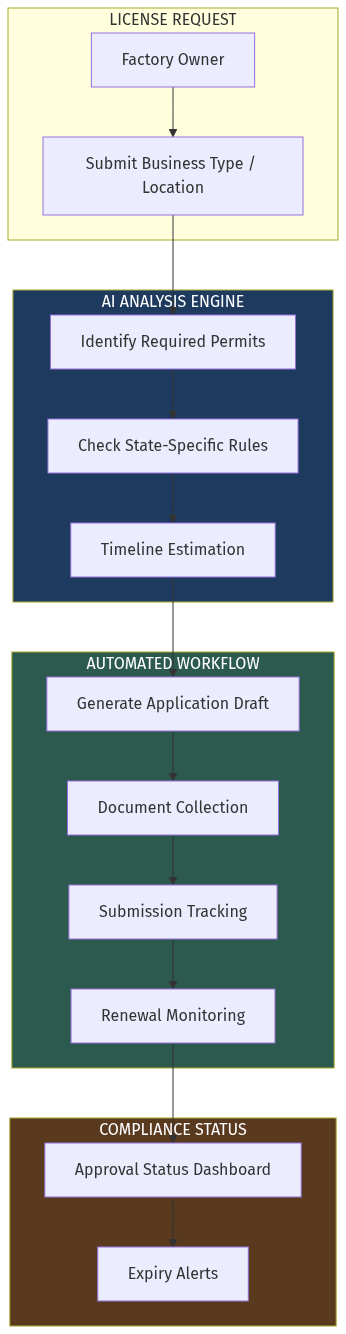
This opportunity creates an end-to-end AI platform that identifies required licenses by business type + location, automates application drafting, tracks submissions, and monitors renewals — reducing permit acquisition from months to weeks.

2.

Problem Statement

The Pain Points

  • Fragmented Authority: A single factory needs permits from 8-15 authorities — state DFTI, State Pollution Control Board (SPCB), District Magistrate, Electrical Safety Officer, Boiler Inspector, Fire Department, BIS (for certain products), Export-Import authorities, FSSAI (if food-adjacent), and more.
  • State-Specific Rules: Each state has different forms, timelines, and portals. A chemical factory in Gujarat follows different rules than one in Tamil Nadu.
  • No Central Registry: There's no "one system" telling a factory owner what they need. They either hire expensive consultants (INR 50K-500K) or trial-and-error with authorities.
  • Delayed Compliance = Financial Loss: Factory can't start production without licenses. Every month of delay is lost revenue. But overstaying violations = penalties + forced closure.
  • Renewal Nightmares: Many permits are annual. Missing a renewal triggers automatic penalties. There's no centralized tracking.

Who Experiences This Pain?

  • Manufacturing MSMEs (especially in chemicals, pharmaceuticals, food processing, textiles, metal fabrication)
  • New greenfield factories setting up for first time
  • Existing factories expanding capacity/product lines
  • Engineers / architects setting up design firms requiring APEDA, CEPTAM, or similar registrations

3.

Current Solutions

CompanyWhat They DoWhy They're Not Solving It
RegisterKaroManual PMC for business registrationHigh-touch, expensive, not AI-powered
IndiaFilingsBare filing servicesDoesn't do permit strategy, just document submission
VakilSearchLegal compliance for lawyersNot MSME-focused, not workflow automation
ClearTax GSTTax fililngsExpanding to licenses — too early to scale
State gov portals (multiple)Individual permit systemsNon-integrated, no cross-portal workflow
Existing solutions treat permits as one-off filings. None provide intelligent workflow orchestration across state-specific requirements, timelines, and dependencies.
4.

Market Opportunity

  • Addressable Market: ~500K new factories registered annually in India + ~2M existing factories needing renewals
  • Compliance Spend: Average INR 2-5 Lakhs per factory per year on consultant fees + penalties
  • Total Market: ~$12B annually (est. 60% consultant fees + 40% delayed penalties)
  • Growth: 15-20% YoY as Make in India drives new factory creation
  • Why Now:
1. GovStack + DigiLocker enable API integrations 2. AI makes state-specific rules parseable at scale 3. MSME distress over compliance is at an all-time high
5.

Gaps in the Market

  • No Intelligent Requirements Engine: No system maps business type + location to required permits. Everything is manual lookup.
  • No Cross-Portal Workflow: Each permit is its own silo. No orchestration across dependencies (can't apply for X before Y).
  • No Proactive Expiry Management: Renewals are manual calendars. System doesn't alert.
  • No State-Specific Version Control: Rules change. No system tracking what changed per state.
  • No Audit Trail for Audits: When factory inspections happen, there's no organized compliance history to present.

  • 6.

    AI Disruption Angle

    How AI Agents Transform the Workflow:
  • Requirements Inference Agent: Given business type (e.g., "pharmaceutical formulation"), location (Maharashtra), and capacity → outputs all required permits with citations.
  • Document Drafting Agent: Automatically fills forms by reading company documents + knowledge base. Reduces consultant drafting time 80%.
  • Status Tracking Agent: Checks each portal periodically for application status. Notifies owner of delays or issues.
  • Renewal Orchestrator: Tracks permit validity periods, starts renewal workflows 60 days before expiry.
  • Compliance Q&A Agent: Answers owner questions: "Can I store 500L solvent in this warehouse?" — maps to specific regulation.

  • 7.

    Product Concept

    Core Features

  • Permit Discovery Engine
  • - Input: Business type, products, state, plot details - Output: List of all required permits with timeline, documents needed, fees
  • Application Auto-Draft
  • - Reads company PAN, GST, site documents - Fills state-specific forms with correct data - Generates declaration letters, NOCs
  • Submission Tracker
  • - Login to multiple government portals on user's behalf (via DigiLocker) - Track application status across each authority - Alert on queries / rejections
  • Renewal Calendar
  • - Proactive alerts 90/60/30 days before expiry - Auto-prepare renewal documents
  • Compliance Assistant
  • - Chat: "What permits needed for cold storage in UP?" - Maps to official regulations

    Platform Architecture

    Workflow Architecture
    Workflow Architecture

    8.

    Development Plan

    PhaseTimelineDeliverables
    MVP8 weeksDiscovery engine for top 5 states (MH, GJ, TN, KA, UP), top 3 categories (chemical, food, textile)
    V116 weeksAuto-draft + portal login for key portals ( factories portal, SPCB, fire)
    V224 weeksFull state coverage, renewal automation, WhatsApp integration

    Key Technical Components

    • State regulation database (scraped + verified)
    • Document parsing (GST, PAN, site plans)
    • Portal automation (via GovStack / DigiLocker APIs)
    • WhatsApp notifications
    • WhatsApp-based Q&A

    9.

    Go-To-Market Strategy

  • Phase 1: Consultant Partnerships
  • - RegisterKaro, IndiaFilings are already serving this market - Offer AI as white-label layer to reduce their costs by 40%
  • Phase 2: Industry Associations
  • - CII, FIICI, state MSME councils - Referrals from existing satisfied factory owners
  • Phase 3: Government Integration
  • - Pitch to state DFTI / MSME departments as "digital facilitation" - Get embedded in state investor portals
  • Pricing: Freed up
  • - INR 15K-50K/year subscription - Success fees for specific high-value permits (pollution clearance = INR 25K) - Consultation-upsell for complex cases
    10.

    Revenue Model

    • SaaS Subscription: INR 15K-50K/year per factory
    • Permit Success Fees: INR 5K-25K per permit filed
    • Consultant Upsell: 20% referral fee to channel partners
    • Enterprise: INR 2-10L/year for large factories / groups

    11.

    Data Moat Potential

    • Permit requirements database: Structured state-by-state, business-type-by-business-type → becomes the definitive reference
    • Timeline actuals: Real rejection rates, approval timelines per district → not just "official" timelines
    • Document templates: What successful applications include → competitive advantage
    • Compliance audit trails: 5-year history per factory → switching cost

    12.

    Why This Fits AIM Ecosystem

    This maps directly to the AIM.in verticalization strategy:

  • Existing infrastructure: AIM has domain database, email intelligence, WhatsApp distribution — all useful for reaching factory owners
  • Complementary: The healthcare RCM platform (April 26 article) already serves hospitals — this serves the equipment suppliers, pharmaceutical manufacturers they work with
  • Data moat synergies: Permit data feeds into MSME credit scoring (another article) — the more data, the better lending decisions
  • WhatsApp-first distribution: Indian MSME owners live on WhatsApp. Platform can deliver alerts, Q&A via WhatsApp integration

  • ## Verdict

    Opportunity Score: 8/10

    The compliance market is massive, fragmented, and painful. AI can make what currently takes months of manual effort into a 2-week automated workflow. The moat — state-specific permit databases — compounds over time.

    Key Risks:
    • Government portal changes (mitigation: build adaptable workflows)
    • Consultant resistance (mitigation: partner not compete initially)
    Recommendation: Build. Partner with 2-3 consultants for initial validation, expand state-by-state.

    ## Sources