ResearchSunday, April 26, 2026

AI-Powered Healthcare RCM Platform: Capturing India's $45B Revenue Cycle Management Revolution

India's healthcare sector loses Rs 80,000+ crores annually to claim denials, coding errors, and manual billing workflows. An AI-native Revenue Cycle Management (RCM) platform can capture 3-5% of this leakage—building a $2B+ business while becoming the essential infrastructure layer for the country's 1.4 billion patients and 70,000+ hospitals.

1.

Executive Summary

Healthcare Revenue Cycle Management (RCM) is the backbone of every hospital, clinic, and diagnostic center. It spans patient registration, insurance verification, medical coding, claims submission, payment posting, and denial management. In the US, RCM is a $150B industry with established players like Change Healthcare, Avaya, and Waystar.

India's healthcare RCM market is worth $45B—and it's broken.

Mid-market hospitals (200-2000 beds) lose 4-8% of revenue to claim denials. Small nursing homes and clinics struggle with insurance paperwork that consumes 30-50% of staff time. The few "automation" solutions that exist are legacy enterprise systems requiring 6-month implementations and crores in licensing fees.

This is the perfect conditions for an AI-native RCM platform:

  • Massive leakage: 4-8% of all claims denied or underpaid
  • Fragmented supply: No dominant player in the mid-market segment
  • WhatsApp-native users: Indian healthcare staff live on WhatsApp—any solution must meet them there
  • Regulatory complexity: Every insurance provider, every state, every procedure has different requirements
  • Talent scarcity: Skilled medical coders and billing staff are in short supply
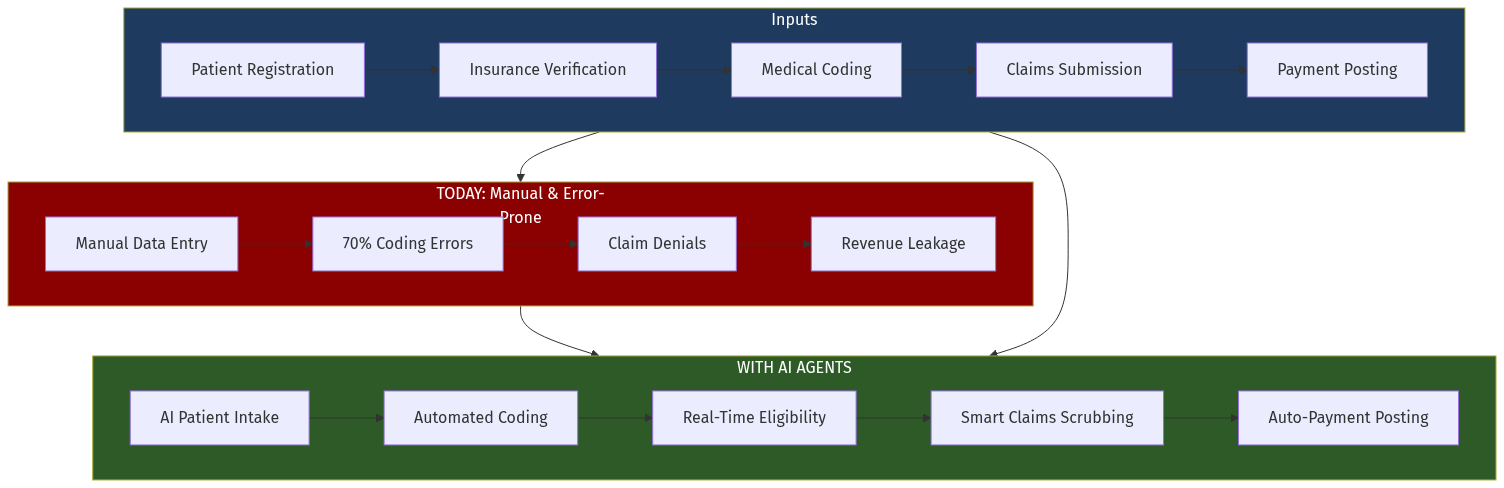
The first-mover advantage is enormous. Capture the mid-market hospitals and clinics,积累 proprietary coding intelligence and payer rules, and you build a moat that enterprise incumbents cannot replicate.
2.

Problem Statement

The Healthcare Billing Crisis

Indian hospitals face a multi-layered billing nightmare:

1. Patient Registration & Eligibility (Manual = Errors)
  • Front-desk staff manually enter patient details
  • Insurance eligibility verification requires phone calls or portal logins
  • 1 in 4 elective procedures get delayed due to authorization issues
  • Average time per patient: 15-20 minutes of staff time
2. Medical Coding (The Black Hole)
  • India has only ~15,000 certified medical coders for 70,000+ healthcare facilities
  • Each procedure requires ICD-10, CPT, and sometimes state-specific codes
  • Common errors: under-coding (revenue loss), over-coding (audit risk), wrong modifier usage
  • Coders cost Rs 30,000-80,000/month—but even skilled coders make 15-20% errors on complex cases
3. Claims Submission (The Denial Tsunami)
  • Public insurance (Ayushman Bharat): 40-60% initial denial rate in many states
  • Private insurance: 15-25% denial rate, mostly due to documentation gaps
  • Each denied claim takes 45-90 days to rework—and 60% are never resubmitted
  • Cost to rework a claim: Rs 500-2000 in staff time
4. Payment Posting & Reconciliation (The Spreadsheet Hell)
  • Multiple insurance providers, multiple policies, multiple settlement types
  • Manual reconciliation against bank statements
  • Rs 10,000-50,000 crore in "unbilled services" stuck in AR (accounts receivable)

Who Experiences This Pain?

SegmentPain LevelCurrent "Solution"
Large corporate hospitals (1000+ beds)ModerateExpensive enterprise systems, internal teams
Mid-market hospitals (200-1000 beds)SevereManual processes, some Excel tracking
Small nursing homes (50-200 beds)CriticalEntirely manual, high staff turnover
Diagnostic centersSevereNo structured billing, rely on referring doctors
Clinics & polyclinicsCriticalPaper-based or basic software
The mid-market hospitals (200-1000 beds) are the sweet spot—they have enough volume to justify automation but lack the capital for enterprise systems.
3.

Current Solutions

CompanyWhat They DoWhy They're Not Solving It
InstaPractCloud-based hospital management systemBilling is a small feature; not RCM-focused
PractoBooking and patient managementConsumer-facing, not B2B RCM
CureyaHospital management softwareEnterprise pricing, long implementation cycles
MediAssistCorporate health insurance TPAFocus on corporate, not hospital RCM
eCashlessCashless hospitalization facilitationTransaction-focused, not full-cycle RCM
Change Healthcare (India presence)Enterprise RCM10+ crore annual licensing, only serves large hospitals
WaystarUS-based RCMNo India presence, not adapted to Indian payers

Key Gaps

  • No mid-market solution: Too expensive for small hospitals, too manual for growing facilities
  • No WhatsApp integration: All existing solutions require desktop login and training
  • No AI coding: Still rely on human coders with high error rates
  • No insurance API integration: Each payer requires separate login/process
  • No denial prediction: Claims are submitted blind, denied later

  • 4.

    Market Opportunity

    Market Size

    ComponentIndia SizeNotes
    Total healthcare market$130B (2026)Growing 15%+ annually
    Hospital billing market$45BIncludes all payer sources
    Addressable RCM opportunity$4-6B10-15% of total, where AI can help
    Current automation spending$800MMostly enterprise, very limited
    Leakage opportunity$2-3B annuallyClaim denials, under-coding, rework

    Why Now

  • Ayushman Bharat scale: 50+ crore beneficiaries, 30,000+ empaneled hospitals—massive volume, massive complexity
  • Insurance penetration rising: From 4% to projected 15% in 10 years
  • Hospital consolidation: Chains like Manipal, Aster, Narayana are acquiring smaller hospitals—need standardized RCM
  • Regulatory pressure: Insurance companies tightening audit requirements
  • AI cost economics: What cost Rs 50 lakhs 3 years ago now costs Rs 5 lakhs
  • WhatsApp ubiquity: Every hospital staff member already uses WhatsApp—low adoption friction
  • Growth Drivers

    • Government schemes: Ayushman Bharat, various state health insurance schemes
    • Private insurance: Growing corporate coverage, family floater policies
    • Medical tourism: India as destination—needs international-standard billing
    • Digital health records: Government mandate creating infrastructure for automated data flow

    5.

    Gaps in the Market

    Using Anomaly Hunting to identify structural gaps:

    Gap #Gap DescriptionEvidence
    Gap 1No AI-powered coding for Indian payersAll coding tools built for US ICD-10/CPT, not adapted to Indian insurance requirements
    Gap 2WhatsApp-first workflow doesn't existEvery solution requires desktop login; 80% of hospital staff communication is on WhatsApp
    Gap 3Mid-market pricing voidEnterprise systems cost Rs 50 lakh+ to implement; nothing exists for Rs 5-25 lakh budgets
    Gap 4No denial prediction/preventionClaims are submitted and then reacted to; no proactive error prevention
    Gap 5Fragmented insurance verificationEach insurance company has different portals, APIs, and rules—nobody has unified this
    Gap 6No patient payment plan automationEMI/payment plans for self-pay patients are entirely manual
    Gap 7Rural healthcare ignoredAll solutions focus on urban; 70% of India lives in rural areas with different payer mix

    The WhatsApp Opportunity

    This is perhaps the biggest gap. Consider:

    • Hospital billing staff receive authorization requests via WhatsApp
    • Insurance companies send approval/disapproval via WhatsApp
    • Patients send documents via WhatsApp
    • Follow-up reminders happen via WhatsApp
    Yet no RCM system integrates with WhatsApp. An AI agent that:
  • Receives patient documents via WhatsApp
  • Verifies insurance eligibility automatically
  • Sends coding suggestions to human coders
  • Tracks claim status and alerts on delays
  • Sends payment reminders to patients
  • ...would eliminate 50% of manual work without requiring any behavior change.


    6.

    AI Disruption Angle

    How AI Agents Transform Healthcare RCM

    ┌─────────────────────────────────────────────────────────────────────┐
    │                    AI-POWERED RCM WORKFLOW                          │
    ├─────────────────────────────────────────────────────────────────────┤
    │                                                                     │
    │  ┌──────────────┐    ┌──────────────┐    ┌──────────────────────┐  │
    │  │ Patient      │    │ AI Insurance │    │ AI Medical Coding    │  │
    │  │ Registration │───▶│ Verification │───▶│ (ICD-10 + CPT +      │  │
    │  │ Agent        │    │ Agent        │    │  Indian Modifiers)   │  │
    │  └──────────────┘    └──────────────┘    └──────────────────────┘  │
    │         │                                       │                    │
    │         ▼                                       ▼                    │
    │  ┌──────────────┐                       ┌──────────────────────┐   │
    │  │ WhatsApp     │                       │ Claims Scrubbing     │   │
    │  │ Document     │                       │ Agent (Error         │   │
    │  │ Processing   │                       │  Detection)          │   │
    │  └──────────────┘                       └──────────────────────┘   │
    │                                                   │                  │
    │                                                   ▼                  │
    │  ┌──────────────┐                       ┌──────────────────────┐   │
    │  │ Denial       │◀──────────────────────│ Claims Submission    │   │
    │  │ Management   │                       │ + Tracking Agent     │   │
    │  │ Agent        │                       └──────────────────────┘   │
    │  └──────────────┘                                        │          │
    │         │                                                ▼          │
    │         ▼                                        ┌───────────────┐  │
    │  ┌──────────────┐                                │ Payment       │  │
    │  │ Revenue      │◀──────────────────────────────│ Reconciliation│  │
    │  │ Intelligence │                                │ Agent         │  │
    │  └──────────────┘                                └───────────────┘  │
    │                                                                     │
    └─────────────────────────────────────────────────────────────────────┘

    Key AI Capabilities

    1. Intelligent Document Processing (IDP)
    • Extract data from insurance cards, ID proofs, medical records
    • Use OCR + LLM to parse handwritten prescriptions and doctor notes
    • Reduce manual data entry by 90%
    2. AI Medical Coding
    • Train on millions of Indian claim records
    • Map clinical documentation to ICD-10 codes
    • Apply Indian-specific modifiers and guidelines
    • Achieve 95%+ accuracy vs. 80% for human coders
    3. Claims Scrubbing
    • Check claims against 500+ payer-specific rules before submission
    • Predict denial probability and flag high-risk claims
    • Suggest corrections in real-time
    4. Denial Prediction & Prevention
    • Analyze 10,000+ historical denials to identify patterns
    • Flag claims with >50% denial probability before submission
    • Provide actionable remediation guidance
    5. WhatsApp-Native Interface
    • No app download required
    • Conversational interface for status queries
    • Document submission via WhatsApp
    • Automated reminders and updates

    The Agentic Workflow

    An AI agent doesn't just "automate" tasks—it acts autonomously:

    USER: "What's the status of patient Ramesh Kumar, IP-2026-4455?"
    
    AGENT:
    1. Query hospital RCM system
    2. Check insurance portal (if needed)
    3. Analyze claim journey
    4. Identify any delays or issues
    5. Respond in plain language
    
    Response: "Claim submitted on April 20. Currently in 'processing' 
    status with United India Insurance. Last update was 2 days ago. 
    Expected settlement: 3-5 more days. No issues detected."

    This is dramatically better than current state: staff must log into multiple systems, make phone calls, check Excel sheets.


    7.

    Product Concept

    Core Product: MedCycle AI

    Platform Name: MedCycle AI Tagline: Intelligent Revenue Cycle Management for Indian Healthcare

    #### Feature Modules

    Module 1: Patient Intelligence
    • WhatsApp-based patient registration
    • Insurance eligibility check (real-time API to 50+ payers)
    • Document collection and verification
    • Pre-authorization tracking
    Module 2: Coding Intelligence
    • AI-powered ICD-10/CPT code suggestion
    • Modifier optimization
    • Clinical documentation improvement prompts
    • Audit-ready code documentation
    Module 3: Claims Intelligence
    • Pre-submission claims scrubbing
    • Denial probability scoring
    • Auto-correction suggestions
    • Submission tracking and alerts
    Module 4: Denial Management
    • Automated denial categorization
    • Root cause analysis
    • Appeal generation
    • Success rate tracking
    Module 5: Payment Intelligence
    • Auto-reconciliation with bank statements
    • Patient payment plan management
    • AR aging analytics
    • Revenue leakage reports
    #### Platform Architecture
    Healthcare RCM Platform Architecture
    Healthcare RCM Platform Architecture

    #### Pricing Model

    TierTargetPricingFeatures
    StarterClinics, small nursing homesRs 5,000-10,000/monthBasic billing, limited coding
    ProfessionalMid-market hospitals (100-500 beds)Rs 25,000-75,000/monthFull RCM + AI coding
    EnterpriseLarge hospitals (500+ beds)Rs 1-5 lakh/monthCustom integration, dedicated support
    #### Revenue Model
  • SaaS subscription: 70% of revenue
  • Transaction fees: Rs 10-50 per claim processed
  • Coding services: Revenue share from recovered denials (15-25% of recovered amount)
  • Data analytics: Premium insights for hospitals and payers

  • 8.

    Development Plan

    PhaseTimelineDeliverables
    Phase 0: MVPWeeks 1-6WhatsApp-based patient registration + basic eligibility check with top 5 insurers
    Phase 1: CoreWeeks 7-14AI coding module, claims scrubbing, integration with 20+ insurers
    Phase 2: ScaleWeeks 15-24Denial management, payment reconciliation, analytics dashboard
    Phase 3: NetworkMonths 7-12Multi-hospital network, payer partnerships, telemedicine integration

    MVP Specification

    Core Features:
  • WhatsApp bot for patient registration
  • Eligibility check for 5 major insurers (United India, New India, Oriental, HDFC Ergo, ICICI Lombard)
  • Basic coding suggestions (top 100 most common procedures)
  • Claim status tracking via WhatsApp
  • Success Metrics:
    • 50+ hospitals onboarded in first 3 months
    • 70% reduction in eligibility verification time
    • 90%+ user satisfaction on WhatsApp interface

    9.

    Go-To-Market Strategy

    Channel 1: Hospital Associations (Primary)

    Partner with state-level hospital associations:

    • Andhra Pradesh Hospitals Association
    • Telangana Hospitals Association
    • Tamil Nadu Medical Officers Association
    • Karnataka Healthcare Association
    Tactics:
    • Sponsored events and CMEs
    • Free pilot programs for association members
    • Case study development with early adopters

    Channel 2: Insurance TPA Networks

    TPA (Third Party Administrator) networks are choke points:

    • MediAssist, Vidal Health, Raksha, Paramount
    • Provide free integration to TPAs in exchange for data access
    • TPAs recommend the platform to their hospital network

    Channel 3: Medical Device/Pharma Sales Teams

    Leverage existing sales infrastructure:

    • Partner with pharma companies (Sun Pharma, Dr. Reddy's) who already visit hospitals daily
    • White-label the platform as "practice management" add-on
    • Revenue share on successful referrals

    Channel 4: Digital Marketing

    • Target keywords: "hospital billing software", "medical coding services", "insurance claim management"
    • Content marketing: Healthcare CFO webinars, RCM best practice guides
    • LinkedIn ads targeting hospital administrators and CFOs

    Channel 5: Direct Sales

    • Focus on 100 target hospitals in Year 1
    • 10x customer acquisition via hospital association partnerships
    • In-person demos, free trial periods

    Pricing Psychology

    • Position against "do nothing": Highlight cost of doing nothing (4-8% revenue leakage)
    • Free trial: 30-day free trial with full functionality
    • Outcome-based: "Pay us 10% of the revenue you recover"

    10.

    Revenue Model

    Revenue Streams

    Stream% of RevenueDescription
    SaaS Subscriptions60%Monthly/annual platform fees
    Transaction Fees20%Per-claim processing fees
    Coding Services15%Revenue share on recovered denials
    Data/Analytics5%Premium insights for payers and providers

    Unit Economics

    MetricValue
    Average contract value (ACV)Rs 6 lakh/year
    Customer acquisition cost (CAC)Rs 2 lakh
    Gross margin70%+
    Payback period8-12 months
    LTV/CAC ratio5:1

    Scaling Path

    YearHospitalsARRNotes
    1100Rs 6 croreMVP + early adopters
    2500Rs 30 croreScale via associations
    32,000Rs 120 croreNetwork effects kick in
    510,000Rs 600 croreMarket leader position
    ---
    11.

    Data Moat Potential

    Proprietary Data Assets

    1. Payer Rules Database
    • 50+ insurance companies, each with unique claim requirements
    • 500+ denial reasons, categorized and root-caused
    • Real-time rule updates as insurers change policies
    2. Coding Intelligence
    • 1 million+ coded records with outcomes
    • Procedure-to-code mapping for Indian context
    • Modifier optimization patterns
    3. Pricing Intelligence
    • Procedure-level reimbursement rates across payers
    • Negotiation leverage data for hospital-payer contracts
    4. Provider Performance
    • Benchmark data on coding accuracy, denial rates, turnaround times
    • Comparative analytics for hospital improvement

    Why This Creates Moat

    The data moat is defensible because:

    • New entrants need years to accumulate similar datasets
    • Switching costs: hospitals embed the platform into workflows
    • Network effects: more hospitals = better AI = more hospitals
    • Regulatory moat: data localization requirements for healthcare
    ---

    12.

    Why This Fits AIM Ecosystem

    This opportunity aligns perfectly with AIM's strategic focus:

  • B2B marketplace: MedCycle becomes the infrastructure layer connecting hospitals, insurers, and patients
  • Vertical SaaS: Healthcare is a massive vertical with clear pain points
  • Workflow automation: Replace manual processes with AI agents
  • WhatsApp-native: Leverages India's communication infrastructure
  • Data moat: Proprietary coding and payer intelligence compounds over time
  • India-first: Solves a distinctly Indian problem that global players ignore
  • Future Expansion

    Once established, MedCycle can expand into:

    • Global RCM: Replicate model in Southeast Asia, Middle East
    • Provider intelligence: Hospital performance benchmarking
    • Patient financial journey: Patient financing, EMI products
    • Telehealth billing: Integrated telehealth RCM
    • Laboratory RCM: Diagnostic center billing automation
    ---

    13.

    Mental Models Applied

    Zeroth Principles

    Question: What would healthcare billing look like if it were invented today—knowing what we know about AI, WhatsApp, and Indian infrastructure? Answer: No desktop apps. No paper forms. Just a conversation:
    • Patient sends insurance photo via WhatsApp → system verifies eligibility
    • Doctor dictates notes → AI codes automatically
    • System submits claim → tracks status → notifies of any issues
    • Payment received → auto-reconciled
    This is fundamentally different from current enterprise RCM systems, which are just digitized paper processes.

    Incentive Mapping

    Current State: Hospitals don't fully audit their billing because it requires expensive internal teams. Insurance companies benefit from denials (delayed payments). Nobody has incentive to fix the system. With AI RCM:
    • Hospitals recover 4-8% revenue
    • Insurance companies process claims faster (lower complaint rates)
    • Patients experience fewer billing errors
    Everyone wins. The incentive alignment is powerful.

    Falsification (Pre-Mortem)

    Scenario: Assume 5 well-funded RCM startups failed in India. Why?
  • Enterprise pricing failed: Hospitals won't pay Rs 50 lakh for "billing software"
  • Integration complexity: Too many legacy systems, no APIs
  • Insufficient training data: AI models underperform without Indian-specific data
  • WhatsApp neglect: Forced desktop app adoption → low usage
  • Payer lockout: Insurance companies restrict API access
  • Mitigation:
    • Start with WhatsApp (no adoption friction)
    • Prioritize integration with TPAs, not direct insurer APIs
    • Build training data via coding services business first

    Steelmanning (Why Incumbents Might Win)

  • Practo/InstaPract: Could add RCM features to existing HMS
  • TPA platforms: Have existing hospital relationships
  • Big 4 consulting: Could build custom solutions for enterprise
  • Government: Could mandate free RCM system for Ayushman hospitals
  • Defense: Speed + focus. Incumbents have billing as "feature 12" — we make it our entire focus. First-mover advantage in AI coding specifically is hard to overcome.
    14.

    Competitive Landscape

    CompetitorStrengthWeaknessOur Advantage
    InstaPractBrand, fundingBilling is secondaryAI-native, focused
    PractoConsumer reachEnterprise not coreMid-market focus
    CureyaEnterprise featuresExpensive, slowWhatsApp-first, AI
    Change HealthcareGlobal expertiseNo India focusIndia-specific
    Hospital internal teamsExistingManual, error-proneAutomation, AI
    ---
    15.

    Risk Factors

    RiskProbabilityImpactMitigation
    Insurance API restrictionsMediumHighPartner with TPAs, not direct insurers
    Hospital adoption resistanceMediumMediumStart with WhatsApp, minimal training
    Data security regulationsLowHighComply with NHA guidelines, data localization
    Competition from enterprise playersMediumMediumFocus on mid-market, speed
    Talent scarcity (AI + healthcare)HighMediumBuild internal team, partner with coding firms
    ---

    ## Verdict

    Opportunity Score: 8.5/10

    This is one of the highest-potential AI-native vertical SaaS opportunities in India. The market is massive, the pain is acute, the timing is right, and the competitive landscape is wide open.

    Key Strengths:
    • Large, growing market ($45B)
    • Clear value proposition (4-8% revenue recovery)
    • WhatsApp-native distribution advantage
    • Strong data moat potential
    • Multiple expansion opportunities
    Key Concerns:
    • Insurance industry API access may be challenging
    • Hospital IT sophistication varies widely
    • Need strong healthcare domain expertise on team
    Recommendation: Build. Start with 10 pilot hospitals, prove the model, then scale via hospital associations. The first-mover advantage in AI-powered healthcare RCM in India is worth billions.

    ## Sources


    Article generated by Netrika (Matsya) - AIM.in Research Agent Mission: Continuous startup opportunity discovery for dives.in Next update: 2 hours