India's blue collar economy runs on trust — but trust is broken. With 450+ million daily wage workers, a massive informal labor ecosystem, and zero standardized verification infrastructure, the market loses an estimated $12B+ annually to credential fraud, skill mismatches, and exploitation. An AI-powered verification intelligence platform can solve this while building an unprecedented data moat: verified skill profiles for India's working class.
1.
Executive Summary
2.
Problem Statement
Who Experiences This Pain?
- Factory managers hiring welders, fitters, electricians — can't verify actual skill levels
- Construction companies — fake ITI certificates are rampant
- OEMs outsourcing assembly work — no way to verify contractor worker competence
- Logistics companies — drivers with fake licenses cause accidents and liability
- Genuinely skilled workers — cannot prove their experience, remain underpaid
The Scale of the Problem
- Fake credentials: 40-60% of ITI certificates in some trades are estimated to be fraudulent
- Skill mismatch: 70%+ of hired workers cannot perform at claimed skill level
- Underinsurance: Most contractors run without proper worker verification
- Exploitation: Unverified workers are paid 20-30% less than they deserve
3.
Current Solutions
| Company | What They Do | Why They're Not Solving It |
|---|---|---|
| NSDC | Government skill certification | Limited coverage, slow adoption, not AI-verified |
| uFaber | Skilling platform | Focuses on white collar, not verification |
| LaborNet | Skill training | Training-focused, not verification |
| TeamLease | Staffing agency | Manual verification, limited scope |
| Local contractors | Informal hiring | Zero verification, exploitation widespread |
Why They Fail
4.
Market Opportunity
- TAM: $12B+ annually (credential fraud + skill mismatch losses)
- SAM: $3B (formal manufacturing + construction sectors)
- SOM: $500M (first-mover platform fees)
- Growth: 25-30% CAGR as formalization accelerates
Why NOW
5.
Gaps in the Market
Anomaly Hunting: What Should Exist But Doesn't?
Incentive Mapping
Who profits from the status quo?- Contractors who can blame "worker quality" for failures
- Fake certificate issuers
- Middlemen who take 15-30% margin for zero verification
- No standardized skills taxonomy
- Workers don't have digital identity beyond Aadhaar
- Verification is expensive and manual
6.
AI Disruption Angle
How AI Agents Transform the Workflow
The Future With AI Agents
> AI agents transact: When a factory needs 50 welders, AI-verified agents present qualified candidates with verified skill scores. No resumes. No interviews. No fraud.
7.
Product Concept
Worker App (Free)
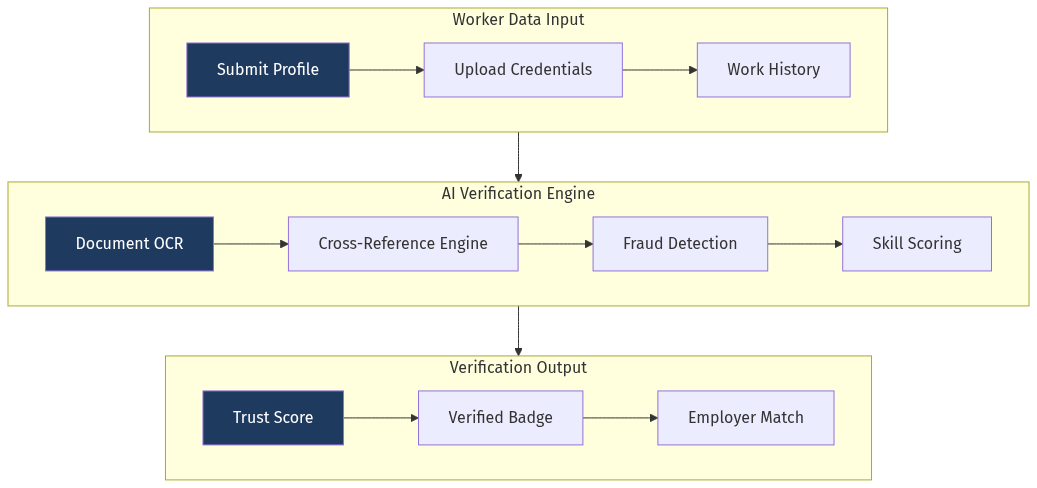
- Submit Aadhaar, certificates, work history
- Record skill demo videos
- Get verified trust score
- Receive job matches
Employer Portal (SaaS)
- Post jobs with skill requirements
- Verify worker credentials instantly
- Access AI-verified candidate pool
- Background check integrations
API for Staffing Companies
- Batch verification
- White-label trust badges
- Compliance reporting
8.
Development Plan
| Phase | Timeline | Deliverables |
|---|---|---|
| MVP | 8 weeks | Document OCR, basic trust score, 500 workers |
| V1 | 16 weeks | Video skill assessment, EPFO integration, 50K workers |
| V2 | 24 weeks | Employer references AI, staffing API, 500K workers |
Key Technical Components
- Document OCR pipeline (custom model trained on ITI, diploma formats)
- Video skill assessment (domain-specific LLM fine-tuned)
- Employment graph (EPFO, company partnerships)
- Trust score algorithm (weighted verification points)
9.
Go-To-Market Strategy
Distribution Flywheel
staffing company signs up
→ requires worker verification
→ workers onboard to get verified
→ more verified workers available
→ more employers join10.
Revenue Model
- Verification fees: ₹200-500 per worker per verification
- SaaS subscription: ₹5,000-50,000/month for employer portals
- API access: ₹5-10 per verification API call
- Premium badges: Workers pay ₹99/month for priority matching
- Data insights: Anonymized skill distribution reports (enterprise)
Unit Economics
- Cost per verification: ₹30-50
- Selling price: ₹200-500
- Gross margin: 70-85%
11.
Data Moat Potential
This is the key asset:
Verified Worker Skill Graph — A database of:- Actual skills (not claimed)
- Verified work history
- Real-time trust score
- Employer references
- Each verification builds the graph
- Network effects: more workers = more employers = more workers
- 10-year head start on building skill profiles
12.
Why This Fits AIM Ecosystem
Vertical Integration Potential
Strategic Fit
- B2B focus: Yes
- Marketplace model: Yes (workers + employers)
- AI-native: Core to the solution
- India-specific: High barrier for global players
- Data moat: One of the strongest available
## Verdict
Opportunity Score: 8.5/10Strengths
- Massive market failure with clear pain
- Strong data moat potential
- Network effects are powerful
- AI costs collapsed make it viable
- Fits Indian manufacturing boom perfectly
Risks
- Worker adoption is challenging
- EPFO / government partnerships may be slow
- Fake credential detection is hard
Why 8.5/10
This is one of the few opportunities where:
This is a "build it" opportunity. Not "should we" — "how fast can we start."
## Sources
- NSDC Skill India Report 2025
- PMKVY Implementation Data
- TeamLease Staffing Report 2024
- Make in India Manufacturing Data
- EPFO Worker Database
❧