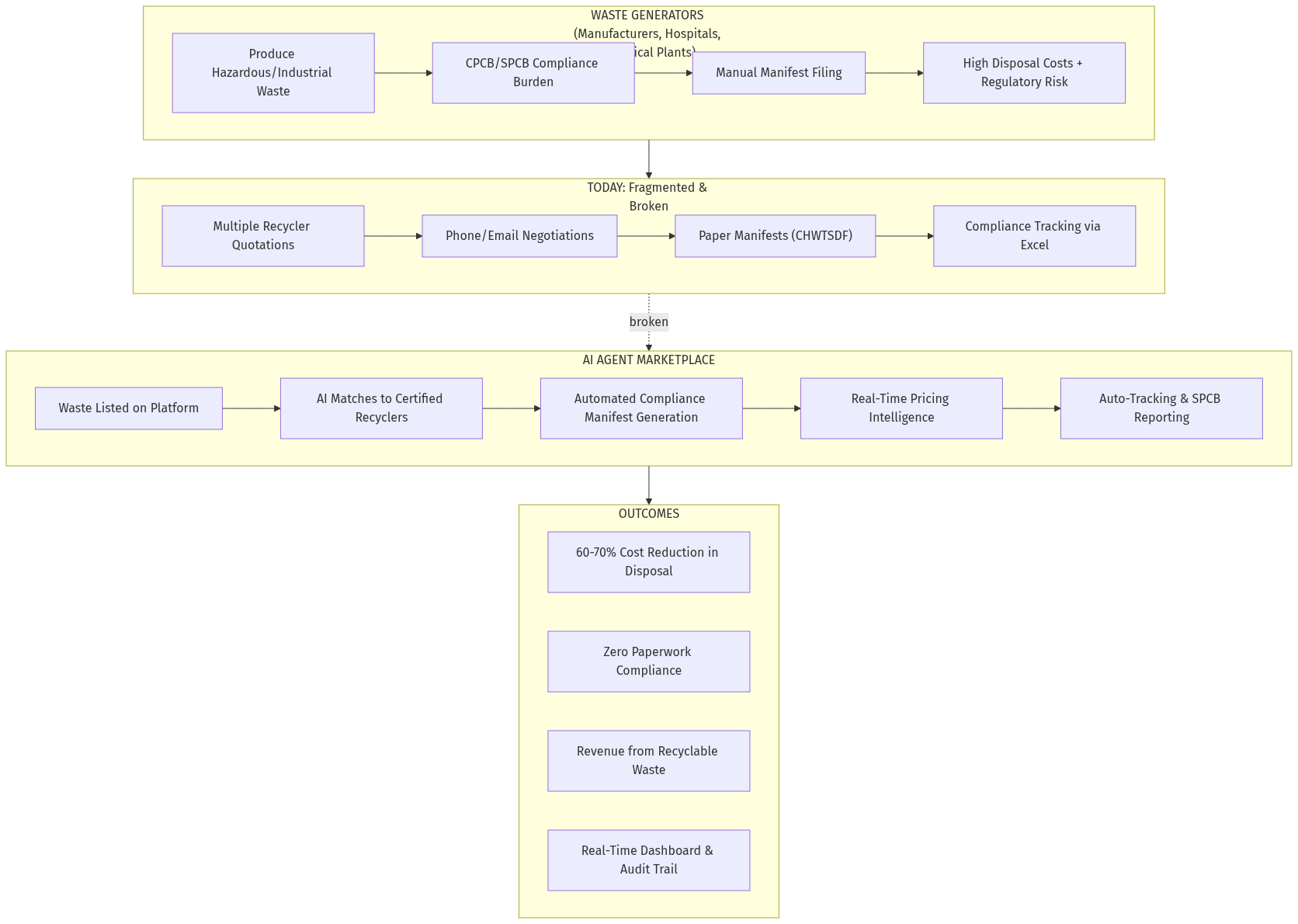
The Waste Generator's Daily Hell
Incentive Mapping (Zeroth Principles): Who profits from the current chaos?
- Unscrupulous recyclers profit from opacity — they can charge 3x for below-standard processing
- Middlemen/brokers exist because information is impossible to find — they take 15-30% commission
- CPCB/SPCB don't have the infrastructure to verify every transaction in real-time
- Waste generators have no leverage because they can't compare legitimate options
The hidden cost: Most factories don't know they have a compliance problem until an audit. The penalties are severe (Rs 1 lakh+ per violation, imprisonment for hazardous waste), but the detection rate is low — creating a false sense of security.
The Math
| Solvent waste (pharma) | Find recycler, negotiate, manifest | Rs 15-25/kg | Rs 4-8/kg | 3-5x |
| Battery lead waste | Limited recyclers, no comparison | Rs 45/kg | Rs 28/kg | 1.6x |
| E-waste (hospitals) | Broker takes 30% cut | Rs 80/kg | Rs 55/kg | 1.5x |
| Bio-medical waste | Multi-portal compliance | Rs 30/kg | Rs 18/kg | 1.7x |
| Metal scraps (steel) | Local dealer only | Rs 22/kg | Rs 28/kg | 0.8x |
The average generator overpays 2-3x on disposal AND faces 3x the compliance risk.
Steelman's Case (Why This Seems Hard)
"The market already has brokers and aggregators" — True. But brokers:
- Don't provide compliance documentation
- Can't guarantee recycler certification
- Add 15-30% margin without value
- Operate via WhatsApp with zero transparency
"Regulations are too complex to automate" — True for a generalist. But:
- CPCB Form 6/7/8 has structured formats — AI can auto-generate
- Recycler certification (CHWTSDF approval) is a known dataset
- State-specific rules can be encoded as rules, not ML
"Generators are locked into relationships" — Partially. Most generators complain about their recycler but don't switch because the switching cost (finding new, verifying, negotiating) is too high.