ResearchSaturday, April 25, 2026

AI-Powered SME Procurement: The $380 Billion Opportunity in B2B Purchasing Automation

Indian SMEs lose 15-25% of procurement value to price opacity, manual processes, and supplier fragmentation. An AI agent layer can fix this — and capture the largest untouched B2B marketplace on the planet.

1.

Executive Summary

B2B procurement for small and medium enterprises (SMEs) in India is broken. Buyers call suppliers on the phone, wait for WhatsApp quotes, compare in Excel, and have zero visibility into delivery status. This isn't a minor inconvenience — it's a $380 billion annual problem that AI agents are perfectly positioned to solve.

The opportunity isn't just automating a workflow. It's building a transaction layer between buyers and suppliers where AI agents negotiate, compare, order, and pay on behalf of human businesses. This is the logical next evolution of B2B commerce — and it's nearly entirely unaddressed in India.

2.

Problem Statement

The zeroth principle: We assume that B2B purchasing requires human judgment at every step. It doesn't.

Today's SME procurement workflow looks like this:

  • Owner or procurement staff spends 2-4 hours per purchase order calling 3-5 suppliers
  • They wait for quotes via WhatsApp or email (usually 24-48 hours)
  • They compare prices manually in a spreadsheet or notepad
  • They negotiate via phone — often with incomplete price information
  • They have no idea when the order will arrive
  • Payment happens manually, often with no digital trail
Who experiences this pain?
  • Manufacturing SMEs (50-500 employees) buying raw materials, components, consumables
  • Construction companies buying building materials, steel, cement
  • Restaurants and cloud kitchens buying perishables and supplies
  • Retailers restocking inventory from distributors
  • Any SME buying anything not on Amazon Business
The scale is staggering: India has 63+ million registered SMEs. Each spends an estimated INR 15-50 lakhs annually on procurement. That's INR 9.5-31.5 lakh crores. Most of it flows through phone calls and WhatsApp.
3.

Current Solutions

The existing landscape has players, but none fully solve the problem:

CompanyWhat They DoWhy They're Not Solving It
IndiaMARTProduct discovery / lead generationSuppliers don't respond reliably; no transaction layer
UdaanB2B e-commerce (specific categories)Limited categories; supplier lock-in; minimum order sizes
Amazon BusinessB2B marketplaceMostly consumer brands; limited for industrial/specific inputs
Procurement SaaS (SAP Ariba)Enterprise procurement softwareOnly for large enterprises; too expensive/complex for SMEs
MSME MartGovernment-backed sourcingLimited supplier network; poor UX; few transactions
The structural gap: IndiaMART is the closest thing to a national supplier directory, but it was built for lead generation, not transactions. Suppliers get enquiries they don't respond to. Buyers give up and call their existing supplier directly. The discovery-to-transaction gap remains enormous.
4.

Market Opportunity

  • Market Size: India B2B procurement market: ~$380 billion (SME segment alone). Global B2B e-commerce is projected to reach $20.9 trillion by 2027.
  • Growth: India's SME sector growing at 12-15% CAGR. Digital procurement adoption still under 8%.
  • Why Now:
- WhatsApp已是默认通信工具 — but no structured procurement layer above it - UPI payment infrastructure exists for instant settlement - AI agents are now capable of multi-turn negotiation, quote comparison, and order tracking - GPU costs dropped 90% since 2023 — agentic workflows are economically viable - IndiaMART's response rate problem is worsening, not improving
5.

Gaps in the Market

Applying Anomaly Hunting:
  • Price opacity is universal. No SME can tell if they're getting a competitive price. There's no "Google Flights" for industrial supplies.
  • Supplier fragmentation is the norm. A typical SME uses 50-200 suppliers, most of whom they've never met in person. Trust is established over years of phone calls.
  • No reverse auction layer. When buyers want competitive quotes, there's no structured mechanism. WhatsApp group bidding exists informally but isn't systematic.
  • Delivery tracking is nonexistent. After placing an order, buyers have zero visibility. A "procurement Uber" experience is nowhere.
  • Payment terms are opaque. Net-30/45/60 terms are negotiated verbally, documented nowhere, creating disputes.
  • Repeat orders are manual. 60-70% of SME purchases are replenishment orders — same items, same suppliers. This should be a subscription, not a phone call.

  • 6.

    AI Disruption Angle

    How AI agents transform procurement:

    Today vs. Tomorrow

    Workflow Shift
    Workflow Shift
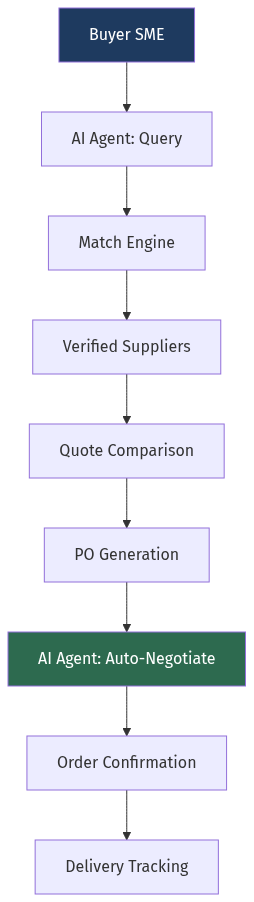
    The AI Procurement Agent Architecture:
    Agent Architecture
    Agent Architecture
    Key capabilities:
  • Intent understanding: Buyer says "I need 500 units of 6mm TMT bars delivered to my factory in Rajkot by April 30, budget up to 38 rupees per kg" — agent understands this and acts.
  • Supplier matching: Agent queries pre-verified supplier network, ranks by price, rating, delivery capability, proximity.
  • Automated negotiation: Agent sends quotes to multiple suppliers, runs a structured reverse auction, negotiates on buyer's behalf.
  • Order execution: Agent places order with winning supplier, tracks delivery in real-time, handles exceptions.
  • Payment automation: On delivery confirmation (photo evidence or API verification), agent releases payment via UPI.
  • Relationship memory: Agent remembers past orders, preferred suppliers, price history — becomes smarter over time.

  • 7.

    Product Concept

    Platform Name (for this analysis): ProcureAI

    A WhatsApp-first B2B procurement platform where AI agents transact on behalf of SME buyers and suppliers.

    Core Features

    For Buyers:
    • Natural language procurement: "I need X by date Y, budget Z"
    • Auto-quote comparison dashboard
    • Supplier rating and verification
    • Real-time order tracking
    • Auto-reorder for repetitive purchases
    For Suppliers:
    • Never miss a lead — AI responds to enquiries 24/7
    • Automated quote generation
    • Reverse auction participation
    • Digital payment settlement
    • Customer relationship management
    The WhatsApp Moat:
    • Buyers already on WhatsApp — no app download required
    • Conversational interface lowers adoption friction to near zero
    • Voice notes for dictating orders in local languages
    • Built-in payment via WhatsApp Pay / UPI links

    8.

    Development Plan

    PhaseTimelineDeliverables
    MVP6 weeksWhatsApp bot + 3 pilot categories (steel, cement, pipes) + 50 suppliers + 20 buyers. Manual quote collection initially.
    V110 weeksAI quote matching + supplier dashboard + basic order tracking + UPI payment integration
    V212 weeksAgentic negotiation engine + auto-reorder subscriptions + analytics dashboard
    V316 weeksMulti-language voice support + logistics integration + credit/insurance layer
    Tech Stack:
    • WhatsApp Business API (Kapso) for buyer interface
    • Next.js dashboard for supplier portal
    • PostgreSQL for transaction data
    • Temporal for workflow orchestration
    • Claude/GPT for NLP and negotiation logic
    • Razorpay + UPI for payments

    9.

    Go-To-Market Strategy

  • Pick one pin code, own it. Start in a manufacturing hub (e.g., Rajkot, Coimbatore, Ludhiana). Get 20 buyers and 30 suppliers. Get 100% of a small geography before expanding.
  • Recruit the "bridge" supplier. Find the most responsive, tech-friendly distributor in the target geography. They'll bring 10+ buyers and 5+ other suppliers as referrals.
  • Launch with repeat purchases. First buyers should be those buying the same things monthly (raw materials, packaging, consumables). High-frequency = fast habit formation.
  • Seed with price savings, not features. Show buyers their first 3 orders compared to their previous prices. 5-10% savings is shareable evidence.
  • Add suppliers via buyer pull. When 20 buyers ask for a category you don't have, suppliers call you. Let demand drive supply.
  • NPS surveys at order #5. Measure whether buyers would recommend. 50+ NPS = product-market fit signal. Below 30 = iterate or pivot.

  • 10.

    Revenue Model

    • Transaction fee: 1-3% on order value, charged to suppliers. Collected on successful delivery.
    • Premium subscriptions: Buyers pay INR 500-2000/month for AI negotiation, auto-reorder, priority matching.
    • Supplier visibility: Suppliers pay for "featured" placement in search results.
    • Data monetization: Anonymized procurement data has enormous value to manufacturers, investors, and market researchers. (Phase 3 only, opt-in.)
    • Finance layer: Offer working capital loans to suppliers based on verified transaction history. Take 2-3% facilitation fee.

    11.

    Data Moat Potential

    This is where the compounding advantage lies:

  • Price intelligence: Real transaction prices across categories and geographies — not quoted prices, actual paid prices.
  • Supplier reliability scores: On-time delivery rate, quality compliance, price consistency — aggregated across thousands of orders.
  • Buyer preference graphs: What they buy, when, from whom, at what price. Enables predictive procurement.
  • Category maps: Which products are frequently purchased together, enabling "complete order" recommendations.
  • Creditworthiness data: Verified transaction history is better than bank statements for SME lending.
  • The moat thickens with every transaction. New entrants face cold-start supplier verification problems that take years to solve.


    12.

    Why This Fits AIM Ecosystem

    AIM.in's thesis is "IndiaMART helps buyers ASK. AIM.in helps buyers DECIDE."

    ProcureAI is the definitive DECISION layer:

    • Decision: AI helps buyers decide who to buy from, at what price, with what terms
    • Discovery: Integrated with AIM's domain intelligence and company data
    • Verification: AIM's existing company/contact data powers supplier verification
    • Verticalization: ProcureAI can be spun out as category-specific verticals (steel.procure, cement.procure, food.procure) — matching AIM's vertical portal strategy
    The playbook: AIM builds the B2B discovery layer. ProcureAI builds the transaction layer. Together, they own the full BUY phase.

    ## Verdict

    Opportunity Score: 8.5/10

    This is a rare combination: massive market, clear problem, proven infrastructure (WhatsApp + UPI), and a new capability (AI agents) that makes the previously impossible suddenly possible.

    Why it scores high:
    • $380B SME procurement market with near-zero digital penetration
    • WhatsApp-first approach eliminates adoption friction entirely
    • AI negotiation is a genuine technical moat — hard to replicate quickly
    • Data moat compounds with every transaction
    • Revenue model is clean: transaction fee + premium subscriptions
    Why it doesn't score 10:
    • Supplier onboarding is slow and relationship-heavy
    • Payment disputes and delivery verification require operational investment
    • Logistics visibility (last-mile tracking) is a separate problem
    • Large buyers will have existing ERP/procurement systems — SME focus only
    The one-sentence pitch: "We put an AI procurement agent in every SME owner's WhatsApp."

    ## Sources