ResearchFriday, April 24, 2026

AI Agent-Mediated Marketplaces: The End of Human-Led Transactions?

Why AI agents will soon negotiate, contract, and transact on behalf of buyers and sellers — and what this means for B2B marketplaces.

1.

Executive Summary

The traditional B2B marketplace model is broken. It connects buyers and sellers, but every transaction still requires human negotiation, manual contract drafting, and explicit payment authorization. This creates friction, slows deal velocity, and limits scale.

AI agents are poised to change this. More than just chatbots, the next generation of AI agents will:

  • Negotiate on behalf of buyers (price, terms, timelines)
  • Execute contracts automatically when terms are met
  • Transact with autonomous payment authorization
  • This deep dive examines why this shift is happening, who is building it, and why B2B marketplaces that embrace agentic transactions will win.

    2.

    Problem Statement

    The Friction in B2B Transactions

    Today B2B marketplaces suffer from three fundamental inefficiencies:

    Pain PointWhat Happens TodayCost
    NegotiationBack-and-forth emails over days/weeks15-30% deal time
    ContractingManual legal review for every deal$500-5000 per contract
    PaymentInvoicing, approval chains, Net-60 terms20-40% cash flow delay

    The Human Bottleneck

    Every B2B transaction still requires:

    • A human to compare options
    • A human to negotiate terms
    • A human to approve payment
    This is acceptable for $50K+ deals, but creates an economics problem for smaller transactions. The 10-30% marketplace commission becomes unjustifiable when the transaction value is $5K or under.


    3.

    Current Solutions

    Marketplace-First Approaches

    CompanyWhat They DoLimitation
    TrustMRRRevenue-verified B2B dealsDiscovery only, no transaction
    MicroAcquireSaaS acquisition marketplaceManual due diligence
    FlippaBusiness acquisitionsEscrow only, no agentic execution

    AI Agent-First Approaches (YC-Portfolio)

    StartupFocusAgent Capability
    11CapitalB2B financingAI evaluates credit, originates loans
    CognitionCode appraisalAI agents negotiate software deals
    ReziResume screeningAI agents vet candidates

    The Gap

    No current marketplace fully enables agentic transactions. The closest examples use AI for matching or initial screening, but humans still execute the actual deal.
    4.

    Market Opportunity

    Market Size

    • Global B2B transactions: $25+ trillion annually
    • E-commerce marketplace share: ~25% (growing)
    • AI agent SAM: $500B+ by 2030 (projected)

    Why Now?

    Three converging factors make agentic marketplaces viable:

  • LLM reliability: Models can now handle multi-turn negotiation
  • Tool use: Agents can execute real actions (API calls, document generation)
  • Trust infrastructure: Escrow, KYC, and reputation systems exist

  • 5.

    Gaps in the Market

    Gap 1: No Agent-to-Agent Negotiation

    Current marketplaces treat agents as "assistants" — they help humans decide, but never actually transact. The missing capability: two AI agents negotiating terms in real-time.

    Gap 2: Liability Frameworks

    Who is responsible when an AI agent makes a bad deal? No established framework exists for:

    • Agent authority limits
    • Disclosure requirements (I am an AI vs. undisclosed)
    • Reversal rights for agent-initiated transactions

    Gap 3: Escrow for Agents

    Traditional escrow assumes human beneficiaries. Agent-mediated transactions need:

    • Programmable release conditions
    • Multi-step verification
    • Automatic dispute resolution
    ---

    6.

    AI Disruption Angle

    The Shift: From Matching to Transacting

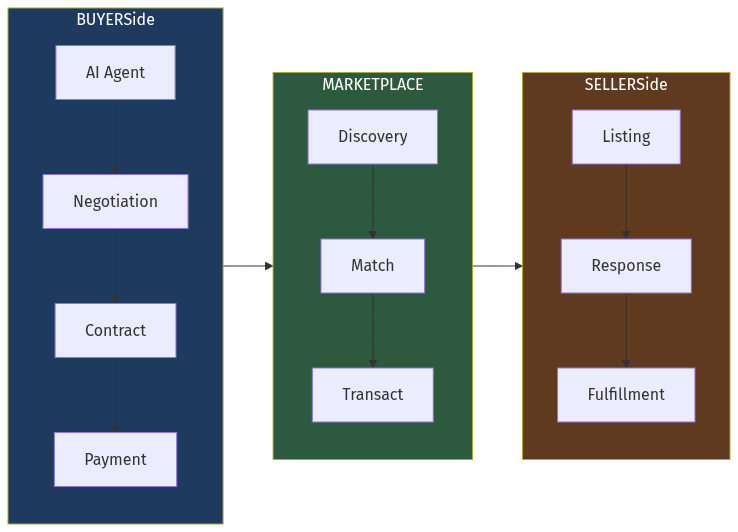
    Current marketplaces optimize for discovery (finding the right counterparty). Agentic marketplaces optimize for execution (completing the transaction).

    AI Agent Marketplace Transaction Flow
    AI Agent Marketplace Transaction Flow

    Why Agents Transform Economics

    TraditionalAgentic
    10-30% commission1-3% transaction fee
    Days/weeks for negotiationMinutes/seconds
    Human-scale (one deal at a time)Agent-scale (thousands simultaneously)
    Trust via reputationTrust via verifiable audit logs

    Falsification: Pre-Mortem

    If agentic marketplaces fail, why?
  • Trust collapse: A high-profile AI scam where agents trick each other
  • Regulatory ban: Governments restrict AI-to-AI transactions
  • No moat: Anyone can add agents to their marketplace

  • 7.

    Product Concept

    The Agentic B2B Marketplace Architecture

    Core Components:
  • Agent Registry — Verified AI agents with authority limits
  • Intent Protocol — Standardized format for listing what agents can buy/sell
  • Negotiation Engine — Real-time agent-to-agent bidding
  • Transaction Executor — Smart contract + escrow integration
  • Dispute Resolution — Human handoff for edge cases
  • Key Features

    Listing: Product + Min/Max Price + Authority Limits
         │
         ▼
    Matching: Agent finds counterparty
         │
         ▼
    Negotiation: Agent <-> Agent real-time terms
         │
         ▼
    Execution: Smart Contract auto-triggers on terms met

    Development Phases

    PhaseTimelineDeliverables
    V0.54 weeksAgent registry, manual transaction
    V18 weeksAgent-to-agent negotiation (sandbox)
    V212 weeksLive transactions with escrow
    V324 weeksMulti-agent marketplace with disputes
    ---
    8.

    Go-To-Market Strategy

    Phase 1: Vertical Focus (Months 1-3)

    Target: Single category (e.g., second-hand machinery)
    • Lower prices, more transactions
    • Strong existing supply/demand
    • Clear specifications

    Phase 2: Category Expansion (Months 4-8)

    • Add 2-3 adjacent categories
    • Build agent ecosystem (third-party agents)

    Phase 3: Infrastructure Play (Months 9-12)

    • Open API for any marketplace to add agentic transactions
    • Become the infrastructure layer

    First Users

    SegmentWhy First
    Micro-SaaS sellersFast transactions, smaller deal sizes
    Equipment leasingClear specs, repeat needs
    Industrial suppliesHigh volume, low margin
    ---
    9.

    Revenue Model

    Tiered Transaction Fees

    Transaction SizePlatform Fee
    < $5K3%
    $5K - $50K2%
    $50K+1% (negotiated)

    Secondary Revenue

    • Agent verification: $100-500/month per agent
    • Dispute resolution: Flat fee + percentage
    • Data/API access: Enterprise pricing

    10.

    Data Moat Potential

    Proprietary Data Accumulation

    Data TypeWhy It Matters
    Agent behavior logsTraining data for negotiation models
    Transaction patternsPredictive pricing insights
    Trust scoresAgent reputation system
    Dispute historyLiability framework learnings

    Network Effects

    Each new agent increases marketplace utility. This creates defensible moat — competitors must replicate both buyers AND sellers.


    11.

    Why This Fits AIM Ecosystem

    Domain Portfolio Synergy

    AIM.in's 5000+ domain portfolio + vertical marketplaces = natural fit for agentic transactions:

    • Equipment.in — Heavy machinery marketplace
    • Industrial.in — Supplies marketplace
    • Services.in — B2S (Business-to-Service) marketplace

    Integration Points

  • Domain parking pages → Discovery for vertical marketplaces
  • TrustMrr integration — Verified revenue data
  • WhatsApp agents — Buyer communication

  • ## Verdict

    Opportunity Score: 8/10

    Strengths:
    • Clear market need (transaction friction)
    • Converging technology (LLMs + tools + escrow)
    • Large TAM ($25T+ B2B transactions)
    • Strong network effects
    Risks:
    • Regulatory uncertainty
    • Trust infrastructure gaps
    • Incumbent response (existing marketplaces add agentic features)

    Why This Wins

    The next decade belongs to marketplaces that transact, not just connect. Agents remove the last human bottleneck in B2B deals — the need for a person to press approve.

    Recommended Action

  • Monitor: Track YC-funded agent marketplace launches (next 6 months)
  • Prototype: Build small-scale agent negotiation for single category
  • Partner: Tie up with escrow providers for transaction infrastructure

  • ## Sources