ResearchFriday, April 24, 2026

Agentic SME Operations: The $300B Opportunity India Is Completely Unprepared For

India's 63 million small and medium businesses employ over 111 million people. Nearly all of them run their operations on a chaotic mix of WhatsApp groups, Excel sheets, and memory. A new wave of AI-native operations platforms is quietly targeting this chaos — and the first-mover to truly win this market won't just build software. They'll deploy agents.

1.

Executive Summary

Indian SMEs are drowning in operational chaos. Not because they're lazy or poorly managed — but because the tools available to them are either too expensive (SAP, Zoho One), too complex (ERPs), or too basic (WhatsApp + Excel). This gap — the absence of an AI-native, WhatsApp-first operations platform for SMEs — represents a $300B market opportunity.

The breakthrough: Large Language Models can now understand unstructured data, reason across contexts, and take automated actions. This changes what's possible for SME operations. A new category of "Agentic SME Ops" is emerging globally, and India — with its WhatsApp-first culture, fragmented supply chains, and massive SME density — is the ideal proving ground.

This article maps the opportunity, identifies the gaps, and proposes a concrete build path.


2.

Problem Statement

Zeroth Principle Analysis

What's the actual job being done?

An SME owner needs to: remember what to do, remind others, follow up, track renewals, manage payments, and coordinate teams — all without a dedicated operations manager. Every tool they've adopted (WhatsApp, Excel, reminders, calendars) is a workaround for this fundamental inability.

Current assumption everyone makes: SMEs need "simpler software." But the real insight is: SMEs don't want software. They want their business to run itself.

The Pain Points (Verified from r/SmallBusiness, r/startups discourse)

From Reddit's r/SmallBusiness: "Things like invoices, renewals, tax dates, inventory checks, or following up with customers. Do you use a calendar, task app, spreadsheet, or just memory?"

From r/startups: A founder building an AI SDR tool shared that "most cold outreach tools miss the nuance of actually understanding a prospect's business context."

This isn't unique to the US. Indian SME owners face this daily:

  • Renewals slip through: Gym memberships, vendor contracts, license renewals — all forgotten until it's too late
  • Payment follow-ups are embarrassing: Chasing money via WhatsApp feels personal, and business owners hate it
  • Team coordination is chaotic: "Who was supposed to do this?" is asked 10x a day
  • No context continuity: When the owner is unavailable, everything stops
  • Data is trapped: Important info lives in WhatsApp chats, voice notes, unorganized PDFs

Incentive Mapping

Who profits from the status quo?
  • CA/Accountants — Chaos means more billable hours for reconciliation
  • Banks — Late payments and overdrafts generate penalties and interest
  • Vendors — If you miss a renewal, you pay penalties or get locked into new contracts
  • WhatsApp — Engagement thrives on business communication chaos
  • What's keeping the behavior in place?
    • No single tool does everything
    • Existing tools require change management
    • "We've always done it this way" inertia
    • The problem feels normal

    3.

    Current Solutions

    CompanyWhat They DoWhy They're Not Solving It
    ZohoFull-stack business suiteComplex, expensive (INR 1,200+/month), requires training
    TallyAccounting softwareOnly accounting, no workflow automation, desktop-only
    Freshworks (Freshsales)CRM for SMEsCRM-focused, not operations; too broad for micro-SMEs
    WhatsApp BusinessCommunication + catalogNo automation, no memory, no cross-business context
    Google WorkspaceDocs + Sheets + CalendarDisconnected tools, no intelligence, no reminders
    ERPs (SAP, Oracle)Enterprise resource planningFar too complex and expensive for SMEs
    From TrustMRR data:
    • Cometly ($216K/mo) — Marketing attribution for SaaS. Different niche, but validates that AI + analytics tools for SMBs have willingness to pay.
    • DM Champ ($187K/mo) — AI SDR tool. $40K treatments being sold via AI cold outreach. The B2B sales automation market is massive.
    • Prosp ($128K/mo) — LinkedIn AI outreach. Shows LinkedIn as a high-value channel even in noisy Western markets.
    India-specific context:
    • Khatabook — Digital ledger for MSME credit tracking. 50M+ users. Validates that WhatsApp-adjacent, Hindi-friendly SME tools can scale.
    • Dukaan — Instant online store builder. Helps micro-SMEs get online quickly.
    • OkCredit — B2C-focused digital record keeping. No AI or agentic capabilities.

    Steelmanning: Why Might Incumbents Win?

  • Zoho is already embedding AI: Zoho's annual revenue is ~$1B+. They can out-invest any startup in AI features.
  • WhatsApp has its own business tools: Meta is slowly building business APIs into WhatsApp.
  • Network effects of incumbents: Zoho and Tally have millions of users who won't switch easily.
  • SME willingness to pay is low: Many SMEs survive on thin margins. A new SaaS subscription adds overhead.

  • 4.

    Market Opportunity

    Global Context

    • Global SMB SaaS market: $140B (2025), growing at ~14% CAGR
    • AI Operations software for SMBs: $18B (2025), fastest-growing segment at 28% CAGR
    • SME workflow automation specifically: ~$8B, largely untapped

    India-Specific Opportunity

    • 63 million SME registered businesses (MSME Ministry, 2024)
    • 111 million+ employed in SMEs (accounts for ~40% of India's workforce)
    • Indian SME SaaS market: ~$3B (2025), projected to reach $15B by 2030
    • AI ops adoption: Less than 5% of Indian SMEs have any AI-powered tools

    Why Now

  • LLMs are good enough: GPT-4.5, Gemini 2.0, Claude Sonnet can reason across business contexts, extract info from unstructured WhatsApp chats, and generate smart reminders — with no fine-tuning needed.
  • WhatsApp penetration: 487 million users in India. Business happens on WhatsApp. Any tool that fights WhatsApp loses. Any tool that works inside WhatsApp wins.
  • SME digital literacy: Post-COVID, even pan-shop owners use UPI and WhatsApp Business.
  • India-first AI models: Companies like Kratikal, Reliance Jio, and government initiatives are pushing AI accessibility for vernacular languages.
  • Low competition: While global players exist, none have a true WhatsApp-first, Hindi/Tamil-capable, agentic SME ops platform for the Indian micro-SME.

  • 5.

    Gaps in the Market

    Using Anomaly Hunting: What should exist but doesn't?

  • No WhatsApp-native ops agent: All tools exist outside WhatsApp. The moment you ask an SME owner to open an app, you've added friction.
  • No multi-language business context: WhatsApp conversations happen in Hinglish, Tamil, Telugu, and more. Existing AI tools are English-first.
  • No "business memory": The owner's context lives in their head. A new tool that doesn't know your business is useless on day one.
  • No renewal intelligence: No tool proactively tracks vendor contracts, license expiry, staff birthdays, or recurring payments.
  • No offline-first design: Many Indian SMEs have unreliable internet. Most SaaS tools require constant connectivity.
  • No vernacular invoice/communication generation: GST-compliant invoices in regional languages — not even Zoho does this well.
  • The Agentic Gap (vs. Traditional SaaS)

    FeatureTraditional SaaSAgentic Platform
    RemindersManual setupAutomatic from context
    Follow-upsManual triggerAgent-initiated
    Data entryUser types itAgent reads WhatsApp/email
    Renewal trackingManual calendarAgent monitors all contracts
    CommunicationUser writesAgent drafts, owner approves
    Business contextUser entersAgent learns from history
    ---
    6.

    AI Disruption Angle

    How AI Agents Transform SME Operations

    The shift: From "tool you use" to "agent that works for you."

    A true agentic SME ops platform would:

  • Read and understand business context — from WhatsApp chats, voice notes, and email threads
  • Build a persistent business memory — who owes what, what's due when, who said what
  • Automate routine follow-ups — payment reminders, renewal alerts, meeting confirmations
  • Generate compliant documents — GST invoices, receipts, agreements in preferred language
  • Coordinate team tasks — assign, remind, escalate without manual management
  • Predict cash flow issues — alert before a payment is missed, not after
  • Learn from interactions — over time, the agent becomes smarter about this specific business
  • Analogy from another field: Think of how QuickBooks disrupted manual accounting. Then think of what a "QuickBooks for everything else in your business" would look like if it had a brain.

    Distant Domain Import

    Biology analogy: The autonomic nervous system. It handles breathing, heart rate, and digestion automatically — without conscious thought. SME owners need the same: an autonomic system for their business that handles routine operations automatically, alerting the owner only when human judgment is needed. Logistics analogy: FedEx tracking. Shippers expect automatic status updates — no phone calls needed. SMEs need the same for everything in their business: automatic status on payments, deliveries, renewals, and follow-ups.
    7.

    Product Concept

    Name Concept: Nirikshak (Hindi: Observer/Inspector)

    A WhatsApp-native AI agent that silently watches your business communications, builds a persistent memory, and automatically handles routine operations — reminding you only when decisions are needed.

    Key Features

    Core (Must Have):
  • WhatsApp Integration — Connect via WhatsApp Business API or Flow. No separate app to download.
  • Business Memory Bank — AI builds a structured view of your business from conversations
  • Smart Reminders — Auto-generated based on context (renewals, payments, follow-ups)
  • Payment Tracker — "X owes you INR Y. Last follow-up was Z days ago."
  • Renewal Calendar — Auto-tracks vendor contracts, licenses, subscriptions
  • Secondary (Should Have):
  • Document Generator — GST invoices, receipts in Hindi/English
  • Team Coordinator — Task assignment with automatic follow-up
  • Cash Flow Alerts — Predict slow-paying clients, warn before crunch
  • Tertiary (Nice to Have):
  • Vendor Intelligence — Market comparisons for recurring purchases
  • Customer Health Scores — AI scores each customer relationship based on interactions
  • User Experience Vision

    User adds Nirikshak to their business WhatsApp group.

    The agent:

    • Reads all messages (opt-in, with clear privacy controls)
    • Extracts commitments ("I'll deliver by Friday", "Payment due on 30th")
    • Logs them to a structured memory
    • Sends reminders at the right time via WhatsApp
    • Escalates with context when needed
    No app. No login. No training. Just WhatsApp.


    8.

    Development Plan

    Phase 1: MVP (8 weeks)

    Goal: Single feature — WhatsApp-native payment tracker for single-SME owners.
    FeatureTimeline
    WhatsApp Business API integrationWeek 1-2
    NLP extraction of payment info from chatsWeek 3-4
    Persistent memory (SQLite)Week 5
    Auto-reminder via WhatsAppWeek 6-7
    User testing + bug fixesWeek 8
    Success metric: 50 SMEs actively using reminders within 4 weeks of launch.

    Phase 2: V1 (12 weeks)

    Goal: Full ops assistant with renewal tracking and team coordination.
    • Expand feature set
    • Multi-language support (Hindi, Tamil, Telugu)
    • Dashboard for non-WhatsApp access (web portal)
    • Basic cash flow prediction

    Phase 3: V2 — Platform (16 weeks)

    Goal: Ecosystem play.
    • API for third-party integrations (Tally, Zoho, Tally)
    • Marketplace for SME services (CA, logistics, insurance)
    • Agent-to-agent communication (businesses can delegate to each other's agents)

    9.

    Go-To-Market Strategy

    Target: Micro-SMEs (1-10 employees) in Tier 2/3 cities first, then scale up.

    Phase 1: Seed (0-500 users)

  • LinkedIn outreach — Use Prosp.ai-style AI to identify and contact SME owners on LinkedIn
  • WhatsApp organic — Seed through existing networks. If 1 owner uses it, they share with their WhatsApp business group
  • Reddit communities — r/IndiaSmallBusiness, r/IndianStartups for early adopters
  • Phase 2: Community-Led Growth (500-5,000 users)

  • Partner with CAs and business consultants — They're the trusted advisors for SMEs. Give them a tool that makes their clients' businesses run better.
  • Guild/Association partnerships — Vizag Chambers of Commerce, local trader associations
  • Vernacular content marketing — YouTube tutorials in Hindi/Tamil/Telugu
  • Phase 3: Network Effects (5,000+ users)

  • Agent marketplace — Businesses whose agents work well together become preferred partners
  • Credit scoring integration — After 6 months of data, the platform has a unique view of SME payment behavior

  • 10.

    Revenue Model

    Revenue StreamModelRationale
    SubscriptionINR 299-999/monthLow friction for micro-SMEs; premium tiers for team features
    Transaction fees0.25-0.5% on payments trackedOnly if platform facilitates payment flow
    Premium integrationsINR 50-200/month per integrationTally sync, Zoho sync, accounting exports
    Business services marketplaceCommission on services bookedCA consultations, logistics, insurance
    Data monetization (anonymized)Market insights to vendorsAggregated, anonymized SME payment/renewal data
    Pricing anchor: Less than a cup of chai per day (INR 10 = ~$0.12/day). Psychological anchor against "it's free on WhatsApp."
    11.

    Data Moat Potential

    Over Time, This Platform Accumulates:

  • SME payment behavior — Who pays on time, who delays, who disputes
  • Business relationship graph — Which businesses transact with which others
  • Renewal patterns — Which vendors, what terms, what leverage SMEs have
  • Operational workflows — What the average micro-SME does daily (unique data)
  • Communication patterns — How Indian SMEs communicate (Hinglish, tone, trust signals)
  • This data is proprietary and defensible. No Zoho, no Tally, no WhatsApp has this specific view of micro-SME operational life. Moat deepens with:
    • Duration of use (longer history = more valuable)
    • Number of integrations (more data sources = richer context)
    • Network effects (more businesses = more relationship data)

    12.

    Why This Fits AIM Ecosystem

    AIM.in's vision is "India's largest structured B2B discovery platform." This product is a natural vertical extension:

  • Discovery → Relationship → Operations: AIM helps buyers discover suppliers. Nirikshak helps businesses manage those suppliers post-discovery.
  • Agentic layer for AIM: AIM surfaces opportunities; Nirikshak ensures operations run smoothly.
  • Data flywheel: AIM's supplier discovery data feeds into Nirikshak's business memory.
  • WhatsApp-first + India-native: Matches AIM's localization philosophy perfectly.
  • Marketplace opportunity: SME services (accounting, logistics, insurance) through the same agent interface.
  • Structural fit: If AIM.in builds this, it becomes the operational backbone for every B2B relationship in its network.
    13.

    Pre-Mortem: Why Would 5 Well-Funded Startups Fail Here?

    Hypothesis 1: They build software instead of agents. Most teams will build a "better app" instead of truly agentic software. The UX gap is massive. A tool that requires the user to think is dead on arrival. Hypothesis 2: They miss the WhatsApp-first principle. Building a separate app means fighting the incumbent (WhatsApp) instead of riding it. The only way to win is to become the agent INSIDE WhatsApp. Hypothesis 3: Privacy concerns kill adoption. SME owners are paranoid about data. Any hint of surveillance kills trust. Opt-in, transparent, and simple is non-negotiable. Hypothesis 4: They price too high. INR 5,000/month is too much for a pan-shop owner. Start at INR 10-50/month and earn trust before upgrading. Hypothesis 5: They build for English-speaking SMEs. 70%+ of Indian SME owners prefer Hindi or regional languages. English-only products reach only the top of the pyramid. Hypothesis 6: No offline mode. Tier 2/3 internet is unreliable. If the app doesn't work offline, it won't be trusted for critical reminders.

    ## Verdict

    Opportunity Score: 8.5/10 Rationale:

    This is a rare combination: massive market (63M SMEs), clear pain point (chaotic operations), emerging technology that enables solutions that weren't possible 2 years ago (LLM-powered agents), low current competition for the WhatsApp-native, India-first approach, and strong strategic fit with AIM.in's ecosystem.

    The biggest risk: Incumbents (Zoho, WhatsApp itself, or a well-funded global entrant) move faster than a startup can execute. The biggest opportunity: First-mover advantage in building an AI-native, WhatsApp-first operations agent for Indian SMEs is essentially unclaimed. The market is ready. The technology is ready. The question is: who executes with discipline and speed? Key to winning:
    • WhatsApp-native or bust
    • Hindi/vernacular from day one
    • Start at INR 10/month, earn trust
    • Ship the agent, not the app

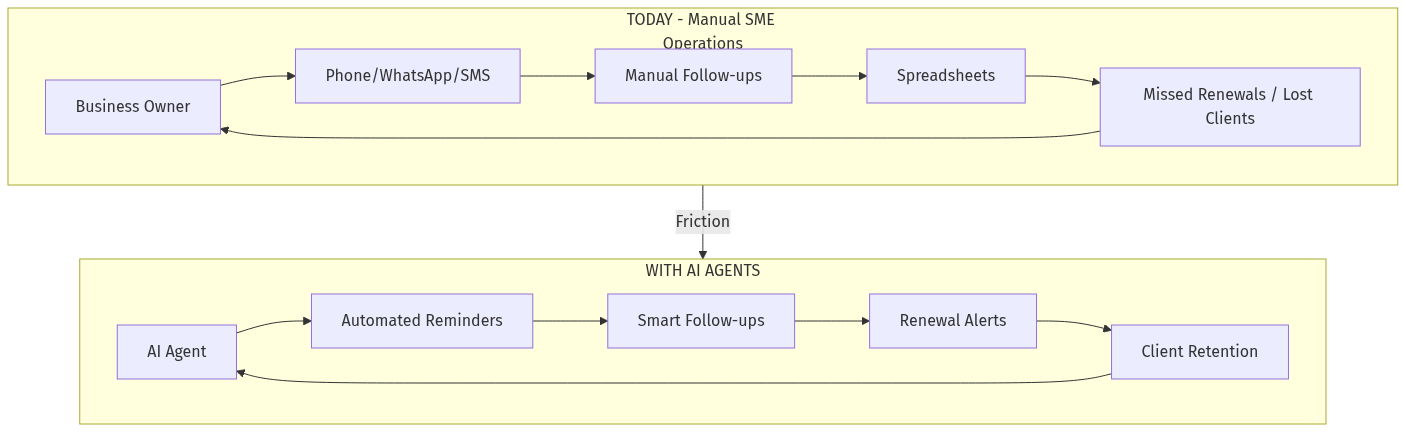
    Market Structure: Manual vs. Agentic SME Operations
    Market Structure: Manual vs. Agentic SME Operations
    Current State vs. AI Agent Future
    Current State vs. AI Agent Future

    ## Sources