ResearchThursday, April 23, 2026

AI-Powered Commercial EV Charging Infrastructure Marketplace: India's $8B Opportunity in Fleet Electrification

India's commercial EV charging infrastructure is fragmented, relationship-driven, and lacks transparency. AI agents can orchestrate the entire lifecycle — from site assessment to installation to ongoing maintenance — creating the first neutral marketplace for fleet operators, warehouse operators, and commercial building owners.

1.

Executive Summary

India's EV transition is accelerating in commercial fleets, but charging infrastructure remains a disjointed, trust-based market. Fleet operators, logistics companies, and warehouse owners face a fragmented supplier landscape with no unified marketplace to compare pricing, verify installation capabilities, or manage ongoing maintenance.

AI agents can fix this by:

  • Building a supplier network with verified installation credentials
  • Automating site assessment and quote comparison
  • Orchestrating installation coordination with multiple stakeholders
  • Providing ongoing monitoring and maintenance contracts
The commercial EV charging infrastructure market in India is projected to reach $8 billion by 2030, driven by:
  • Government FAME subsidies for commercial EVs
  • Corporate sustainability mandates (RE100, ESG goals)
  • Rising diesel costs → electric fleet economics
  • E-commerce and logistics expansion in tier-2/3 cities
---

2.

Problem Statement

The Buyer's Pain

Who experiences this:
  • Fleet operators (electric buses, trucks, delivery vehicles)
  • Logistics companies (last-mile EV delivery)
  • Warehouse operators (forklift electrification, dock vehicles)
  • Commercial building owners (parkingEV for tenants)
  • Factory owners (material handling equipment)
What they face:
  • Fragmented supplier landscape — No centralized directory of EV charging installation companies. Each city has 3-5 local installers with no way to verify quality.
  • No price transparency — The same 7kW charger installation can cost ₹50,000 to ₹2,50,000 depending on location, relationships, and perceived complexity.
  • Technical verification burden — Buyers must verify:
  • - Electrical panel capacity - Transformer load availability - DMC (Discom) connection requirements - Safety compliance (CEA regulations)
  • Installation delays — Average commercial installation takes 45-90 days due to:
  • - Discom approvals - Electrical upgrades - Civil work (foundation, cabling) - Inspection and commissioning
  • No ongoing service market — Maintenance contracts, fault resolution, and equipment upgrades are negotiated separately each time.
  • The Seller's Pain

  • Customer acquisition — Installers rely on referrals and Google ads. High CAC, unpredictable pipeline.
  • Site survey waste — 40% of site visits result in no sale due to inadequate electrical infrastructure.
  • Payment unpredictability — Projects get delayed due toDiscom approval timelines.
  • No recurring revenue — After installation, no contract for ongoing maintenance.

  • 3.

    Current Solutions

    CompanyWhat They DoWhy They're Not Solving It
    Delta Electronics IndiaHardware manufacturer (chargers)Sells hardware only, no marketplace
    ExicomEV charging solutionsDirect sales only, not open marketplace
    VoltawareIoT-enabled chargingConsumer-focused, not commercial fleet
    FortumPublic charging networkPublic charging, not commercial B2B
    ElectreefiCharging solutionsLimited geographic presence
    IndiaMART (EV category)General B2B marketplaceNot EV-specific; flooded with unverified sellers

    Gap Analysis

    • No AI agent integration — Existing solutions are transactional, not advisory
    • No site assessment automation — Electrical capacity verification remains manual
    • No multi-vendor quote comparison — Buyers must individually visit each supplier
    • No maintenance contract marketplace — Ongoing service is ad-hoc
    • No compliance verification — CEA, Discom requirements remain buyer burden

    4.

    Market Opportunity

    Market Size

    SegmentIndia Size (2026)2030 Projection
    Commercial EV Chargers$800M$4B
    Installation Services$300M$2B
    Maintenance/AMC$100M$2B
    Total Addressable$1.2B$8B
    CAGR: 35-45% driven by:
    • FAME-III subsidies (15% for commercial EVs)
    • Corporate ESG mandates
    • Diesel-to-electricTCO savings (40-60%)
    • E-commerce expansion

    Why Now

  • Government push — FAME-III, PLI schemes for battery manufacturing
  • Corporate commitments — Amazon, Flipkart, Swiggy committing to EV fleets
  • Cost economics — EV maintenance 30% of diesel; charging at ₹8/kWh vs diesel ₹100/liter
  • Infrastructure maturation — Multiple charger brands now available in India
  • AI capability —LLMs can now handle complex installation coordination

  • 5.

    Gaps in the Market

    Gap 1: Supplier Verification Desert

    No centralized database of verified EV charging installers with:
    • CEA (Central Electricity Authority) compliance
    • Past installation portfolio
    • Customer ratings and reviews
    • Geographic service area

    Gap 2: Site Assessment Automation

    No automated way to assess:
    • Existing electrical capacity (kVA available)
    • Panel upgrade requirements
    • Discom approval timeline
    • Estimated installation cost

    Gap 3: Quote Comparison Intelligence

    No tool to normalize quotes from multiple suppliers including:
    • Charger specifications
    • Installation scope
    • Civil work requirements
    • Timeline commitments
    • Warranty terms

    Gap 4: Ongoing Service Marketplace

    No standardized marketplace for:
    • Annual Maintenance Contracts (AMC)
    • Fault resolution SLAs
    • Spare parts availability
    • Equipment upgrades

    Gap 5: Compliance Coordination

    No platform to manage:
    • Discom application process
    • CEA inspection coordination
    • Net metering agreements

    6.

    AI Disruption Angle

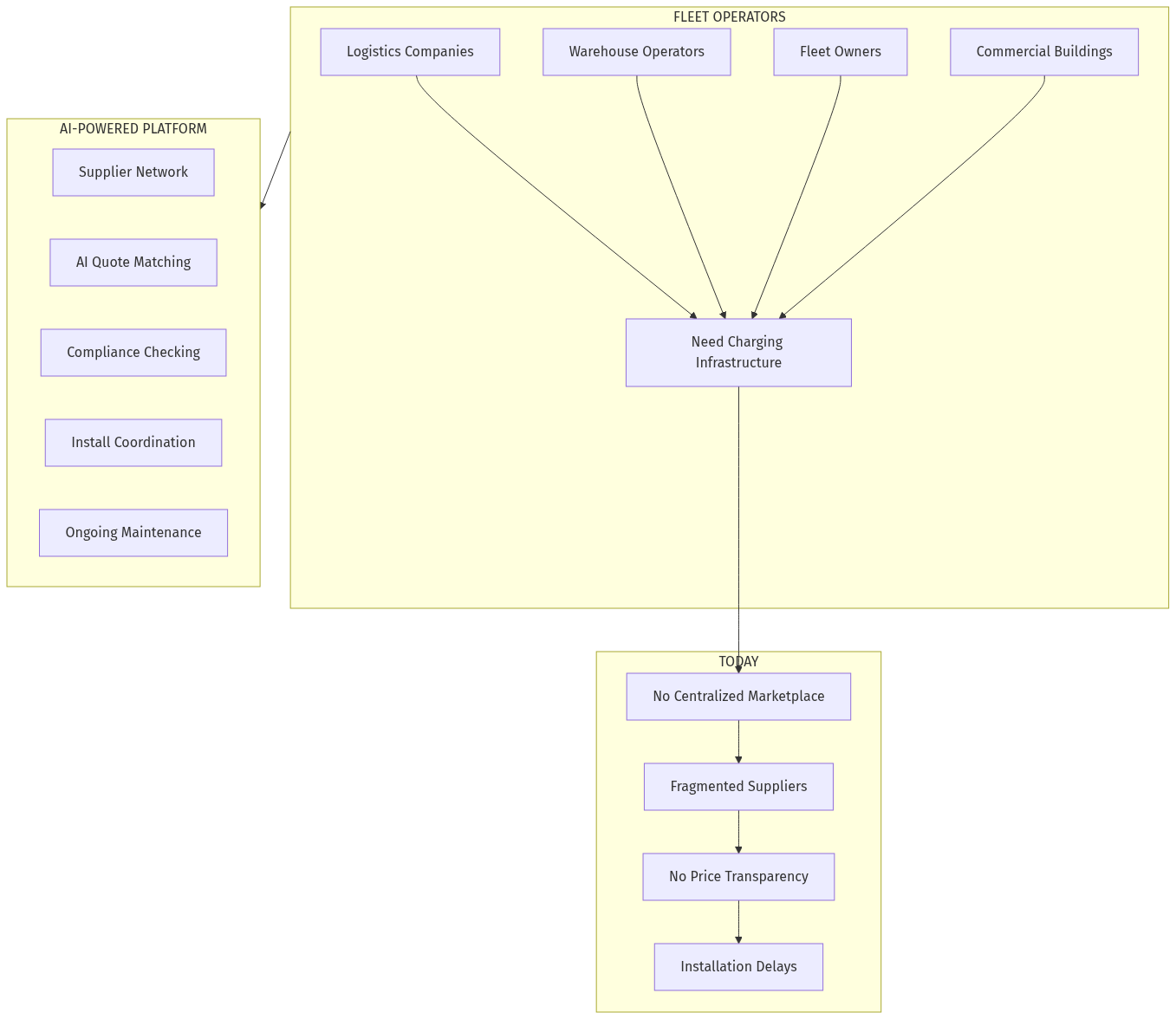
    EV Charging Infrastructure Architecture
    EV Charging Infrastructure Architecture

    How AI Agents Transform the Workflow

    Current State (Manual):
    Fleet operator needs charging → Asks peers for installer contacts → Calls 5 installers → Waits for site visits → Compares quotes manually → Negotiates → Signs contract → Waits 60 days for installation → Handles issues ad-hoc
    Future State (Agent-Driven):
    Buyer: "We have 10 electric delivery vans, need charging at ourwarehouse in Gurgaon. Budget up to 15 lakhs."
    AI Agent:
    1. Searches verified installer database (filters by Gurgaon service area)
    2. Requests site assessment from top 3 installers
    3. AI analyzes electrical capacity from uploaded bill
    4. Compares quotes: charger specs, installation scope, timeline
    5. Presents top 3 options with recommendation
    6. On approval: manages Discom application, coordinates installation
    7. Sets up monitoring dashboard, creates AMC quote
    8. Ongoing: monitors charging patterns, predicts maintenance needs

    Key Agent Capabilities

    CapabilityDescription
    Site Assessment AssistantUpload electricity bill → AI estimates capacity, upgrade cost
    Supplier MatchingFilter by geography, certifications, past work
    Quote NormalizationStandardize quotes for apples-to-apples comparison
    Discom Application AgentAuto-fill forms, track approval status
    Installation CoordinatorSchedule vendors, manage timeline
    AMC ManagementContract renewal, fault ticket management
    Charging AnalyticsUtilization reports, cost-per-km insights
    ---
    7.

    Product Concept

    Product Name Ideas

    • ChargeFlow — Commercial Charging Marketplace
    • FleetCharge AI — EV Infrastructure Platform
    • ChargeOps — Installation & Maintenance OS

    Core Features

    For Buyers:
  • AI Site Assessment — Upload electricity bill, get capacity report
  • Supplier Directory — Verified installers with ratings
  • Quote Comparison — Side-by-side with AI recommendation
  • Project Tracking — End-to-end from inquiry to commissioning
  • Charging Dashboard — Real-time monitoring, utilization
  • AMC Management — Contract creation, renewal alerts
  • For Sellers:
  • Lead Generation — Pre-qualified inquiries
  • Quote Builder — Template-based quote generation
  • Project Management — Track ongoing installations
  • Customer Portal — Self-service for buyers
  • Parts Marketplace — Spare parts ordering
  • Revenue Model

    StreamDescriptionPotential
    Commission8-12% on equipment + installationHigh
    Listing FeesPremium placement for suppliersMedium
    AMC Markup10-15% on maintenance contractsMedium
    Site AssessmentPremium reports (₹5,000-25,000)Low
    Data InsightsMarket intelligence reportsLow (at scale)
    ---
    8.

    Development Plan

    PhaseTimelineDeliverables
    Phase 1: Directory6 weeksSupplier database (100 verified), basic search
    Phase 2: Quote v18 weeksQuote comparison, site assessment tool
    Phase 3: Transaction8 weeksOrder management, payment, Discom coordination
    Phase 4: Services10 weeksAMC marketplace, maintenance contracts
    Phase 5: Scale12 weeksMulti-city expansion, financial services (leases)

    Technical Stack

    • Frontend: Next.js (React)
    • Backend: Node.js / Python (for AI)
    • Database: PostgreSQL (structured), Pinecone (embeddings)
    • AI: OpenAI / Anthropic for agent logic
    • Integrations: Exicom, Delta, Ather APIs (where available)

    9.

    Go-To-Market Strategy

    Step 1: Fleet Pilots (Months 1-3)

    • Target: 10 logistics companies with 20+ EVs
    • Approach: Free site assessment, discounted first installation
    • Channel: Direct outreach, logistics associations

    Step 2: Supplier Network (Months 3-6)

    • Onboard: 100 verified installers across 10 cities
    • Incentive: Lead generation at no upfront cost
    • Channel: Trade shows, installer associations

    Step 3: Network Effects (Months 6-12)

    • More buyers → more suppliers → better pricing → more buyers
    • Launch: WhatsApp-first support (fleet operators are active)
    • Add: charger brand partnerships (Delta, Exicom, Bolt)

    Step 4: Scale (Year 2)

    • Add: Commercial buildings, factory electrification
    • Add: Financial services (equipment leasing)
    • Expand: Tier 2-3 cities, highway corridor charging

    10.

    Data Moat Potential

    This business accumulates:

  • Supplier Database — Verified credentials, portfolio, ratings
  • Site Assessment History — Electrical capacity data by geography
  • Pricing Intelligence — Historical quotes → fair price benchmarks
  • Installation Timelines — Discom approval delays by region
  • Service Quality Data — AMC performance metrics
  • Moat: The data moat is strong because:
    • New entrants must build installer trust from scratch
    • Geographic expertise takes time to develop
    • Discom relationships are local and relationship-based

    11.

    Why This Fits AIM Ecosystem

    This platform can become a vertical under AIM.in:

    AIM CapabilityEV Charging Application
    Domain portfoliochargeinfrastructure.in, fleetev.in
    WhatsApp integrationQuote requests, installation updates via WhatsApp
    Trust verificationInstaller verification aligns with Nandini (Trust)
    SEO/contentEV charging guides, fleet electrification playbooks
    Revenue potential: If 5% of India's commercial EV charging market flows through the platform at 10% commission = $40M annual revenue by 2030.

    ## Verdict

    Opportunity Score: 7.5/10

    This is an emerging, high-growth B2B opportunity with clear AI agent applicability. The market is transitioning from relationship-driven to platform-driven, and no player has built an agent-driven solution.

    Strengths:
    • Large TAM ($8B by 2030)
    • Clear pain point (fragmentation, no transparency)
    • Strong data moat potential
    • Recurring revenue via AMC contracts
    Risks:
    • Market timing uncertainty (EV adoption could slow)
    • Discom approval delays vary by state
    • Hardware brand relationships take time
    Recommendation: High-priority opportunity. Start with a narrow focus (Delhi-NCR, Mumbai, Bangalore logistics fleets) before expanding.

    ## Sources