ResearchThursday, April 23, 2026

The $50 Billion Opportunity: AI Phone Agents for Indian SMBs

Every missed call is a lost customer. In India, 63 million small businesses answer phones with silence because they can't afford 24/7 receptionists. AI voice agents can change that — and the window to build this is closing fast.

1.

Executive Summary

India has 63 million small and medium businesses. Most of them run on phone calls — inquiries, bookings, follow-ups, complaints. Very few can afford a dedicated person to answer every call, 24/7. The result: missed calls, lost leads, and revenue left on the table.

AI phone agents are the obvious solution. A software layer that answers calls, qualifies leads, books appointments, and updates CRMs — all without human intervention. The global market for AI-powered voice agents is projected to hit $50B by 2030. Yet Indian SMBs remain grossly underserved by existing solutions.

This article maps the opportunity, the gaps, and the AI disruption angle that could build the next great Indian SaaS company.


2.

Problem Statement

The Core Pain

SMBs in India live and die by phone calls. Unlike Western markets where email and web forms dominate, Indian customers call first, ask questions, and only then decide. A plumber in Vizag, a event planner in Pune, a diagnostics lab in Bangalore — all rely on incoming calls to drive revenue.

But here's the paradox:

  • Shops open at 10am, close at 8pm. Leads that come in at 9pm or 6am? Gone.
  • One person businesses can't answer and work simultaneously. When the owner is serving a customer, the phone goes unanswered.
  • Staff turnover in SMBs is brutal. Train someone for 3 months, they leave. Phone quality degrades.
  • No CRM, no follow-up. Even when calls are answered, the data is lost. "Who called about the wedding hall package?" → shrug.

The Scale of the Problem

StatSource
63M SMBs in IndiaNASSCOM, 2025
~75% use phone as primary customer contactLocalCircles survey
Average SMB loses 12-18% of inbound leads to missed callsIndustry estimate
SMBs spending >Rs 5K/month on missed call backfillIndustry estimate
This isn't a niche problem. It's a systemic inefficiency that costs Indian SMBs lakhs of crores in lost revenue every year.
3.

Current Solutions

Global Players

CompanyWhat They DoAnnual RevenueGap for Indian SMBs
Bookedin.aiAI receptionist for US service businesses~$600K ARR ($50K MRR)English-only, US-centric, expensive
Air.aiUnlimited AI calls, 24/7Growth stageNo Indian language support
Bland AIVoice API for enterprisesSeries A ($22M)Developer-focused, not SMB-ready
CallGFIndia-focused AI voice agentEarly stageLimited language support

Indian Market Players

CompanyWhat They DoGap
ExotelEnterprise telephony + basic IVRAI is add-on, not core. Pricing for 50+ seat enterprises.
KnowlarityCloud telephony + AI featuresComplex onboarding, SMB-unfriendly
Freshworks (Freshdesk)Helpdesk + phone channelCRM-centric, not purpose-built for lead gen
ZohoCRM with telephony add-onFeature creep, steep learning curve

The Pattern

Existing solutions are either:
  • Too expensive (enterprise-grade pricing for SMBs)
  • Too complex (require IT teams to configure)
  • Too English-centric (no Hindi, Tamil, Telugu, Kannada support)
  • Too generic (not trained on Indian business context — appointment booking, price inquiries, location questions)

  • 4.

    Market Opportunity

    Market Size

    SegmentIndia SizeGlobal Size
    AI Voice Agents (overall)~$2B by 2028~$50B by 2030
    SMB telephony / lead gen~$800M (addressable)~$15B
    India SMB software market~$15B (growing 25% YoY)

    Growth Drivers

    1. Post-COVID Digital Adoption: SMBs that resisted online presence now understand the cost of being invisible. Many have websites, Google Business profiles, and WhatsApp Business — but can't handle the call volume these generate. 2. AI Cost Curve: Text-to-speech and speech-to-text costs have dropped 90% in 3 years. What cost $0.05/minute in 2022 now costs $0.002/minute. Margins are now possible at SMB price points. 3. WhatsApp as Infrastructure: Indian consumers are comfortable with WhatsApp. A phone agent that can also handle WhatsApp messages creates a unified experience. Companies like Kapso have built the infrastructure — the AI layer on top is the missing piece. 4. Talent Shortage: Hiring good receptionists is hard and expensive. In Tier 2-3 cities, finding someone who speaks multiple languages and understands the business is nearly impossible. AI agents solve this permanently.

    Why Now

    The convergence is perfect:

    • Costs are low enough for SMB pricing
    • Indian language AI models are finally good enough
    • WhatsApp + voice integration is commoditized
    • SMBs are desperate for lead management tools
    • No dominant player has captured the Indian SMB voice agent market
    ---

    5.

    Gaps in the Market

    Applying anomaly hunting — what's strange that shouldn't be?

    Gap 1: No "Phone Agent for Rs 999/month" product Existing solutions start at Rs 5,000-10,000/month. The 90% of Indian SMBs who need basic AI answering can't afford it. A sub-Rs 1,000/month "starter" tier would unlock a massive new market. Gap 2: Zero Indian language voice AI at SMB price point Most Indian businesses deal with Hindi, Tamil, Telugu, Marathi, Bengali callers. Yet every AI phone agent product is English-first. This is the equivalent of building a restaurant POS system without support for Indian cuisines. Gap 3: No "lead qualification for free" model In the US, AI receptionists charge per-call or per-minute. Indian SMBs want to know: "How many new customers did I get this month?" Existing tools don't tie call quality to business outcomes. Gap 4: Industry-specific agents don't exist A dentist's phone agent needs to book appointments, ask about insurance, and handle cancellations. A wedding hall needs to collect guest counts, check date availability, and send quotes. Generic AI can't do this without deep industry training. Nobody is building vertical-specific voice agents for India. Gap 5: No integration with Indian payment flows "Pay Rs 500 to block the date" — this is standard in Indian wedding halls, event planners, decorators. AI agents that can initiate and confirm UPI payments mid-call would be transformative. Existing solutions treat payment as an afterthought. Gap 6: WhatsApp-voice duality Indian customers might call first, then WhatsApp for photos, then call again to book. The AI needs to track this entire journey. No current solution does this well.
    6.

    AI Disruption Angle

    How AI Agents Transform the Workflow

    TODAY (Manual):
    Lead calls → Nobody answers → Voicemail → Business calls back → Lead doesn't answer → Lead goes to competitor
    WITH AI AGENT:
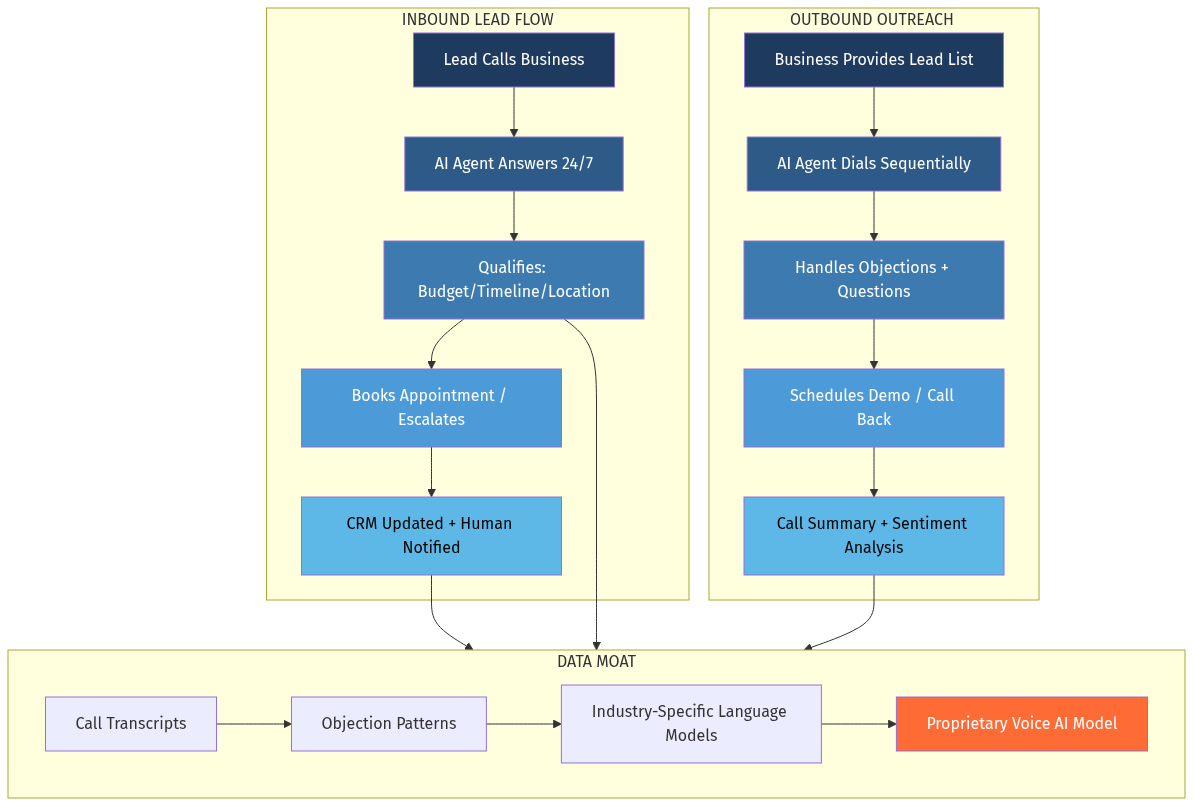
    Lead calls → AI answers in 1 ring → Qualifies (budget? timeline? location?) → Books appointment → Sends WhatsApp confirmation → CRM updated → Owner notified only if qualified lead

    The Falsification Test (Why This Could Fail)

    Assume 5 well-funded startups tried to build this and failed. Why?
  • Language model cost kills unit economics — Hindi voice synthesis at scale is still expensive. If each call costs Rs 3 in AI costs and the SMB pays Rs 500/month, you need 167 minutes of calls per month just to break even. Many SMBs won't hit that.
  • Trust barrier in Tier 2-3 markets — "Talk to a machine" is a hard sell in smaller cities. Indians expect to talk to a human who understands their specific situation. Generic AI fails this test.
  • Integration nightmare — Indian businesses use a dozen different systems: WhatsApp Business, Google Business, Instagram, individual websites. Building integrations for all is a massive engineering problem.
  • Incumbent retaliation — Exotel and Knowlarity have relationships with these SMBs. If AI phone agents become mainstream, incumbents will add the feature and use their distribution advantage to win.
  • Call quality issues — Bad network, background noise, heavy accents. AI that fails 20% of calls is worse than no AI — it actively damages business reputation.
  • How to Survive the Failure Modes

    Solution 1: Hybrid AI + Human handoff Not fully AI, not fully human. The agent handles FAQs and qualification; humans handle complex queries and final negotiation. This reduces AI cost per call and increases trust. Solution 2: Vertical-first approach Instead of building for "all SMBs", build for one industry at a time. Dental clinics first (standardized workflows, high call volume, easy to train). Then expand. This creates the industry-specific training data moat. Solution 3: Outcome-based pricing Don't charge per minute. Charge a percentage of booked revenue: "We charge 5% of the value of appointments we book for you." Align incentives. SMB only pays when AI delivers results.
    7.

    Product Concept

    Core Product: "Jaanwar" (Working Title)

    An AI phone agent for Indian SMBs that:

    Features:
  • 24/7 AI Answering — Always-on, never misses a call. Multi-language (Hindi, English + 2 regional languages per region).
  • Lead Qualification Engine — Asks 3-5 key questions: "Are you looking for this weekend or next week?", "How many guests?", "What's your budget?"
  • Appointment Booking — Calendly-style availability matching, automated confirmations via WhatsApp.
  • CRM + WhatsApp Integration — Every lead automatically added to a simple dashboard with call notes, status, follow-up date.
  • Industry-Specific Templates — Pre-built for dental clinics, wedding halls, diagnostic labs, home services, real estate.
  • Voice + WhatsApp Unification — Same agent handles both channels, maintaining conversation context.
  • Payment Integration — Initiate UPI payments during calls for deposits. Confirm and reconcile automatically.
  • User Flow

    1. Business signs up → Selects industry → Picks plan
    2. Uploads business info: services, pricing, availability, common questions
    3. Points their phone number to Jaanwar (call forwarding)
    4. First call comes in → AI answers → Qualifies lead → Books or escalates
    5. Business receives WhatsApp summary: "[Lead Name] called about [Service]. Budget: [X]. Wants [Date]. Status: [Qualified]"
    6. Business follows up only on qualified leads

    Architecture

    Architecture Diagram
    Architecture Diagram

    8.

    Development Plan

    Phase 1: MVP (Weeks 1-8)

    • Single industry: Dental clinics (standardized booking flow)
    • Single language: Hindi + English
    • Basic call answering + qualification + WhatsApp summary
    • Manual review of all calls for first 2 weeks; AI learns
    • Target: 20 pilot customers, $2K MRR

    Phase 2: V1 (Weeks 9-16)

    • Expand to 3 industries: Dental, Home Services, Diagnostic Labs
    • Add regional language support (Tamil, Telugu, Marathi)
    • Calendar integration (Google Calendar, WhatsApp Business)
    • Simple CRM with lead status tracking
    • Target: 100 paying customers, $10K MRR

    Phase 3: V2 (Weeks 17-24)

    • Multi-language voice synthesis (10+ Indian languages)
    • UPI payment initiation during calls
    • Outcome-based pricing pilot
    • Industry-specific AI training data
    • Target: 500 customers, $50K MRR
    PhaseTimelineKey FeaturesTarget MRR
    MVP8 weeksSingle industry, Hindi+English$2K
    V18 weeks3 industries, 5 languages$10K
    V28 weeks10 languages, payments, outcomes$50K
    ---
    9.

    Go-To-Market Strategy

    Indian SMB Go-To-Market is Different

    Forget Silicon Valley playbooks. Indian SMB marketing is:

    • Referrals first. If a neighboring salon started using it, others will try it.
    • WhatsApp groups are the channel. Industry WhatsApp groups (there are thousands of dentist WhatsApp groups) are where deals happen.
    • Demonstration beats explanation. Show, don't tell. Record a call where the AI handled a lead perfectly and share it.
    • Pricing must be transparent. No "call for pricing." SMBs hate that.

    GTM Steps

    Step 1: Build in public on LinkedIn + Twitter Founder documents the journey of "building an AI agent for dental clinics." Share call recordings (anonymized). Create content about missed calls = lost revenue. Target: 1,000 followers in the dental community. Step 2: Cold outreach via WhatsApp Business API Find dental clinic WhatsApp groups. Not spam — valuable content. Share a PDF: "The 5 Questions Your Phone Agent Should Ask Every Caller." Include a link to a free demo. Step 3: Free 7-day trial No credit card. Connect their phone number. Show them the leads they missed. The data speaks for itself: "You received 47 calls last week. We handled 31. Your staff handled 16. 11 were missed." Step 4: First 100 customers = referral engine Offer 1 month free for every referral. A dental clinic that saves 10 hours/month and books 5 extra patients will tell every dentist they know. Build a partner program for dental associations. Step 5: Expand via industry events Dental exhibitions, home services conferences, diagnostic lab summits. These are where the industry gathers and talks about problems. Be present, demo live, collect leads.

    Distant Domain Import

    Borrow from Zoho's playbook: they became dominant in Indian SMB software by being everywhere, easy to use, and having a free tier. Borrow from Practo: they succeeded in healthcare by being genuinely useful to doctors, not just patients. Borrow from Freshworks: they succeeded globally by starting with a painful Indian problem and making it globally scalable.


    10.

    Revenue Model

    Primary Revenue Streams

    1. Subscription (70% of revenue)
    • Starter: Rs 499/month — 100 AI-handled calls, basic qualification
    • Growth: Rs 1,499/month — Unlimited calls, 3 industries, 5 languages, CRM
    • Enterprise: Rs 4,999/month — All features, dedicated support, custom training
    2. Outcome Bonus (20% of revenue)
    • 5% of appointment value for bookings made entirely by AI
    • Only charged when the lead converts to a paying customer
    • Aligns incentives perfectly
    3. Data Insights (10% of revenue)
    • Industry benchmarks: "Your booking rate is 34%. Top performers in your city average 51%."
    • Anonymous competitive data: "Clinics with AI agents book 40% more new patients."
    • Premium reports for enterprise clients

    Unit Economics

    MetricStarterGrowth
    ARPU/monthRs 499Rs 1,499
    Gross Margin75%75%
    CAC (digital)Rs 800Rs 1,200
    LTVRs 3,500Rs 10,500
    LTV:CAC4.4x8.8x
    ---
    11.

    Data Moat Potential

    This is where the long-term defensibility lives.

    Moat 1: Industry-Specific Voice Training Data Every call generates transcripts, objection patterns, booking conversion data. After 100,000 dental clinic calls, you have a model that's better at handling dental-specific queries than any general-purpose AI. This is a flywheel — more calls → better model → more customers → more calls. Moat 2: Indian Accent Training India has hundreds of distinct accents. Bihari Hindi, Tamil Hindi, Marathi Hindi, Punjabi Hindi. Each has different phonemes, rhythms, and slang. Training a model on 1 million Indian phone calls creates a moat no international player can replicate quickly. Moat 3: Industry Workflow Patterns A dentist books differently than a wedding hall. A diagnostic lab handles referrals differently than a home services company. Over time, the platform accumulates industry-specific workflow patterns that become embedded in the product — not just prompts, but structured processes that are hard to replicate. Moat 4: Business Outcome Data "Which leads convert? What questions predict conversion? What's the optimal booking confirmation flow?" This data — across industries and thousands of businesses — is valuable for building recommendation engines and eventually, autonomous deal-closing agents.
    12.

    Why This Fits AIM Ecosystem

    AIM.in's vision is becoming India's largest structured B2B discovery platform — where buyers ASK and DECIDE. AI phone agents are the natural completion layer:

    • For buyers: Instant qualification and booking. No more "call between 10am-6pm." No more waiting 24 hours for a callback.
    • For suppliers (SMBs): Every inquiry handled professionally, 24/7. No missed leads. No manual follow-up. A AI agent that works while they sleep.
    • For AIM: A unified interaction layer across all vertical marketplaces. Whether someone finds a dentist on AIM or a wedding hall, the booking experience is the same: AI-powered, instant, WhatsApp-native.
    The phone agent becomes the transaction completion mechanism for every vertical on AIM.in. And as it handles millions of calls, it generates the structured data that makes the discovery platform smarter.

    ## Verdict

    Opportunity Score: 8.5/10
    DimensionScoreReasoning
    Market Size9/1063M SMBs, $2B+ Indian market
    Timing9/10Cost curve ready, AI quality ready, no dominant player
    Defensibility7/10Data moat is real but incumbents can catch up
    Unit Economics8/10SMB pricing is tight but achievable with outcome model
    Team Risk7/10Requires rare combination: voice AI + Indian SMB + product
    Distribution Risk8/10WhatsApp + referral network is cheap and proven
    Final Assessment:

    The AI phone agent market for Indian SMBs is a genuine greenfield. No dominant player, massive unmet need, perfect timing. The risks are real but manageable: language diversity is a moat-builder, not just a problem; vertical-first approach creates defensibility; outcome-based pricing aligns incentives.

    The window is closing though — as AI costs continue to drop, incumbents like Exotel and Freshworks will add AI features. The first-mover advantage in industry-specific voice training data is real. Build now, build vertical-first, and the flywheel starts turning.


    ## Sources