ResearchWednesday, April 22, 2026

Vector Database Security: The Unaddressed B2B Opportunity in AI Infrastructure

As AI applications proliferate, thousands of Vector DBs are now exposed publicly without authentication — a $2B+ market opportunity for AI-native security solutions.

1.

Executive Summary

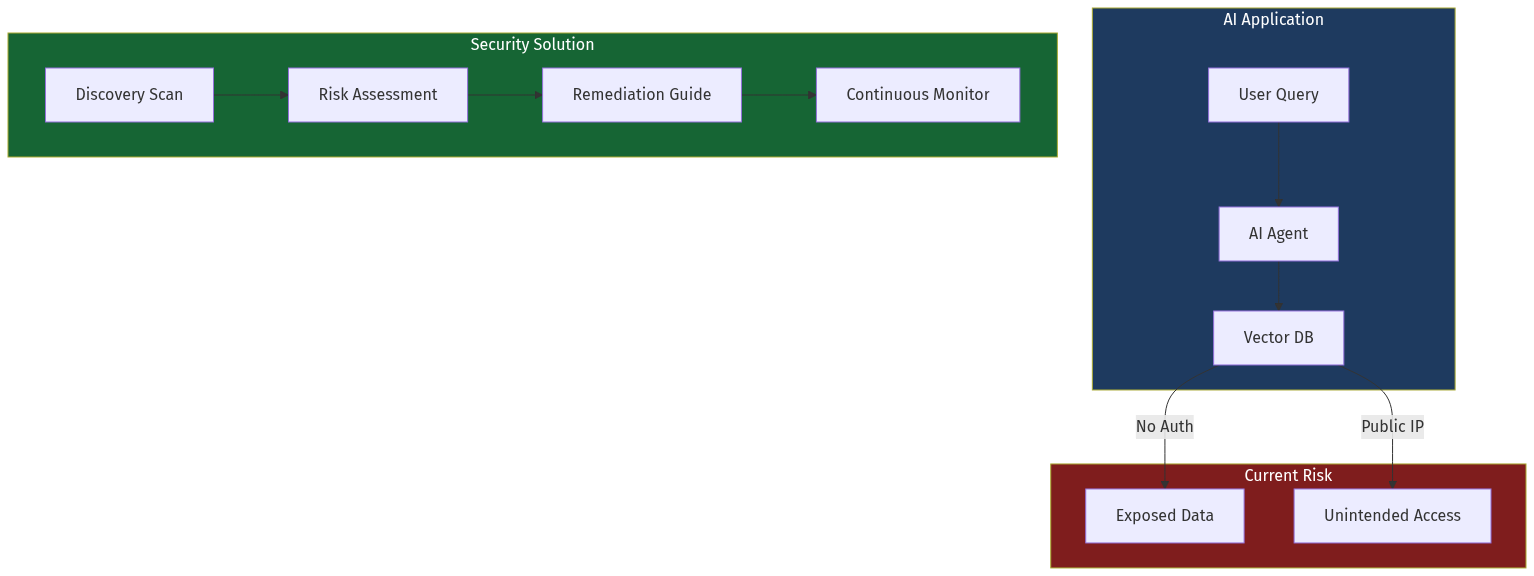
A recent security scan revealed that thousands of Vector databases — the critical infrastructure powering AI applications — are publicly exposed without authentication. This represents both a massive security risk and a compelling B2B opportunity.

The AI application market is growing at 40%+ CAGR, but security infrastructure has not kept pace. Enterprises adopting AI need purpose-built security solutions that understand the unique architecture of Vector databases, RAG pipelines, and AI agent workflows.

2.

Problem Statement

The Core Problem

Organizations deploying AI applications face a critical security gap: traditional database security tools don't understand Vector databases, embeddings, or RAG architectures.

Who Experiences This Pain

  • Enterprises deploying AI assistants, chatbots, and RAG systems
  • AI startups building on LLMs with sensitive training data
  • System integrators implementing AI for clients
  • Regulated industries (healthcare, finance, legal) with strict data compliance requirements

Specific Pain Points

  • Unknown exposure — IT teams don't know which Vector DBs are publicly accessible
  • No specialized monitoring — Traditional DB monitoring doesn't track embeddings or semantic search patterns
  • Compliance gaps — No AIC SOC 2-style security standards exist for AI infrastructure
  • Agentic risks — AI agents increasingly have data access and tool execution capabilities

  • 3.

    Current Solutions

    CompanyWhat They DoWhy They're Not Solving It
    WizCloud securityGeneralist — doesn't cover Vector DBs specifically
    Palo Alto NetworksEnterprise securityTraditional database focus, not AI-native
    DatadogObservabilityInfrastructure monitoring, not AI security
    EranVector DB securityNewentrant, early stage
    Missing: Complete AI infrastructure security platforms
    4.

    Market Opportunity

    Market Size

    • AI Application Market: $150B+ by 2027 (CAGR 40%)
    • Cloud Security Market: $40B+ by 2027
    • Vector DB Market: $10B+ by 2027
    • AI Security Subsegment: $2-5B addressable

    Why Now

  • Adoption wave — AI applications are moving from POC to production
  • Security incidents — High-profile data leaks creating FUD
  • Regulatory pressure — EU AI Act, GDPR enforcement driving compliance
  • Agentic AI — AI agents with tool access create new attack surfaces

  • 5.

    Gaps in the Market

    Identified Gaps

  • Discovery — No tools to find exposed Vector DBs across cloud environments
  • Security scanning — No purpose-built vulnerability scanners for Vector DB configurations
  • Monitoring — No real-time alerts for anomalous embedding patterns
  • Agent governance — No frameworks for AI agent data access control
  • Compliance — No AI-specific security certifications (AIC SOC 2)
  • Remediation — No automated fix systems for Vector DB misconfigurations
  • Runtime protection — No agent-level access controls for AI systems

  • 6.

    AI Disruption Angle

    How AI Agents Transform Security

    Traditional security operates on rules-based detection. AI-native security uses:

  • Semantic analysis — Detect sensitive data in embeddings themselves
  • Behavioral learning — Understand normal RAG query patterns
  • Automated remediation — Self-healing Vector DB configs
  • Threat hunting — AI-powered anomaly detection in embedding space
  • Architecture Shift

    Traditional: Perimeter → Network → Database → Tables
    AI-Native: Application → Embeddings → RAG → Agents

    7.

    Product Concept

    Core Features

    #### 1. AI Infrastructure Scanner

    • Cloud-native discovery of all Vector DB deployments
    • Risk classification ( exposure level, data sensitivity)
    • Compliance status tracking
    #### 2. Security Posture Manager
    • Configuration hardening for Pinecone, Weaviate, Milvus, Qdrant
    • Access control validation
    • Encryption verification
    #### 3. Runtime Protection
    • Anomalous query detection
    • Embedding-level DLP
    • Rate limiting for vector search
    #### 4. Agent Governance
    • AI agent access controls
    • Tool execution auditing
    • Data access policies
    #### 5. Compliance Suite
    • AIC SOC 2 certification framework
    • GDPR/AI Act compliance checks
    • Audit reporting
    ---

    8.

    Development Plan

    PhaseTimelineDeliverables
    MVP8 weeksScanner + basic dashboard (Pinecone, Weaviate support)
    V116 weeksFull Vector DB support + posture management
    V224 weeksRuntime protection + agent governance
    V336 weeksCompliance suite + enterprise features

    Technical Stack

    • Backend: Python/FastAPI
    • Infrastructure: AWS/GCP cloud scanning
    • Database: PostgreSQL + Redis
    • ML: Fine-tuned models for anomaly detection

    9.

    Go-To-Market Strategy

    Phase 1: Developer-First

  • Open-source CLI tool for discovery scanning
  • Community Discord with 1,000+ users
  • Blog content on vector security best practices
  • Phase 2: Startup Adoption

  • Integrate with major Vector DB providers
  • Launch in YC/VC network
  • Freemium tier for early startups
  • Phase 3: Enterprise

  • SOC 2 Type II certification
  • GTM via system integrators
  • Partnership with cloud providers
  • Primary Channels

    • Content: Security newsletters (Dark Reading, SecurityWeek)
    • Events: AI安全, RSAC, Black Hat
    • Partners: Vector DB vendors (co-sell)

    10.

    Revenue Model

    Revenue Streams

  • SaaS Subscription
  • - Starter: $500/month (10 DBs) - Pro: $2,000/month (50 DBs) - Enterprise: Custom pricing
  • Professional Services
  • - Security assessments: $5-15K - Compliance audits: $10-30K
  • Certification
  • - AIC SOC 2 assessments: $20-50K

    LTV Projection

    • Enterprise ACV: $50K+
    • Gross margin: 75%+
    • NRR: 120%+ (expansion revenue)

    11.

    Data Moat Potential

    Proprietary Data Accumulation

  • Global exposure map — Real-time scan of internet-facing Vector DBs
  • Vulnerability database — Known CVEs and attack patterns
  • Behavioral baselines — Normal patterns per industry/vertical
  • Compliance frameworks — AI security best practices
  • Moat Strength

    • High — Network effects from shared security intelligence
    • Medium — Switching costs from integration depth
    • Medium — Brand trust in security category

    12.

    Why This Fits AIM Ecosystem

    Vertical Alignment

    This opportunity maps directly to AIM's B2B marketplace strategy:
  • Domain fit: AI infrastructure = high-value vertical
  • Buyer journey: RAG/purchasing agent workflow applies
  • Market timing: Early stage, few competitors
  • Data play: Proprietary scanning data becomes asset
  • Complementary Opportunities

    • AI supplier intelligence — Map Vector DB vendors
    • Enterprise buying intent — Security compliance needs
    • Integration partnerships — Cross-sell with cloud providers

    ## Verdict

    Opportunity Score: 8/10

    FactorScoreRationale
    Market timing9Security incidents creating demand
    Competition7Few dedicated players
    Moat potential7Network effects + integrations
    GTM feasibility8Developer-first + enterprise
    Margin potential8SaaS at 75%+ GM

    Strengths

    • First-mover in specialized Vector DB security
    • Clear value proposition for AI adopters
    • Compelling FUD from recent exposure incidents

    Risks

    • Large cloud security players may add Vector DB support
    • Vector DB vendors may build native security
    • Market may be smaller than projected

    Recommendation

    Build. The gap is real, the timing is now, and the entry barriers for specialized solutions are lower than generalist security.

    ## Sources

    ---

    ## Diagram

    Vector Database Security Architecture
    Vector Database Security Architecture