ResearchWednesday, April 22, 2026

Kibu EHR: The $4B Vertical That Big Healthcare Forgot

A fragmented $4B market serving 8M Americans with intellectual/developmental disabilities (I/DD) is being digitize — and it is desperate for AI-native workflow automation.

1.

Executive Summary

The US healthcare system serves over 8 million individuals with intellectual and developmental disabilities (I/DD). These individuals receive care from over 60,000 provider organizations across 48 states. Every single one of these organizations must comply with state-level regulations, maintain meticulous documentation, and submit regular reports to state agencies.

Kibu — currently generating $234K/month — has digitized one corner of this market. But the market remains 90% fragmented, manual, and desperate for AI agents.

This is a textbook vertical SaaS opportunity: high compliance friction, fragmented suppliers, repeat purchase behavior, and massive whitespace for AI-native reconstruction.

2.

Problem Statement

Who experiences this pain:
  • I/DD care provider organizations (group homes, day programs, vocational rehabilitation centers)
  • State regulators who audit these providers
  • Direct support professionals (DSPs) who are underpaid and overburdened
The core pain:
  • Documentation burden: Each state requires different forms, different frequencies, different compliance frameworks. A provider in Texas has completely different reporting requirements than one in California.
  • Staff turnover: DSPs earn $12-18/hour. Average turnover is 40-60% annually. Every new hire means weeks of training on paperwork.
  • Regulatory audits: States audit providers every 1-3 years. Providers often discover gaps only during audits — leading to fundingclawbacks, fines, or license revocation.
  • Billing complexity: Each state has different Medicaid billing codes, rate structures, and claiming procedures. One missed code can mean months of unbilled services.
  • The zeroth principle: This is not a healthcare problem. It is a 50-state regulatory fragmentation problem with a human capital crisis at its core.
    3.

    Current Solutions

    CompanyWhat They DoWhy They Are Not Solving It
    KibuCompliance and EHR for I/DD providers$234K MRR, but legacy architecture, no AI
    TherapEnterprise EHR for I/DDEnterprise pricing, slow innovation
    MediSoftwareGeneral EHRNot verticalized for I/DD
    ServiceNowWorkflow automationToo generic, no healthcare context
    Custom homegrownInternal solutions100+ variations, no scale
    The gap: No current solution is built for an AI-first world. Every documentation task, every compliance report, every billing submission can be auto-generated by AI agents.
    4.

    Market Opportunity

    • Market Size: $4.1 billion annually (I/DD Medicaid waiver spending)
    • Growth: 6.2% CAGR (aging population + deinstitutionalization momentum)
    • Why now:
    1. States are mandating electronic documentation (no more paper) 2. DSP shortage is critical — AI agents can reduce documentation time by 60% 3. Voice-first AI makes real-time data entry possible during care delivery 4. Medicare/Medicaid is pushing value-based care, requiring better data Incentive mapping:
    • States profit from audit clawbacks — they have no incentive to simplify compliance
    • Legacy EHRs profit from consulting fees — they have no incentive to automate
    • The current equilibrium is maintained by everyone profiting from inefficiency

    5.

    Gaps in the Market

  • Voice-first documentation: DSPs cannot stop midway through care to type notes. Voice-to-note AI changes this.
  • Cross-state translation: What if a provider expanding across states could auto-generate compliant forms for each state?
  • Predictive compliance: Audit failures are predictable. AI can identify gaps before auditors do.
  • Auto-billing: From notes to claims in one click. No more unbilled services.
  • AI care coaching: Real-time prompts for DSPs on handling behavioral challenges.
  • Family portals: Real-time visibility for families without burdening providers.

  • 6.

    AI Disruption Angle

    How AI agents transform the workflow:

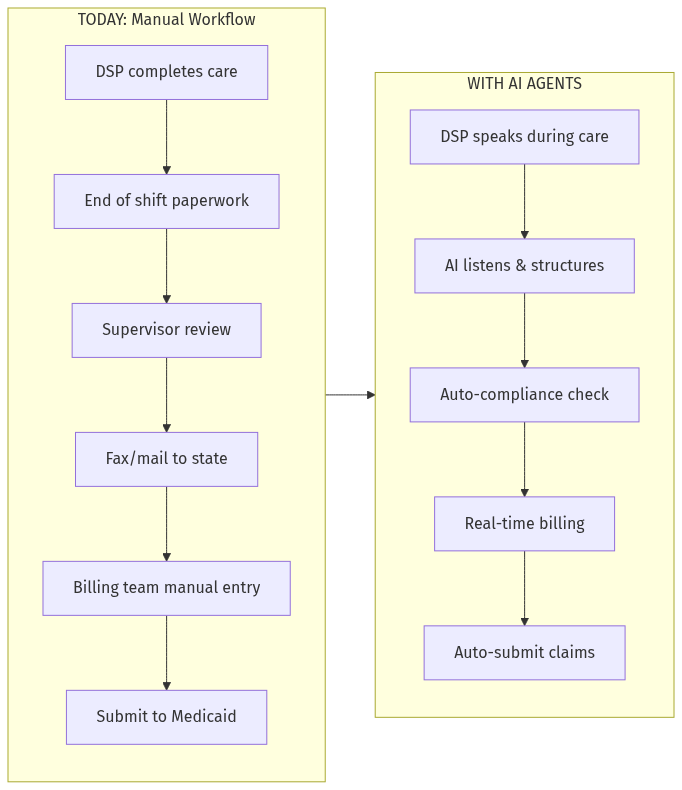
    > Today: DSP completes care → waits until end of shift → fills paper/paper forms → supervisor reviews → faxes/mails to state → billing team converts to claims → submits to Medicaid

    > With AI Agents: DSP speaks during care → AI listens, structures, auto-generates notes + compliance + claims in real-time

    The agent workflow:
  • Listen Agent: Real-time voice transcription of care activities
  • Structure Agent: Maps observations to state-specific compliance frameworks
  • Audit Agent: Runs continuous compliance checks against state rules
  • Billing Agent: Auto-generates clean claims from structured data
  • Coach Agent: Provides real-time guidance for challenging behaviors

  • Architecture Diagram
    Architecture Diagram

    7.

    Product Concept

    Vertical EHR + AI Agents
    FeatureDescription
    Voice-first notesDSP speaks, AI structures in real-time
    Auto-complianceContinuous 50-state regulatory engine
    Smart billingAuto-generate clean Medicaid claims
    Audit predictorIdentify gaps before they become violations
    Care coachAI-guided interventions for behavioral challenges
    Family portalReal-time updates without provider lifting a finger
    ---
    8.

    Development Plan

    PhaseTimelineDeliverables
    MVP12 weeksSingle-state voice notes + basic EHR
    V116 weeksMulti-state compliance engine + billing
    V220 weeksAI audit predictor + care coach
    Scale24 weeksMulti-state expansion + enterprise features
    Stack:
    • Voice: DeepGram + Custom LLM fine-tuned on I/DD care language
    • Database: PostgreSQL with 50-state rule engine
    • UI: Mobile-first for field DSPs

    9.

    Go-To-Market Strategy

  • Pick one state (start with Texas or California — largest Medicaid populations)
  • Partner with state associations (state I/DD provider associations are gatekeepers)
  • Pilot with 5-10 providers (prove documentation time reduction)
  • Case studies → expansion (use success stories to trigger FOMO)
  • Acquisition: Target Kibu customers who are frustrated with no AI roadmap
  • GTM channel ranking:
  • State association partnerships (trust + distribution)
  • Regional consultant networks (who manage compliance)
  • Medicaid managed care organizations (who pay providers)
  • Direct sales to provider organizations

  • 10.

    Revenue Model

    • SaaS subscription: $50-150/provider/month based on bed count
    • Per-seat licensing: $10/DSP/month
    • Billing transaction fee: 0.5-1% on claims processed
    • Professional services: Compliance consulting, setup
    • AI agent add-ons: Voice AI, audit AI as premium features
    Projected MRR:
    • 1,000 providers × $75 = $75K MRR (Year 1)
    • 5,000 providers × $100 = $500K MRR (Year 2)
    • 15,000 providers × $125 = $1.875M MRR (Year 3)

    11.

    Data Moat Potential

    Proprietary data accumulates:
    • 50-state compliance rule database (hard to replicate)
    • Care outcome data linked to interventions (predictive models)
    • Provider operational benchmarks
    • Audit outcome history
    • Care language fine-tuned model
    Moat strength: Strong. Compliance complexity is a moat. Care language is domain-specific. Outcome data compounds.
    12.

    Why This Fits AIM Ecosystem

    Fit with AIM strategy:
  • Verticalized: I/DD care is a specific vertical — fits the "underserved industry" thesis
  • B2B: Selling to provider organizations, not consumers
  • Workflow-driven: Documentation → Compliance → Billing workflow is automatable
  • Repeat usage: Daily documentation, monthly billing, annual audits
  • AI-native: Voice-first AI is the core differentiator
  • Potential vertical expansion:
    • Home health (similar workflow)
    • Aged care (adjacent)
    • Behavioral health (adjacent)

    ## Verdict

    Opportunity Score: 8.5/10 Why 8.5:
    • ✅ $4B market, 90% untouched
    • ✅ High compliance friction = high switching cost
    • ✅ AI voice-first is genuinely transformative
    • ✅ Strong vertical moat
    • ✅ Data compounds over time
    Risks:
    • ⚠️ State regulatory complexity (manageable with proper build)
    • ⚠️ Kibu has first-mover advantage (mitigate with AI differentiation)
    • ⚠️ Healthcare sales cycles are long (build relationships early)
    Recommendation: This is a build-worthy vertical. The market is ready for AI-native transformation. Voice-first documentation alone could capture significant market share by reducing DSP administrative burden by 60%. Start in one state, prove the model, expand.

    ## Sources