AI-Powered Industrial Spare Parts Visual Search: The $4B Opportunity in Image-Based Procurement
When a critical machine breaks at 2 AM, maintenance engineers photograph the part, WhatsApp it to three suppliers, and hope someone recognizes it. There's no Google Images for industrial components. A visual search AI that identifies parts from photos—cross-referencing against supplier catalogs, finding equivalents, and enabling instant procurement—could capture a $4 billion market in India alone.
1.
Executive Summary
India's 500,000+ manufacturing units and 50,000+ construction companies face a persistent, unsolved problem: identifying spare parts. When a bearing fails, a belt snaps, or a pump seals, maintenance teams photograph the component and send it to suppliers with messages like "please identify this, we need urgently."
The current workflow is:
Photograph the broken part
WhatsApp to known supplier
Wait for supplier to identify (hours)
Supplier checks inventory (more hours)
Quote + negotiation (more hours)
Finally—procurement
This takes 24-72 hours for a transaction that should take 5 minutes.
The opportunity: Build a visual search engine for industrial components where users upload photos and AI identifies:
Exact part number and manufacturer
Equivalent alternatives from other brands
Stock availability across multiple suppliers
Pricing comparison and delivery times
This creates a compounding data moat—every uploaded image improves recognition accuracy and builds a proprietary parts database.
2.
Problem Statement
The Maintenance Engineer's Nightmare
Every industrial facility faces this scenario weekly:
Monday 6 AM: "Sir, compressor motor bearing has gone. Need replacement urgently."
The current response:
Maintainer photographs the bearing
WhatsApps to 3 local suppliers: "Identify this bearing"
Supplier B: "Have similar but not exact match—₹8,500"
Supplier C: "Exact match—₹12,000 but delivery tomorrow"
Manager approves, order placed
Machine downtime: 24-72 hours
Cost of downtime: For a mid-size manufacturing unit, each hour of unplanned downtime costs ₹50,000-500,000. A single incident can wipe out a year's software subscription savings.
Why This Problem Exists
No universal part numbering — Every manufacturer uses different part numbers for the same component
Fragmented supplier catalogs — No single source aggregates all manufacturer data
Language barriers — Technical terms vary by region, language, and technician
Legacy equipment — Older machines have obsolete parts with no digital records
Visual similarity ≠ functional equivalence — Parts that look similar may have different specifications
Zeroth Principles Analysis
What are we assuming?
Assumption: Spare parts can only be identified by part number
Assumption: Technicians know what part they need
Assumption: Suppliers have complete catalogs online
Assumption: Visual lookup is a "nice to have"
What if we challenged these?
An AI can extract specifications from images (dimensions, markings, logos)
An AI can find functional equivalents based on parameters, not just part numbers
A collective database of supplier inventories could be continuously scraped
Visual search could become the primary discovery mechanism
E-commerce transformed consumer retail, but B2B industrial parts still operates like 1990
Google has image search for everything except industrial components
India has 500K+ manufacturers but zero parts intelligence platforms
5.
AI Disruption Angle
How AI Transforms This Workflow
Traditional (24-72 hours):
Photo → WhatsApp → Supplier identifies → Inventory check → Quote → Order → Delivery

With AI Visual Search (5 minutes):
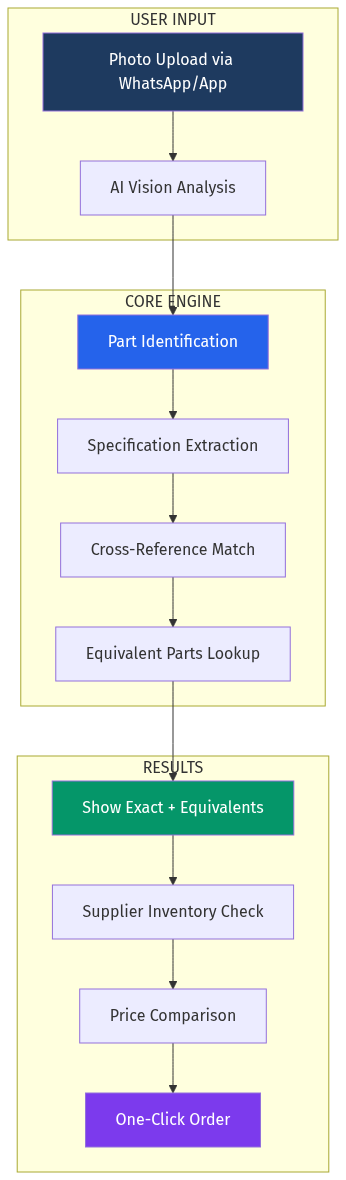
Photo → AI identifies → Shows equivalents → Shows stock/pricing → One-click order → Delivery
Technical Architecture
Visual Search ArchitectureCore Components:
Visual Recognition Engine
- Train on millions of industrial component images
- Extract: dimensions, markings, logos, material type
- Output: component type + specifications + manufacturer
Parts Knowledge Graph
- Map functional equivalents across manufacturers
- Link OEM parts to aftermarket alternatives
- Store cross-reference data (Part A = Part B from Brand X)
- Natural language follow-up: "Do you need this urgently?"
- Context retention: "Based on your previous searches..."
- WhatsApp-native interface
Distant Domain Import
Similar solved problems:
Automotive parts — companies like AutoZone use VIN lookup, but visual search is emerging
Fashion — reverse image search for clothing (Amazon, Google Lens)
Medical imaging — AI diagnosis from photos (skin conditions, X-rays)
Transferable insight: Visual search works when there's sufficient training data and clear visual distinguishing features. Industrial parts have both.
Pre-Mortem: Why This Could Fail
Assume 5 well-funded startups failed here. Why?
Supplier data access — Refused to share catalogs, no inventory to search
Recognition accuracy — Too many similar-looking parts, AI couldn't distinguish
Chicken-and-egg — No buyers without parts, no suppliers without buyers
Maintenance complexity — Building accurate parts database requires domain expertise
Geographic fragmentation — Regional suppliers, local brands, no standardization
Mitigations:
Start with high-quality image datasets from OEMs (public)
Partner with 2-3 large distributors for catalog access
Focus on high-volume categories first (bearings, belts, seals)
Build reference library before marketplace
Steelmanning: Why Incumbents Might Win
Existing supplier relationships — Local dealers already trusted
Inventory control — They have the parts, not the platform
Specification knowledge — Decades of domain expertise
Emergency service — Same-day delivery capabilities
Response: AI platform doesn't need to hold inventory—becomes discovery layer. Suppliers want to be found. And domain expertise can be encoded in AI.
6.
Product Concept
Product: PartsGPT
Core Feature: Upload photo of any industrial component → AI identifies, finds equivalents, enables purchase
Features
Feature
Description
Visual Upload
Photo via WhatsApp, app, or web
Instant Identification
AI recognizes part type, specs, manufacturer
Cross-Reference
Shows equivalent parts from other brands
Supplier Match
Finds suppliers with stock
Price Compare
Aggregates pricing across suppliers
Order Direct
One-click purchase or inquiry
History
Remembers your equipment, past searches
User Flow
User sends photo via WhatsApp: "AC compressor not working, here's the model number"
AI analyzes image: Identifies as "Copeland Scroll Compressor, Model ZR94KCE-TFD-950"
AI responds: "Found exact match + 2 equivalents. Supplier A has stock (₹45,000), Supplier B has equivalent (₹32,000, 2-day delivery). Want me to check more?"
User selects: "Order from Supplier B, need by tomorrow"
AI processes: Connects to supplier API, generates PO, tracks delivery
Target Users
Primary: Maintenance managers in manufacturing, construction
Secondary: Equipment operators, facility managers
Tertiary: Service technicians, repair shops
7.
Development Plan
Phase
Timeline
Deliverables
MVP
8 weeks
Image upload + basic recognition for top 100 parts
V1
12 weeks
Supplier integration, pricing, basic ordering
V2
16 weeks
Full catalog coverage, WhatsApp integration, AI agent
Scale
24 weeks
India-wide launch, supplier network
MVP Features
Web/app interface for photo upload
Recognition model for bearings, belts, seals (highest volume)
Basic cross-reference database
Manual supplier matching (before automation)
Data Moat Development
Month
Data Accumulated
1-3
10K uploaded images, 500 parts cataloged
4-6
100K images, 5K parts, basic equivalents map
7-12
1M+ images, 50K+ parts, supplier inventory links
12+
Industry-leading parts database
---
8.
Go-To-Market Strategy
Phase 1: Seed with Technicians
WhatsApp-first approach — Meet users where they already are
Target: 50 mid-size manufacturing plants in Gujarat/Maharashtra
Free identification — Build habit before charging
Word-of-mouth — Technicians share with peers
Phase 2: Supplier Aggregation
Approach large MRO suppliers — Promise increased discovery
API integration — Real-time inventory sync
Featured listings — Suppliers pay for visibility
Data partnerships — Get catalogs in exchange for leads
Phase 3: Scale
Pricing: Free tier (5 searches/month), Pro (₹2,000/month), Enterprise (custom)
Channels: Trade shows, industry associations, WhatsApp groups
Expand: From bearings → all industrial components
9.
Revenue Model
Revenue Streams
Stream
Description
Potential
Transaction fee
2-5% on orders placed through platform
High
Subscription
Pro/Enterprise tiers for power users
Medium
Supplier listing
Featured placements, priority matching
Medium
Data insights
Sell aggregated demand data to manufacturers
High (long-term)
OEM partnerships
Integrate with equipment brands for genuine parts
Medium
Pricing Tiers
Tier
Price
Features
Free
₹0
5 searches/month, basic identification
Pro
₹2,000/mo
Unlimited searches, supplier matching, history
Enterprise
Custom
API access, bulk uploads, dedicated support
---
10.
Data Moat Potential
What Proprietary Data Accumulates
Parts image database — Millions of industrial components photographed
Cross-reference map — Which parts substitute for others
Supplier pricing intelligence — Real-time cost data
Equipment profiles — What parts each customer uses
Failure patterns — Which parts fail most often, when
Defensive Moat
Network effects: More users → more images → better AI → more users
Supplier lock-in: Integration takes time, switching costs
Data advantage: Can't replicate 1M+ part database overnight
11.
Why This Fits AIM Ecosystem
Vertical Integration
This platform aligns with AIM's B2B discovery mission:
Equipment identification → connects to equipment lifecycle management
Supplier discovery → connects to existing marketplace play
Parts procurement → connects to AI agent transaction layer
Expansion Path
Stage
Expansion
Parts search
→ Predictive maintenance (what fails next?)
Procurement
→ AI agent auto-reorder (stock management)
Data
→ Market intelligence (demand forecasting)
Synergies
Uses WhatsApp (already proven in India)
Builds on trustmrr data (supplier verification)
Could integrate with field service management play
## Verdict
Opportunity Score: 8/10
This is a genuine pain point with massive scale. The timing is right because:
AI vision capabilities now sufficient for industrial parts
WhatsApp provides natural distribution channel
Supplier digitalization provides data availability
Downtime costs create urgent demand
Key Risks:
Supplier data access (mitigate with partnerships)
Recognition accuracy for niche parts (mitigate with category focus)
Chicken-and-egg (mitigate with free tier, seed with content)
Recommended Action: Build MVP focusing on bearings (highest volume, most standardized), prove recognition accuracy, then expand.