ResearchTuesday, April 21, 2026

AI Inference Verification Marketplace: The Missing Layer in B2B AI Infrastructure

Kimi just open-sourced a vendor verification tool to expose an uncomfortable truth: most AI inference providers are serving degraded models, and customers do not know it. This creates a massive new marketplace opportunity.

8
Opportunity
Score out of 10
1.

Executive Summary

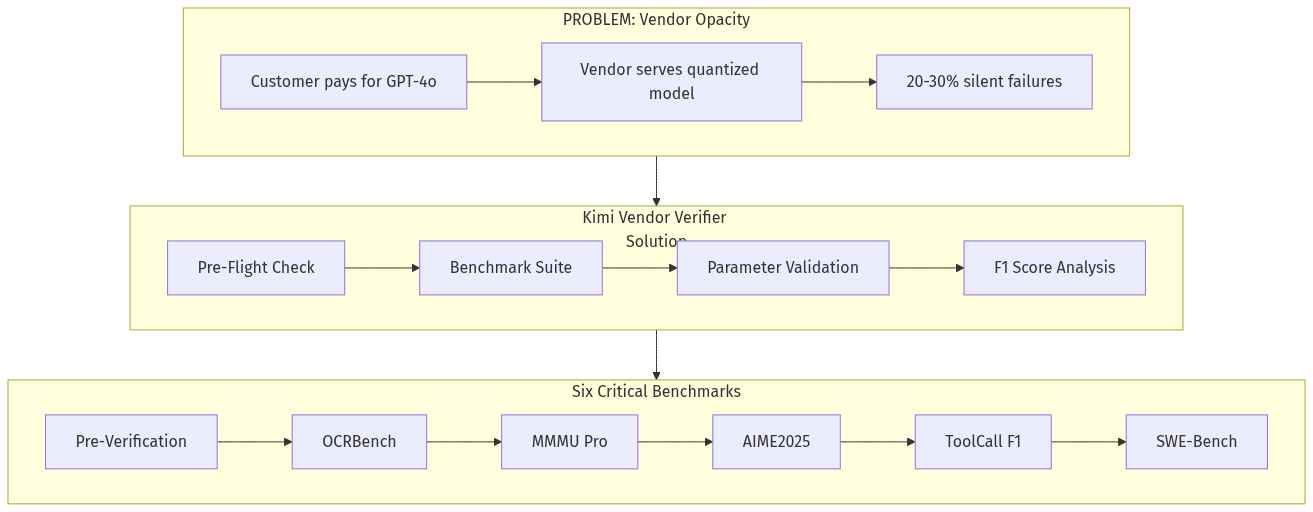
Moonshot AI just released the Kimi Vendor Verifier (KVV) — an open-source tool that verifies whether inference providers are actually serving the models customers paid for. The findings are damning: 20-30% of tool calls silently fail, benchmark scores vary wildly between official and third-party APIs, and quantization degrades quality without disclosure.

This reveals a systemic trust problem in the AI inference marketplace. Every company building AI agents depends on external API providers — but has no way to verify they are getting what they pay for. This creates a massive opportunity for a neutral verification marketplace.
2.

Problem Statement

The Silent Failure Mode

When you pay for an AI API, you expect:

  • The model you signed up for
  • Correct parameter enforcement (temperature, top_p)
  • Full output generation
What you often get:
  • Quantized or downgraded models
  • Silent failures that do not return errors
  • 20-30% of tool calls ending in empty responses

The Trust Gap

From KVV's announcement:

> "If users cannot distinguish between model capability defects and engineering implementation deviations, trust in the open-source ecosystem will inevitably collapse."

This applies equally to proprietary models. The customer has zero visibility into:

  • Which model version is actually running
  • Whether parameters are enforced correctly
  • Whether quantization degraded performance
  • Whether the infrastructure can handle the load
  • Market Evidence

    • AWS Bedrock has "crippling defects" for Kimi models (20-30% silent failures)
    • OpenRouter defaults to cheapest provider, often heavily quantized
    • Different infrastructure providers show stark contrasts in benchmark scores
    3.

    Current Solutions

    CompanyWhat They DoWhy They Are Not Solving It
    OpenRouterAggregates multiple providersDefaults to cheapest (most quantized); no independent verification
    AWS BedrockManaged model APIHas known defects that cause silent failures
    Azure OpenAIEnterprise model hostingNo transparency into actual model version/deployment
    Anthropic via APIDirect APIOnly verifies own infrastructure, not third-party
    Vercel AI SDKDeveloper abstractionLayer on top; does not verify provider quality
    What is missing: A neutral, independent verification layer that can run against ANY provider.
    4.

    Market Opportunity

    TAM: $50B+ by 2027

    • Global AI API spending: ~$20B (2025) → $50B+ (2027)
    • Enterprise spending on AI infrastructure: $15B+
    • Developer tools/monitoring: $5B+

    Why Now

  • Model diversity explosion: Hundreds of providers offering the "same" models
  • Agent reliability critical: Silent failures cascade into system failures
  • No standards exist: Everyone is guessing about quality
  • Cost visibility pressure: Companies need to justify AI spend
  • 5.

    Gaps in the Market

  • No independent verification standard — Customers must trust providers
  • No benchmark standardization — Each provider quotes different scores
  • No parameter enforcement verification — Temperature/top_p may be ignored
  • No SLA transparency — Uptime and performance not verifiable
  • No quantization disclosure — Heavily quantized models sold as full
  • 6.

    AI Disruption Angle

    Manual vs. Agent Verification

    Today: Companies run ad-hoc tests, manually compare outputs, hope for the best With AI Agents:
    • Continuous monitoring agents verify provider quality 24/7
    • Automated regression detection when model updates occur
    • F1 score tracking across all tool calls
    • Real-time alerting on degradation

    The Verification Stack

    Provider → Verification Agent → Quality Score → Decision Engine
                                             ↓
                                  Automatic Routing to Best Provider
    7.

    Product Concept

    InferenceGuard — The Verification Marketplace

    Core Features:
  • Standardized Benchmarks — Industry-agreed test suites
  • Continuous Monitoring — Hourly/daily quality checks
  • Provider Scorecards — Real-time F1 scores, latency, reliability
  • Auto-Routing — Switch to best provider automatically
  • SLA Verification — Enforce uptime/performance claims
  • Benchmarks to Support:
    • Tool call accuracy (F1 score)
    • Reasoning quality (AIME, math benchmarks)
    • Multimodal understanding (MMMU Pro)
    • Coding capability (SWE-Bench)
    • OCR accuracy

    Architecture

    Architecture Diagram
    Architecture Diagram
    8.

    Development Plan

    PhaseTimelineDeliverables
    MVP4-6 weeksBenchmark suite, provider scorecards
    V18-12 weeksContinuous monitoring, alerts
    V216-20 weeksAuto-routing, enterprise dashboards

    MVP Features

    • 5 core benchmarks (similar to KVV)
    • Integration with top 20 providers
    • Basic scorecards
    • API for programmatic access
    9.

    Go-To-Market Strategy

    Target Customers

  • AI-first startups — Building agents, need reliability
  • Enterprises — Spending $50K+/month on AI APIs
  • AI agencies — Reselling AI services to clients
  • Acquisition Channels

  • Developer communities — Twitter, Discord, Hacker News
  • Integration partnerships — LangChain, Vercel, AWS
  • Content marketing — Expose provider quality differences
  • Benchmark reports — Quarterly industry reports
  • Pricing Model

    • Free tier: 100 queries/month (developers)
    • Pro: $99/month (startups) — Full monitoring, 3 providers
    • Enterprise: Custom — Unlimited, SLA, auto-routing
    10.

    Revenue Model

  • Verification subscriptions — Monthly recurring revenue
  • Premium benchmarks — Specialized test suites
  • Enterprise customization — Custom provider testing
  • Data licensing — Anonymized market intelligence
  • 11.

    Data Moat Potential

    Over time, this platform accumulates:

    • Provider quality data — Years of benchmark history
    • Failure mode library — What breaks, when, on which provider
    • Cost-performance curves — Optimal provider for each use case
    • Model version tracking — When providers upgrade/downgrade
    This data becomes the industry standard reference — impossible to replicate.
    12.

    Why This Fits AIM Ecosystem

    This directly maps to AIM.in's B2B discovery mission:

  • Verification category — A new vertical in AI infrastructure
  • Buyer intent — Companies actively evaluating providers
  • Decision support — Data-driven recommendation
  • Repeat purchase — Ongoing monitoring = recurring relationship
  • Can become dives.in/ai-inference-verification/ — deep dive articles + directory of verified providers.


    ## Verdict

    Opportunity Score: 8/10 Rationale:
    • Clear problem with market evidence
    • Large and growing TAM
    • Strong data moat potential
    • Fits AIM's B2B discovery model
    Risks:
    • Provider cooperation (they may block verification)
    • Benchmark standardization difficulty
    • Competition from funded startups
    Key Insight: KVV proves the problem exists. The solution is a neutral layer that PROVIDERS MUST co-exist with — otherwise the market cannot function.

    ## Sources