ResearchTuesday, April 21, 2026

AI-Powered Industrial Labeling & Barcode Solutions Marketplace

Every manufacturing plant, warehouse, and logistics hub in India loses Crores annually to mislabeled inventory, unreadable barcodes, and supply chain errors that could be solved by AI-powered labeling intelligence. The market is valued at $4.2B globally with virtually no AI-native solution provider.

1.

Executive Summary

Industrial labeling and barcode systems are the invisible backbone of manufacturing, logistics, and retail supply chains. Yet this space remains remarkably unsophisticated in India — dominated by local print shops, legacy ERP vendors, and expensive imported thermal printer suppliers. There is no AI-native vertical marketplace connecting buyers with label designers, barcode solution providers, barcode scanning hardware, and compliance labeling services.

This gap creates a massive opportunity for an AI-powered marketplace that:

  • Matches buyers with label suppliers based on their exact specifications (size, material, environment, regulatory compliance)
  • Uses AI to auto-generate label designs optimized for scanning reliability
  • Provides intelligent barcode readability scoring before printing
  • Connects enterprises with barcode verification and compliance certification services
The market is large, fragmented, and primed for AI disruption.


2.

Problem Statement

The Hidden Cost of Mislabeling

Indian manufacturing and logistics companies face daily challenges with industrial labeling:

Pain PointImpact
Unreadable barcodesScanners fail at checkouts/sorting — manual re-scanning costs ₹50-200 per item
Wrong labels on shipmentsWMS rejects incoming inventory — delays of 2-4 hours per truck
Regulatory non-complianceFSSAI/EPC/PESO compliance failures — fines, shipment holds
Label fading/peelingEnvironmental damage (heat, moisture, UV) — entire batches misidentified
No label standardizationDifferent plants use different formats — no cross-facility readability
Manual label designDesign errors require re-prints — 12-24 hour delays in production
No barcode quality verificationLabels pass design but fail scanning — discovered at customer site

Who Experiences This Pain?

  • Manufacturing plants (automotive, pharma, FMCG, electronics): Thousands of SKUs requiring labels
  • Warehouses & 3PL providers: High-volume inbound/outbound labeling
  • Export-oriented units (EOUs): Mandatory export labeling compliance
  • Cold chain operators: Labels that survive extreme temperatures
  • Pharma & food companies: Regulatory label requirements (FSSAI, GMP)

3.

Current Solutions

Existing players in the industrial labeling space:

CompanyWhat They DoWhy They're Not Solving It
Zebra TechnologiesThermal printers, barcode scannersEnterprise-focused, expensive imported hardware
HoneywellIndustrial scanning solutionsHardware-first, no marketplace model
Dymo/BrotherDesktop label makersOffice-focused, not industrial-grade
Local print shops (thousands across India)Custom label printingNo AI, no standardization, unreliable quality
SAP Business OneERP with label modulesEnterprise-only, expensive
Tally SolutionsSMB accounting with basic labelingLimited labeling capabilities
Shopify/Amazon Seller appsE-commerce labelingConsumer-focused, not industrial

Key Gap

No AI-native marketplace connects industrial buyers with verified label suppliers, provides intelligent design assistance, or offers barcode quality verification as a service.
4.

Market Opportunity

Market Size (India)

SegmentEstimated Market SizeNotes
Industrial label printing₹8,000 Cr ($1.9B)Growing 18% annually
Barcode scanning hardware₹2,500 Cr ($600M)40% of warehouses under-equipped
Labeling software/services₹1,500 Cr ($350M)Most using basic Excel/ERP
Compliance labeling (FSSAI, EPC, PESO)₹800 Cr ($190M)Growing with export surge
Total Addressable Market₹12,800 Cr ($3B)

Global Context

  • Global industrial labeling market: $4.2B (2025)
  • Expected to reach: $7.1B by 2032 (CAGR 7.8%)
  • India's share: ~8% of global market, growing fastest

Why Now

  • UPI for B2B: Digital payments finally common in B2B transactions
  • Export boom: Indian exports hitting $800B — compliance labeling demand surging
  • Warehouse automation: Flipkart, Amazon, Swiggy building massive logistics — labels = data infrastructure
  • Regulatory tightening: FSSAI, GST, EPC compliance requiring standardized labels
  • AI model availability: VLM models can now verify barcode readability, generate designs

  • 5.

    Gaps in the Market

    Identified Gaps

  • No verification marketplace — No service exists to verify if a barcode will scan before printing
  • No AI label design — Label design is manual, error-prone, lacks intelligence
  • No material selection guidance — Buyers don't know which label material suits their environment
  • Supplier discovery fragmentation — No platform to discover and vet industrial label suppliers
  • No compliance automation — Regulatory label requirements handled manually
  • No print quality scoring — Can't predict printing issues before committing to a run
  • No label standardization across plants — Large enterprises have inconsistent labeling across facilities
  • Anomaly Hunting: What's Missing?

    • No "label-as-a-service" model — Most buyers still buying physical rolls, not subscription
    • No B2B label marketplace — Consumer labels have Etsy, Amazon; industrial labels have nothing equivalent
    • No mobile-first label design — QR code labels for warehouse use — no dedicated marketplace

    6.

    AI Disruption Angle

    How AI Agents Transform Labeling

    Today (Manual Process):
    Buyer → Research suppliers (Google/Referral) → Negotiate price → Submit design → Wait for proofs → approve → Print → Hope it works
    With AI Agents (Automated):
    Buyer → Describe requirement to AI Agent → AI generates optimal design → AI verifies scan quality → AI matches with verified supplier → AI automates compliance → Print → Verified working

    Key AI Capabilities

    CapabilityDescriptionValue
    Barcode readability scoringVLM analyzes barcode image, predicts scan success rateEliminates re-print costs
    Auto-label designAI generates label from product data, regulatory requirementsSaves 12-24 hours per label
    Material recommendationAI recommends label stock based on environment (heat, cold, moisture)Prevents label failure
    OCR for existing labelsAI reads and extracts data from existing labels for inventoryEnables legacy migration
    Compliance template generationAI auto-generates labels meeting FSSAI/EPC/PESO requirementsEliminates compliance errors
    Quality predictionAI predicts print quality issues before printingReduces waste

    Visual Workflow

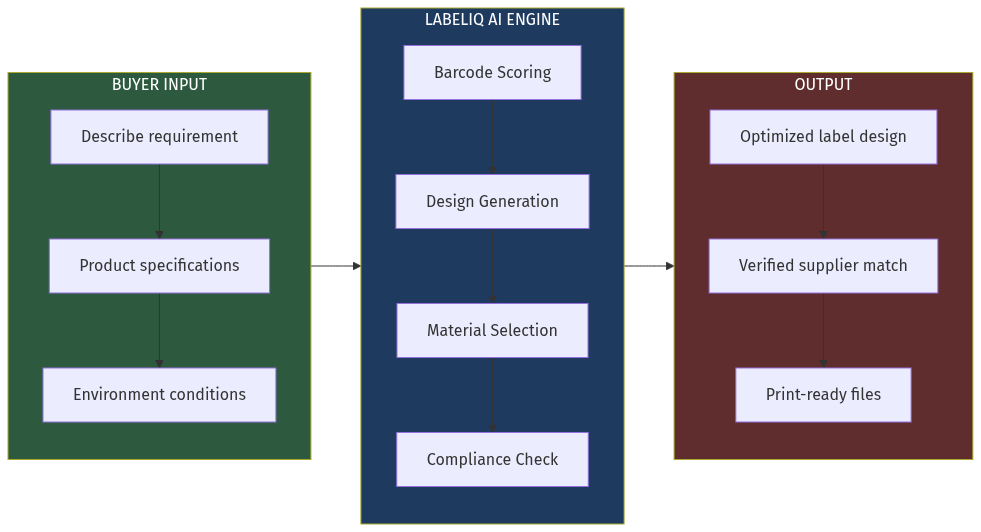
    AI Labeling Engine Architecture
    AI Labeling Engine Architecture
    flowchart LR
        subgraph Buyer["BUYER JOURNEY"]
            A[Describe requirement] --> B[AI generates design]
            B --> C[AI verifies readability]
            C --> D[AI matches to supplier]
            D --> E[AI handles compliance]
            E --> F[Print & Verify]
        end
        
        subgraph AI["AI AGENT CAPABILITIES"]
            G[Barcode Scoring] --> H[Design Generation]
            H --> I[Material Selection]
            I --> J[Compliance Check]
            J --> K[Supplier Matching]
        end
        
        Buyer --> AI

    7.

    Product Concept

    Platform: LabelIQ — AI-Powered Industrial Labeling Marketplace

    Core Features:
  • AI Label Generator
  • - Input: Product name, SKU, regulatory requirements, environment - Output: Ready-to-print label design with optimal barcode placement - Supports: QR, Code128, DataMatrix, PDF417
  • Barcode Verification Engine
  • - Upload barcode image → Get scan success probability - Grade: A (will scan), B (may need adjustment), C (will fail) - Specific feedback on improvement
  • Supplier Marketplace
  • - Verified industrial label suppliers - Filter by: Location, material, certifications, capacity, price - Reviews, ratings, compliance verification
  • Material Selector
  • - Guided selection: Paper, polyester, vinyl, polyimide - Environment considerations: Temperature, moisture, UV exposure, chemical resistance
  • Compliance Dashboard
  • - FSSAI, EPC, PESO label requirements pre-loaded - Auto-generate compliant label templates - Compliance verification as a service
    8.

    Development Plan

    PhaseTimelineDeliverables
    MVP4 weeksAI label generator + barcode scoring (web app)
    V18 weeksSupplier matching + product database
    V212 weeksCompliance automation + enterprise features
    V316 weeksHardware integration (scanner API) + mobile app

    MVP Tech Stack

    • Frontend: Next.js + Tailwind
    • AI: OpenAI Vision API + custom barcode scoring model
    • Database: Supabase (PostgreSQL)
    • Storage: S3 for label designs

    Launch Strategy

  • Phase 1: Focus on 50 manufacturing plants in Vizag/WG district — early adopters
  • Phase 2: Expand to Hyderabad, Chennai manufacturing corridors
  • Phase 3: National rollout via partner channel

  • 9.

    Go-To-Market Strategy

    How to Acquire First Users

    ChannelStrategy
    Manufacturing associationsVizag Industries Association, CII, FIEO
    Trade showsIMTEX, PLATE
    ERP integratorsPartner with Tally, SAP consultants
    Digital marketingGoogle Ads - industrial labeling keywords
    Referral program10% commission for each supplier referral

    Early Adopter Profile

    • Target: Mid-sized manufacturing (₹50-500 Cr revenue)
    • Location: Vizag, Hyderabad, Chennai, Pune
    • Pain: Currently using local print shops with inconsistent quality

    Supplier Acquisition

    • Inbound: List on platform → verification process
    • Outbound: Visit industrial areas, pitch to label shops
    • Incentive: First 100 suppliers get free premium for 6 months

    10.

    Revenue Model

    Revenue Streams

    StreamModelExpected Revenue
    Supplier commission8-12% per orderPrimary
    AI verification₹50-500 per barcode verificationSecondary
    Premium listings₹2,000-10,000/month for suppliersSecondary
    Enterprise订阅₹25,000-2,00,000/yearEnterprise tier

    Pricing Strategy

    • Buyers: Free to list requests
    • Suppliers: Commission on closed orders
    • Verification: Pay-per-use for non-suppliers

    11.

    Data Moat Potential

    Proprietary Data That Accumulates

  • Label design patterns by industry — Most effective designs for each sector
  • Material performance data — Real-world label durability tracking
  • Supplier quality scores — Verified performance data across buyers
  • Barcode readability database — Training data for scoring model
  • Compliance requirement knowledge base — Regulatory templates
  • Defensibility

    • Network effects: More buyers → more suppliers → more data → better AI → more buyers
    • Switching costs: Suppliers build reputation, buyers build design libraries

    12.

    Why This Fits AIM Ecosystem

    Integration Points

  • dives.in: Publish as vertical intelligence — industrial labeling opportunity
  • AIM.in: Vertical portal for manufacturing supply chain
  • Domain portfolio: Labelingsuppliers.in, barcodesolutions.in
  • WhatsApp commerce: Inquiry automation for label buying
  • Cross-Sell Opportunities

    • Already working with manufacturing → cross-sell procurement agents
    • Already working with logistics → cross-sell warehouse management
    • Already working with compliance → cross-sell regulatory services

    ## Verdict

    Opportunity Score: 7.5/10

    Strengths

    • Genuinely underserved vertical
    • Clear AI differentiation pathway
    • Large market with fragmented suppliers
    • Low capital requirement to start
    • Proven demand (every plant needs labels)

    Risks

    • Supplier quality control is challenging
    • Low margins in commodity labels
    • Enterprise sales cycles long
    • Hardware integration complexity

    Recommendation

    Build MVP — Focus on AI verification + design generation as differentiator. Start with 50 early adopters, prove the model, then expand supplier marketplace. Target Vizag/Hyderabad manufacturing corridor first.

    ## Sources