ResearchMonday, April 20, 2026

Wedding & Event Planning AI: The $70B Opportunity India's Fragmented Vendor Market Can't Solve

India's wedding industry is a $70 billion market where 80% of bookings still happen through personal references and WhatsApp. An AI-powered B2B marketplace connecting families with verified vendors—caterers, venues, decorators, photographers—can create a data moat worth billions.

1.

Executive Summary

India hosts over 10 million weddings annually—more than any other country in the world. The average wedding costs ₹20-30 lakhs (~$25-35K), with ultra-high-net-worth families spending ₹2+ crores. Yet despite this massive market, there is no dominant platform for vendor discovery, booking, and management.

The current state is brutal: families spend 3-6 months manually coordinating 15-20 vendors, relying on "known" contacts or expensive wedding planners. Venues and vendors struggle with inconsistent demand, no advance bookings, and zero digital presence beyond Instagram.

This creates a clear opening for an AI-powered B2B platform that:

  • Helps families discover and compare vendors (venues, caterers, decorators, photographers, makeup artists)
  • Provides verified reviews, pricing transparency, and availability
  • Manages the entire wedding workflow via AI agents
  • Handles payments, contracts, and logistics
The opportunity is $70B+ in India alone, with massive global expansion potential.


2.

Problem Statement

The Wedding Planning Pain

For Families (Buyers):
  • No centralized vendor discovery — Finding reliable vendors means asking friends, scrolling Instagram, or hiring expensive wedding planners (who take 10-15% commission).
  • Price opacity — The same venue charges different prices based on negotiation skills. No benchmark for "fair" pricing.
  • Quality uncertainty — Vendor portfolios are polished (heavily filtered photos). Real reviews are hard to find.
  • Coordination chaos — 15-20 vendors to manage, each with different communication preferences (WhatsApp, phone, email).
  • Booking conflicts — Peak dates get double-booked. No real-time availability.
  • For Vendors (Suppliers):
  • No predictable demand — Most vendors survive on referrals. In peak season, overwhelmed. In off-season, starving.
  • No digital infrastructure — Most caterers, decorators, and photographers operate on WhatsApp and paper diaries.
  • No advance bookings — Can't plan workforce and inventory because bookings happen 2-4 weeks before wedding.
  • Payment issues — Partial payments via cash or UPI with no formal contracts.
  • Who experiences this pain:
    • Urban families planning weddings (₹10 lakhs+ budget)
    • NRIs planning destination weddings in India
    • Corporate event managers
    • Wedding planners (who need vendor networks)

    3.

    Current Solutions

    CompanyWhat They DoWhy They're Not Solving It
    WeddingWire IndiaVendor directoryBasic listings only, no booking, limited verification
    ShaadiSagaWedding planning platformFocus on invitations, not vendor marketplace
    WedMeGoodVendor discoveryCurated (vendor-paid) listings, limited inventory
    WeddingBazaarVendor marketplaceLead generation model, not transaction
    WeddingPlanners.inAgency directoryExpensive middlemen, no tech layer
    Instagram/GoogleManual searchNo verification, no structured data
    Gap Analysis: No platform offers:
    • Real-time vendor availability
    • Verified reviews with unfiltered photos/videos
    • AI-powered matching based on budget/preferences
    • End-to-end booking and payment
    • Logistics management

    4.

    Market Opportunity

    Market Size

    SegmentIndia SizeGlobal Size
    Wedding Market$70B (2025)$300B+
    Corporate Events$15B$100B+
    Venue Rental$25B$150B+
    Catering Services$20B$120B+

    Key Statistics

    • 10M+ weddings in India annually (highest globally)
    • ₹20-30 lakhs average wedding cost (urban, mid-market)
    • 1.2 million active wedding vendors (caterers, venues, decorators)
    • 22% CAGR in wedding spend through 2030

    Why Now

  • WhatsApp-first behavior — Every vendor and family uses WhatsApp. AI agents can operate natively.
  • UPI for payments — Even ₹5-10 lakh transactions happen via UPI/NEFT seamlessly.
  • Social media documentation — Vendors and families already create content. Structured data is available.
  • Rising NRIs — Non-resident Indians plan Indian weddings remotely. Need digital infrastructure.
  • Second weddings — Growing acceptance means more demand for quick, professional planning.

  • 5.

    Gaps in the Market

    Gap 1: No Verified Vendor Database

    No unified database with:
    • GST-compliant vendors
    • Past event photos/videos (not curated portfolios)
    • Real availability calendars
    • Pricing transparency

    Gap 2: No Real Reviews System

    Current platforms have:
    • Vendor-paid reviews (bias)
    • Curated photos only
    • No video verification
    A platform with unfiltered video reviews and AI-detected fake reviews would be revolutionary.

    Gap 3: No Dynamic Pricing

    Vendors quote based on gut feeling. AI can analyze:
    • Date (peak vs off-peak)
    • Guest count
    • Venue type
    • Service complexity
    Provide fair price benchmarks for families.

    Gap 4: No Logistics Coordination

    Wedding day has 15-20 vendors arriving at specific times. No existing system coordinates:
    • Vendor arrival schedule
    • Electrical/power requirements
    • Parking logistics
    • Vendor coordination WhatsApp group

    Gap 5: No Post-Wedding Analytics

    No data on:
    • Actual vs planned spend
    • Vendor performance scores
    • Guest engagement metrics
    This data is valuable for future planning and vendor selection.
    6.

    AI Disruption Angle

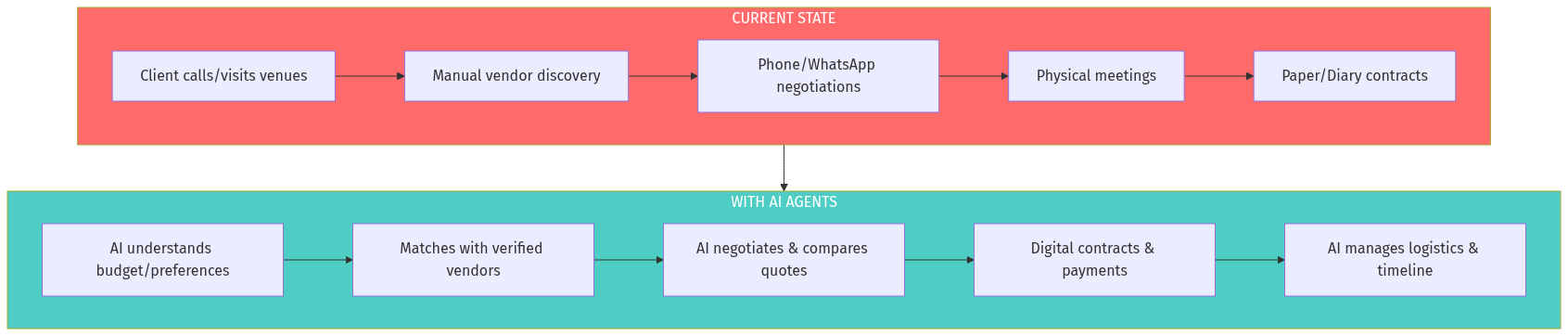
    The Wedding AI Agent Workflow

    Wedding Planning Flow
    Wedding Planning Flow
    How AI transforms each step:
  • Needs Understanding — AI agent chats with family to understand: budget, date, venue preference, guest count, style, must-have vendors.
  • Vendor Matching — AI queries verified vendor database, matches by:
  • - Availability on date - Budget alignment - Past reviews - Location/venue type
  • Comparison & Negotiation — AI presents 3-5 options per vendor category with:
  • - Price comparison - Review summary - Portfolio samples (real, unfiltered) - Availability
  • Booking — AI handles:
  • - Digital contracts (e-signatures) - Advance payments (UPI/Stripe) - Vendor confirmation
  • Coordination — AI manages:
  • - Vendor timeline - Payment schedules - Day-of coordination - Emergency contacts
  • Post-Event — AI collects:
  • - Video reviews from family/vendors - Performance data - Spend analysis

    The Key Insight

    AI doesn't replace wedding planners—it makes them 10x more productive. A planner handling 5 weddings/year can now handle 50.
    7.

    Product Concept

    Core Product: WedFlow AI

    Platform: WhatsApp-first (for families and vendors) + Web dashboard (for power users) Key Features:
    FeatureDescription
    AI Wedding AgentConversational interface to discover, compare, and book vendors
    Vendor NetworkVerified database of 100K+ vendors across categories
    Smart MatchingAI matches budget + style + date + location
    Real ReviewsVideo-based reviews with AI fake detection
    Price BenchmarksDynamic pricing by date, venue, guest count
    Coordination SuiteTimeline management, vendor communication, logistics
    Digital ContractsE-signatures, payment schedules, legal templates
    User Flow:
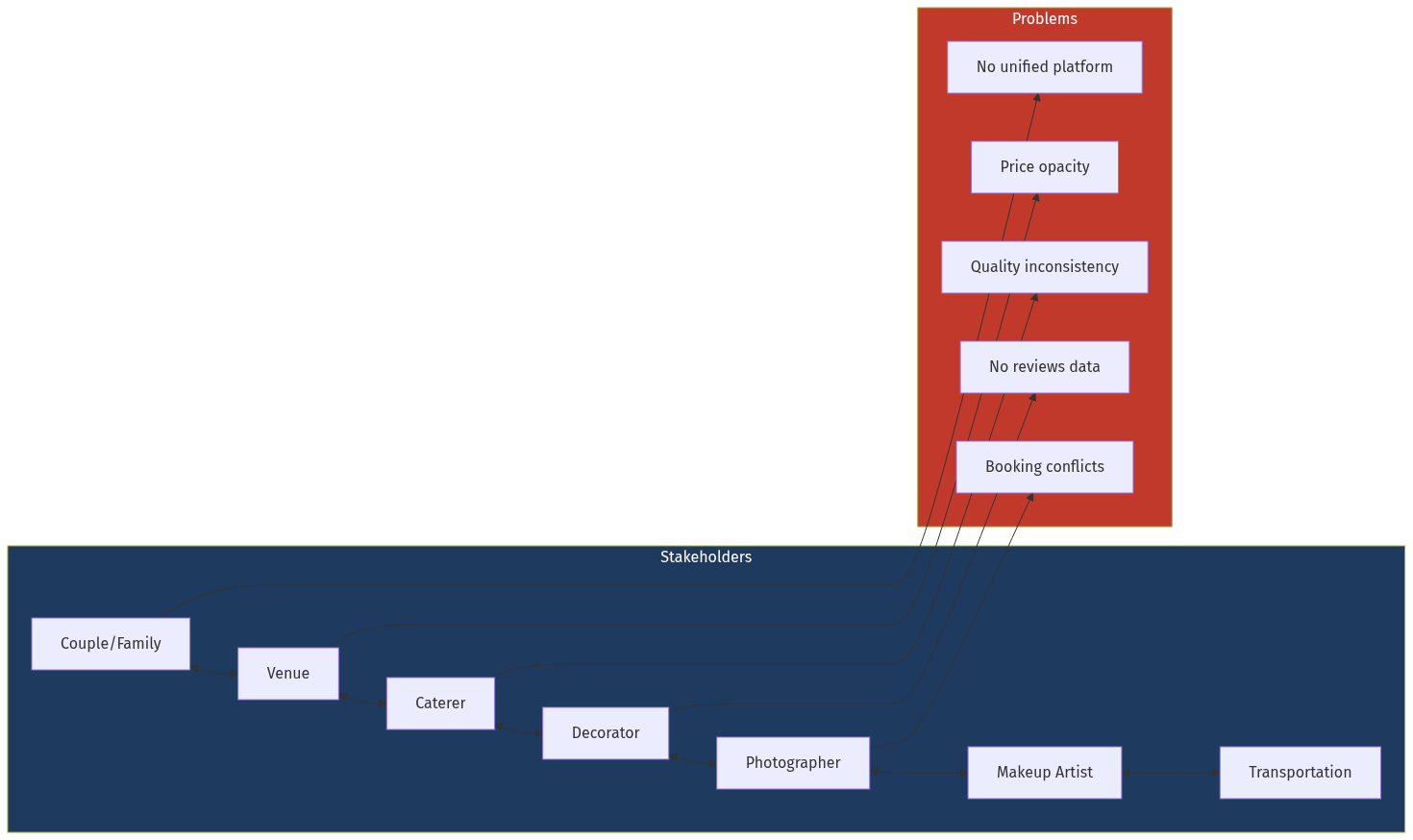
    Market Stakeholders
    Market Stakeholders

    8.

    Development Plan

    PhaseTimelineDeliverables
    MVP8 weeksWhatsApp bot, vendor directory (5,000 vendors), basic booking flow
    V112 weeksAI matching engine, real reviews, payment integration
    V216 weeksCoordination suite, video reviews, analytics

    Tech Stack

    • Frontend: Next.js + Tailwind
    • Backend: Node.js + Supabase
    • AI: OpenAI (GPT-4) + LangChain + Whisper
    • WhatsApp: Kapso API
    • Payments: Razorpay + Stripe (NRI)
    • Video: Cloudinary (reviews)

    9.

    Go-To-Market Strategy

    Phase 1: Vendor Acquisition (Month 1-3)

  • Onboard 5,000 verified vendors in 5 cities
  • Focus on: venues, caterers, decorators (highest demand)
  • Offer free listing + booking management
  • Train AI on vendor capabilities
  • Phase 2: Family Acquisition (Month 3-6)

  • Target wedding fairs and exhibitions
  • Partner with wedding planners (not compete, empower)
  • NRIs via India communities and Facebook groups
  • First 100 weddings with full service
  • Phase 3: Network Effects (Month 6-12)

  • More families = more vendor data
  • More vendors = better pricing for families
  • Build defensible: reviews, pricing, availability
  • Channels

    • Wedding fairs: Physical presence in tier-1/2 cities
    • Wedding planners: Partner, don't compete
    • Instagram: Vendor showcases, family testimonials
    • NRIs: India diaspora communities, WeddingSutra collaboration

    10.

    Revenue Model

    Revenue StreamDescriptionPotential
    Transaction Fee5-10% on each booking$350M at scale
    Subscription₹5,000-20,000/month for premium AI features$50M ARR
    Vendor Listing₹500-2,000/month for premium placement$20M ARR
    AdvertisingTargeted vendor promotions$10M ARR
    NRI ServicesPremium packages for destination weddings$30M ARR
    Initial focus: Transaction fees from Day 1. Subscription for advanced AI in V1.
    11.

    Data Moat Potential

    This business accumulates defensible data:

  • Vendor performance data — Real reviews, response times, pricing history.
  • Pricing intelligence — Historical transaction data shows fair prices by date, venue, guest count.
  • Availability patterns — Which dates book fast, seasonal demand curves.
  • Family preferences — Budget distribution, popular combinations, style trends.
  • Coordination workflows — What works, what fails, vendor reliability scores.
  • Once built, this data is extremely hard to replicate. A new entrant would need years of bookings to match pricing accuracy and vendor intelligence.
    12.

    Why This Fits AIM Ecosystem

    This opportunity aligns with AIM's vision:

  • Vertical focus — Wedding planning is a clearly defined vertical with distinct dynamics.
  • Offline to online — 80% of bookings are still phone/WhatsApp-based. Perfect for AI intervention.
  • B2B marketplace — Matches AIM's core competency in structured B2B discovery.
  • Fragmented vendors — Millions of small vendors, no dominant player.
  • Massive market — $70B in India alone, global expansion possible.
  • Future expansion:
    • Corporate events
    • Destination weddings (Thailand, Bali, Dubai)
    • Cultural events (Annaprashan, thread ceremonies)
    • Party planning (birthdays, anniversaries)

    ## Verdict

    Opportunity Score: 9/10

    Why High Score

    • $70B market with 22% growth
    • Clear problem with no dominant solution
    • AI agent capability matches workflow complexity
    • Strong data moat potential
    • NRI market adds premium segment
    • Fits AIM ecosystem perfectly

    Risks to Consider

  • Trust building — Families won't trust AI with wedding bookings without proven track record
  • Vendor onboarding — Need critical mass for value (both sides of marketplace)
  • Peak season concentration — 80% of weddings in 4 months; demand spikes
  • Pre-Mortem (Why Might This Fail)

    • If families prefer personal relationships over platform bookings
    • If Instagram/YouTube becomes the discovery platform
    • If wedding planners resist (and undercut) the platform

    Steelman (Why Incumbents Might Win)

    • WeddingWire/WedMeGood have existing user base
    • Large event management companies have vendor relationships
    • Instagram provides free discovery and marketing

    ## Sources